
PMP-150 · Lesson 9 of 12 · 25 min
Organizational change: culture and readiness
Projects change organizations. A new branch changes where staff work and how patrons are served; self-checkout changes what circulation staff do all day; an app changes how patrons expect to interact with the library. If the people affected do not understand, accept and adopt the change, the project's outputs sit unused and its benefits never arrive. The 2026 outline asks project leaders to support organizational change: to assess the organization's culture, evaluate how the change affects the organization and the project, and decide what actions are needed. This lesson covers understanding culture and readiness; lesson 10 covers supporting people through the transition.
Organizational change and project change
It helps to separate two ideas. Project change control, covered in PMP-131, manages changes to the project's scope, schedule and cost. Organizational change management is about helping people and the organization move from the current way of working to a new one that the project makes possible. Both matter, but they are different disciplines. A project can control its own changes perfectly and still fail because nobody adopts what it delivers.
The project manager is rarely the only person responsible for organizational change. Many organizations have change managers or human resources specialists, and the sponsor and line managers play central roles, because people take their cues from their own leaders. The project manager's job is to make sure organizational change is planned alongside the project, that its activities appear in the plan and that its risks are managed. On smaller projects, the project manager may do much of the change work personally.
Understanding organizational culture
Culture is the shared set of beliefs, values, norms and habits that shape how people in an organization behave, often without thinking about it. A widely used model by Edgar Schein describes three levels: visible artifacts and behaviors (office layouts, dress, meeting habits, the way decisions are announced), espoused values (what the organization says it values, in mission statements and policies) and underlying assumptions (the deeply held, often unspoken beliefs that actually drive behavior). Change efforts fail most often when they clash with underlying assumptions that nobody has named.
| Level | What it is | Larkfield example |
|---|---|---|
| Artifacts and behaviors | What you can see and hear | Staff greet every patron at the desk; circulation staff take pride in fast, accurate checkouts |
| Espoused values | What the organization says it values | "Welcoming, inclusive and responsive" in the strategic plan |
| Underlying assumptions | Unspoken beliefs that drive behavior | Good service means a staff member handles each transaction personally; technology is something done to us by head office |
Seen this way, self-checkout touched an assumption at the core of how circulation staff saw their value. Telling them that kiosks were "efficient" did not address that. What helped, as lesson 10 shows, was reframing their role: freeing time from routine transactions for the help, programs and outreach that patrons valued most, and involving them in designing the new service model.
Other aspects of culture also shape how a change lands: how much people trust leadership, how decisions are usually made (top-down or consultative), how the organization treats mistakes, how much change people have recently absorbed, and whether there is a union or other formal voice for staff. A culture assessment, which can be as simple as interviews and a short survey, helps the project anticipate where resistance will come from and why.
Assessing the impact of the change
A change impact assessment identifies who is affected, how and how much. For each group it typically records what changes (processes, systems, roles, skills, location, reporting lines, behaviors), the degree of change, when it happens and what the group needs to succeed. Groups affected heavily and early need the most attention.
| Group | What changes | Degree | Main needs |
|---|---|---|---|
| Eastgate branch staff (new team) | New location, new service model, kiosks, app support for patrons | High | Training, clear roles, involvement in design, team building |
| Circulation staff across the system | Self-checkout to be rolled out to other branches later; fewer routine checkouts | High, later | Reassurance about jobs, new role definitions, union consultation |
| IT service desk | Support for kiosks and the app; new vendor relationship | Medium | Training, support procedures, escalation paths with the vendor |
| Collections team | RFID tagging, new floating collection rules | Medium | Procedures, workload planning during tagging |
| Patrons | New branch, self-checkout, app | Varies | Clear information, help on the floor, accessible alternatives |
Models of change
Several models help explain how people and organizations move through change. The exam does not require you to memorize any one of them, but you should recognize the main ideas and know how they guide action.
| Model | Core idea | How it guides the project |
|---|---|---|
| Lewin: unfreeze, change, refreeze | People must first see a need to leave the current state, then move, then stabilize the new state | Build the case for change before the change; reinforce new habits afterward |
| Kotter's eight steps | Leaders create urgency, build a guiding coalition, set a vision, communicate it, remove obstacles, create short-term wins, build on change and anchor it in culture | Plan visible early wins; involve respected leaders; remove structural obstacles |
| ADKAR | Individuals need awareness, desire, knowledge, ability and reinforcement, in that order | Diagnose where each group is stuck and act on the first gap |
| Bridges' transition model | Change is external; transition is the internal process of endings, a neutral zone and new beginnings | Acknowledge what people are losing; support them through the uncertain middle |
| Satir change model | Performance often dips into a period of chaos before improving to a new, higher level | Expect and plan for a temporary dip; avoid judging the change too early |
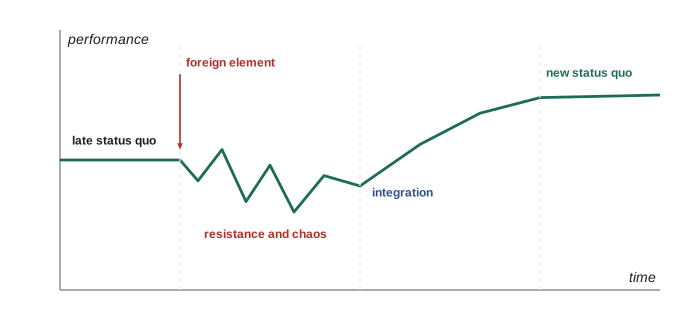
The Satir model is worth remembering for exam questions about performance just after a change. A team or process that gets worse immediately after a new tool or way of working is introduced is behaving normally. The right response is usually support and patience with clear measures, not reversing the change at the first sign of difficulty.
Measuring readiness
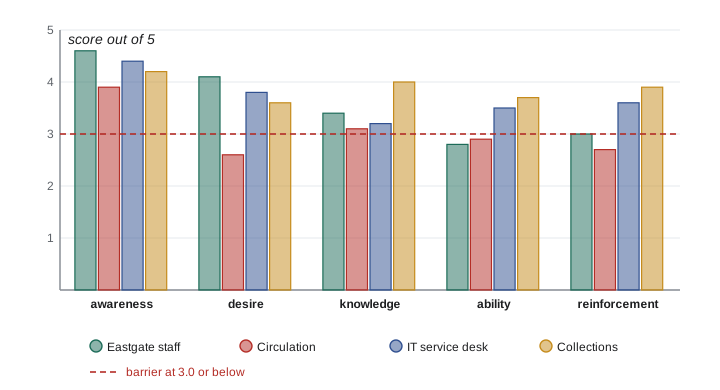
Readiness assessments ask whether people are prepared for the change. Using the ADKAR model, the Compass change lead surveyed four staff groups three months before opening, asking each person to rate statements for each element from 1 to 5. Averages at or below 3 signaled a barrier. Because ADKAR elements build on each other, the first low element in the sequence is where effort should go first: there is no point training people who do not yet want the change.
# ADKAR readiness survey of staff groups before Eastgate opens (average scores out of 5).
groups = {
    "Eastgate branch staff":   [4.6, 4.1, 3.4, 2.8, 3.0],
    "Circulation (system)":    [3.9, 2.6, 3.1, 2.9, 2.7],
    "IT service desk":         [4.4, 3.8, 3.2, 3.5, 3.6],
    "Collections team":        [4.2, 3.6, 4.0, 3.7, 3.9],
}
elements = ["Awareness", "Desire", "Knowledge", "Ability", "Reinforcement"]
for g, scores in groups.items():
    # The first element scoring 3 or less is the barrier point; work there first.
    barrier = next((e for e, s in zip(elements, scores) if s <= 3.0), "none")
print(f"{g:24} " + " ".join(f"{s:.1f}" for s in scores) + f" barrier: {barrier}")Eastgate branch staff 4.6 4.1 3.4 2.8 3.0 barrier: Ability Circulation (system) 3.9 2.6 3.1 2.9 2.7 barrier: Desire IT service desk 4.4 3.8 3.2 3.5 3.6 barrier: none Collections team 4.2 3.6 4.0 3.7 3.9 barrier: none
The results pointed to two very different needs. Eastgate branch staff were aware of the change and wanted it, many had applied to join the new branch, but their ability scores were low: they had seen demonstrations but had not yet practiced running a branch with kiosks and supporting patrons on the app. They needed hands-on practice, not more presentations. Circulation staff across the system, by contrast, stalled at desire: they understood what was happening but did not want it, largely because of worries about their jobs when self-checkout reached other branches. Training them would have been premature. They needed honest answers from leadership about job security and a say in how their roles would change.
Resistance
Resistance is a normal reaction to change, not a sign of bad attitude. People resist because they fear losing status, skills, relationships, control or their jobs; because they doubt the change will work; because they were not consulted; or because they have seen previous changes fail. Treating resistance as information is more useful than trying to overcome it by force. It often reveals real problems the project had not considered. When circulation staff pointed out that some older patrons and patrons with disabilities would struggle with kiosks, the project kept a staffed desk at Eastgate and added assistance as a standard service, which improved the design.
Organizational change and the project plan
Organizational change activities need to be planned, resourced and tracked. On Compass, the change plan included leadership briefings, a sponsor town hall, the readiness survey, staff involvement in designing the Eastgate service model, union consultation, training, floor-walker support at opening, communications to patrons and a reinforcement plan for the first three months. These activities appeared in the integrated schedule with owners. Risks such as low adoption and staff turnover appeared in the risk register, with the readiness survey as an early-warning measure.
Worked problem
Training or something else?
A survey before a new scheduling system goes live shows that frontline supervisors understand why it is being introduced and know how to use it, but strongly disagree that it will help them, and many say they intend to keep using their spreadsheets. The HR lead proposes another round of training. What should the project manager recommend?
Show solution
- Map the results to ADKAR: awareness and knowledge are high, but desire is low.
- Desire comes before knowledge and ability in the sequence, so more training addresses the wrong element.
- Find out why supervisors doubt the system: interviews or a focus group may reveal practical problems, loss of control or poor past experiences.
- Respond to the causes, for example by involving supervisors in configuring the system, showing early wins and having their own managers explain the reasons.
Answer: Address desire first by understanding and responding to supervisors' concerns, rather than adding more training.
Change saturation
Organizations can only absorb so much change at once. When several projects land on the same people in the same period, each one may look manageable on its own, but together they can overwhelm staff and slow adoption of all of them. This is sometimes called change saturation. In the year Eastgate opened, circulation staff were also adapting to a new staff scheduling system and a revised customer service policy. The readiness survey showed the effect: reinforcement scores were low partly because staff felt they never had time to settle into one change before the next arrived.
Portfolio and program managers can reduce saturation by looking at the combined change load on each group and sequencing initiatives. For Compass, the library delayed the systemwide rollout of the new service policy by two months so that it would not coincide with Eastgate's opening, and the change lead shared a single calendar of upcoming changes with branch managers. On the exam, a scenario in which staff are overwhelmed by multiple simultaneous changes points toward coordination at portfolio or program level, not just more communication from one project.
Common mistakes
MistakeConfusing organizational change management with project change control.
InsteadChange control manages project baselines; organizational change management helps people adopt new ways of working.
MistakeAssuming stated values describe the real culture.
InsteadLook for underlying assumptions that actually drive behavior.
MistakeTraining people who do not yet want the change.
InsteadDiagnose readiness and act on the first barrier in the sequence.
MistakeTreating resistance as defiance to be overcome.
InsteadTreat it as information; understand causes and involve people.
MistakeReversing a change because performance dipped right after it.
InsteadExpect a temporary dip, support people and judge results over a reasonable period.
Summary and key terms
- Organizational change management helps people adopt what the project delivers; it differs from project change control.
- Culture has visible artifacts, espoused values and underlying assumptions; change that clashes with assumptions meets resistance.
- A change impact assessment records who is affected, how, how much and what they need.
- Lewin, Kotter, ADKAR, Bridges and Satir offer complementary views of change.
- Readiness assessments show where each group is stuck; act on the first barrier.
- Resistance is information, and change activities belong in the project plan with owners.
- Organizational change management
- Practices that help people and organizations move to new ways of working.
- Organizational culture
- The shared beliefs, values, norms and habits that shape behavior in an organization.
- Change impact assessment
- An analysis of who is affected by a change, how and how much.
- ADKAR
- A model of individual change: awareness, desire, knowledge, ability, reinforcement.
- Readiness assessment
- A check of how prepared people and the organization are for a change.
- Resistance
- Reluctance or opposition to change, often rooted in concerns about loss or doubt.
- Satir change model
- A model showing a temporary dip in performance before reaching a higher new level.
Practice problems
Work each problem on paper first, then reveal the answer to check.
How does organizational change management differ from change control?
Show answer
It helps people adopt new ways of working; change control manages project baselines.
Name Schein's three levels of culture.
Show answer
Artifacts and behaviors, espoused values, underlying assumptions.
Which underlying assumption did self-checkout challenge at Larkfield?
Show answer
That good service means a staff member handles each transaction personally.
List the five ADKAR elements in order.
Show answer
Awareness, desire, knowledge, ability, reinforcement.
Where were Eastgate branch staff stuck?
Show answer
Ability.
Why would training circulation staff have been premature?
Show answer
Their barrier was desire, which comes before knowledge and ability.
What does the Satir model predict right after a change?
Show answer
A temporary dip in performance before improvement.
Give two common causes of resistance.
Show answer
For example, fear of losing jobs or status, doubts the change will work, not being consulted.
What design change came from circulation staff resistance?
Show answer
Keeping a staffed desk and assistance for patrons who struggle with kiosks.
Name two of Kotter's steps.
Show answer
For example, create urgency, build a guiding coalition, create short-term wins, anchor change in culture.
Lesson quiz · 5 questions
Score 60% or more to complete this lesson.
Create a free account to save your progress, take quizzes and earn a certificate.