
PMP-150 · Lesson 2 of 12 · 26 min
Business cases and value
Every project should be able to answer a simple question: why is this worth doing, compared with the alternatives, including doing nothing? The document that answers it is the business case. It is usually prepared before the project is chartered, owned by the sponsor and kept current as the project proceeds. In the 2026 outline, the Process task on value-based delivery asks project leaders to identify what makes up the value of a project, examine business value throughout the project and evaluate delivery options in terms of the value they demonstrate. Governance and change questions in the Business Environment domain often come back to the business case too: a large change, a new regulation or a market shift matters precisely because it changes the case for the project.
What a business case contains
Formats vary by organization and sector, but a sound business case covers the same ground. Public bodies often use a structured model with strategic, economic, commercial, financial and management sections; private companies may use a shorter template. On the exam, expect the content rather than any particular template.
| Section | Question it answers | Project Compass content |
|---|---|---|
| Problem or opportunity | Why act now? | East-side population has grown by about a quarter in ten years; the nearest branch is a 30-minute bus ride away |
| Strategic fit | How does this serve our goals? | Access within 15 minutes; stronger digital services (lesson 1 scoring) |
| Options considered | What else could we do? | Bookmobile service, lease and fit out a unit, build a new branch, do nothing |
| Costs and benefits | What will each option cost and deliver? | Ten-year discounted costs, visits and community value |
| Risks and assumptions | What could change the answer? | Lease terms, grant renewal, construction costs, visit forecasts |
| Recommendation | Which option, and why? | Lease and fit out Eastgate |
| Delivery and governance | How will it be managed and judged? | Hybrid project, sponsor, change control board, benefits owners |
The business case is not the same as the project charter. The charter authorizes the project and the project manager; it summarizes objectives, high-level scope, budget and success criteria and is signed by the sponsor. The business case justifies the investment and is the reference for judging whether the project remains worthwhile. In many organizations a benefits management plan sits alongside both, describing how and when benefits will be measured and who owns them. Lesson 3 covers that plan.
Value is more than money
For a company, value is often expressed in money: revenue, cost savings, return on investment. Even there, much of what matters is hard to price, such as brand reputation, customer satisfaction, regulatory standing or the option to enter a new market later. For a public library, financial return is not the point at all; value lies in access, literacy, digital inclusion, community connection and good stewardship of public money. A good business case says plainly which kinds of value it is counting and how.
- Financial value: cost savings, avoided costs, revenue or grant income.
- Customer or public value: access, satisfaction, outcomes for patrons or citizens.
- Strategic value: progress toward strategic goals, positioning for future options.
- Compliance and risk value: meeting legal duties, reducing exposure to harm or penalties.
- Social and environmental value: community benefits, emissions avoided, sustainability.
When some value cannot be priced, two approaches are common. Cost-effectiveness analysis compares options by cost per unit of outcome, such as cost per visit, without putting a dollar value on the outcome. Cost-benefit analysis does put a dollar value on outcomes, usually using an agreed or published figure, so that options can be compared on net present value. Larkfield's board agreed to use both: cost per visit as the main measure, and an illustrative value of $14 per visit for a cost-benefit comparison.
The financial measures you need
The PMP exam expects you to interpret, and occasionally calculate, a handful of measures. All of them compare money arriving or leaving at different times, so they rely on the idea that a dollar today is worth more than a dollar later.
Present value discounts a future amount back to today: a cash flow \(C\) received in year \(t\) at discount rate \(r\) is worth
Net present value (NPV) is the sum of the present values of all benefits minus the sum of the present values of all costs. A positive NPV means the option creates more value than it costs at the chosen discount rate; when comparing mutually exclusive options, the higher NPV is generally preferred.
| Measure | What it tells you | Decision rule | Watch out for |
|---|---|---|---|
| Net present value (NPV) | Value created in today's dollars | Positive is good; higher is better between alternatives | Depends on the discount rate and horizon chosen |
| Internal rate of return (IRR) | The discount rate at which NPV is zero | Higher is better; compare with the required rate | Can mislead when comparing projects of very different size |
| Benefit-cost ratio (BCR) | Present value of benefits divided by present value of costs | Above 1 is good | Hides scale: a small project can have a high ratio |
| Payback period | How long until cumulative benefits repay the investment | Shorter is better | Ignores what happens after payback, and usually ignores discounting |
| Return on investment (ROI) | Net gain as a share of cost | Higher is better | Definitions vary; check how it was calculated |
| Opportunity cost | Value of the best alternative given up | Choose the option with the higher net value | Easily forgotten when only one option is presented |
Comparing the Eastgate options
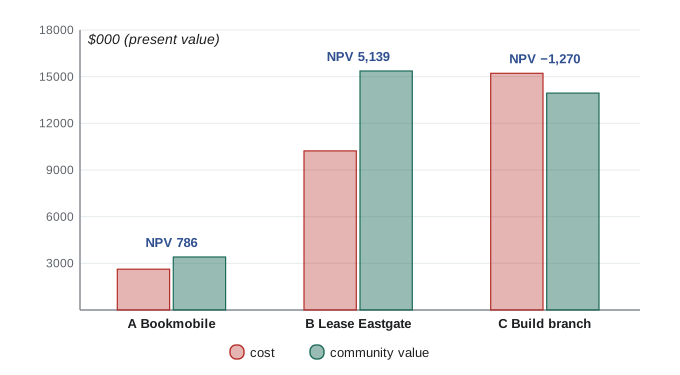
The business case compared three ways of serving the east side over ten years. Option A was an expanded bookmobile service: low capital cost, but limited hours and collection. Option B was to lease and fit out a former retail unit: the project now known as Project Compass. Option C was to build a new branch on city land: a larger, permanent building that would take two years to build. The board used a real discount rate of 4 %, a common choice for public projects, and the agreed value of $14 per visit.
# Ten-year comparison of three ways to serve the east side of Larkfield.
# Costs and visits are invented planning figures; the value per visit is an
# illustrative figure the board agreed to use for comparing options.
RATE = 0.04            # real discount rate for public projects
VALUE_PER_VISIT = 14   # dollars of community value per visit (illustrative)
YEARS = 10
options = {
    #                 capital by year (year 0, 1, 2) $000, annual operating $000, visits per year (000)
    "A Bookmobile":   ([350, 0, 0],       280, [30] * YEARS),
    "B Lease Eastgate": ([2520, 0, 0],    950, [110, 130] + [140] * (YEARS - 2)),
    "C Build branch": ([4900, 4900, 0],   900, [0, 0] + [160] * (YEARS - 2)),
}
def pv(amount, year):
    return amount / (1 + RATE) ** year
print(f"{'Option':17}{'PV cost':>9}{'PV value':>10}{'NPV':>8}{'BCR':>6}{'$/visit':>9}")
for name, (capital, opex, visits) in options.items():
    cost = sum(pv(c, y) for y, c in enumerate(capital))
    cost += sum(pv(opex if v > 0 else 0, y + 1) for y, v in enumerate(visits))
    value = sum(pv(v * VALUE_PER_VISIT, y + 1) for y, v in enumerate(visits))
    total_visits = sum(pv(v, y + 1) for y, v in enumerate(visits))
print(f"{name:17}{cost:9,.0f}{value:10,.0f}{value - cost:8,.0f}{value / cost:6.2f}{cost / total_visits:9.2f}")Option PV cost PV value NPV BCR $/visit A Bookmobile 2,621 3,407 786 1.30 10.77 B Lease Eastgate 10,225 15,364 5,139 1.50 9.32 C Build branch 15,214 13,944 -1,270 0.92 15.28
Option B has the highest NPV, about $5.1 million, the highest benefit-cost ratio at 1.50 and the lowest cost per visit at about $9.32. Option C serves more visits per year once open, but its higher capital cost and two-year delay before any visits mean its NPV over ten years is negative at this discount rate. Option A is cheap but serves few people, so its NPV is positive but small. The analysis also shows how sensitive the answer can be: over a 40-year horizon a permanent building might look very different, which is why the business case named the horizon as a key assumption and noted that a permanent building could be reconsidered when the lease ends.
Assumptions, sensitivity and the do-nothing option
A business case is only as good as its assumptions. Good practice is to list them, say how confident the organization is in each, and test how much the recommendation depends on them. Sensitivity analysis changes one input at a time to see where the answer flips; scenario analysis changes several together (for example, a pessimistic case with lower visits and higher costs). For Eastgate, the recommendation held unless visits fell more than about a third below forecast, which the board judged unlikely given the population growth.
Every business case should also describe the do-nothing or do-minimum option honestly. Doing nothing is rarely free: in Larkfield's case it meant continued crowding at the nearest branch, growing travel times for east-side residents and a likely loss of the senior-government grant earmarked for new service points. Making the cost of inaction visible helps decision makers see the real trade-off.
Keeping the business case alive
The business case is written early, when uncertainty is highest, so it must be revisited. Typical review points are phase gates, major change requests, significant external changes and the annual budget cycle. In adaptive projects, the product owner effectively tests the case every iteration by ordering the backlog by value and by watching whether released features produce the expected outcomes. If the case weakens, the right response may be to change scope, change approach, pause or stop; continuing simply because work has started is not a valid reason.
| Trigger on Project Compass | Effect on the business case | Who decides |
|---|---|---|
| Construction bids come in 12 % over estimate | Cost rises; NPV still positive but lower | Sponsor, with board approval if extra funding is needed |
| City announces a new bus route past Eastgate | Visit forecast likely rises | Noted in the next business case review |
| Grant program cut by the senior government | Funding gap; option comparison may change | Board, on the sponsor's recommendation |
| App usage in pilot far below expectation | Digital benefits weaker; app scope may change | Product owner and sponsor, within governance limits |
The project manager does not own the business case, but is often the first to see evidence that it is changing. Raising that evidence early, with an assessment of its effect, is one of the most valuable things a project manager can do in the Business Environment domain.
Worked problem
Which option, and on what basis?
Two mutually exclusive proposals compete for the same capital. Proposal X has an NPV of $420,000 and a payback of 4 years. Proposal Y has an NPV of $610,000 and a payback of 6 years. Both meet the organization's minimum rate of return and neither faces a capital limit. Which should be recommended, and why?
Show solution
- Both have positive NPV, so both create value at the required rate.
- They are mutually exclusive, so the organization can choose only one.
- NPV measures total value created in today's dollars and already accounts for timing; Y creates $190,000 more.
- Payback ignores value after the payback point, so the shorter payback of X does not outweigh Y's higher NPV unless liquidity or risk constraints are stated.
Answer: Recommend Y, because it has the higher NPV and no constraint makes payback the deciding factor.
Common mistakes
MistakeTreating the business case and the charter as the same document.
InsteadThe business case justifies the investment; the charter authorizes the project.
MistakeChoosing the option with the shortest payback by default.
InsteadPrefer the higher NPV unless the question states a constraint that makes payback matter.
MistakeCounting only money as value in a public or non-profit setting.
InsteadState the kinds of value counted and use cost-effectiveness where value cannot be priced.
MistakeLeaving out the do-nothing option.
InsteadDescribe the cost of inaction so the real trade-off is visible.
MistakeFiling the business case after approval and never revisiting it.
InsteadReview it at gates, major changes and significant external events.
Summary and key terms
- The business case explains why a project is worth doing compared with the alternatives and is owned by the sponsor.
- Value can be financial, public, strategic, compliance-related, social or environmental.
- NPV, IRR, benefit-cost ratio, payback and ROI compare options; NPV is generally the deciding measure between alternatives.
- For Eastgate, leasing and fitting out a unit had the highest NPV and the lowest cost per visit.
- Sensitivity analysis and an honest do-nothing option make the recommendation robust.
- The business case is reviewed throughout the project, and the project manager raises evidence that it is changing.
- Business case
- A document that justifies an investment by comparing options, costs, benefits and risks.
- Net present value
- The present value of benefits minus the present value of costs.
- Internal rate of return
- The discount rate at which a project's NPV equals zero.
- Benefit-cost ratio
- The present value of benefits divided by the present value of costs.
- Payback period
- The time until cumulative benefits equal the investment.
- Opportunity cost
- The value of the best alternative not chosen.
- Cost-effectiveness analysis
- Comparing options by cost per unit of outcome without pricing the outcome.
- Sensitivity analysis
- Changing one input at a time to see how much the result depends on it.
Practice problems
Work each problem on paper first, then reveal the answer to check.
Who usually owns the business case?
Show answer
The sponsor.
What is the present value of $10,000 received in 2 years at 4 %?
Show answer
About $9,246.
Option B has NPV $5.1M and BCR 1.50. What does the BCR mean?
Show answer
Each dollar of discounted cost produces about $1.50 of discounted value.
Why did Option C have a negative NPV over ten years?
Show answer
High capital cost and two years with no visits before opening.
What is the main weakness of payback period?
Show answer
It ignores value after the payback point and usually ignores discounting.
What is cost-effectiveness analysis?
Show answer
Comparing options by cost per unit of outcome, such as cost per visit.
Name two triggers for a business case review.
Show answer
For example, a phase gate, a major change, a large cost increase or a significant external change.
What should a business case say about doing nothing?
Show answer
Its real costs and consequences, so the trade-off is visible.
Between two mutually exclusive positive-NPV options with no constraints, which is preferred?
Show answer
The one with the higher NPV.
How does an adaptive team keep the business case alive?
Show answer
By ordering the backlog by value and checking outcomes of each release.
Lesson quiz · 5 questions
Score 60% or more to complete this lesson.
Create a free account to save your progress, take quizzes and earn a certificate.