
PMP-150 · Lesson 12 of 12 · 25 min
Continuous improvement and Business Environment questions
Organizations that improve keep learning from their projects and act on what they learn. Organizations that do not keep repeating the same mistakes, project after project, while the same lessons sit unread in closure reports. The sixth Business Environment task in the 2026 outline is continuous improvement: applying lessons learned, keeping improvement processes current and updating the organization's process assets. This final lesson covers how projects capture and use knowledge, the main improvement methods, and how to approach Business Environment questions on the exam, drawing together the whole course.
Lessons learned throughout the project
Lessons learned are the knowledge gained during a project about what worked, what did not and what should be done differently. The traditional practice of collecting them only at closure has two weaknesses: people forget details by the end, and the lessons arrive too late to help the project that produced them. Good practice captures lessons continuously, in retrospectives, at phase ends, after significant events and in a lessons learned register that the team can see and use during the project.
On Compass, the lessons learned register was a shared list reviewed at each monthly steering committee and at every app retrospective summary. Each entry recorded what happened, its effect, the root cause, the recommendation and who should act on it. Some lessons were applied immediately within the project, such as the hold point added after the asbestos survey breach in lesson 7. Others were addressed to the organization, such as changing the business case template to require explicit dependencies on other agencies, after the delayed bus route weakened the Eastgate visit forecast.
| When | Mechanism | Compass example |
|---|---|---|
| Every iteration | Sprint retrospective | App team moved accessibility checks earlier in each sprint |
| After significant events | Short after-action review | Kiosk firmware failure: vendor test environment requirement added to contracts |
| Phase ends and gates | Phase review | Design phase: earlier involvement of the fire inspector |
| Closure | Project lessons learned session and closure report | Decision delays were the top cause of rework across workstreams |
| Months after closure | Post-implementation or benefits review | Visit forecasts adjusted for transit dependencies in future branch cases |
Finding the causes that matter
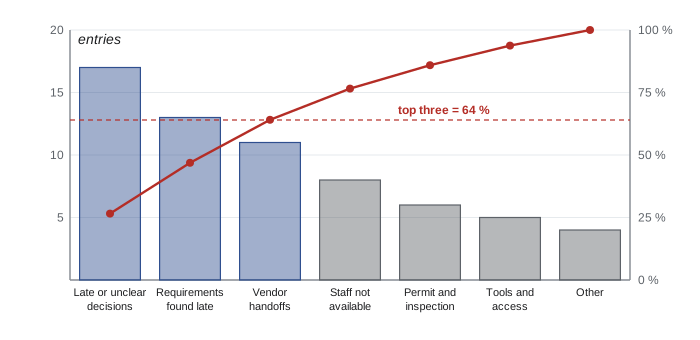
A long list of lessons is only useful if it leads to action on the causes that matter most. Grouping lessons by root cause and ranking them often reveals that a few causes account for most problems, the Pareto pattern also used in quality management. At closure, the Compass project manager worked with the workstream leads to assign each of 64 lessons learned entries to a root cause category.
# Pareto of root causes behind 64 lessons-learned entries from Project Compass.
causes = {"Late or unclear decisions": 17, "Requirements found late": 13,
          "Vendor handoffs": 11, "Staff not available for testing": 8,
          "Permit and inspection timing": 6, "Tools and access": 5, "Other": 4}
total = sum(causes.values())
cum = 0
print(f"{'Cause':32}{'Count':>6}{'Cum %':>7}")
for cause, n in sorted(causes.items(), key=lambda kv: kv[1], reverse=True):
    cum += n
print(f"{cause:32}{n:>6}{100 * cum / total:>6.0f}%")Cause Count Cum % Late or unclear decisions 17 27% Requirements found late 13 47% Vendor handoffs 11 64% Staff not available for testing 8 77% Permit and inspection timing 6 86% Tools and access 5 94% Other 4 100%
Three causes accounted for almost two-thirds of the entries: late or unclear decisions, requirements found late and vendor handoffs. None of these was specific to Compass; they were patterns the PMO recognized from earlier projects. That made them candidates for organization-level improvement rather than project-level fixes. The PMO proposed three changes: decision deadlines recorded in the governance plan with automatic escalation when they slip; requirements workshops including operations staff before design approval; and a standard vendor integration test stage in technology contracts.
Improvement methods
Continuous improvement has a long history in quality management and lean thinking. The exam expects you to recognize the main methods and when they apply.
| Method | Core idea | When it fits |
|---|---|---|
| Plan-do-check-act (PDCA) | Plan a change, try it, check the results, act to adopt, adjust or abandon it | Any improvement; small, testable changes |
| Kaizen | Continuous small improvements by the people doing the work | Everyday process improvement; building an improvement culture |
| Retrospectives | The team regularly reflects on how it works and chooses changes | Adaptive teams every iteration; also useful in predictive teams |
| Root cause analysis | Find underlying causes with tools such as five whys or cause-and-effect diagrams | Recurring or serious problems |
| Lean and value stream mapping | Remove waste and wait time from a process | Slow processes with many handoffs |
| Six Sigma (DMAIC) | Define, measure, analyze, improve and control process variation | Repeatable processes with measurable defects |
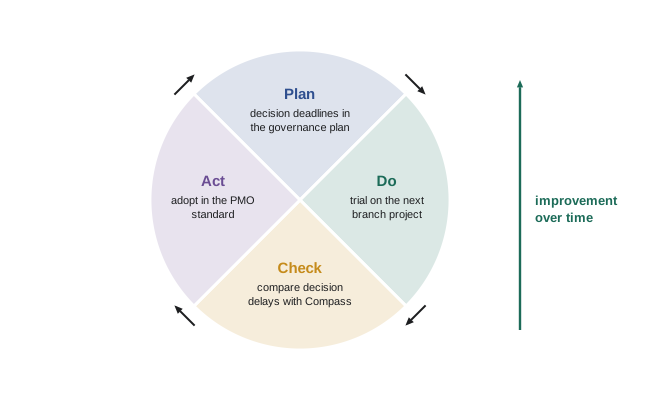
These methods share an attitude: treat improvements as experiments, measure their effect and keep what works. The PMO did not simply announce new rules after Compass. It trialled decision deadlines on the next branch project, compared decision delays with those on Compass, and only then wrote them into the organization's project management standard. That is plan-do-check-act at organizational scale.
Updating organizational process assets
Lessons that change how the organization works should end up in its process assets: policies, procedures, templates, checklists, standard contract clauses and historical data. Otherwise they depend on individuals remembering them. After Compass, the library and the city's PMO updated the business case template (explicit external dependencies), the governance plan template (decision deadlines and escalation), the technology procurement template (vendor integration test stage), the risk checklist for leased premises (asbestos survey and hold points), and the historical cost database (actual fit-out costs per square meter or square foot and app development costs per release). The lessons learned register itself was archived where future project managers could search it.
Knowledge management goes beyond documents. Much project knowledge is tacit: it lives in people's heads and is shared through conversation, mentoring and communities of practice. The library set up a short "project clinic" where project managers could present a current problem and get advice from colleagues, and Priya Natarajan mentored the project manager for the next branch, which transferred knowledge that no template could hold.
Business Environment questions on the exam
Business Environment questions often look like People or Process questions on the surface: a stakeholder disagreement, a schedule problem, a vendor issue. What makes them Business Environment questions is that the best answer depends on understanding governance, compliance, organizational change, external conditions or value. A few patterns recur, and recognizing them helps you pick the best answer under time pressure.
| If the scenario involves | Ask yourself | The best answer usually |
|---|---|---|
| A decision above your authority | Who has the authority under governance? | Analyses impact and options, then escalates to the right body |
| A decision within your authority | Am I empowered to act? | Acts and informs, rather than escalating |
| A legal, regulatory or policy requirement | Is it mandatory, and who interprets it? | Meets mandatory requirements, involves specialists and never hides gaps |
| A new external development | How likely and how big is the effect? | Assesses impact first, then updates the risk register, backlog or plans |
| Resistance or low adoption | Where are people stuck and why? | Engages people, addresses the real barrier, involves leaders |
| Weakening value | Does the business case still hold? | Raises evidence early and supports a governance decision, ignoring sunk cost |
| A recurring problem | Is this a pattern the organization should fix? | Records it, finds root causes and feeds organizational improvement |
| An agile team and heavy governance | Which decisions can be delegated within guardrails? | Delegates backlog decisions, keeps formal control at boundaries |
Two habits help with all of them. First, prefer answers that analyze before acting: assess the impact, understand the cause, check the requirement. Second, prefer answers that respect roles: the sponsor owns the business case, governance bodies make decisions within their authority, specialists interpret their fields, business owners own benefits and the project manager makes sure all of this happens at the right time with the right information. Answers in which the project manager ignores a problem, hides it, or takes over someone else's decision are rarely correct.
Bringing the course together
Project Compass opened in time for the autumn programming season. Cost pressure from the tariff, the late permit and the second electrician crew used up the management reserve, and the sponsor went back to the board for a modest top-up, a decision made openly through governance rather than hidden in the numbers. Its business case held, though visits ran behind forecast for reasons outside the project, and the branch manager took action. Governance worked because decision rights were clear and the hybrid boundaries were explicit. Compliance was met because requirements were found early, built into plans and the definition of done, and measured. Staff and patrons adopted the change because the project understood the culture, diagnosed readiness and supported the transition. External changes were caught and assessed through a standing agenda item. And the organization learned, updating its templates and standards so the next branch would start from a better place. That is the Business Environment domain in practice: making sure the project serves the organization, within the rules and the world it operates in, and leaves the organization better able to run the next one.
Worked problem
Lessons learned at closure
A project is closing. The team has compiled a lessons learned document with 40 entries. The sponsor asks what should happen to it. Several lessons concern problems that also occurred on two earlier projects in the same organization. What should the project manager recommend?
Show solution
- Group the lessons by root cause to find the patterns that matter most.
- Lessons that recur across projects point to organizational causes, so they should go to the PMO or process owners for improvement.
- Recommend specific updates to process assets, such as templates, checklists or standard clauses, and suggest trialling them on the next project.
- Archive the full register in the organization's knowledge repository where future project managers can find it.
Answer: Analyze root causes, send recurring patterns to the PMO with recommended updates to process assets, and archive the lessons where others can use them.
Psychological safety and honest lessons
Lessons learned are only as good as people's willingness to talk honestly about what went wrong. In organizations where mistakes are punished, lessons sessions produce safe, vague statements such as "communication could be improved", and the real causes stay hidden. Psychological safety, the shared belief that people can speak up about problems without fear of embarrassment or punishment, is therefore a precondition for continuous improvement. Leaders build it by asking questions, admitting their own mistakes, thanking people who raise problems and focusing on systems rather than blame.
The Compass closure session used a simple rule: discuss what happened and why, not who was at fault. When the late decisions came up, the sponsor said that some of them had been hers, because she had been reluctant to approve changes without the full steering committee present. That admission opened the conversation and led directly to the PMO's proposal for decision deadlines. On the exam, answers that create a safe, blame-free environment for reflection are generally preferred over answers that assign blame or limit lessons to the project team.
Common mistakes
MistakeCollecting lessons learned only at closure.
InsteadCapture and apply lessons continuously through retrospectives, reviews and a visible register.
MistakeFiling lessons in the project archive and stopping there.
InsteadShare them and update organizational process assets.
MistakeTreating every lesson as equally important.
InsteadGroup by root cause and act on the causes behind most problems.
MistakeAnnouncing improvements without testing them.
InsteadTreat improvements as experiments using plan-do-check-act.
MistakeChoosing exam answers in which the project manager takes over others' decisions.
InsteadPrefer answers that analyze first and respect roles and governance.
Summary and key terms
- Continuous improvement means applying lessons, keeping improvement processes current and updating process assets.
- Capture lessons throughout the project and apply them immediately where possible.
- Pareto analysis of root causes shows where organization-level improvement will help most.
- PDCA, kaizen, retrospectives, root cause analysis, lean and Six Sigma are the main improvement methods.
- Lessons that matter should change templates, policies, clauses and historical data, supported by tacit knowledge sharing.
- For Business Environment questions, analyze before acting and respect roles and governance.
- Lessons learned
- Knowledge gained during a project about what worked and what should change.
- Lessons learned register
- A living record of lessons, causes, recommendations and owners.
- Continuous improvement
- Ongoing effort to improve products, services and processes.
- Plan-do-check-act
- An iterative cycle for testing and adopting improvements.
- Kaizen
- Continuous small improvements made by the people doing the work.
- Knowledge management
- Practices for capturing, sharing and using an organization's explicit and tacit knowledge.
- Tacit knowledge
- Knowledge held in people's experience that is hard to write down.
Practice problems
Work each problem on paper first, then reveal the answer to check.
What are the two weaknesses of collecting lessons only at closure?
Show answer
Details are forgotten, and lessons arrive too late to help the project.
Which three root causes accounted for almost two-thirds of Compass lessons?
Show answer
Late or unclear decisions, requirements found late and vendor handoffs.
What are the four steps of PDCA?
Show answer
Plan, do, check, act.
How did the PMO test decision deadlines before adopting them?
Show answer
It trialled them on the next branch project and compared decision delays.
Name two process assets updated after Compass.
Show answer
For example, the business case template, governance template, procurement template, risk checklist or cost database.
What is tacit knowledge?
Show answer
Knowledge held in people's experience that is hard to write down.
When is Six Sigma most suitable?
Show answer
For repeatable processes with measurable defects.
What should happen to lessons that recur across projects?
Show answer
They should go to the PMO or process owners for organizational improvement.
What two habits help with Business Environment questions?
Show answer
Analyze before acting, and respect roles and governance.
What did the delayed bus route lesson change?
Show answer
The business case template now requires explicit external dependencies.
Lesson quiz · 5 questions
Score 60% or more to complete this lesson.
Create a free account to save your progress, take quizzes and earn a certificate.