
PMP-120 · Lesson 3 of 12 · 30 min
Building the team: acquisition, onboarding and skills
A project team does not appear fully formed on the day the charter is signed. Someone has to work out what skills the work needs, find people who have them, negotiate for their time, bring them up to speed and fill the gaps that remain. Get this wrong and the best plan in the world will stall for want of the right people at the right time. This lesson covers how project managers plan resources, acquire team members, analyze skills, build diverse and inclusive teams, and onboard people so they can contribute quickly.
Planning the team you need
Team planning starts from the work. In a predictive project, the work breakdown structure and activity list show what must be done, and the schedule shows when. In an adaptive project, the product backlog and roadmap show the kinds of work coming, and the team is usually a stable, cross-functional group sized to deliver a steady flow of value. In both cases, the project manager asks four questions: what roles and skills are needed, how many people of each kind, when, and where they will come from.
The results are usually recorded in a resource management plan (or the team section of a lighter project plan). Typical contents include roles and responsibilities, the project organization chart, how team members will be acquired and released, training needs, recognition plans, compliance requirements such as safety training or security clearances, and the approach to managing physical resources. A RACI or other responsibility assignment matrix links roles to deliverables (PMP-110, lesson 10 introduced RACI; lesson 4 of this course uses it to clarify decision rights).
| Role | Skills needed | Effort | Timing | Source |
|---|---|---|---|---|
| Business analyst | Requirements elicitation; process modeling | 1.0 FTE | Months 1 to 4 | Internal, business transformation office |
| Solution architect | Integration design; cloud security | 0.5 FTE | Months 1 to 6 | Internal, enterprise architecture |
| Developers (3) | Java; API development; automated testing | 3.0 FTE | Months 3 to 9 | Two internal, one contractor |
| Test lead | Test planning; automation framework | 1.0 FTE | Months 4 to 10 | Internal, quality assurance |
| Change manager | Training design; communication | 0.5 FTE | Months 6 to 11 | Vendor |
Resource histograms and leveling
A resource histogram is a bar chart showing how much of a resource the schedule requires in each period. It quickly reveals peaks, where demand exceeds availability, and valleys, where people are under-used. Leveling and smoothing are the two techniques for dealing with the peaks.
Worked problem
Reading a resource histogram
Your project has two testers available. The schedule requires the following tester-weeks: week 1: 1, week 2: 2, week 3: 4, week 4: 3, week 5: 1, week 6: 1. Where is the problem, and what could you do?
Show solution
- Compare demand with availability: weeks 3 (4 needed) and 4 (3 needed) exceed the two available testers by 2 and 1 tester-weeks respectively.
- Total demand is 1 + 2 + 4 + 3 + 1 + 1 = 12 tester-weeks; total availability over six weeks is 2 × 6 = 12 tester-weeks. So the total is feasible; the problem is timing.
- Option 1, smoothing: delay non-critical test activities within their float so that some week 3 and 4 work moves into weeks 5 and 6, without changing the end date.
- Option 2, leveling: if the over-allocated work is on the critical path, shifting it will extend the schedule; for example, to two testers per week for six weeks.
- Option 3, acquire more capacity for weeks 3 and 4: borrow a tester from another project or hire a contractor, at extra cost.
Answer: Demand exceeds supply in weeks 3 and 4 by 3 tester-weeks in total. Smooth within float if possible; otherwise level (and accept a later finish) or add temporary capacity.
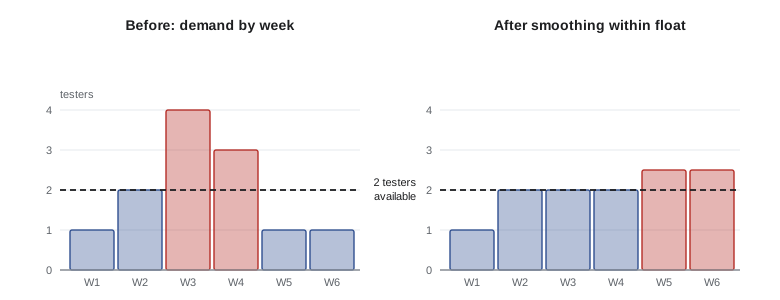
The difference between the two techniques is a favorite exam point. Resource leveling adjusts start and finish dates to balance demand with supply, and it can change the critical path and extend the project. Resource smoothing adjusts activities only within their free and total float, so the critical path and end date do not change, but it may not remove every peak. Scheduling details belong to PMP-130; here the point is that the people side of a project depends on these choices. Repeatedly overloading the same people is one of the fastest ways to burn out a team.
Acquiring team members
In most organizations, project managers do not simply choose their teams. They negotiate. The PMBOK tradition calls this "acquire resources", and it can involve several routes.
| Method | How it works | Points to watch |
|---|---|---|
| Pre-assignment | People are named in the charter, a proposal or a contract before planning | Check that pre-assigned people have the skills the plan now needs |
| Negotiation | The project manager negotiates with functional managers and other project managers for people and their time | Use the business case and priorities; agree availability in writing |
| Acquisition from outside | Hiring, contracting or using a vendor when internal skills or capacity are lacking | Procurement rules, onboarding time, knowledge retention |
| Virtual or remote teams | Using people in other locations to access scarce skills | Time zones, tools and communication norms (lesson 10) |
| Multi-criteria selection | Scoring candidates against weighted criteria such as skills, availability, cost and attitude | Make criteria and weights explicit and fair |
Negotiation is where many project managers win or lose their projects. A functional manager has their own goals and limited people; you are asking them to give up some of their best staff. Good practice includes preparing a clear business case for each request, knowing exactly when and how much of each person you need, offering something in return (development opportunities for their staff, flexibility on timing, visibility to senior management), and documenting agreements so that availability is not quietly withdrawn later. If negotiation fails on a genuinely critical resource, the sponsor may need to help resolve the conflict; that is the purpose of governance, not a sign of failure.
Worked problem
Weighted selection of a team member
You need a data engineer. You score two candidates out of 5 on four criteria with weights: technical skills (40 %), availability (30 %), domain knowledge (20 %) and cost (10 %). Priya scores 5, 2, 4, 3. Marco scores 4, 5, 3, 4. Which candidate scores higher?
Show solution
- Priya: 0.40 × 5 + 0.30 × 2 + 0.20 × 4 + 0.10 × 3 = 2.0 + 0.6 + 0.8 + 0.3 = 3.7.
- Marco: 0.40 × 4 + 0.30 × 5 + 0.20 × 3 + 0.10 × 4 = 1.6 + 1.5 + 0.6 + 0.4 = 4.1.
- Marco scores higher, mainly because Priya is only available part of the time.
- Sanity check: if Priya's availability could be negotiated up to 4, her score would rise to 4.3. Negotiation might change the answer.
Answer: Marco 4.1 versus Priya 3.7 on these weights. The calculation supports a decision but does not replace judgment or negotiation.
Skills matrices and gap analysis
A skills matrix (also called a competency matrix) lists the skills a project needs down one side and team members across the top, with a rating for each person in each skill. It answers three questions: do we collectively have the skills we need, where are we dependent on a single person, and who could be developed to fill gaps? The ratings can be simple, such as 0 (none), 1 (aware), 2 (can do with help), 3 (can do independently), 4 (can teach others).
| Skill (target) | Ana | Raj | Lee | Sam | People at level 3 or above | Gap? |
|---|---|---|---|---|---|---|
| API design (2 people at level 3+) | 4 | 2 | 3 | 1 | 2 | No |
| Cloud security (2 at level 3+) | 3 | 1 | 1 | 0 | 1 | Yes: single point of failure |
| Test automation (2 at level 3+) | 1 | 3 | 2 | 3 | 2 | No |
| Data migration (1 at level 3+) | 0 | 1 | 2 | 2 | 0 | Yes: nobody independent |
| Accessibility testing (1 at level 3+) | 0 | 0 | 1 | 2 | 0 | Yes |
Worked problem
Closing the gaps
Using the matrix above, propose actions for the three gaps.
Show solution
- Cloud security: only Ana is independent, so she is a single point of failure. Pair Raj with Ana on security tasks and fund a certification course for him; record her knowledge in design notes.
- Data migration: nobody is independent, and it is a high-risk activity. Bring in a specialist contractor for the migration, with Lee and Sam shadowing so the skill stays in the team.
- Accessibility testing: Sam is at level 2. Arrange targeted training and have an external accessibility audit before release.
- Record these actions in the resource management plan and the training plan, and revisit the matrix at each phase.
Answer: Use pairing and training for the security gap, a contractor with shadowing for migration, and training plus an external audit for accessibility.
Skills matrices also support T-shaped development, a common goal on agile teams. A T-shaped person has deep expertise in one area (the vertical bar of the T) and working knowledge in several others (the horizontal bar). Teams of T-shaped people can swarm on bottlenecks, cover for absences and avoid hand-off delays. The matrix shows where broadening would help most.
Diversity, equity and inclusion on project teams
Diverse teams bring different experiences, perspectives and ways of solving problems. Research on decision making suggests that diverse groups, when well led, consider more information and make fewer errors caused by shared blind spots, although diversity without inclusion can increase conflict and reduce cohesion. The ECO asks project managers to "support the team's varied experiences, skills, and perspectives", which is a concise description of inclusion.
Diversity is about who is on the team: differences in background, culture, gender, age, disability, education, discipline and thinking style. Inclusion is about how the team works: whether everyone can contribute, is heard and is treated fairly. A project manager has more control over inclusion than over diversity, but can influence both:
- In acquisition: use clear, job-related selection criteria; avoid relying only on people you already know; ask for diverse candidate pools from functional managers and vendors.
- In meetings: use techniques that give everyone a voice, such as round-robins, silent brainstorming, anonymous input and rotating facilitation.
- In logistics: schedule meetings fairly across time zones, provide accessible documents and tools, and accommodate religious observances and caregiving responsibilities.
- In assignments: rotate high-visibility work so development opportunities are shared.
- In behavior: address disrespectful comments promptly and privately, and model curiosity about different perspectives.
Legal obligations reinforce these practices. Title VII of the Civil Rights Act, the Age Discrimination in Employment Act and the Americans with Disabilities Act prohibit employment discrimination, and the ADA requires reasonable accommodation for qualified people with disabilities unless it causes undue hardship. Many states add protections. Federal policy on diversity programs has changed in 2025 and 2026, so organizations should follow current guidance from counsel and human resources; anti-discrimination and accommodation duties remain in force.
A practical caution: inclusion is not about treating everyone identically. Fairness sometimes means adjusting how people participate, for example giving a colleague who works in a second language the agenda in advance, or captioning video calls for a colleague who is hard of hearing. The aim is equal opportunity to contribute.
Onboarding new team members
Onboarding is the process of helping a new team member become productive and connected. On projects, poor onboarding is expensive: a new developer who spends two weeks waiting for access and searching for documents is two weeks of lost capacity, and someone who never feels part of the team may leave. Good onboarding covers four areas, sometimes called the four C's: compliance (policies, safety, security, confidentiality), clarification (role, expectations, how work is done), culture (team norms and values) and connection (relationships with colleagues).
| When | Onboarding actions |
|---|---|
| Before day one | Request accounts, equipment and access; assign a buddy; send a welcome message with the project vision and first-week plan |
| Day one | Welcome from the project manager; introductions; walk through the team charter, ways of working and key documents |
| First week | Pair with the buddy on real work; meet key stakeholders; complete mandatory training such as security and privacy |
| First month | Agree development goals; check in weekly; invite feedback on the onboarding process |
| Ongoing | Include in recognition and retrospectives; update the skills matrix |
Onboarding also matters when people join part-way through. A new member changes the team's dynamics and can send it back to an earlier stage of development (lesson 5). Brief the existing team, revisit the team charter together and give the newcomer a meaningful early task so they can contribute and be seen to contribute.
Releasing people is the other end of acquisition. Plan releases as carefully as arrivals: transfer knowledge before people leave, recognize their contribution, give feedback to their functional managers and update the resource plan. A project that hoards people after their work is done damages its relationships with the functional managers it will need next time.
Common mistakes
MistakeAccepting pre-assigned team members without checking their skills against the plan.
InsteadCompare pre-assigned people with required skills and address gaps early.
MistakeAgreeing resource availability verbally.
InsteadDocument agreements with functional managers, including dates and percentages.
MistakeConfusing resource leveling with resource smoothing.
InsteadLeveling can move the end date; smoothing stays within float and does not.
MistakeRelying on one expert for a critical skill.
InsteadUse a skills matrix to find single points of failure and cross-train or pair.
MistakeTreating inclusion as identical treatment.
InsteadAdjust participation methods so everyone has an equal opportunity to contribute.
MistakeLetting new members start without access, equipment or a buddy.
InsteadPrepare before day one and follow a structured onboarding plan.
Summary and key terms
- Team planning starts from the work: roles, skills, numbers, timing and sources.
- The resource management plan records roles, acquisition, release, training and recognition.
- Resource histograms show peaks and valleys; leveling may extend the schedule, smoothing does not.
- Team members are acquired through pre-assignment, negotiation, external acquisition and virtual teams.
- Skills matrices reveal gaps and single points of failure and support T-shaped development.
- Diversity is who is on the team; inclusion is whether everyone can contribute fairly.
- Structured onboarding covers compliance, clarification, culture and connection.
- Resource management plan
- The plan describing how project resources, including people, are acquired, managed and released.
- Resource histogram
- A bar chart showing resource demand per time period.
- Resource leveling
- Adjusting activity dates to balance demand with supply, possibly changing the critical path.
- Resource smoothing
- Adjusting activities within float to reduce peaks without changing the end date.
- Pre-assignment
- Naming team members before planning, for example in a charter or contract.
- Skills matrix
- A table rating team members against required skills.
- T-shaped person
- Someone with deep expertise in one area and broad working knowledge of others.
- Inclusion
- Practices that let every team member contribute, be heard and be treated fairly.
- Onboarding
- Helping a new team member become productive and connected.
- Full-time equivalent (FTE)
- A unit equal to one person working full time.
Practice problems
Work each problem on paper first, then reveal the answer to check.
A histogram shows demand of 5 designers in a week when 3 are available. Name two responses.
Show answer
Smooth or level the schedule, or acquire temporary extra designers.
Which technique can change the critical path: leveling or smoothing?
Show answer
Leveling.
Weights 50 %, 30 %, 20 %; scores 4, 3, 5. Weighted score?
Show answer
0.5 × 4 + 0.3 × 3 + 0.2 × 5 = 2.0 + 0.9 + 1.0 = 3.9.
What does a skills matrix reveal besides gaps?
Show answer
Single points of failure and candidates for development.
What is a T-shaped team member?
Show answer
Someone with deep expertise in one area and working knowledge of several others.
Name the four C's of onboarding.
Show answer
Compliance, clarification, culture and connection.
Give two inclusive meeting techniques.
Show answer
For example, round-robins and silent brainstorming.
Why should resource agreements be documented?
Show answer
So availability is not quietly withdrawn and both parties share the same expectations.
A pre-assigned engineer lacks a needed skill. What should you do?
Show answer
Record the gap and address it through training, pairing or additional resources, and inform the sponsor if it affects the plan.
Why plan the release of team members?
Show answer
To transfer knowledge, recognize contributions and maintain good relations with functional managers.
Lesson quiz · 5 questions
Score 60% or more to complete this lesson.
Create a free account to save your progress, take quizzes and earn a certificate.