
PLB-320 · Lesson 8 of 12 · 20 min
Reduced pressure principle assemblies
One morning in Maya's second month on the backflow unit, the building operator called Luis about water on the boiler room floor. Maya found it first: a steady stream pouring from the relief port of the reduced pressure assembly on the boiler fill line, splashing into the floor drain below. She reached for the inlet valve to stop it, and Luis caught her arm. "Wait. That device is doing exactly what it's supposed to do. It's telling us something is wrong. Find out what before you shut it up." The fault turned out to be a sliver of solder holding the first check open, left from a boiler room repair the week before. The relief valve had opened to keep boiler water out of the building's drinking water, and dumped the incoming water to the drain instead. This lesson is about that device, the reduced pressure principle assembly: the most protective mechanical backflow preventer, and the only one whose failures announce themselves.
How a reduced pressure principle assembly works
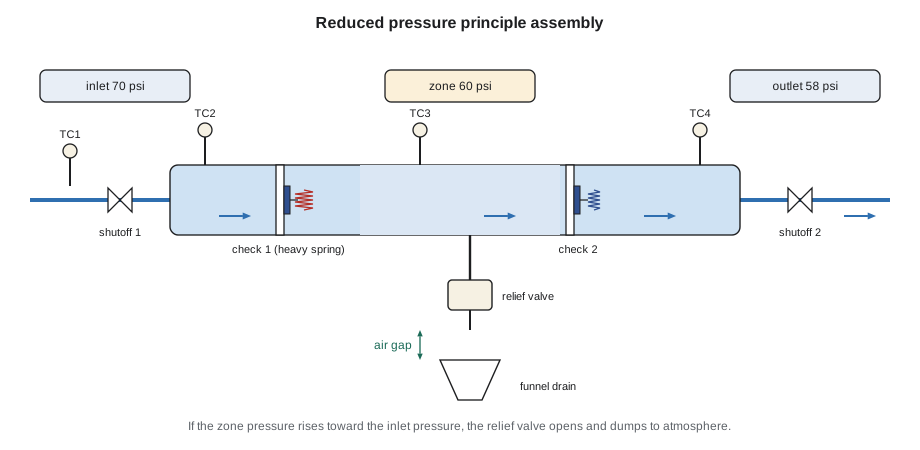
A reduced pressure principle assembly, usually called an RP or RPZ, has two independent spring-loaded check valves in series, like a double check. Between them is a chamber called the zone, and on the zone is a hydraulically operated relief valve that opens to the atmosphere. The assembly has shutoff valves at each end and four test cocks.
The first check is loaded more heavily than in a double check, so that when water flows, the pressure in the zone is always noticeably lower than the inlet pressure, typically 5 to 7 psi lower. That is the reduced pressure the device is named for. The relief valve senses both the inlet pressure and the zone pressure. As long as the zone stays enough below the inlet, the relief valve stays closed. If the zone pressure rises to within about 2 psi of the inlet pressure, the relief valve opens and dumps the zone to the atmosphere.
That rule covers every way the device can be challenged.
- If the supply pressure drops, as in backsiphonage, the inlet pressure falls toward the zone pressure. The relief valve opens, the zone drains to atmosphere, and the first check closes. Even if the first check leaked, any water coming back from downstream would go out the relief port rather than upstream.
- If the downstream pressure rises, as in backpressure, the second check closes. If the second check leaks, the leaking water raises the zone pressure, the relief valve opens, and the backflow water discharges to the drain instead of reaching the first check.
- If the first check is fouled open, as in Maya's boiler room, the zone pressure rises close to the inlet pressure even with normal flow. The relief valve opens and discharges continuously, which is visible and wasteful, and is exactly the warning the device is designed to give.
Why the relief valve matters
The relief valve turns a silent failure into a visible one. With a double check, a fouled check can sit unnoticed for a year. With a reduced pressure assembly, a fouled first check or a leaking second check under backpressure makes water pour from the relief port. Someone sees the puddle, calls a plumber, and the problem is found in days rather than months. This is why reduced pressure assemblies are accepted for the highest hazards, and why many designers use them even where a double check would satisfy the code.
The relief valve also provides a second layer of protection in the worst case. Even if both checks were damaged, the relief valve would open as long as the inlet pressure dropped toward the zone pressure, giving an atmospheric break in the middle of the device. In effect, a reduced pressure assembly creates a small, temporary air gap inside itself whenever it is needed.
That strength comes with costs. The assembly loses more pressure than a double check because of the heavy first check, often 7 to 15 psi at its rated flow. It discharges water whenever it is challenged, and occasionally during sharp pressure fluctuations, so it needs a drain that can carry the full discharge. It cannot be installed where it could be flooded, because floodwater could reach the relief port. And it costs more to buy, install, test and repair.
Spitting, dumping and nuisance discharge
Plumbers use informal words for relief valve discharge. A brief spit when pressure surges is normal: when a big valve closes elsewhere in the building or the city main surges, the inlet pressure can drop for a moment, and the relief valve opens just long enough to restore the difference. A continuous dump means a check is fouled or the relief valve itself is not sealing. An intermittent discharge that repeats with pressure swings often means the supply pressure fluctuates more than the device can tolerate.
Each pattern points to a different fix. A continuous dump with steady supply pressure usually means debris on the first check or a damaged first check disc. Discharge only when the downstream equipment heats up or a downstream pump starts means the second check is leaking under backpressure. Frequent spitting with surges may be cured with a pressure-reducing valve or a surge arrester upstream, or with a soft-closing valve elsewhere in the system. Simply capping or plugging the relief port, which some owners have tried to stop the water, defeats the device completely and is illegal.
Worked problem
Reading an RP's pressures
Maya measured the boiler fill RP after the repair. Inlet pressure: 70 psi. Zone pressure with flow: 62.5 psi. The relief valve opens when the difference falls to 2.5 psi. During a later main surge, the inlet dropped to 64 psi for two seconds. Did the relief valve open?
Show solution
- Normal difference across the first check: 70 − 62.5 = 7.5 psi, well above the 2.5 psi opening point.
- During the surge the zone holds about 62.5 psi for a moment, because the first check closes as the inlet falls.
- Difference during the surge: 64 − 62.5 = 1.5 psi, which is less than 2.5 psi, so the relief valve opens.
Answer: The relief valve spits briefly until the zone pressure drops and the difference is restored. That is normal behavior, not a failure. If the operator reports frequent spitting, the next step is to watch the supply pressure for surges.
# Will an RP's relief valve open? It opens when inlet - zone <= the opening point.
def relief_opens(inlet_psi, zone_psi, opening_psi=2.0):
    return (inlet_psi - zone_psi) <= opening_psi

events = [("normal flow", 70, 62.5), ("main surge", 64, 62.5), ("first check fouled", 70, 69),
          ("backsiphonage", -3, 62.5), ("second check leaking under backpressure", 70, 69.5)]
for name, inlet, zone in events:
    state = "OPEN - discharging" if relief_opens(inlet, zone, 2.5) else "closed"
print(f"{name:40s} inlet {inlet:5.1f} psi, zone {zone:5.1f} psi -> relief {state}")normal flow inlet 70.0 psi, zone 62.5 psi -> relief closed main surge inlet 64.0 psi, zone 62.5 psi -> relief OPEN - discharging first check fouled inlet 70.0 psi, zone 69.0 psi -> relief OPEN - discharging backsiphonage inlet -3.0 psi, zone 62.5 psi -> relief OPEN - discharging second check leaking under backpressure inlet 70.0 psi, zone 69.5 psi -> relief OPEN - discharging
Every abnormal condition in the list ends with the relief valve open. That is the design goal: whatever goes wrong, the zone is opened to the atmosphere rather than letting downstream water reach the inlet.
Drainage for the relief discharge
A reduced pressure assembly must be installed where its discharge can be safely carried away. The relief port discharges through an air gap into a funnel or directly over a floor drain or receptor; the drain line must never be connected tightly to the relief port, because a blocked drain could then back up into the zone. The drain must be sized for the device's full relief discharge, which manufacturers publish. Small assemblies may discharge only 8 to 15 gpm at full dump, but large ones on fire lines or premise services can discharge 100 gpm or more, far more than a single small floor drain can carry.
When Kingsway Tower's premise RP was installed in the water service room, the designer sized a dedicated floor drain and trench for its full discharge, and placed the assembly so the relief water would not hit the electrical panel on the adjacent wall. Air gap drain funnels made by assembly manufacturers make the connection neat, but the funnel's capacity must match the discharge, and the funnel's drain must be sized separately.
Detector assemblies and large RPs
Fire lines that carry antifreeze, chemical additives or other higher hazards use a reduced pressure detector assembly, the reduced pressure version of the double check detector assembly covered in Lesson 7. The same metered bypass reveals small flows. Large RPs on premise services, often 4 in and larger, are usually installed in pairs so one can be taken out of service for testing or repair without shutting off the building. Parallel installation is common practice in hospitals, high-rise residential buildings and anywhere water cannot be shut off for the hour a test and repair may take.
Where RPs are used at Kingsway Tower
By the end of the survey, Kingsway Tower had reduced pressure assemblies at five places: the premise device at the water service, installed as a parallel pair so the building is never without water during testing; the boiler plant fill; the chilled water fill; the dental clinic's tenant supply; and a new device on a chemical feed line for the cooling tower serving the café's refrigeration. Each sits at least a step above the floor, with its test cocks facing out, its relief port over a properly sized drain, and a tag recording its serial number and last test date.
Reading an RP's behavior on site
An RP tells you a lot by how it behaves. A device that discharges steadily, even with no demand downstream, usually has a leaking first check or a fouled relief valve seat. A device that discharges only when the supply pressure drops, then stops, may be working exactly as designed. A device that discharges in short bursts when a downstream valve closes quickly is often reacting to water hammer, which can be fixed with a hammer arrester or slower closing valves rather than by repairing the RP.
When Maya was called to look at the boiler fill RP after a complaint about a wet floor, she watched it for a full minute before touching anything. The relief port dripped slowly and steadily. Grace's diagnosis was a piece of debris under the first check, which let the zone pressure creep up to the relief opening point. Cleaning the first check stopped the discharge, and the retest passed. "If it's dripping steadily, look at the first check before you blame the relief valve," Grace said. Maya wrote that down too.
Steady discharge also wastes water and can damage the floor or equipment around the device, so it should never be ignored or plugged. Plugging the relief port, or piping it directly to a drain without an air gap, turns the device into a hazard and is a serious violation. The right response is always to find and fix the cause, then retest.
Common mistakes
MistakeShutting off a discharging RP and leaving it off.
InsteadFind the cause: a fouled check, a leaking second check under backpressure, or supply surges.
MistakeHard-piping the relief port to a drain.
InsteadThe relief must discharge through an air gap so a blocked drain cannot back into the zone.
MistakeInstalling an RP in a pit or anywhere it could flood.
InsteadFloodwater could reach the relief port; install it above grade and above any flood level.
MistakeSizing the drain for normal spitting rather than full discharge.
InsteadSize the drain for the device's published maximum relief flow.
Summary and key terms
- A reduced pressure principle assembly has two checks with a relief valve on the zone between them.
- The zone is held lower than the inlet; if the difference falls to about 2 psi, the relief valve opens.
- It protects against backsiphonage and backpressure at the highest hazards.
- A fouled check or a leaking second check under backpressure makes it discharge visibly.
- The relief port discharges through an air gap to a drain sized for the full discharge.
- It must not be installed where it could be flooded, such as in a pit.
- Reduced pressure principle assembly
- A testable assembly of two checks with a relief valve between them that opens if the zone pressure rises too close to the inlet pressure.
- Zone
- The chamber between the two checks of a reduced pressure assembly.
- Relief valve
- The valve on the zone that opens to the atmosphere when the pressure difference across the first check becomes too small.
- Reduced pressure detector assembly
- A reduced pressure assembly for fire lines with a metered bypass for small flows.
- Parallel installation
- Two assemblies side by side so one can be serviced while the other keeps the building supplied.
Practice problems
Work each problem on paper first, then reveal the answer to check.
What keeps the zone pressure below the inlet pressure?
Show answer
The heavier spring loading of the first check.
An RP discharges continuously with steady supply pressure. What is the likely cause?
Show answer
Debris or damage on the first check, or a relief valve that is not sealing.
Why must the relief port discharge through an air gap?
Show answer
So a blocked drain cannot back up into the zone.
Why are large premise RPs often installed in parallel?
Show answer
So one can be tested or repaired while the other keeps the building supplied.
Inlet 72 psi, zone 70.5 psi, opening point 2 psi. Is the relief valve open?
Show answer
72 − 70.5 = 1.5 psi, which is less than 2, so yes.
Lesson quiz · 5 questions
Score 60% or more to complete this lesson.
Create a free account to save your progress, take quizzes and earn a certificate.