
PLB-320 · Lesson 1 of 12 · 20 min
Why cross-connections matter
Maya's third year at Kingsway Tower began with a question she could not answer. Luis had sent her to the basement to tag a new reduced pressure principle assembly on the line feeding the boiler plant. When she came back up, Raj asked her why the building needed it. "The boiler water has chemicals in it," she said. "So what?" Raj answered. "The boiler is a closed system. The water goes in and never comes out." Maya started to answer and stopped. Water does not normally flow from the boiler back to the city main, so why spend thousands of dollars on a valve that only matters if it does? This course is the answer to Raj's question. It is about the rare moments when water flows the wrong way, and about the devices, rules and people that keep those moments from poisoning a building or a neighborhood.
What a cross-connection is
A cross-connection is any actual or possible link between the drinking water system and anything that is not drinking water. The other side might be a boiler full of treated water, a tank of cleaning chemicals, a garden hose lying in a puddle, a dental chair's suction line, a fire sprinkler system holding stagnant water, a commercial dishwasher, a lab sink, or a carbonated drink machine. The link can be a pipe that is always connected, like the fill line to a boiler, or one that exists only some of the time, like a hose that someone leaves submerged in a bucket.
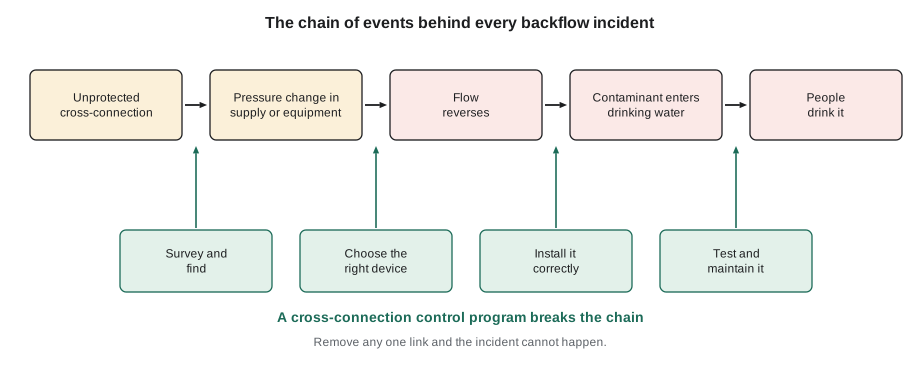
Most cross-connections are not mistakes. Buildings need to send drinking water into equipment that holds or uses other liquids. The boiler needs makeup water. The dishwasher needs a supply. The lawn needs irrigation. The problem is not the connection itself but what happens if the flow reverses. A cross-connection becomes dangerous when it is unprotected, meaning nothing stops the water on the non-potable side from coming back into the drinking water.
Backflow is the general name for water moving opposite to its intended direction in a piping system. It happens in only two ways. Backsiphonage occurs when the pressure in the supply drops below atmospheric, so the non-potable side is sucked back, the way a drink rises up a straw. Backpressure occurs when the pressure on the non-potable side rises above the supply pressure and pushes water back, the way a pump or a heated boiler can push against a weak supply. Lesson 2 looks at the hydraulics of both. For now the key idea is simple: water always moves from higher pressure to lower pressure, and the supply side is not always the higher one.
Why the supply pressure is not always higher
Inside a building, the drinking water system usually sits at a comfortable pressure, perhaps 60 to 80 psi at the bottom of a tower and less near the top. Most of the time that pressure is far above anything in the connected equipment, so water flows only one way. But the supply pressure can collapse suddenly. A water main breaks down the street. A fire department connects pumpers to a hydrant and draws hard during a fire. A utility crew shuts a valve for repairs and drains the main. A large valve in the building closes while a booster pump trips. Each event can drop the pressure in part of the system, sometimes below atmospheric, and in that moment any unprotected cross-connection can pull water backward.
The other side of the connection can also rise above the supply. A boiler heated to 180 °F pushes its own pressure up as the water expands. A booster pump on an irrigation system can push water back toward a lower-pressure supply. A chemical injection pump on a cooling tower can raise local pressure. A tank on the roof creates head that pushes down on everything below it. When the non-potable side outpushes the supply, backpressure backflow begins.
Incidents that shaped the rules
Cross-connection rules exist because people were made sick and some died. The most cited early case in North America is the 1933 outbreak of amoebic dysentery linked to two hotels in Chicago during the World's Fair. Investigators found faulty plumbing that allowed sewage to contaminate the drinking water, including cross-connections between sewer and water lines. More than a thousand people became ill and dozens died. The investigation was a turning point that pushed plumbing codes to require separation of drinking water from waste and to treat cross-connections as a public health issue rather than a plumbing detail.
Since then, hundreds of smaller incidents have been documented by water utilities and health agencies in both countries. The patterns repeat. A pesticide applicator fills a spray tank with a hose submerged in the mix while the water main is being flushed, and herbicide reaches neighboring homes. A building's boiler chemicals, often colored so leaks are easy to spot, appear in a drinking fountain after a pressure drop. An industrial process line connected without protection pushes chemicals into an office building. A carbonated drink machine without proper protection lets carbonated water dissolve copper from the supply line, and customers become ill from copper in their drinks. A fire sprinkler system's stagnant, discolored water reaches a tenant's tap. None of these required exotic plumbing, only an unprotected connection and a pressure change.
These stories matter to an apprentice because they are ordinary. The person who connected the spray tank, the boiler or the drink machine was usually trying to do a quick, practical job. The difference between a near miss and a poisoning was whether a correct device was installed, installed correctly, and maintained.
The multi-barrier approach and where plumbers fit
Drinking water in the United States is protected by a multi-barrier approach: protect the source, treat the water, keep the distribution system tight, and protect the water inside buildings. The Safe Drinking Water Act sets the federal framework, and states require public water systems to run cross-connection control programs. Backflow prevention is the barrier at the end of the chain, where the utility's responsibility meets the building owner's.
Responsibility is shared. The water utility protects its distribution system, usually by requiring a backflow preventer at the property line or at the water meter of any building that poses a risk. This is called premise isolation or containment. The plumbing code protects people inside the building by requiring the right device at each fixture or piece of equipment that creates a cross-connection. This is called zone or fixture isolation. The building owner must keep devices working and tested. The plumber installs, repairs and often tests the devices. The certified tester, who may also be a plumber, verifies each testable assembly at least once a year and sends the results to the utility.
In Columbus, the Division of Water runs a backflow prevention program under city code chapter 1113 and the Department of Public Utilities rules. Properties with assemblies required by those rules must have them tested at least every 12 months, and a failed assembly must be repaired within 21 days or the city can shut off water service. The Ohio plumbing code also requires testing of backflow assemblies it calls for. Kingsway Tower, with its commercial tenants, boiler plant and fire sprinkler system, falls squarely in the program.
Kingsway Tower's cross-connections
Luis gave Maya a clipboard and a floor plan and sent her to list every place in Kingsway Tower where drinking water met something else. She came back with more than she expected. The boiler plant fill line. The chilled water system's fill line for the café's cooling. The fire sprinkler system and its standpipes. The café's espresso machines, dishwasher, ice machines and drink dispenser. A dental clinic tenant with chairs, a vacuum system and a sterilizer. The fitness center's laundry machines. Hose bibbs on the podium terrace and an irrigation system for the planters. The janitor's chemical dispensing station on every floor. A water softener on the boiler makeup. Mop sinks. Over the next eleven lessons she will learn how each of these is classified, what device protects it, how it should be installed, how it is tested and how the records are kept.
| Location | What is on the other side | Why it matters |
|---|---|---|
| Boiler plant fill | Treated boiler water, possibly with glycol | Chemicals and heat; backpressure when hot |
| Fire sprinkler system | Stagnant water, possibly antifreeze | Discolored, low-oxygen water; chemicals in some systems |
| Café drink dispenser | Carbon dioxide and carbonated water | Carbonated water dissolves copper |
| Dental clinic | Suction lines, sterilizer, chair water | Body fluids and disinfectants |
| Janitor chemical station | Concentrated cleaners | High concentration, easy to siphon |
| Podium irrigation | Soil, fertilizer, standing water | Backsiphonage when sprinklers are underground |
Worked problem
How much chemical reaches a tap
A janitor fills a 5 gallon mop bucket from a hose that hangs below the surface of the cleaning solution. The solution is 5 percent concentrate. During a pressure drop, 1 gallon are siphoned back into a 1 in branch that feeds a lunchroom sink. The branch between the hose bibb and the sink holds 1.5 gallons of water. If the siphoned liquid mixes evenly with the water in the branch, what concentration of concentrate reaches the sink?
Show solution
- Concentrate pulled back: 1 gal × 0.05 = 0.05 gal.
- Total liquid in the branch after mixing: 1.5 gal + 1 gal = 2.5 gal.
- Concentration at the sink: 0.05 ÷ 2.5 = 0.02, or 2 percent concentrate.
Answer: The first glass of water from the lunchroom tap could be a 2 percent cleaning solution, strong enough to burn the mouth and stomach. This is why a simple hose bibb vacuum breaker, or a proper air gap at the chemical station, matters even in an office building.
# Concentration of a siphoned chemical after it mixes into a branch line
def mixed_fraction(siphoned_gal, strength, branch_gal):
    pulled = siphoned_gal * strength        # gallons of concentrate pulled back
    return pulled / (branch_gal + siphoned_gal)

for siphoned in (0.25, 0.5, 1.0, 2.0):
    f = mixed_fraction(siphoned, 0.05, 1.5)
print(f"{siphoned} gal siphoned -> {f*100:4.1f} % concentrate at the first tap")0.25 gal siphoned -> 0.7 % concentrate at the first tap 0.5 gal siphoned -> 1.2 % concentrate at the first tap 1.0 gal siphoned -> 2.0 % concentrate at the first tap 2.0 gal siphoned -> 2.9 % concentrate at the first tap
The numbers rise quickly. Even a small siphoned volume produces a strong solution at the first tap, because a branch line holds very little water. Dilution happens only once the contaminant reaches a large main, and by then many taps may have drawn from the contaminated section.
How this course is organized
Lessons 2 to 4 cover the why: the hydraulics of backflow, where cross-connections hide in buildings, and how hazards are rated. Lessons 5 to 8 cover the devices, from the simple air gap to the reduced pressure principle assembly. Lessons 9 and 10 cover choosing and installing the right device. Lesson 11 covers field testing, and lesson 12 covers the programs, certifications and records that keep the whole system working year after year.
Throughout, the course refers to the Ohio plumbing code, which is based on the International Plumbing Code, and to the device standards published by ASSE, AWWA and others that the code references. Field test procedures follow widely used methods such as those taught under ASSE's 5000 series and the University of Southern California's cross-connection manual. The course paraphrases these documents; when you work, use the edition your jurisdiction has adopted and the method your certification taught you.
Common mistakes
MistakeAssuming a closed system can never flow backward.
InsteadAny system connected to the supply can backflow when the supply pressure drops or the system pressure rises.
MistakeThinking backflow devices are only for factories.
InsteadOffices, apartment buildings, restaurants and homes all have cross-connections.
MistakeLeaving a hose submerged in a bucket or a tank.
InsteadKeep hose ends above the liquid, or use a hose connection vacuum breaker.
MistakeTreating the utility's meter device as protection for everyone inside.
InsteadPremise isolation protects the city main; people inside still need fixture and zone protection.
Summary and key terms
- A cross-connection is any actual or possible link between drinking water and anything that is not drinking water.
- Backflow is reversed flow; it happens by backsiphonage (supply pressure drops) or backpressure (equipment pressure rises).
- Pressure in the supply can collapse during main breaks, firefighting, repairs or pump failures.
- Historic outbreaks, starting with the 1933 Chicago case, led to modern cross-connection rules.
- Utilities protect the main with premise isolation; codes protect occupants with zone and fixture isolation.
- Even a small siphoned volume can make a strong solution at the first tap.
- Cross-connection
- Any actual or possible link between the drinking water system and a non-potable substance or system.
- Backflow
- Flow of water or other liquid opposite to the intended direction in a piping system.
- Backsiphonage
- Backflow caused by a drop in supply pressure below atmospheric pressure.
- Backpressure
- Backflow caused by pressure on the non-potable side rising above the supply pressure.
- Premise isolation
- Protection of the public water system by a device at the service connection; also called containment.
- Fixture isolation
- Protection of the building's own drinking water by a device at each fixture or piece of equipment.
Practice problems
Work each problem on paper first, then reveal the answer to check.
Name the two ways backflow can happen.
Show answer
Backsiphonage and backpressure.
Give two events that can drop the pressure in a water main.
Show answer
A main break, heavy firefighting draw, a shutdown for repairs or a pump failure.
Why does a heated boiler create a backpressure risk?
Show answer
Its water expands as it heats, raising its pressure above a weak supply.
Who is responsible for premise isolation?
Show answer
The building owner installs it because the utility requires it; the utility enforces it to protect its main.
A 0.75 gal siphoned volume of 10 percent chemical mixes into 2.25 gal of water in a branch. What concentration reaches the tap?
Show answer
0.075 ÷ 3 = 2.5 percent.
Lesson quiz · 5 questions
Score 60% or more to complete this lesson.
Create a free account to save your progress, take quizzes and earn a certificate.