
PLB-320 · Lesson 6 of 12 · 22 min
Pressure vacuum breakers and spill-resistant vacuum breakers
The podium terrace at Kingsway Tower has six irrigation zones. The landscape designer had first drawn an atmospheric vacuum breaker on each zone, downstream of each zone valve, the textbook arrangement. The contractor who built the terrace had other ideas: one device on the main irrigation line, upstream of all six zone valves, so there would be one device to maintain instead of six. Maya asked Raj whether that was allowed. "Not with an atmospheric one," he said. "Those zone valves are downstream, and the main stays pressurized all season. You need a pressure vacuum breaker." This lesson covers the pressure vacuum breaker and its indoor cousin, the spill-resistant vacuum breaker: what they add to the simple atmospheric device, where they fit, and their installation rules.
What a pressure vacuum breaker adds
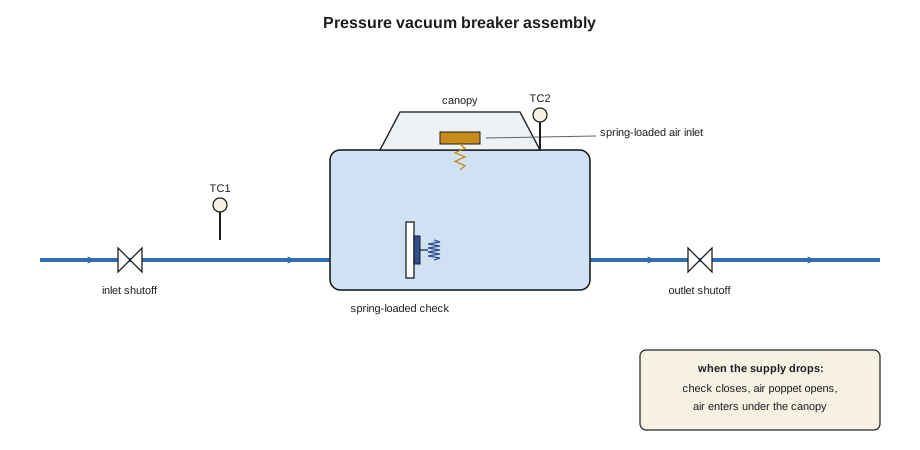
A pressure vacuum breaker, usually called a PVB, is a vacuum breaker built for lines that stay under pressure. It has two working parts inside one body. The first is a spring-loaded check valve that closes when flow stops or when downstream pressure tries to push back through it. The second is a spring-loaded air inlet valve, held shut by water pressure, that opens when the pressure inside the body falls close to atmospheric. The springs are the key difference from the atmospheric vacuum breaker: because the air inlet is pushed open by a spring rather than falling open by gravity, it does not stick shut after long periods under pressure.
That design lets a pressure vacuum breaker do two things an atmospheric one cannot. It can stay pressurized continuously, and it can have shutoff valves downstream of it. A single PVB on an irrigation main can protect a whole set of zone valves, and a PVB on a lab's supply can serve faucets that are opened and closed all day.
The pressure vacuum breaker is also a testable assembly. It is made with a shutoff valve on its inlet and another on its outlet, and with test cocks that let a tester connect a gauge and check that the check valve holds and that the air inlet opens at the right pressure. Lesson 11 describes the test.
What it still cannot do
A pressure vacuum breaker is still a vacuum breaker. It protects against backsiphonage only. If the downstream system can build pressure higher than the supply, from a pump, from elevation or from heat, the check valve is the only thing in the way, and a single check is not accepted as protection against backpressure. Any time Maya sees a booster pump, a tank above the device or a heated system downstream, a PVB is the wrong choice.
Because water downstream must not be able to rise up to the air inlet, a pressure vacuum breaker must be installed at least 12 in above the highest downstream outlet or piping it serves. On a sloping site that can be a real constraint: the device must be higher than the highest sprinkler head, which on a terrace with raised planters may mean mounting it on a riser well above the deck.
A pressure vacuum breaker also discharges a little water from its air inlet when it is first pressurized and when the air inlet opens and closes. That spill is harmless outdoors over a planting bed, but it is a problem indoors, where it can soak a ceiling or a lab bench. This is the reason the spill-resistant vacuum breaker exists.
The spill-resistant vacuum breaker
A spill-resistant vacuum breaker, usually called an SVB, does the same job as a pressure vacuum breaker but is designed so the air inlet seals before water can escape when the device is pressurized. It has a single check valve and an air inlet, arranged so that during start-up the check opens only after the air inlet has closed. Like the PVB, it can be under continuous pressure, can have valves downstream and is testable, though it usually has one test cock and a vent valve rather than two test cocks.
Spill-resistant vacuum breakers are made for indoor use where a spill would cause damage, such as laboratory supplies, process water lines in clean rooms, and building service lines feeding equipment above ceilings. They protect against backsiphonage only, with the same elevation rule as the pressure vacuum breaker.
In the United States, pressure vacuum breakers are made to ASSE 1020 and spill-resistant vacuum breakers to ASSE 1056, with listings from recognized laboratories. Many utilities and states also accept only devices that have passed the field evaluation of the University of Southern California's foundation for cross-connection control. Ohio's plumbing code lists the acceptable devices for each application by their standard.
| Feature | Atmospheric vacuum breaker | Pressure vacuum breaker | Spill-resistant vacuum breaker |
|---|---|---|---|
| Protects against | Backsiphonage | Backsiphonage | Backsiphonage |
| Continuous pressure | No | Yes | Yes |
| Valves downstream | No | Yes | Yes |
| Height above highest outlet | At least 6 in | At least 12 in | At least 12 in |
| Testable | No | Yes | Yes |
| Spills on start-up | Can | Yes, a little | No, by design |
| Typical use | Single irrigation zone, flush valves | Irrigation mains, outdoor process lines | Indoor lab and equipment supplies |
Worked problem
Can the terrace use one pressure vacuum breaker?
The terrace irrigation main enters a planter on the deck. The highest sprinkler head sits on a raised planter 3 ft 6 in above the deck. The irrigation system has no booster pump and no tank, and fertilizer is not injected. Can one PVB serve all six zones, and how high must it be?
Show solution
- Backflow type: there is no pump, tank or heat downstream, so only backsiphonage is possible. A vacuum breaker is suitable.
- Valves downstream: six zone valves sit downstream, so an atmospheric vacuum breaker cannot be used on the main. A pressure vacuum breaker can.
- Height: the device must be at least 12 in above the highest head, so its critical level must be at least 42 + 12 = 54 in above the deck.
Answer: One pressure vacuum breaker on the main is acceptable if it is mounted with its critical level at least 54 in above the deck. The crew set it on a riser beside the planter at 60 in, with a lockable enclosure so it would not be knocked off or tampered with. If the owner later adds a fertilizer injector, the hazard and the device must be reviewed.
# Check the height of a vacuum breaker against the highest downstream outlet
MIN_ABOVE_IN = {"AVB": 6, "PVB": 12, "SVB": 12}

def height_ok(kind, device_in, highest_outlet_in):
    need = highest_outlet_in + MIN_ABOVE_IN[kind]
    return device_in >= need, need

for kind, dev, top in [("PVB", 60, 42), ("PVB", 50, 42), ("AVB", 50, 42), ("SVB", 96, 81)]:
    ok, need = height_ok(kind, dev, top)
print(f"{kind}: device at {dev} in, highest outlet {top} in, needs {need} in -> {'OK' if ok else 'too low'}")PVB: device at 60 in, highest outlet 42 in, needs 54 in -> OK PVB: device at 50 in, highest outlet 42 in, needs 54 in -> too low AVB: device at 50 in, highest outlet 42 in, needs 48 in -> OK SVB: device at 96 in, highest outlet 81 in, needs 93 in -> OK
The device height is measured to its critical level, a mark that the manufacturer puts on the body or that the listing defines, usually near the bottom of the air inlet or check. Measuring to the bottom of the inlet pipe or the top of the canopy gives the wrong answer. When in doubt, check the installation instructions.
Freeze protection and seasonal service
Outdoor pressure vacuum breakers freeze easily, because their bodies hold water above ground with only a thin canopy. In Columbus, irrigation PVBs are usually drained each fall: the inlet shutoff is closed, the test cocks are opened, and the line is blown out or drained. In spring, the device is refilled slowly so the air inlet seats without slamming, inspected for cracks, and tested before the season starts if the utility requires it. A cracked body or a split bonnet is a common spring discovery and is one reason utilities ask for testing after the device is reinstalled, not before it is drained.
Insulated enclosures and heat tape can protect devices that must stay in service through winter, but they cannot cover the air inlet in a way that blocks air from entering. A plastic bag tied over a PVB to keep out snow defeats its purpose and is a common inspection finding.
Vacuum breakers on equipment
Many pieces of equipment come with a vacuum breaker built in or specified by the manufacturer. Flush valves for toilets and urinals contain an atmospheric vacuum breaker in the tailpiece. Laboratory faucets with serrated hose ends usually have a vacuum breaker in the spout. Commercial dishwasher and glass washer rinse lines often have one on the final rinse. Equipment listings tell you whether the built-in device satisfies the code for that use. Replacing a part with a version that lacks the vacuum breaker, such as a flush valve tailpiece from a non-matching kit, removes protection that the code requires.
Sizing and pressure loss
Pressure vacuum breakers are sized to the line they serve, but their pressure loss must be checked. A PVB has a spring-loaded check, and water must push against that spring to flow. At low flows the loss is small, but at the full design flow of an irrigation zone it can be 3 to 5 psi or more, depending on the size and model. On a site with marginal pressure, that loss can reduce the throw of sprinkler heads enough to leave dry patches.
Worked problem
Checking pressure for the rooftop irrigation
Kingsway Tower's rooftop planters are fed from a branch with 40 psi static pressure. The PVB loses 4 psi at the design flow, the piping loses 5 psi, and lifting water from the PVB to the highest drip emitter takes 2 psi. The emitters need 20 psi. Is the pressure adequate?
Show solution
- Available pressure after losses: 40 − 4 − 5 − 2 = 29 psi.
- Required: 20 psi.
- 29 psi is more than 20 psi, with 9 psi to spare.
Answer: The pressure is adequate. Luis noted that a pressure regulating valve after the PVB would still be needed because drip emitters work best at a lower, steady pressure.
Common installation faults
Most vacuum breaker problems on site are installation faults. A PVB installed below the highest sprinkler head will not protect against backsiphonage, because the water in the higher piping can drain back past it. A PVB installed in a valve box underground can be flooded. A spill-resistant vacuum breaker installed where the small discharge on start-up will damage finishes is a source of complaints, and the owner may remove it. Test cocks that face a wall cannot be reached with a test kit. Each of these is easy to avoid at installation and hard to fix later.
Maya made a short checklist for every vacuum breaker she installed: the correct type for the hazard and the pressure condition, mounted at the required height above all downstream piping and outlets, upright as the maker requires, with test cocks and the bonnet accessible, protected from freezing, and somewhere a small discharge will do no harm. She also wrote the device's serial number on the drawing so the first test report would match.
Vacuum breakers are often the first backflow devices an apprentice installs, because they are small and common. That makes it easy to treat them casually, but a hose bibb or irrigation line is where many real backflow incidents begin.
Common mistakes
MistakeChoosing a pressure vacuum breaker where a pump or tank can push back.
InsteadVacuum breakers stop backsiphonage only; use an assembly rated for backpressure.
MistakeMeasuring height to the bottom of the inlet pipe.
InsteadMeasure to the device's marked critical level.
MistakeInstalling a pressure vacuum breaker indoors over a finished ceiling.
InsteadUse a spill-resistant vacuum breaker where start-up spill would cause damage.
MistakeWrapping the canopy to keep out snow.
InsteadThe air inlet must stay open to the atmosphere; protect the device without blocking it.
Summary and key terms
- A pressure vacuum breaker has a spring-loaded check and a spring-loaded air inlet, and can stay under pressure with valves downstream.
- Pressure and spill-resistant vacuum breakers protect against backsiphonage only.
- Both must be at least 12 in above the highest downstream outlet, measured to the critical level.
- Both are testable assemblies with shutoff valves and test cocks.
- A spill-resistant vacuum breaker seals before it can spill, so it suits indoor use.
- Outdoor devices must be drained or protected from freezing without blocking the air inlet.
- Pressure vacuum breaker
- A testable vacuum breaker with a spring-loaded check and spring-loaded air inlet that can stay under continuous pressure.
- Spill-resistant vacuum breaker
- A testable vacuum breaker designed so its air inlet seals before water can spill on start-up.
- Critical level
- The point on a vacuum breaker, marked by the maker, used to measure its required height above downstream outlets.
- Test cock
- A small valve on an assembly where a test gauge is connected.
- Canopy
- The cover over a vacuum breaker's air inlet that keeps debris out while allowing air in.
Practice problems
Work each problem on paper first, then reveal the answer to check.
What lets a pressure vacuum breaker stay under continuous pressure?
Show answer
Its air inlet is opened by a spring, so it does not stick shut.
The highest sprinkler is 30 in above grade. How high must a PVB's critical level be?
Show answer
At least 30 + 12 = 42 in above grade.
Why use a spill-resistant vacuum breaker indoors?
Show answer
It does not spill water on start-up, so it will not damage ceilings or benches.
Can a pressure vacuum breaker protect a line with a booster pump downstream?
Show answer
No; it protects against backsiphonage only.
What should be done to an outdoor PVB each fall in a cold climate?
Show answer
Close the inlet valve, open the test cocks and drain or blow out the line.
Lesson quiz · 5 questions
Score 60% or more to complete this lesson.
Create a free account to save your progress, take quizzes and earn a certificate.