
PLB-320 · Lesson 5 of 12 · 21 min
Air gaps and atmospheric vacuum breakers
Luis took Maya to the janitor's closet on the twelfth floor and pointed at the chemical dispenser on the wall. Four tubes ran from it into jugs of concentrate on the floor, and a short hose hung from its outlet into the mop sink. "Where's the backflow protection?" he asked. Maya looked for a valve and found none. Luis pointed to a gap inside the clear plastic body of the dispenser, where the incoming water sprayed across an open space before mixing with the chemical. "There. That's an air gap. No valve, no springs, nothing to wear out. Water can't jump back across empty air." This lesson covers the two simplest forms of backflow protection: the air gap, the most reliable method there is, and the atmospheric vacuum breaker, the simplest mechanical device.
The air gap
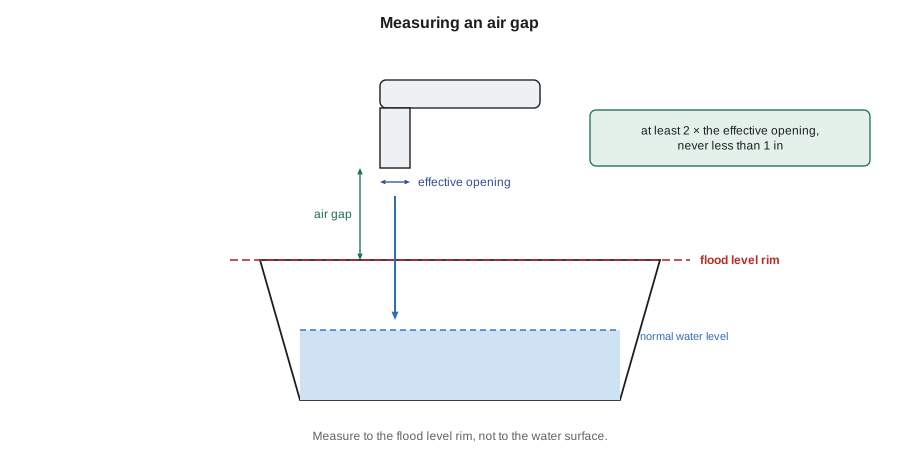
An air gap is an unobstructed vertical distance through the open air between the lowest opening of a water supply outlet and the highest point to which the receiving vessel can fill. That highest point is usually the flood level rim of a fixture or the overflow of a tank. If the supply outlet is above that level by enough distance, no matter what happens to the pressure in the supply, the liquid in the vessel cannot reach the outlet and cannot be drawn or pushed back into it.
Air gaps protect against both backsiphonage and backpressure, at every degree of hazard. They have no moving parts and need no testing in the sense that assemblies do, though they must be inspected to make sure nobody has added a hose, raised the water level or lowered the outlet. Their drawback is that the water falls to atmospheric pressure. Anything downstream of an air gap must be fed by gravity or by a pump, which is why air gaps are common at tanks, fixtures and equipment reservoirs but rare in the middle of pressurized piping.
The size of an air gap is set by the code. In general terms, the gap must be at least twice the effective opening of the supply outlet, and never less than 1 in. The effective opening is the smallest cross-section that controls the flow, usually the inside diameter of the outlet or of the supply pipe. Where the outlet is close to a wall or another obstruction, the code requires a larger gap, commonly three times the effective opening, because a nearby wall can disturb the air and let water climb.
Air gaps in practice
Air gaps appear in many places in buildings, some so familiar that plumbers stop noticing them.
- Faucets: a lavatory or sink faucet whose spout ends above the fixture's flood level rim provides an air gap for the fixture. Faucets that sit lower, or that have pull-out sprayers that can drop into the bowl, need other protection.
- Tank fills: a storage tank, cooling tower basin or break tank filled by a pipe that ends above the overflow level is protected by an air gap. The overflow must be sized so the water cannot rise above it even if the fill valve sticks open.
- Chemical dispensers: many dispensers have an internal air gap, as Luis showed Maya. The gap only works if the outlet hose does not end below the liquid in the bucket or sink and the dispenser is mounted as the manufacturer intends.
- Equipment reservoirs: ice machines, steam tables, coffee urns and many process machines have an internal air gap at their fill point. The device listing tells you whether the built-in gap satisfies the code.
- Break tanks: in high-hazard industrial settings, the supply discharges into an open tank, and a pump draws from the tank to feed the process. This complete physical separation is the strongest form of protection.
An air gap is different from an air break. An air break is a separation used on drain lines, where a waste pipe from equipment such as a dishwasher or ice machine ends above or into a receptor like a floor sink, but not far enough above it to qualify as an air gap. Air breaks keep sewage from backing up into the equipment through a direct drain connection; they are a drainage rule, not protection for the water supply. Confusing the two is a common exam trap.
Worked problem
Sizing a tank fill air gap
Kingsway Tower's podium irrigation tank is filled through a 1 in pipe that discharges near the tank's side wall. How high above the tank's overflow must the fill outlet end?
Show solution
- Effective opening: 1 in (the inside diameter controls the flow).
- Normal rule: 2 × 1 = 2 in, which is more than the 1 in minimum.
- Near a wall the code calls for 3 × the effective opening: 3 × 1 = 3 in.
Answer: The outlet must end at least 3 in above the overflow. Maya's crew set it at 4 in to allow for the float valve bracket and so inspectors would not have to measure twice.
# Minimum air gap: at least 2 x effective opening (3 x near a wall), never under 1 in
def air_gap_in(d_eff_in, near_wall=False):
    factor = 3 if near_wall else 2
    return max(factor * d_eff_in, 1.0)

for d, wall in [(0.375, False), (0.5, False), (0.75, True), (1.0, False), (1.0, True), (2.0, True)]:
    where = "near wall" if wall else "open"
print(f"opening {d:5.3f} in, {where:9s}: air gap at least {air_gap_in(d, wall):4.2f} in")opening 0.375 in, open : air gap at least 1.00 in opening 0.500 in, open : air gap at least 1.00 in opening 0.750 in, near wall: air gap at least 2.25 in opening 1.000 in, open : air gap at least 2.00 in opening 1.000 in, near wall: air gap at least 3.00 in opening 2.000 in, near wall: air gap at least 6.00 in
Small outlets hit the code minimum before the multiplier matters, which is why most faucets need only the minimum gap. Large outlets, especially near walls, need surprisingly tall gaps, and designers sometimes choose a mechanical device instead because the tank or fixture cannot be arranged to give enough height.
The atmospheric vacuum breaker
An atmospheric vacuum breaker, often called an AVB, is the simplest mechanical backflow device. It has a body with an air inlet port at the top and a light float or poppet inside. When water flows, the pressure lifts the float and seals the air inlet, and water passes through. When the supply pressure drops to atmospheric or below, the float falls, closing the water inlet and opening the air port. Air rushes into the line downstream, breaking any siphon that could pull water back.
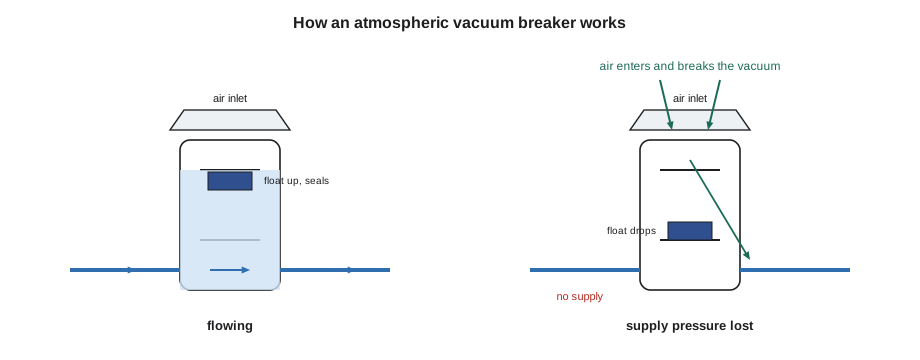
Because it works by letting air in, an atmospheric vacuum breaker protects only against backsiphonage. It cannot stop backpressure: a pressure from downstream simply pushes the float up against its seat or pushes water out of the air port. It has three installation rules that come straight from how it works.
It must be installed at least 6 in above the highest downstream outlet or the flood level rim of the equipment it serves, so that water downstream cannot rise to the air port and siphon past it.
- No shutoff valve may be installed downstream of it. If a valve downstream is closed, the device stays pressurized, the float stays seated, and the device cannot operate when the supply drops. Valves belong upstream.
- It must not be under continuous pressure for long periods. Codes limit how long it may remain pressurized, commonly no more than 12 hours in any 24, because a float held against its seat for days can stick, and the device must cycle to stay reliable.
These rules make the atmospheric vacuum breaker a good fit for fixtures that are used intermittently, such as lawn irrigation zones where the zone valve sits upstream of the breaker, flush valve toilets and urinals, laboratory faucets with hose outlets, and some commercial dishwasher rinse lines. They make it a poor fit for anything with a valve or nozzle at the end of a hose, anything that stays pressurized and anything that can create backpressure.
Hose connection vacuum breakers
The hose connection vacuum breaker, often called a hose bibb vacuum breaker, is a small atmospheric-type device that threads onto a hose bibb or sill cock. It contains a spring-loaded check and an atmospheric vent. When the supply pressure drops, the check closes and the vent opens, so a hose lying in a pool or bucket cannot siphon back. Many models have a breakaway set screw so they cannot be removed once installed. Frost-free wall hydrants and many sill cocks are sold with a built-in vacuum breaker.
Hose connection vacuum breakers are designed for intermittent use and low hazards in the backsiphonage sense; they are not meant to protect a hose that stays connected under pressure to a spray nozzle all day, and they are not testable. Codes require some form of protection on every hose-threaded outlet, which is why mop sink faucets with hose threads and service sink faucets in Kingsway Tower all got hose connection vacuum breakers after Maya's survey.
Inspecting air gaps and vacuum breakers
Non-testable devices still need regular inspection. For an air gap, check that the outlet has not been extended with a hose or tubing, that the receiving vessel's overflow is clear, and that the gap still meets the required height. For an atmospheric vacuum breaker, check that no valve has been added downstream, that it is still above the highest outlet, that the air port is clear and not painted or taped over, and that it does not spit water when the line is pressurized, which suggests a worn float or seat. For hose connection vacuum breakers, check that they are still in place and not leaking from the vent when the hose is in use.
Air gaps on equipment and tanks
Air gaps are not only for faucets. Many pieces of equipment are filled through an air gap built into the equipment itself, such as a dishwasher's fill funnel or a cooling tower's makeup float valve. When equipment comes with a built-in air gap, the plumber must make sure it is installed as the maker designed and that nothing defeats it, such as a hose that extends the outlet below the flood level rim or a float valve set so low that the outlet is submerged. At Kingsway Tower, the cooling tower's makeup line had a float valve discharging above the basin, and Maya measured the gap to confirm it met the required height above the overflow level.
Tanks are filled through an air gap above their overflow, not above their normal water level. If the tank's outlet blocks and the level rises, the water will reach the overflow before the fill outlet, and the overflow must be sized to carry the full flow of the fill line so that the level can never rise to the outlet. An overflow that is too small, blocked or connected directly to a drain without its own air gap defeats the air gap on the fill.
Air gaps are also used on drains, which is a different job. An indirect waste air gap protects the equipment from the drain, so that a sewer backup cannot flow back into a food preparation sink or an ice machine. It works the same way, with the drain pipe ending above the flood level rim of the receptor, but it protects against contamination from the drain rather than contamination of the supply. Students often confuse the two, and inspectors look for both.
Common mistakes
MistakeMeasuring an air gap to the normal water level.
InsteadMeasure to the flood level rim or overflow, the highest level the water can reach.
MistakePutting a shutoff valve downstream of an atmospheric vacuum breaker.
InsteadValves go upstream so the device can open to air when the supply drops.
MistakeUsing an atmospheric vacuum breaker where backpressure can occur.
InsteadIt protects against backsiphonage only; use an assembly or an air gap.
MistakeCalling a drain's air break an air gap.
InsteadAn air break protects the drain connection; an air gap protects the water supply and needs the full code height.
Summary and key terms
- An air gap is an open vertical distance from the outlet to the flood level rim, at least twice the effective opening and never under 1 in.
- Air gaps protect against backsiphonage and backpressure at any hazard level but drop the water to atmospheric pressure.
- Near a wall, air gaps commonly need three times the effective opening.
- An atmospheric vacuum breaker admits air when the supply drops and protects against backsiphonage only.
- Atmospheric vacuum breakers go at least 6 in above the highest outlet, with no valves downstream and no continuous pressure.
- Hose connection vacuum breakers protect hose-threaded outlets; they are not testable.
- Air gap
- An unobstructed vertical distance through the air between a supply outlet and the flood level rim of the vessel it fills.
- Effective opening
- The smallest cross-section of a supply outlet that controls flow, used to size an air gap.
- Air break
- A drain arrangement where a waste pipe discharges into a receptor above its flood level, without a full air gap.
- Atmospheric vacuum breaker
- A device with a float and air port that admits air to break a siphon when supply pressure drops.
- Hose connection vacuum breaker
- A small vacuum breaker that threads onto a hose outlet to prevent backsiphonage through a hose.
Practice problems
Work each problem on paper first, then reveal the answer to check.
A 1/2 in faucet outlet in the open needs what air gap?
Show answer
2 × 0.5 = 1 in, which equals the minimum, so 1 in.
A 1-1/2 in tank fill near a wall needs what air gap?
Show answer
3 × 1.5 = 4.5 in.
Why can no valve be installed downstream of an atmospheric vacuum breaker?
Show answer
A closed valve would keep the device pressurized so it could not open to air.
Why are atmospheric vacuum breakers limited to intermittent pressure?
Show answer
A float held seated for long periods can stick and fail to operate.
What is the difference between an air gap and an air break?
Show answer
An air gap protects the water supply with a full code height; an air break protects a drain connection.
Lesson quiz · 5 questions
Score 60% or more to complete this lesson.
Create a free account to save your progress, take quizzes and earn a certificate.