
PLB-320 · Lesson 12 of 12 · 20 min
Cross-connection control programs, tester certification and records
By the end of the Kingsway Tower job, Maya had installed, commissioned and helped test more than a dozen backflow preventers. On the last afternoon, Raj spread the binder of test reports across the site office table. "Everything we did is only as good as the paperwork that follows it," he said. "The utility doesn't see these devices. It sees reports. If a report is missing or late, as far as the utility is concerned the building is unprotected." This lesson pulls the course together by looking at the systems around the devices: the utility's cross-connection control program, the people who are allowed to test, the records that must be kept, and how enforcement works when something is not done.
What a cross-connection control program is
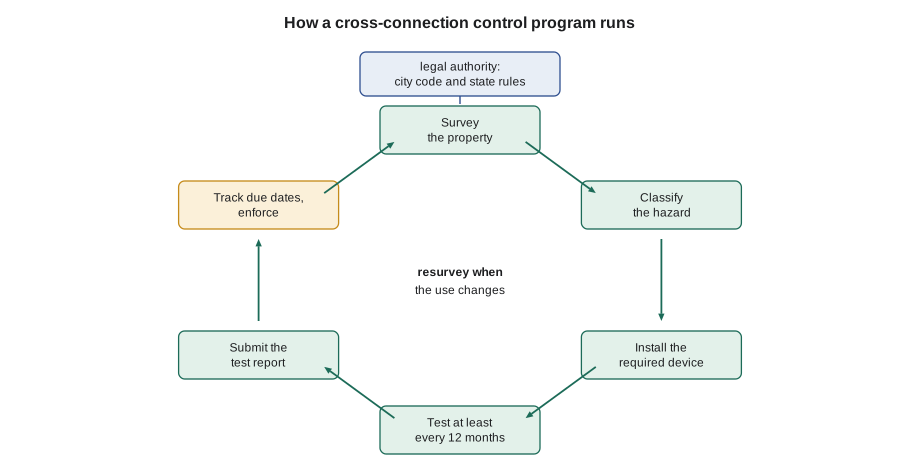
A cross-connection control program is the set of rules, procedures and records a water supplier uses to protect its distribution system from backflow. It is the reason containment devices exist. The plumbing code protects the people inside a building; the utility's program protects everyone on the public system. A typical program has five parts: legal authority, which lets the utility require devices and enter premises to inspect them; a survey process, which identifies which properties need protection and at what level; device requirements, which set the type of device for each hazard; a testing and reporting system, which tracks every device and its annual test; and enforcement, which deals with properties that do not comply.
In Ohio, public water systems must operate a backflow prevention and cross-connection control program under the state's drinking water rules, which require containment at premises with hazards and annual testing of the assemblies. Columbus runs its program through the Division of Water under city code chapter 1113 and its department rules, which require devices to be tested at least every 12 months, failed devices to be repaired within a set time, and test results to be reported to the city. Other Ohio systems follow similar state rules but have their own procedures and forms.
Surveys and hazard classification
A program begins with knowing which customers are a risk. Utilities survey industrial, commercial and institutional properties, often starting with those that are obviously high hazard, such as hospitals, laboratories, plating shops and car washes. A survey may be done by utility staff or by a qualified person hired by the owner, and the result is a hazard classification that sets the containment device. Properties are resurveyed when their use changes, when a building permit shows new equipment, or on a cycle set by the program. A restaurant that becomes a dental office, or a warehouse that adds a chemical process, needs a new look.
The survey cycle matters because buildings change. Kingsway Tower's first survey, done when the building was designed, classified it based on residential floors and a few retail units. When the clinic, the café and the rooftop cooling equipment were added, the hazard rose, and the utility required a reduced pressure assembly at the service entrance instead of a double check.
Who may test
Only certified testers may test backflow prevention assemblies for a program. In Ohio, testers must hold a state backflow prevention certification, which requires a training course and examination and must be renewed on a set cycle. Columbus also requires testers to be on its approved list, which means registering with the city and showing current certification and gauge accuracy records. Many testers also hold a professional qualification under ASSE's 5000 series standards, which some utilities accept or require.
A certified tester is personally accountable for every report they sign. Grace explained to Maya that she would not sign a report for a test she had not seen, and that an apprentice may help with a test but the certified tester must perform or directly supervise it and sign the form.
The test report
The test report is the core record of the program. Utilities usually provide their own form or online submission system, and most reports include the same information.
| Section | What is recorded |
|---|---|
| Property | Address, owner or manager, contact details, account number |
| Device | Type, make, model, size, serial number, location, hazard served, containment or isolation |
| Initial test | Readings for each check and relief valve or air inlet, pass or fail |
| Repairs | What was found, what was replaced, parts used |
| Final test | Readings after repair, pass or fail |
| Tester | Name, certification number, gauge serial number and accuracy verification date, signature, date |
Reports must be accurate and submitted on time, usually within a set number of days of the test. A report that is incomplete, such as one missing a gauge verification date, may be rejected and the test may have to be repeated. Owners should keep their own copies, and contractors should too. A good binder or electronic file on site lets the next tester see the history of each device, which helps diagnose recurring problems.
Scheduling and tracking
Every device has a due date, usually 12 months from its last passing test. Utilities send reminders, but the owner is responsible for having the test done. Large buildings with many devices often schedule all their tests at once to save on call-out costs and make tracking simpler. A tracking spreadsheet or database lists each device, its location, type, last test date and next due date.
Worked problem
Building Kingsway's schedule
Kingsway Tower has the following devices with their last passing test dates: service entrance RP, 14 March; fire service DCDA, 2 April; boiler fill RP, 20 May; café DC, 6 June. Which devices are due by 30 April next year, and what is a sensible plan?
Show solution
- Add 12 months to each date: RP due 14 March, DCDA due 2 April, boiler RP due 20 May, café DC due 6 June next year.
- By 30 April, the service RP and fire DCDA are due.
- A sensible plan is to test all four in early March, which brings the boiler and café devices forward and aligns every device to one annual date. Testing early is allowed; testing late is not.
Answer: The service RP and fire DCDA are due by 30 April. Raj chose to align all four devices to a March test date so the building has one annual test visit.
# Annual test scheduler: due dates and a combined test date
from datetime import date

devices = {
    "service RP": date(2026, 3, 14),
    "fire DCDA": date(2026, 4, 2),
    "boiler fill RP": date(2026, 5, 20),
    "cafe DC": date(2026, 6, 6),
}

def due(last):
    return last.replace(year=last.year + 1)

cutoff = date(2027, 4, 30)
for name, last in devices.items():
    d = due(last)
    flag = "DUE by cutoff" if d <= cutoff else ""
    print(f"{name:15s} last {last}  due {d}  {flag}")

combined = min(due(d) for d in devices.values())
print("combined test date (earliest due):", combined)service RP last 2026-03-14 due 2027-03-14 DUE by cutoff fire DCDA last 2026-04-02 due 2027-04-02 DUE by cutoff boiler fill RP last 2026-05-20 due 2027-05-20 cafe DC last 2026-06-06 due 2027-06-06 combined test date (earliest due): 2027-03-14
A scheduler like this is the simplest version of the systems utilities and building managers use. Testing all devices on the earliest due date keeps every device in compliance and makes one visit cover the whole building.
Enforcement
When an owner does not install a required device, does not test it on time, or does not repair a failed device, the utility follows a series of steps. It usually sends a notice with a deadline, then a final notice, and if the owner still does not comply, it may charge fees or terminate the water service until the problem is fixed. Columbus's rules allow termination of service for non-compliance, and state rules require water systems to take action. Shutting off water is a serious step, especially for residential buildings, so utilities use it only after other steps fail, but the authority exists because an unprotected cross-connection is a risk to the whole system.
Plumbers are part of enforcement in a practical way. When you find an unprotected cross-connection on a job, you tell the owner, explain the risk, and offer to correct it. If the building's containment device is missing or failed, the owner must deal with it, and in many programs the plumber or tester must report a failed device to the utility.
Bringing Kingsway Tower together
Looking back over the job, Maya could trace each lesson in the building. The hydraulics of backsiphonage and backpressure explained why the rooftop booster pumps and boiler needed protection. The survey found the cross-connections: the hose bibbs, the chemical feeder on the cooling tower, the dental suction, the café's carbonator and dish machine. The hazard classification set the level of protection: the highest hazards at the clinic and the boiler, lower ones at the café. The device selection matched each hazard: air gaps at the cooling tower makeup, RPs at the boiler and clinic, a double check at the café, vacuum breakers on hose bibbs and irrigation. The installation rules put each RP above the floor with drains sized for its relief flow. The tests proved that each device worked. The records made sure the utility knew.
| Location | Hazard | Protection |
|---|---|---|
| Service entrance | High (health hazard: clinic and boiler) | Reduced pressure assembly |
| Fire service | Low (non-health: fire line without additives) | Double check detector assembly |
| Boiler fill | High (treatment chemicals) | Reduced pressure assembly |
| Cooling tower makeup | High | Air gap |
| Dental clinic | High | Reduced pressure assembly at the clinic branch |
| Café | Low (non-health) | Double check assembly, with dedicated device on carbonator |
| Hose bibbs and irrigation | Varies | Hose connection and pressure vacuum breakers |
Raj closed the binder. "Next year someone else will test these," he said. "If the reports are good, they'll know exactly what they're looking at."
Electronic records and data quality
Many utilities now take test reports through an online system rather than paper forms. The tester logs in, selects the device from a list, enters readings and repair details, and submits the report. Online systems reduce errors because they check that every field is filled in and that readings are within possible ranges, and they let the utility see at once which devices are overdue. They also let owners see their own devices' history.
Data quality still depends on the people entering it. A serial number typed wrongly creates a new device in the system and leaves the real one looking overdue. A device that is replaced but not updated in the system shows the old model's history. Testers should check the device details against the nameplate at every test and correct the record if needed. At Kingsway Tower, Raj had Maya photograph each nameplate and attach the photo to the record, so that the next tester would see exactly what was installed.
Owners benefit from keeping their own register as well. A simple list of devices, their locations, types and due dates, kept with the building's maintenance records, lets a property manager book tests before reminders arrive and helps a new manager understand the building quickly. For a large building with many devices, it can save a lot of time and money.
Good records also help when something goes wrong. If a contamination incident is reported in an area, the utility can quickly see which properties have current protection, which devices failed recently, and which have overdue tests. That information guides the investigation and can show where the contamination came from.
For Maya, the records were the last lesson of the job and the one she least expected to matter. By the time she left the site, she understood that the binder on the office table was as much a part of the protection as the brass and rubber in the mechanical room. A device that works but has no record cannot be trusted by the utility, and a record that is wrong can hide a device that has stopped working. Both halves have to be right for the water to be safe, and the plumber who installs and tests the devices is responsible for both.
Common mistakes
MistakeTreating the test report as a formality.
InsteadThe report is what the utility relies on; it must be complete, accurate and on time.
MistakeLetting an apprentice sign a test report.
InsteadOnly the certified tester who performed or supervised the test may sign.
MistakeTesting late and assuming a grace period.
InsteadDue dates are firm; test early to align devices if needed.
MistakeForgetting to resurvey after a change of use.
InsteadA new tenant or process can raise the hazard and the required device.
Summary and key terms
- A cross-connection control program combines legal authority, surveys, device rules, testing and enforcement.
- Surveys set hazard classifications and are repeated when a building's use changes.
- Only certified, registered testers with verified gauges may test and sign reports.
- Test reports record the property, device, readings, repairs and tester details, and must be submitted on time.
- Devices are tested at least every 12 months; aligning due dates simplifies tracking.
- Utilities enforce programs with notices, fees and, as a last step, shutting off the service.
- Cross-connection control program
- A water supplier's system of rules, surveys, device requirements, testing and enforcement.
- Certified tester
- A person qualified and registered to test backflow assemblies and sign reports.
- Survey cycle
- The interval at which properties are reassessed for cross-connection hazards.
- Due date
- The date by which a device's next test must be done, usually 12 months after the last one.
- Termination of service
- Shutting off a property's water supply for failing to comply with program requirements.
Practice problems
Work each problem on paper first, then reveal the answer to check.
Name the five parts of a cross-connection control program.
Show answer
Legal authority, surveys, device requirements, testing and reporting, and enforcement.
When should a property be resurveyed?
Show answer
When its use changes, when new equipment is added, or on the program's cycle.
A device last passed on 10 September. When is it due?
Show answer
By 10 September the following year.
Who signs a test report?
Show answer
The certified tester who performed or directly supervised the test.
What may a utility do if a failed device is not repaired?
Show answer
Send notices, charge fees or fines, and ultimately shut off the service.
Lesson quiz · 5 questions
Score 60% or more to complete this lesson.
Create a free account to save your progress, take quizzes and earn a certificate.