
PLB-320 · Lesson 11 of 12 · 20 min
Field testing backflow prevention assemblies
Maya's first full test was on the boiler fill RP, under the eye of Grace Lin, who holds a state backflow inspector certification and tests dozens of assemblies a month. Grace set her test kit on a clean rag, checked the calibration sticker, and talked the whole time. "Testing is a conversation with the device," she said. "You close a valve, you open a valve, and you watch what the needle tells you. Every step answers one question. Is the relief valve opening at the right point? Is the second check tight? Does the first check hold enough difference? If you rush, you'll get numbers. If you watch, you'll get answers." This lesson describes how testable assemblies are field tested: the equipment, the general sequence for each device type, typical acceptance values, and what to do when a device fails.
Why and when assemblies are tested
A testable assembly is tested to prove that its checks and relief valve still meet their performance requirements. Testing is required when the assembly is installed, every year after that, after any repair, after it is moved or reinstalled, and whenever the utility asks. Some utilities require more frequent testing for the highest hazards. A test is not a quick look; it is a measured verification of each component with a calibrated instrument, recorded on a standard form.
The procedure must be the one the tester is certified for. In the United States, widely used methods include those in the University of Southern California's Manual of Cross-Connection Control and those taught under ASSE's 5000 series professional qualification standards; Ohio and many utilities specify which methods they accept. The descriptions below are general and paraphrased; they show the logic of each test, not every step.
The test kit
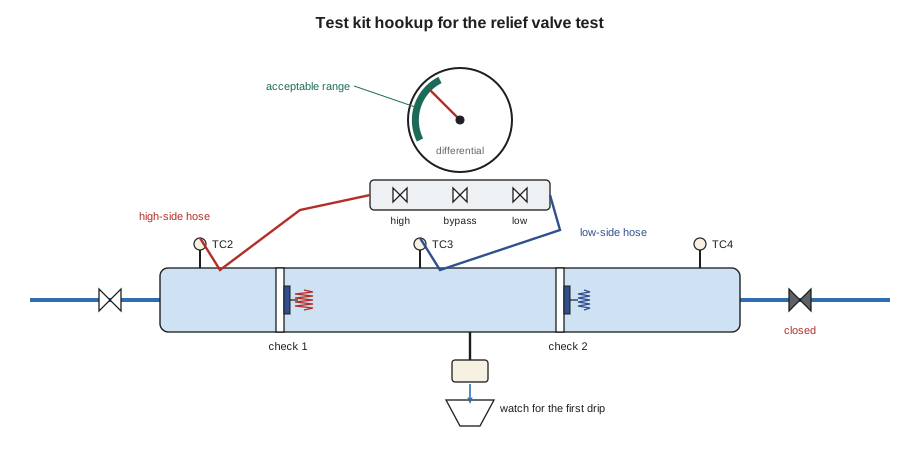
A backflow test kit is a differential pressure gauge with hoses and a manifold of small valves. Differential means it reads the difference between two pressures, high side and low side, rather than pressure above atmosphere. Most kits read from 0 to about 15 psid, with fine divisions near the low end where acceptance values lie. Kits come with three or five valves on the manifold: a high-side valve, a low-side valve and a bypass valve on the basic kit, with extra valves on five-valve kits for faster or alternative procedures.
The kit must be accurate. Most utilities and certifying bodies require the gauge to be checked for accuracy against a reference at least once a year, with the calibration record kept and often submitted with test reports. A gauge that has been dropped or frozen must be rechecked before use. Grace's kit carries a sticker showing its last calibration date, and she will not test with it if the date has passed.
Before the test
Preparation prevents bad results and damaged property. Get permission from the owner or operator, because closing the outlet shutoff stops water to everything downstream. On a fire line, notify the fire alarm monitoring company and follow the fire protection rules for impairments. Look at the device: note its make, model, size and serial number, and check that it is installed correctly. Flush each test cock briefly to clear debris that could get into the gauge. Bleed air from the hoses so the readings are not affected. Confirm that the outlet shutoff valve closes tightly; a leaking shutoff makes accurate check testing impossible and must be noted and repaired.
Testing a reduced pressure principle assembly
The RP test has three main parts, and their order matters.
Relief valve opening point. With the outlet shutoff closed and the gauge's high side on the upstream side of the first check and low side on the zone, the tester slowly reduces the pressure difference by bleeding the high side toward the low side through the kit. The relief valve must begin to discharge before the difference falls to a minimum value. A typical acceptance value is that the relief valve opens with at least 2.0 psid still remaining. The reading at the moment the first drip appears is recorded as the opening point.
- Second check tightness against backpressure. The tester uses the kit to apply upstream pressure on the downstream side of the second check, simulating backpressure, and watches whether the zone pressure rises. If the second check leaks, water passes into the zone and the relief valve opens. A tight second check holds, and the gauge stays steady.
First check pressure difference. With the outlet shutoff still closed and flow stopped, the gauge reads the pressure difference across the first check. It must be comfortably higher than the relief valve's opening point, so that normal fluctuations do not make the device spit. Widely used methods require at least about 5.0 psid across the first check and at least about 3.0 psid more than the measured relief opening point.
The tester then reopens the outlet valve, removes the kit, closes the test cocks and returns the device to service, checking for leaks.
Testing a double check valve assembly
A double check test checks each check in turn. With the outlet shutoff closed, the tester measures the pressure difference across the first check, between test cocks 2 and 3, and then across the second check, between test cocks 3 and 4, using the kit to create a backward pressure condition and watching whether each check holds. A typical acceptance value is that each check holds tight with at least 1.0 psid. Because a double check has no relief valve, a leaking check shows up only as a falling or unstable reading, and the tester must interpret the gauge carefully.
Testing pressure and spill-resistant vacuum breakers
A pressure vacuum breaker test has two parts. For the air inlet, the tester closes the shutoffs, connects the gauge to the test cock on the body, and slowly bleeds pressure until the air inlet opens; it must open at a pressure of at least about 1.0 psi and open fully. For the check, the tester measures the pressure difference across it; it must hold at least about 1.0 psid. Spill-resistant vacuum breakers are tested in a similar way using their single test cock and vent valve.
| Device | What is tested | Typical acceptance value |
|---|---|---|
| Reduced pressure assembly | Relief valve opening point | Opens with at least 2.0 psid difference remaining |
| Reduced pressure assembly | Second check | Tight against backpressure |
| Reduced pressure assembly | First check | At least 5.0 psid, and at least 3.0 psid above relief opening |
| Double check assembly | Each check | Holds at least 1.0 psid |
| Pressure or spill-resistant vacuum breaker | Air inlet | Opens at no less than 1.0 psi and opens fully |
| Pressure or spill-resistant vacuum breaker | Check | Holds at least 1.0 psid |
Worked problem
Reading Maya's first test
Maya recorded these readings on the boiler fill RP: relief valve opened at 2.8 psid, second check held steady under backpressure, first check held 7.5 psid. Does the device pass?
Show solution
- Relief valve: 2.8 psid is more than the 2.0 psid minimum. Pass.
- Second check: tight. Pass.
- First check: 7.5 psid is more than 5.0 psid, and 7.5 − 2.8 = 4.7 psid is more than the 3.0 psid margin. Pass.
Answer: The device passes. Grace had Maya record each reading on the form, along with the gauge serial number and calibration date, before signing it herself as the certified tester.
# Pass/fail check of field test readings against typical acceptance values (psid)
def rp_result(relief, check2_tight, check1):
    fails = []
    if relief < 2.0: fails.append("relief valve opens too late")
    if not check2_tight: fails.append("second check leaks")
    if check1 < 5.0 or check1 - relief < 3.0: fails.append("first check difference too low")
    return "PASS" if not fails else "FAIL: " + "; ".join(fails)

def dc_result(check1, check2):
    fails = [f"check {i} below 1.0 psid" for i, c in ((1, check1), (2, check2)) if c < 1.0]
    return "PASS" if not fails else "FAIL: " + "; ".join(fails)

print("boiler fill RP :", rp_result(2.8, True, 7.5))
print("chilled RP     :", rp_result(1.7, True, 7.0))
print("dental RP      :", rp_result(2.9, False, 5.5))
print("fire DCDA      :", dc_result(1.3, 0.6))
print("cafe DC :", dc_result(1.5, 1.2))boiler fill RP : PASS chilled RP : FAIL: relief valve opens too late dental RP : FAIL: second check leaks; first check difference too low fire DCDA : FAIL: check 2 below 1.0 psid cafe DC : PASS
A checker like this mirrors the logic on the test form, but the real decision is the tester's. Gauges must be read correctly, procedures followed in order, and doubtful readings repeated.
When a device fails
A failed test is not unusual, and it is the reason testing exists. The tester records the readings that failed and the likely cause, then, if qualified and authorized by the owner, repairs the device or arranges a repair. Typical repairs include cleaning debris from a check seat, replacing check discs, springs, seat rings and O-rings with the manufacturer's repair kit, or cleaning and rebuilding the relief valve. Shutoff valves that do not seal may need replacing, which can require shutting down the service.
After any repair, the device must be retested and pass before it returns to service. The report records the original failed readings, the repair made and the parts used, and the passing retest readings. Utilities set deadlines for repairs, often a few weeks, and can shut off water to a property that does not repair a failed device. If a device cannot be repaired, it is replaced with an approved model, and the new device is tested.
Testers must never adjust a device to make it pass without fixing the cause, and must never report readings they did not observe. Falsified test reports are treated very seriously by utilities and certifying bodies, because a utility relies on the report to decide whether the public is protected.
Common test errors
Most failed tests reflect real problems, but some come from the test itself. Air trapped in the gauge hoses makes the needle bounce or drift, and must be bled out before each reading. A gauge that is not held at the same height as the test cock it is connected to can show a small error, which matters when acceptance values are only a few kilopascals. Fluctuating supply pressure, caused by other users in the building or the street, makes readings unstable; testing at a quiet time, or waiting for a steady reading, helps. A test cock with debris can give a false reading or damage the gauge.
Grace's habit was to repeat any reading that looked doubtful before deciding on a result. If the repeat agreed, she trusted it. If it differed, she looked for air, debris or a leaking shutoff before blaming the device. "A false failure costs the owner a repair they didn't need," she said. "A false pass costs everyone the protection they paid for. Both are mistakes."
Testers should also look beyond the gauge. A device that passes its test but is installed in a pit, below the downstream piping, or with no drain for its relief discharge is not providing proper protection, and the report should say so. Most report forms have a space for comments on installation, and a good tester uses it.
Finally, a test is a chance to teach the owner. Explaining what was tested, what the readings mean and why the device matters helps the owner understand why the annual test is worth paying for.
Common mistakes
MistakeTesting with a gauge whose calibration has expired.
InsteadCheck the calibration record before every test; recheck after drops or freezing.
MistakeSkipping the check of the outlet shutoff valve.
InsteadA leaking shutoff makes check readings meaningless; note it and repair it.
MistakeTesting the first check of an RP before the relief valve.
InsteadFollow the method's order; each step sets up the next.
MistakeReturning a repaired device to service without retesting.
InsteadEvery repair needs a passing retest and a report.
Summary and key terms
- Testable assemblies are tested at installation, every year, after repair or relocation, and when the utility requires.
- A differential pressure test kit reads the difference between two pressures and must be calibrated regularly.
- An RP test checks the relief valve opening point, the second check against backpressure, and the first check difference.
- A double check test checks that each check holds a minimum difference.
- Pressure and spill-resistant vacuum breaker tests check the air inlet opening and the check.
- Failed devices are repaired with the maker's parts and retested; reports must record exactly what was found and done.
- Differential pressure gauge
- An instrument that reads the difference between two pressures, used to test backflow assemblies.
- Relief valve opening point
- The pressure difference across the first check at which an RP's relief valve starts to discharge.
- Test report
- The form recording a device's identity, test readings, repairs and the tester's certification.
- Repair kit
- The manufacturer's set of replacement parts for a specific assembly model.
- Impairment
- A period when a fire protection system is out of service, which must be managed under fire protection rules.
Practice problems
Work each problem on paper first, then reveal the answer to check.
Why must the outlet shutoff close tightly before testing checks?
Show answer
A leak past it would make the check readings unreliable.
An RP's relief valve opened at 1.6 psid. Pass or fail?
Show answer
Fail; it must open with at least 2.0 psid remaining.
An RP's relief opened at 2.4 psid and its first check held 4.8 psid. Pass or fail?
Show answer
Fail; 4.8 is below 5.0 psid and only 2.4 psid above the relief opening.
A double check's checks held 1.8 and 0.7 psid. Pass or fail?
Show answer
Fail; the second check is below 1.0 psid.
What must happen after a repair?
Show answer
The device must be retested and pass, and the report must record the repair.
Lesson quiz · 5 questions
Score 60% or more to complete this lesson.
Create a free account to save your progress, take quizzes and earn a certificate.