
PLB-230 · Lesson 4 of 12 · 22 min
Gas piping materials: steel, CSST, copper and polyethylene
The Kingsway gas main is black steel pipe, threaded in the smaller sizes and welded in the large riser. The café's branch lines are threaded steel, the connection to the café's movable fryer is a listed flexible connector with a quick-disconnect, and the gas line to an outdoor barbecue on the amenity terrace is corrugated stainless steel tubing run through the terrace ceiling. Underground, a polyethylene line feeds a gas lamp at the lane entrance. Four materials on one job, each chosen for a reason. Dana handed Maya a short offcut of each and asked her to say where it was allowed and where it was not.
This lesson covers the piping materials permitted for fuel gas, their joining methods, where each may and may not be used, and the protection each needs. Every material must be approved by the code and, for most products, certified or listed to a recognized standard; the fitter checks the marking before installing anything.
Steel pipe and fittings
Steel pipe is the traditional gas piping material and remains the standard for commercial and large installations. Gas piping is usually black steel, Schedule 40, made to ASTM A53 or an equivalent standard, joined by threads in smaller sizes and by welding in larger sizes or where the design calls for it. Threaded fittings are malleable iron or steel. Galvanized pipe is permitted for gas by some codes and discouraged by some utilities and engineers, because flakes of zinc coating can break loose and plug regulators and orifices; on Kingsway the specification calls for black steel throughout.
Threaded joints are only as good as their threads. Pipe threads for gas are tapered pipe threads, cut cleanly with sharp dies to the right length, reamed on the inside to remove the burr, and sealed with a thread compound or tape listed for use with fuel gas, applied to the male threads only so that sealant does not enter the pipe. Thread compound is never applied to flare fittings or to joints designed to seal metal to metal. A joint that leaks is taken apart and remade; tightening it until it stops bubbling or adding sealant from the outside is not a repair.
Welded steel gas piping is done by certified welders to a qualified procedure, and in many places the welds must be inspected. Press fittings for steel pipe, which use a tool to compress an elastomer seal and a steel grip ring onto the pipe, are available for gas when listed for that use. They save time in retrofit work but must be installed exactly as the manufacturer requires, with the right tool and jaws, the pipe cut square and deburred, and the insertion depth marked.
Steel pipe exposed to weather or to a corrosive environment needs protection, usually paint for outdoor piping above ground, and a factory coating, wrapping and often cathodic protection for buried steel. Many fitters and engineers avoid burying steel at all, using polyethylene outdoors underground instead.
Corrugated stainless steel tubing
Corrugated stainless steel tubing, CSST, is a flexible stainless steel tube with corrugations along its length and a plastic jacket over the outside, joined with mechanical fittings made by the same manufacturer. It comes on reels and can be pulled through walls and joists like electrical cable, with far fewer joints than rigid pipe, which makes it popular in houses and small buildings. CSST systems are certified or listed as a complete system, including the tubing, fittings, striker plates and manifolds. Each manufacturer's fittings fit only its own tubing, and mixing brands is not allowed.
CSST must be installed by people trained on the manufacturer's system; manufacturers issue training cards, and the fuel gas code requires the installer to follow the listed instructions in full. The tubing must be protected where it passes through framing near a surface, using hardened striker plates to stop nails and screws, and it must be supported at the intervals the instructions give. It is not run where it can be damaged, and the jacket is not stripped back further than the fitting requires.
The most important CSST rule concerns lightning. A nearby lightning strike can energize building systems, and an arc between CSST and another metal object can burn a hole in the thin tubing wall, causing a gas leak and fire. The IFGC and the residential code require CSST that is not listed with an arc-resistant jacket to be bonded to the building's electrical grounding electrode system with a copper conductor no smaller than 6 AWG, connected to a metal pipe or fitting, not to the corrugated tubing, with the bonding conductor no longer than 75 feet. Arc-resistant products listed for the purpose are treated differently, but the manufacturer's instructions still govern. On Kingsway, the terrace barbecue line is bonded by the electrician at the steel piping where it begins.
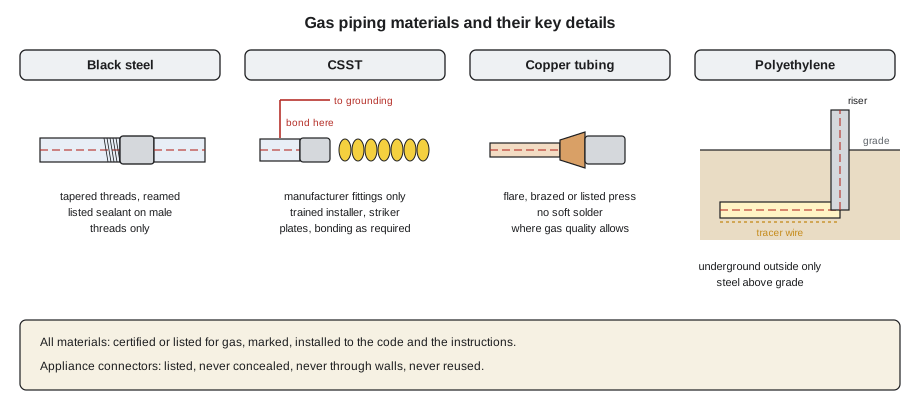
Copper tubing
Copper tubing is permitted for natural gas and propane in many places, joined with flare fittings or, for some products, brazed joints or listed press fittings, but not with soft solder. It is restricted by gas quality: sulfur compounds in gas, especially hydrogen sulfide, attack copper and produce flakes that can block orifices and valves, so the codes allow copper only when the gas meets a low limit for hydrogen sulfide. Some utilities do not permit copper on their systems at all. Before using copper, the fitter checks the code, the utility and the local inspector.
Copper used for gas must be of a type and wall thickness the code permits, and it must be identified where required so that it cannot be confused with water piping. Flare joints are made with a proper flaring tool, the flare inspected for cracks and even shape, and the flare nut tightened without sealant. Copper is soft and must be protected from damage and supported more closely than steel.
Polyethylene and other plastics
Polyethylene, PE, pipe is the standard material for gas distribution mains and services, and it is used for customer piping buried outdoors. It does not corrode, it is flexible and it is joined by heat fusion or by mechanical fittings listed for gas. Polyethylene is permitted only underground outside the building. It must not be installed inside buildings or above ground, because it softens in a fire and degrades in sunlight.
Buried plastic gas pipe must be laid at the depth the code requires, typically at least 12 inches for customer piping in many codes, on clean bedding, away from sharp stones, and with a tracer wire or tape so that it can be located later, because plastic cannot be found with a metal detector. Where the plastic line comes up to a building or an appliance, a transition fitting or an anodeless riser brings the gas above ground in a metal casing, and the steel piping takes over above grade. Plastic pipe is never brought into a building through a foundation wall below grade.
Before anyone digs, whether for a new gas line or a fence post, the underground utilities must be located by the local one-call service. A fitter installing customer-owned buried gas lines should record them on drawings, because the utility locates only its own service, not the customer's piping beyond the meter.
Appliance connectors and prohibited materials
Movable appliances such as ranges, dryers and commercial cooking equipment on casters connect to the rigid piping through a listed appliance connector: a flexible metal connector of the right size and length, with an accessible shutoff valve ahead of it. Commercial cooking equipment on casters uses a heavy-duty connector, often with a quick-disconnect device, and a restraining cable so that the appliance cannot be pulled far enough to strain the connector. Connectors must not pass through walls, floors or ceilings, must not be concealed, and must not be reused after they are disconnected from one appliance and moved to another, because the corrugations work-harden.
Some materials are never used for gas. Cast iron pipe, plastic pipe inside buildings, aluminum tubing in many locations, non-listed flexible hoses, plumbing fittings not rated for gas, and sealants not listed for gas are all prohibited or restricted. Garden-variety rubber hose has no place on a fixed gas appliance. Old installations sometimes contain unlisted brass connectors from decades ago, which can crack at the flare; when a fitter finds one, it is replaced.
Gas piping in commercial and industrial buildings is identified, usually by painting it yellow or by labels at regular intervals, so that it cannot be mistaken for other services. On Kingsway, the specification calls for yellow labels with flow arrows at regular intervals and at every wall penetration, which also helps the next trade when they are about to drill.
| Material | Typical joining | Where permitted | Key precautions |
|---|---|---|---|
| Black steel, Schedule 40 | Threads, welding, listed press | Inside and outside, above ground | Gas-rated sealant on male threads; protect outdoor and buried steel |
| CSST | Manufacturer fittings only | Inside buildings and as listed | Trained installer, striker plates, bonding per code and instructions |
| Copper tubing | Flare, brazed, listed press | Where gas quality and utility permit | No soft solder; protect and support closely |
| Polyethylene | Heat fusion, listed mechanical | Underground outside only | Tracer wire, riser to steel above grade, never indoors |
| Appliance connector | Listed fittings | Between shutoff valve and movable appliance | No concealment, no wall penetration, no reuse |
# Inside diameters of Schedule 40 steel pipe and the flow area each offers
ids_in = {"1/2": 0.622, "3/4": 0.824, "1": 1.049, "1-1/4": 1.380, "1-1/2": 1.610, "2": 2.067}
import math
base = math.pi * ids_in["1/2"] ** 2 / 4
for size, d in ids_in.items():
    area = math.pi * d ** 2 / 4
print(f'{size:6s} ID {d:.3f} in ({d * 25.4:5.1f} mm) area {area:5.3f} sq in x{area / base:4.1f} of 1/2"')1/2 ID 0.622 in ( 15.8 mm) area 0.304 sq in x 1.0 of 1/2" 3/4 ID 0.824 in ( 20.9 mm) area 0.533 sq in x 1.8 of 1/2" 1 ID 1.049 in ( 26.6 mm) area 0.864 sq in x 2.8 of 1/2" 1-1/4 ID 1.380 in ( 35.1 mm) area 1.496 sq in x 4.9 of 1/2" 1-1/2 ID 1.610 in ( 40.9 mm) area 2.036 sq in x 6.7 of 1/2" 2 ID 2.067 in ( 52.5 mm) area 3.356 sq in x11.0 of 1/2"
The script shows why a size step matters so much: each nominal size up gives roughly 60 to 80 percent more flow area, and because friction falls as the pipe gets larger, the gas capacity rises even faster than the area. Lesson 5 turns that into pipe sizing.
Worked problem
Choosing materials for the terrace line
The amenity terrace needs a gas outlet for a barbecue, 60 feet from the nearest steel branch, through a finished ceiling and an exterior wall to the outlet. Which material should Maya and Dana use, and what details must be included?
Show solution
- Threaded steel through a finished ceiling would mean many joints in a concealed space; CSST makes one continuous run with fittings only at the ends.
- Use a CSST system listed for the purpose, installed by a trained installer following the manufacturer's instructions.
- Protect the tubing with striker plates where it passes near framing surfaces, support it as the instructions require, and keep the jacket intact.
- Bond the system as the code and instructions require, coordinating with the electrician.
- Terminate outdoors at a listed outlet with an accessible shutoff valve, and connect the barbecue with a listed outdoor connector.
Answer: CSST is the practical choice, provided it is installed, protected and bonded exactly as listed.
Choosing the material
The choice of material depends on the building, the code, the utility and the installer's skills. Steel is durable, fire-resistant and familiar to every inspector, but it is heavy and slow to install in finished spaces. CSST is fast and has few concealed joints, but needs trained installers, bonding and protection. Copper is light and easy to bend, but is not accepted everywhere. Polyethylene is the right answer underground and the wrong answer anywhere else. On many jobs, the answer is a combination: steel for the main and for exposed work, CSST for runs through finished walls, and polyethylene for buried lines to outbuildings, each joined at a listed transition.
Whatever the choice, the fitter checks the markings on each length and fitting before installing it: the material standard, the certification or listing mark, the pressure rating where it applies, and, for CSST, the manufacturer's name so that only matching fittings are used. Materials without markings are set aside, not installed, and returned to the supplier.
Common mistakes
MistakeApplying thread sealant to the female threads.
InsteadApply listed sealant to male threads only, keeping it out of the pipe.
MistakeMixing fittings from different CSST manufacturers.
InsteadUse only the fittings listed for that manufacturer's tubing.
MistakeLeaving CSST unbonded.
InsteadBond as the code and instructions require.
MistakeRunning polyethylene inside a building or above ground.
InsteadUse PE only underground outside, with a riser to steel above grade.
MistakeReusing an old appliance connector on a new range.
InsteadInstall a new listed connector of the right size and length.
Summary and key terms
- Black steel Schedule 40, threaded or welded, is the standard gas piping material.
- Thread sealant must be listed for gas and applied to male threads only.
- CSST is installed only by trained installers, with the manufacturer's own fittings, striker plates and bonding.
- Non-arc-resistant CSST is bonded with at least 6 AWG copper, no longer than 75 feet, to a metal pipe or fitting.
- Copper is limited by gas quality and utility rules and is never soft-soldered.
- Polyethylene is used only underground outside, with a tracer wire and a riser to steel.
- Movable appliances use listed connectors that are never concealed, passed through walls or reused.
- Schedule 40
- The standard wall thickness of steel pipe used for gas.
- CSST
- Corrugated stainless steel tubing, a flexible jacketed gas piping system.
- Bonding
- Connecting metal systems to the electrical grounding system to equalize voltage.
- Striker plate
- A hardened plate that protects concealed tubing from nails and screws.
- Tracer wire
- A wire laid with buried plastic pipe so that it can be located.
- Anodeless riser
- A factory riser that brings buried plastic gas pipe above ground in a metal casing.
Practice problems
Work each problem on paper first, then reveal the answer to check.
Where is polyethylene gas pipe permitted?
Show answer
Underground outside buildings only.
Why is soft solder not used on copper gas lines?
Show answer
It is not permitted for gas; flare, brazed or listed press joints are used.
Why is CSST bonded?
Show answer
To reduce the risk of lightning arcs burning through the tubing.
Where is thread sealant applied?
Show answer
To the male threads only.
May an appliance connector pass through a wall?
Show answer
No.
What limits the use of copper for gas?
Show answer
Sulfur compounds in the gas and utility rules.
Lesson quiz · 5 questions
Score 60% or more to complete this lesson.
Create a free account to save your progress, take quizzes and earn a certificate.