
PLB-230 · Lesson 3 of 12 · 21 min
Gas supply: meters, regulators and delivery pressures
The gas service for Kingsway Tower enters the building through the foundation wall into a ventilated meter room at grade on the lane side. Two meters sit side by side on a steel rack: the house meter, which supplies the mechanical room and the roof, and a separate meter for the café tenant. Dana walked Maya along the path the gas takes, from the main under the street to the burner of the café range, and named every pressure along the way. "If you understand where the pressure drops and why," she said, "you understand half of gas work. The other half is not letting it leak."
This lesson follows gas from the distribution main to the appliance: the utility's service, the meter, the service regulator, elevated-pressure systems with line regulators, appliance regulators, and the propane equivalent of each. It also covers the pressure units that gas fitters use and how to read them.
Pressure units in gas work
Gas pressures in buildings are low, and fitters measure them in several units. US fuel gas codes and appliance manuals use inches of water column for low pressures and pounds per square inch for higher ones. Inches of water column, written in. w.c., measure the height of a column of water the pressure would support in a manometer; one inch of water column is about 0.036 psi. Pounds per square inch gauge, psig, are used for higher pressures and for pressure tests. One psi is about 27.7 inches of water column, or about 6.9 kilopascals. The gauge pressure is measured relative to the surrounding atmosphere, which is why a reading of zero means atmospheric pressure, not a vacuum.
Low gas pressures are read with a manometer, either a U-tube filled with water or a digital manometer. A digital manometer reads directly in the chosen unit and can record readings for the job file. Higher pressures are read with dial gauges, which must have a range suited to the reading so that the needle sits in the middle part of the scale. Every reading is taken at a test port provided for the purpose: a plugged tee, a pressure tap on a regulator or the inlet and manifold taps on an appliance gas valve.
# Gas pressure conversions
INWC_PER_PSI = 27.7
def show(inwc):
    return f"{inwc:7.1f} in. w.c. = {inwc / INWC_PER_PSI:6.3f} psi = {inwc * 0.2491:6.2f} kPa"
for name, inwc in [("natural gas standard delivery", 7.0),
                   ("natural gas manifold, typical", 3.5),
                   ("propane at appliance, typical", 11.0),
                   ("elevated pressure system (2 psi)", 2 * 27.7),
                   ("pressure test, 15 psi", 15 * 27.7)]:
print(f"{name:36s} {show(inwc)}")natural gas standard delivery 7.0 in. w.c. = 0.253 psi = 1.74 kPa natural gas manifold, typical 3.5 in. w.c. = 0.126 psi = 0.87 kPa propane at appliance, typical 11.0 in. w.c. = 0.397 psi = 2.74 kPa elevated pressure system (2 psi) 55.4 in. w.c. = 2.000 psi = 13.80 kPa pressure test, 15 psi 415.5 in. w.c. = 15.000 psi = 103.50 kPa
From the main to the meter
Natural gas travels across the continent in high-pressure transmission pipelines. At a city gate station, the pressure is reduced and the odorant added, and the gas enters the local distribution system of mains under streets, at pressures that vary by utility and by area from a few kilopascals to several hundred. A service line branches from the main to each building, with a service valve, often a curb valve near the property line or a valve on the riser at the building, that lets the utility shut off the service.
The service line ends at the meter set assembly: the riser, the service shutoff valve, the service regulator, the meter and the outlet piping as far as the customer's connection. The utility designs, installs and maintains it. Meters are of several types. Diaphragm meters, the familiar residential meters with dials or a digital register, measure gas by filling and emptying chambers of known volume. Rotary meters, used for larger commercial loads, use two figure-eight shaped impellers. Turbine and ultrasonic meters handle the largest flows. Many meters now transmit their readings electronically.
Meters must be protected and accessible. The utility and the code require the meter set to be located where it can be read and serviced, where it is protected from vehicles, ice and snow falling from roofs, and away from building openings and sources of ignition. Indoor meter rooms like Kingsway's are ventilated to the outdoors and kept clear of storage. A service regulator vent must discharge outdoors at a location set by the utility and code, kept clear of windows, doors, air intakes and ignition sources, because a failed regulator relieves gas through its vent. Bollards protect meters where vehicles move nearby.
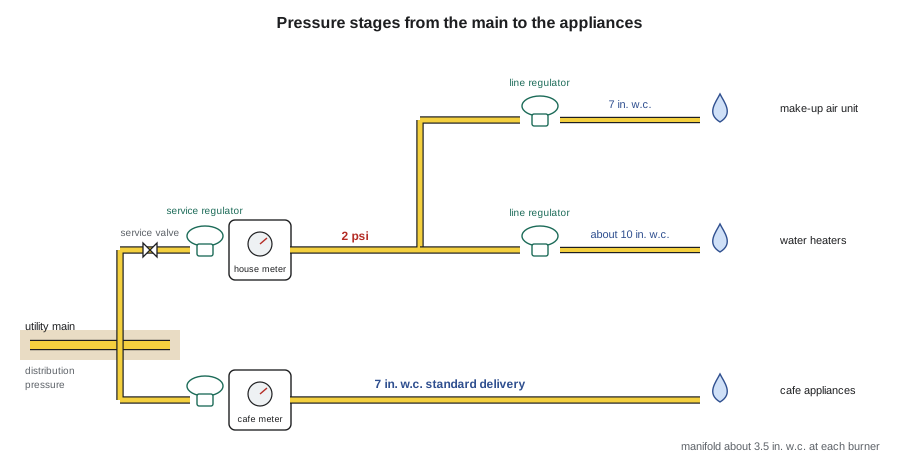
Service regulators and delivery pressure
The service regulator reduces the distribution pressure to the delivery pressure agreed between the utility and the customer. For most houses and small buildings, the standard delivery pressure for natural gas is about 7 inches of water column, roughly a quarter of a psi. Appliances are designed to operate from a supply within a range around this value, and the low-pressure sizing tables in the code assume it. The pressure at the meter outlet is set by the utility and must not be adjusted by the fitter.
Larger buildings and long runs often use an elevated delivery pressure, most commonly 2 psi, with some commercial and industrial services at 5 psi or more. At higher pressure, the same pipe carries much more gas, so smaller piping can serve large loads over long distances. Before the gas reaches appliances designed for low pressure, a line pressure regulator reduces it to the appliance supply pressure. The Kingsway house meter delivers 2 psi to a steel main that rises through a shaft to the roof, with one line regulator for the mechanical room water heaters and another for the rooftop unit. The café meter delivers standard low pressure.
A line regulator in an elevated-pressure system must be certified or listed for the purpose, sized for the load and inlet pressure, installed with a shutoff valve upstream and a test port downstream, and provided with overpressure protection where the code requires it. Its vent must go outdoors unless the regulator has a listed vent-limiting device that allows it to be installed indoors; a vent limiter restricts gas escaping from a ruptured diaphragm to a small, safe flow. Regulators are installed in the orientation the manufacturer specifies and are accessible for service.
Appliance regulators and manifold pressure
Every gas appliance has its own regulator, usually built into the combination gas valve, that reduces the supply pressure to the manifold pressure the burner is designed for. For natural gas appliances, the manifold pressure is commonly about 3.5 inches of water column, and for propane appliances about 10 inches of water column, but the rating plate and the instructions give the exact value for each appliance. Many modern appliances, including the Kingsway condensing water heaters, use a negative-pressure gas valve whose outlet pressure is set relative to the blower and checked with a combustion analyzer rather than a simple manifold reading.
The appliance needs a supply pressure inside a stated range at its inlet: a minimum below which the appliance regulator cannot hold the manifold pressure, and a maximum above which the valve may be damaged. The supply pressure is checked twice: static, with no gas flowing, and dynamic, with the appliance and everything else on the system firing. A large difference between static and dynamic readings shows that the piping or the regulator cannot deliver the flow, which is a sizing problem covered in lesson 5.
| Point | Natural gas, typical | Propane, typical |
|---|---|---|
| Standard delivery at meter outlet | 7 in. w.c. | 11 in. w.c. after second stage |
| Elevated delivery | 2 psi or more | First stage about 10 psi |
| Appliance manifold | about 3.5 in. w.c. | about 10 in. w.c. |
| Pipe sizing drop, low pressure | 0.5 in. w.c. common | per code table |
Propane supply systems
A propane system has no utility main. Liquid propane is stored in a tank or cylinders on the property, owned or leased from a propane supplier, and the vapor above the liquid supplies the building. Tank pressure depends on temperature and can be several hundred kilopascals in summer, so the pressure is reduced in stages. A first-stage regulator at the tank reduces it to about 10 psi, and a second-stage regulator near the building reduces it to about 11 inches of water column for the appliances. Two-stage regulation keeps the appliance pressure steady as the tank pressure changes and limits the consequences if one regulator fails. Some systems use 2 psi between the second stage and line regulators, as natural gas elevated systems do.
Propane tanks and cylinders are covered by NFPA 58 and state rules on location, clearances to buildings and openings, protection and filling. The supplier usually installs the tank and the first-stage regulator; the licensed fitter installs the piping from the second stage. Propane cylinders are never stored indoors, and the clearance between a tank's relief valve and building openings, air intakes and ignition sources is set by the code.
A propane tank's vaporization rate falls as the temperature drops and as the liquid level falls, because the liquid itself supplies the heat to boil. A small tank serving a large load on a very cold day can fail to keep up: the pressure falls, the appliances underfire, and the tank sweats or frosts. Tank size is therefore chosen for the load and the coldest expected weather, which is the supplier's job but a question the fitter should ask when a large appliance is added.
Worked problem
Checking the café supply pressure
Dana connects a digital manometer to the inlet test port of the café range's gas valve. With nothing firing, it reads 7.0 in. w.c.. With the range, fryer and every café appliance firing, it reads 5.9 in. w.c.. The range requires a minimum inlet pressure of 5.0 in. w.c.. Is the supply adequate, and what does the drop show?
Show solution
- Static pressure: 7.0 in. w.c., standard delivery.
- Dynamic pressure: 5.9 in. w.c., a drop of 1.1 in. w.c. under full load.
- The dynamic reading stays above the 5.0 in. w.c. minimum, so the range will operate.
- The drop is larger than the 0.5 in. w.c. usually allowed for sizing, which suggests the café piping is near its capacity or a section is undersized; Dana notes it for the review in lesson 5.
Answer: The supply is adequate today, but the drop shows little reserve for added appliances.
Overpressure protection and meter rooms
A regulator can fail open. A worn seat, debris under the valve or a broken diaphragm can let the full upstream pressure through to piping and appliances designed for much less. On an elevated-pressure system, a failed line regulator could put 2 psi on appliance gas valves rated for a fraction of that. The codes therefore require overpressure protection where a regulator failure could expose downstream equipment to pressures above its rating: a relief valve, a monitoring regulator, or an automatic shutoff device, chosen and sized for the system. Many line regulators include a built-in overpressure protection device, which satisfies the requirement when it is listed for the purpose.
Indoor meter rooms such as Kingsway's are treated as part of the gas system. They are ventilated so that a small leak cannot build up, kept free of storage and ignition sources, lit, and accessible to the utility without passing through a tenant space. The doors are labeled, and the emergency shutoff location is posted. When Maya and Dana worked in the room, they kept the door propped open and the gas detector clipped to Dana's belt.
Common mistakes
MistakeAdjusting the utility's service regulator to raise pressure.
InsteadNever adjust the utility's regulator; call the utility.
MistakeVenting a line regulator indoors without a listed vent limiter.
InsteadPipe the vent outdoors or use a regulator with a listed vent-limiting device.
MistakeChecking only static pressure.
InsteadCheck static and dynamic pressure with the full load firing.
MistakeReading low pressures on a high-range dial gauge.
InsteadUse a manometer or a gauge whose range suits the reading.
MistakeConnecting a low-pressure appliance directly to a 2 psi system.
InsteadInstall a line regulator sized for the load ahead of the appliance.
Summary and key terms
- Gas pressures are read in inches of water column and psig; 1 psi is about 27.7 in. w.c.
- The utility owns the service, meter and service regulator, and sets the delivery pressure.
- Standard natural gas delivery is about 7 in. w.c.; elevated systems often use 2 psi.
- Line regulators reduce elevated pressure for appliances and need outdoor vents or listed vent limiters.
- Appliance regulators set manifold pressure; supply pressure is checked static and dynamic.
- Propane uses two-stage regulation from the tank; vaporization falls in cold weather.
- Delivery pressure
- The pressure the utility supplies at the meter outlet.
- Service regulator
- The utility regulator that reduces distribution pressure to delivery pressure.
- Line regulator
- A regulator in the customer piping that reduces elevated pressure for appliances.
- Vent limiter
- A listed device that restricts gas escaping from a regulator vent so the regulator can be installed indoors.
- Manifold pressure
- The gas pressure at the appliance burner manifold, set by the appliance regulator.
- Dynamic pressure
- Pressure measured while gas is flowing to the connected load.
Practice problems
Work each problem on paper first, then reveal the answer to check.
Convert 2 psi to inches of water column.
Show answer
About 55 in. w.c.
What does a line regulator do?
Show answer
Reduces elevated system pressure to the appliance supply pressure.
Why is supply pressure checked dynamically?
Show answer
To show whether the piping can deliver the flow with the load firing.
Who may adjust the service regulator?
Show answer
Only the utility.
What is the typical propane appliance supply pressure?
Show answer
About 11 in. w.c.
Why does a propane tank struggle in very cold weather?
Show answer
Vaporization falls as the liquid gets colder and its vapor pressure drops.
Lesson quiz · 5 questions
Score 60% or more to complete this lesson.
Create a free account to save your progress, take quizzes and earn a certificate.