
PLB-230 · Lesson 2 of 12 · 21 min
Fuel gas codes, licensing and who may do the work
On her first morning in the gas meter room, Maya reached for a pipe wrench to tighten a union on the test assembly Dana had set up. Dana stopped her. "Not without me. You work under my direct supervision on gas, and the permit for this job is in the contractor's name. If something goes wrong, the inspector will ask who did the work and who was responsible for it. That isn't me being fussy. It's the law, and it exists because people have died from gas work done by someone who thought it looked easy."
Gas work is regulated more tightly than almost any other part of a building. This lesson explains where the rules come from, which documents a gas fitter uses, who may install and service gas piping and appliances, and how permits, inspections and the gas utility fit together. The details differ between provinces, states and cities, so the lesson describes the system on the Kingsway job and the questions to ask anywhere else.
The installation code
In the United States, the technical rules for fuel gas piping, appliances and venting come from one of two model codes. NFPA 54, the National Fuel Gas Code, is published by the National Fire Protection Association and is also issued as ANSI Z223.1; its current edition is 2024. The International Fuel Gas Code, IFGC, is published by the International Code Council and is closely aligned with NFPA 54 in most technical rules; it also has a 2024 edition. Propane storage and handling is covered by NFPA 58, the Liquefied Petroleum Gas Code. States and cities adopt one of these codes, usually a particular edition with local amendments. Ohio's commercial code adopts the 2021 IFGC for fuel gas under the 2024 Ohio Building Code framework, and houses fall under the Residential Code of Ohio, whose fuel gas chapter comes from the International Residential Code.
The adopted code is the law on the job, and the edition matters. A rule that changed between editions applies only once the state or city has adopted the new edition, and a local amendment can replace a section entirely. A fitter working in several jurisdictions needs to know which code and edition each one uses. When a manufacturer's listed installation instructions are more restrictive than the code, the code requires the instructions to be followed too.
Who may do gas work
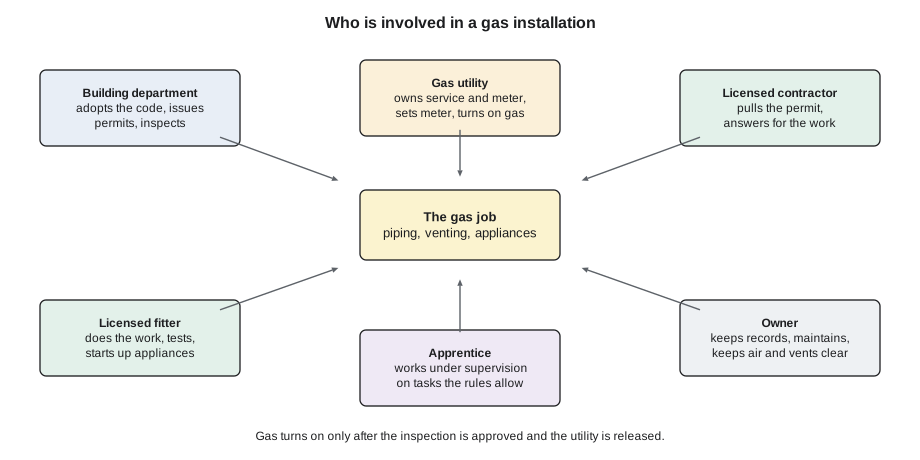
In the United States, licensing for gas work is set by states and cities, and the patterns vary widely. Some states issue separate gas fitter licenses. Others treat gas piping as part of plumbing or of heating and air conditioning work. In Ohio, contractors who do plumbing and heating work for others are licensed by the Ohio Construction Industry Licensing Board, OCILB, and gas piping in buildings is done under permits from the local building department. Cities such as Columbus set their own requirements for the people who do the work, issue the permits and inspect the piping before the utility sets the meter.
Most jurisdictions that license gas work distinguish between the contractor, the business that pulls permits and answers for the work, and the individual who does it. An apprentice works under the supervision of a licensed person, and the licensed person is responsible for what the apprentice does. Many licenses are limited by the type or size of system, by residential or commercial work, or by the scope of the trade. Before Maya does any gas task in a new city, she and her supervisor check what the local rules allow an apprentice to do and under what supervision.
A plumbing license does not automatically authorize gas work, and a heating license does not authorize plumbing. On Kingsway, the gas piping is installed by Northbridge under the contractor's license and the city permit, by licensed staff and apprentices under their supervision, and the start-up of large equipment such as the 750,000 Btu/h rooftop make-up air unit belongs to the manufacturer's start-up technician and Northbridge's service department.
| Role | Typical responsibility | Answers to |
|---|---|---|
| Licensed contractor | Pulls permits, employs licensed workers, answers for the work | State board and local building department |
| Licensed worker | Installs, tests and services within the license scope | The contractor and the license authority |
| Apprentice | Works under supervision on tasks the rules allow | The supervising licensed worker |
| Inspector | Checks the work against the adopted code before approval | The building department |
Permits, inspections and the gas utility
In Columbus and most US cities, gas piping needs a permit before work starts. The building department inspects the rough piping before it is concealed and witnesses or reviews the pressure test, then notifies the gas utility that the system has passed so that the utility can install the meter and turn on gas. Some jurisdictions in Ohio require long tests: one county building department's checklist calls for a 24-hour test at 20 psi above ground and 50 psi below ground, far beyond the code minimum. The permit tells the fitter which requirements apply, and the inspection record follows the building.
The gas utility owns the service line from the main to the meter, the meter and usually the service regulator. Its staff set and seal the meter, and only they may turn on gas at the meter for the first time or after a shutoff for safety reasons. The customer's piping starts at the outlet of the meter. That boundary matters: a gas fitter does not tamper with the utility's meter, regulator or service valve, and the utility does not install or repair the customer's piping.
The utility also responds to emergencies. Every gas fitter keeps the utility's emergency number in their phone, and every customer should have it posted near the meter. When a fitter finds a hazardous condition, such as a leak, a cracked heat exchanger or a vent that spills, the codes and utility procedures require the appliance to be shut off and tagged and the customer warned in writing. In some cases the utility must be notified and will shut off the meter.
Professional responsibility
Gas codes rely on the judgment of trained people more than most codes do. The code cannot list every building, appliance and situation, so it sets objectives and minimum requirements and leaves the technician to apply them. A fitter who is unsure stops and asks. A fitter who finds that an installation cannot be made safe under the code does not make it work anyway; they explain the problem to the customer and the supervisor and decline to activate it.
Gas fitters are also responsible for what they leave behind. The person who last worked on an appliance is often the one questioned after a carbon monoxide incident. Clear records, tags on unsafe appliances, written notices to customers, and test tags on new piping protect the public and the technician. Dana's rule for Maya was simple: if it is not written down, it did not happen.
Finally, gas work changes with technology. Hydrogen blends, new piping materials, high-efficiency equipment, smart controls and electrification are changing what fitters install. Certificates and licenses are renewed, codes are revised, and manufacturers update their instructions. A good gas fitter keeps learning, takes the refresher courses the regulator or employer requires and reads the code changes when a new edition is adopted.
Worked problem
Can Maya do this task?
Maya is a second-year plumbing apprentice. Dana, her licensed supervisor, is on the roof. Maya is asked to (a) pressure test a new 3/4 inch branch to a café range while Dana is away, and (b) perform the first light-off of the new café range. What should she do?
Show solution
- Check the local rules and Northbridge's procedures for what an apprentice may do on gas, and under what supervision.
- Most jurisdictions require the apprentice to work under the licensed person's supervision; many expect the supervisor to witness tests that will be signed and submitted.
- First light-off of a new appliance belongs to the licensed fitter or the manufacturer's technician, not to an apprentice.
- Maya prepares the test, waits for Dana to witness it, and assists Dana with the start-up.
Answer: She prepares and assists, but the test sign-off and first light-off belong to her licensed supervisor.
Training, records and renewal
Maya's apprenticeship program covers fuel gas in its classroom units, and the Kingsway work counts toward her required on-the-job hours. Her logbook records the dates, tasks and supervisors, and her supervisor signs it. In cities that license gas or plumbing workers, the logged hours and classroom credits are what qualify an apprentice to sit the licensing examination later, which is why Dana insists the logbook is kept up to date at the end of every week rather than reconstructed from memory.
Licenses are not permanent permissions to work without further learning. Most licensing bodies require renewal and, in many places, continuing education hours, especially after a new code edition is adopted. Contractors must keep their licenses, insurance and bonding current and keep records of the workers they employ and the permits they hold.
Supervision is also a two-way responsibility. The supervisor must actually supervise: be present or available as the rules require, check the apprentice's work before it is covered or tested, and refuse to sign for work they did not see. The apprentice must ask before doing anything new, stop when unsure, and report mistakes at once rather than hiding them. A joint that was cross-threaded and then forced, or a test gauge that was read wrongly, is easy to fix the day it happens and dangerous to discover years later. Dana told Maya that the apprentices she trusts most are the ones who tell her about their mistakes before she finds them.
On a large job, the paperwork matters as much as the piping. Kingsway's gas file contains the permit or job registration, the drawings showing pipe sizes and lengths, the load schedule, the material approvals, the CSST training cards of everyone who installed CSST, the test records and tags, the start-up and combustion reports for every appliance, and the manufacturer's instructions. The file is handed over to the building owner at the end of the job, and Northbridge keeps a copy.
# Track logged gas hours toward an apprenticeship requirement
log = [("2026-09-07", "pressure test, cafe branch", 6), ("2026-09-08", "thread steel main", 8),
       ("2026-09-09", "CSST terrace line", 7.5), ("2026-09-10", "purge and start-up assist", 5)]
required = 300          # gas hours set by this program, for illustration
done = sum(h for _, _, h in log)
for day, task, h in log:
    print(f"{day}  {task:28s} {h:4.1f} h")
print(f"logged {done} of {required} gas hours ({100 * done / required:.0f} percent)")2026-09-07 pressure test, cafe branch 6.0 h 2026-09-08 thread steel main 8.0 h 2026-09-09 CSST terrace line 7.5 h 2026-09-10 purge and start-up assist 5.0 h logged 26.5 of 300 gas hours (9 percent)
The script shows the habit of tallying hours weekly; the program's own requirements and logbook format are the authority. Programs differ in how many hours they require in each area of work, and gas piping is often one of several areas that must each reach a minimum.
Common mistakes
MistakeAssuming a plumbing license covers gas work.
InsteadCheck the gas licensing rules; they are separate in most places.
MistakeUsing an old edition of the code from the truck.
InsteadConfirm which edition and amendments are adopted where the job is.
MistakeIgnoring the manufacturer's instructions because the code allows something else.
InsteadFollow both; the stricter requirement governs.
MistakeTurning on gas at a utility meter.
InsteadLeave the meter, regulator and service valve to the utility.
MistakeLeaving an unsafe appliance running because the customer insists.
InsteadShut it off, tag it and give the customer a written notice.
Summary and key terms
- NFPA 54 and the IFGC are the US fuel gas model codes, adopted by states and cities with amendments.
- Ohio's commercial code adopts the 2021 IFGC; houses fall under the Residential Code of Ohio.
- Gas work needs the licenses and permits the state and city require; apprentices work under supervision.
- First light-off of new equipment belongs to the licensed fitter or the manufacturer's technician.
- The utility owns the meter and service and is the only party that sets and turns on the meter.
- Rough piping is inspected and tested before concealment, then the utility is released to set the meter.
- Unsafe appliances are shut off, tagged and reported in writing.
- Authority having jurisdiction
- The body that adopts and enforces the code where the work is done.
- Code adoption document
- The local ordinance or regulation that adopts a model code with amendments.
- Registered contractor
- A business licensed to pull permits and employ licensed workers.
- Direct supervision
- Supervision with the supervisor on site, close by and available to help.
- Initial activation
- The first lighting of a new or newly converted appliance.
- Test tag
- A durable record of a pressure test left on the piping system.
Practice problems
Work each problem on paper first, then reveal the answer to check.
What are the two US model fuel gas codes?
Show answer
NFPA 54 (the National Fuel Gas Code) and the International Fuel Gas Code.
Which code edition does Ohio's commercial code adopt for fuel gas?
Show answer
The 2021 IFGC.
Which Ohio board licenses plumbing and heating contractors?
Show answer
The Ohio Construction Industry Licensing Board.
Who may set and turn on a new gas meter?
Show answer
The gas utility.
When does the inspector see gas piping?
Show answer
Before it is concealed, with the pressure test, before the utility sets the meter.
Does a plumbing license automatically cover gas work?
Show answer
No; check the local rules.
Lesson quiz · 5 questions
Score 60% or more to complete this lesson.
Create a free account to save your progress, take quizzes and earn a certificate.