
PLB-230 · Lesson 1 of 12 · 23 min
Fuel gases: natural gas, propane and combustion
Maya's second-level block at Kingsway Tower began on the roof. The rooftop make-up air unit, the two central condensing water heaters in the mechanical room and the kitchen line in the ground-floor café all burn natural gas, and Northbridge Mechanical had won the gas piping as part of its contract. Dana, the company's licensed gas fitter, met Maya at the gas meter room. "Your apprenticeship covers fuel gas piping this year," Dana said. "Good. Before you touch a pipe, you need to know what is inside it. Gas is the most useful fuel we install and the least forgiving. Everything in this course comes back to two facts: gas burns, and gas has to burn properly."
This course covers the gas side of a plumber's work: what the fuel gases are, who may work on them, how gas reaches a building, the materials and sizing of gas piping, installation, appliance connections, combustion air, venting, testing, purging and appliance start-up. This first lesson sets out the properties of natural gas and propane and the chemistry of combustion, because every rule that follows is a consequence of them.
What natural gas is
Natural gas is a mixture of light hydrocarbons taken from underground reservoirs, cleaned and processed, and delivered through transmission pipelines and local distribution mains. The main component is methane, usually well over 90 percent of the gas by volume, with small amounts of ethane, propane, nitrogen and carbon dioxide. Methane is the simplest hydrocarbon: one carbon atom bonded to four hydrogen atoms. Processing removes water, most of the heavier hydrocarbons and almost all of the hydrogen sulfide, a corrosive and poisonous compound found in some raw gas.
Natural gas in the pipeline has almost no smell. Because a leak of an odorless flammable gas would be impossible to detect, distributors add an odorant, usually a blend of sulfur compounds called mercaptans, that gives gas its familiar rotten-egg smell. The odorant is added at a concentration that most people can smell long before the gas reaches a dangerous level in air. Odorant can fade, however, in a process called odor fade, when new steel pipe or certain soils absorb it, and some people have a poor sense of smell. That is why a gas fitter never relies on smell alone and uses a gas detector and leak solution to find leaks.
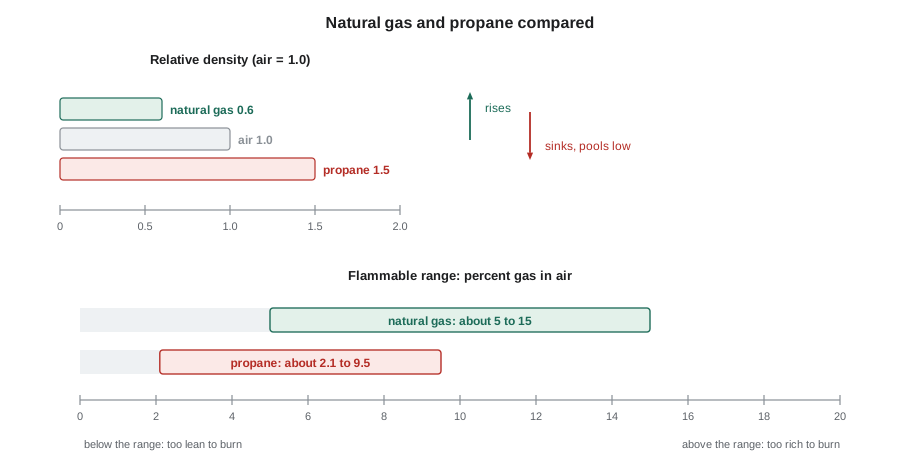
Natural gas is lighter than air. Its relative density, sometimes called specific gravity, is about 0.6, meaning a volume of natural gas weighs about 60 percent as much as the same volume of air. Leaking natural gas tends to rise and collect at ceilings and in the upper parts of rooms, though air movement mixes it quickly. That property matters for where gas detectors are mounted and for how a room is ventilated after a leak.
Natural gas releases roughly 1,000 to 1,050 British thermal units (Btu) of heat per cubic foot when it burns, which is about 37 to 39 megajoules per cubic meter. Gas fitters often use the round figure of 1,000 Btu per cubic foot for sizing work, then use the exact heating value printed on the utility's bill or supplied by the utility when they check an appliance's input at start-up. In the United States, utilities bill natural gas in therms or hundreds of cubic feet, and appliance inputs are listed in Btu per hour.
What propane is
Propane is a heavier hydrocarbon, with three carbon atoms and eight hydrogen atoms in each molecule. It is recovered from natural gas processing and from oil refining and is sold as a liquefied petroleum gas, or LPG. Under modest pressure, propane becomes a liquid, which is why it can be stored and delivered in cylinders and tanks. When the pressure is released, the liquid boils back into a gas. At atmospheric pressure, propane boils at about −42 °C (−44 °F), so it vaporizes readily at ordinary outdoor temperatures, although a tank produces less vapor in very cold weather because the liquid is colder and its vapor pressure is lower.
Propane vapor is heavier than air, with a relative density of about 1.5. Leaking propane flows downward and collects in low places: basements, pits, trenches, floor drains and crawl spaces. A pool of propane vapor in a basement can wait there for an ignition source. This is the single most important difference between the two fuels for safety, and it is why propane appliances in basements and other below-grade spaces face extra rules and why propane detectors are mounted low.
Propane carries much more energy per unit of volume than natural gas: roughly 2,500 Btu per cubic foot of vapor, or about 93 megajoules per cubic meter. It needs correspondingly more air to burn, and appliances are built or converted for one gas or the other. A natural gas appliance connected to propane would burn far too rich and produce dangerous amounts of carbon monoxide; a propane appliance on natural gas would starve. Conversion requires the manufacturer's conversion kit, which changes burner orifices and the regulator setting, and it is done only by a qualified technician who labels the appliance afterwards.
Propane is also odorized, and the same warnings about odor fade apply. In tanks, the odorant can be absorbed by rust on the inside of a new or poorly maintained tank. Propane is supplied to appliances at a higher pressure than natural gas, typically about 11 inches of water column at the appliance, compared with about 7 inches of water column for natural gas delivered at standard pressure.
Flammable range and ignition
A fuel gas burns only when it is mixed with air in the right proportions. Below the lower flammable limit, the mixture is too lean: there is not enough fuel to sustain a flame. Above the upper flammable limit, it is too rich: there is not enough oxygen. Between the two is the flammable range. For natural gas, the range is roughly 5 to 15 percent gas in air. For propane, it is roughly 2 to 10 percent. Propane's lower limit is lower, which means a smaller leak can produce a flammable mixture.
A flammable mixture also needs an ignition source with enough energy and temperature. The ignition temperature of natural gas is roughly 1,000 to 1,170 °F, and of propane about 880 °F. Pilot flames, hot surface igniters, spark igniters, electrical switches, static discharges, a running motor, a cigarette or a cutting torch can all ignite a mixture. That is why the response to a gas leak is to avoid creating sparks: do not operate light switches, telephones or doorbells inside, do not start vehicles nearby, get people out and call the gas utility's emergency line from a safe place.
A gas detector, often called a combustible gas indicator, reads gas concentration as a percentage of the lower flammable limit. A reading of 20 percent LEL means the air contains one-fifth of the gas needed to reach the lower limit. Many companies set evacuation and shutdown procedures at a low LEL reading, well before the mixture can burn, and Northbridge's procedure required everyone to leave and the gas to be shut off at any sustained reading at the level set in its safety program.
Combustion chemistry
Combustion is a rapid chemical reaction between a fuel and oxygen that releases heat. When methane burns completely, each molecule combines with two molecules of oxygen to make one molecule of carbon dioxide and two molecules of water vapor. Propane, with more carbon and hydrogen, needs five molecules of oxygen and makes three of carbon dioxide and four of water vapor.
Air is only about 21 percent oxygen by volume; the rest is mostly nitrogen, which does not burn but passes through the flame and leaves with the flue gases. To supply two volumes of oxygen, a burner needs about 9.5 to 10 volumes of air for every volume of natural gas. For propane, about 24 volumes of air are needed for every volume of gas. This is called the theoretical, or stoichiometric, air.
Real burners cannot mix gas and air perfectly, so they are designed to supply excess air, more than the theoretical amount, to make sure every molecule of fuel finds oxygen. Too little excess air risks incomplete combustion; too much wastes heat by sending warm, unused air up the vent. Combustion analyzers measure the oxygen or carbon dioxide left in the flue gases to tell how much excess air an appliance is using, a test covered in lesson 12.
When combustion is incomplete, part of the carbon leaves as carbon monoxide instead of carbon dioxide. Carbon monoxide is colorless, odorless, and highly toxic, because it binds to the hemoglobin in blood far more strongly than oxygen does and stops the blood carrying oxygen to the body. Incomplete combustion happens when there is not enough air, when the flame is cooled by striking a cold surface, when the burner is dirty or misadjusted, when the wrong gas or the wrong pressure is supplied, or when flue gases are drawn back into the combustion air. Soot, a yellow lazy flame and a sharp smell are signs of incomplete combustion, but carbon monoxide itself gives no sign.
The water vapor produced by combustion also matters. If the flue gases cool below their dew point, which is around 55 °C (130 °F) for natural gas flue gases, the vapor condenses into liquid water that is mildly acidic. Condensing appliances are designed to make that happen and to drain the condensate safely; non-condensing appliances and their vents are designed to keep the gases hot enough to stay above the dew point so that condensate does not corrode the vent or chimney.
Energy units and appliance input
Gas appliances are rated by their input: the rate at which they consume fuel energy. In the United States, inputs appear on the rating plate in Btu per hour, and sizing tables and codes use Btu/h and cubic feet per hour. One kilowatt is about 3,412 Btu per hour. A 199,000 Btu/h condensing water heater, like the two at Kingsway, burns about 199 cubic feet of natural gas per hour at full fire, using the round figure of 1,000 Btu per cubic foot. The output, the heat actually delivered to the water, is the input multiplied by the efficiency.
The input also sets the volume of gas the piping must carry. Gas piping is sized in cubic feet per hour (or cubic meters per hour) of flow, and the flow for each appliance is its input divided by the heating value of the gas. The total connected load is the sum of the inputs of every appliance on the system, which is the starting point for pipe sizing in lesson 5.
Worked problem
Converting the Kingsway loads
Dana listed the main Kingsway gas loads: two condensing water heaters at 199,000 Btu/h each, a rooftop make-up air unit at 750,000 Btu/h, and café appliances totaling 280,000 Btu/h. Find the total load and the gas flow in cubic feet per hour, using 1,000 Btu per cubic foot, and the daily gas use if the total ran for six hours.
Show solution
- Water heaters: 2 × 199,000 = 398,000 Btu/h.
- Total: 398,000 + 750,000 + 280,000 = 1,428,000 Btu/h.
- Gas flow: 1,428,000 ÷ 1,000 = 1,428 cubic feet per hour.
- Six hours at full load: 1,428 × 6 = 8,568 cubic feet, about 86 hundred cubic feet.
Answer: The connected load is 1,428,000 Btu/h, which needs about 1,430 cubic feet per hour of gas when everything fires at once.
# Convert appliance inputs to gas flow (natural gas)
loads_btuh = {"water heater 1": 199000, "water heater 2": 199000,
              "make-up air unit": 750000, "cafe line": 280000}
HV = 1000                     # Btu per cubic foot, round sizing figure
total = sum(loads_btuh.values())
for name, q in loads_btuh.items():
    print(f"{name:18s} {q:>9,} Btu/h  {q / HV:7.0f} cu ft/h")
print(f"total              {total:>9,} Btu/h  {total / HV:7.0f} cu ft/h")
print(f"in kilowatts: {total / 3412:.0f} kW")water heater 1 199,000 Btu/h 199 cu ft/h water heater 2 199,000 Btu/h 199 cu ft/h make-up air unit 750,000 Btu/h 750 cu ft/h cafe line 280,000 Btu/h 280 cu ft/h total 1,428,000 Btu/h 1428 cu ft/h in kilowatts: 419 kW
The script makes the same conversions as the worked example and is a habit worth building: list every load, convert once, and keep the list with the job file. When an owner later adds an appliance, the list shows at once whether the existing piping and meter can carry it.
Why gas work is regulated
Natural gas and propane deliver a great deal of energy cheaply and cleanly when they are handled correctly, and they cause fires, explosions and poisonings when they are not. A small leak in a closed room can build to a flammable mixture. A blocked vent can fill a house with carbon monoxide while its occupants sleep. A wrong pressure can overfire an appliance and crack its heat exchanger. Because the consequences fall on people who never see the work, gas installation is one of the most tightly regulated parts of the building trades, with its own codes, licenses, permits and inspections, covered in the next lesson.
Throughout this course, each technical rule comes with its reason. A gas fitter who understands why the code asks for a drip leg, a slope, a test pressure or a clearance makes fewer mistakes than one who memorizes numbers, and is better placed to spot the installation that technically passes but still looks wrong.
Common mistakes
MistakeRelying on the smell of the odorant to find leaks.
InsteadUse a gas detector and leak solution; odor can fade and noses vary.
MistakeTreating propane like natural gas in a basement.
InsteadRemember propane is heavier than air and collects in low spaces.
MistakeConnecting an appliance to a gas it is not built or converted for.
InsteadCheck the rating plate; conversion needs the manufacturer's kit and a qualified technician.
MistakeAssuming a blue flame means no carbon monoxide.
InsteadOnly a combustion analyzer measures carbon monoxide; a good flame is not proof.
MistakeMixing up input and output ratings.
InsteadSize piping on input; output is input times efficiency.
Summary and key terms
- Natural gas is mostly methane, odorized with mercaptans and lighter than air.
- Propane is a liquefied petroleum gas, heavier than air, with about two and a half times the energy per unit volume.
- Natural gas burns between about 5 and 15 percent in air; propane between about 2 and 10 percent.
- Complete combustion makes carbon dioxide and water vapor; incomplete combustion makes carbon monoxide.
- Burners need about 10 volumes of air per volume of natural gas and about 24 for propane, plus excess air.
- Natural gas carries about 1,000 Btu per cubic foot; propane about 2,500.
- Pipe sizing starts from the total connected input of every appliance.
- Relative density
- The weight of a volume of gas compared with the same volume of air.
- Odorant
- A sulfur compound added to fuel gas so that leaks can be smelled.
- Flammable range
- The range of gas-in-air concentrations that can burn.
- Lower flammable limit
- The lowest concentration of gas in air that can sustain a flame.
- Excess air
- Air supplied to a burner beyond the theoretical amount for complete combustion.
- Input
- The rate at which an appliance consumes fuel energy.
Practice problems
Work each problem on paper first, then reveal the answer to check.
Is natural gas lighter or heavier than air?
Show answer
Lighter, with a relative density of about 0.6.
Where does leaking propane collect?
Show answer
In low places such as basements, pits and trenches.
What is the flammable range of natural gas?
Show answer
Roughly 5 to 15 percent gas in air.
What does incomplete combustion produce?
Show answer
Carbon monoxide.
How many cubic feet per hour does a 150,000 Btu/h appliance burn on natural gas?
Show answer
About 150 cubic feet per hour.
Why do gas fitters use detectors as well as smell?
Show answer
Odorant can fade and some people cannot smell it well.
Lesson quiz · 5 questions
Score 60% or more to complete this lesson.
Create a free account to save your progress, take quizzes and earn a certificate.