
PLB-210 · Lesson 9 of 12 · 21 min
Water supply rules: pressure, sizing and protection
The café's water supply was simpler than its drainage, but the code still had plenty to say about it. The new supply would branch from the low-zone main in the parking ceiling, pass through a new submeter, feed the hand sinks, the three-compartment sink, the mop sink, the washrooms, a dishwasher, an ice machine and a coffee machine, and serve a small electric water heater under the counter. Luis asked Maya to check the design against the code's water supply rules: materials, pressure, sizing, valves and, above all, protection of the potable water.
PLB-130 taught the engineering of water supply systems. This lesson shows where the matching code rules live and how to check a design against them. Lesson 10 continues with hot water and backflow in more depth.
What the water supply rules cover
In the IPC, Chapter 6, Water Supply and Distribution, covers the water supply: the requirement for potable water, protection of the potable supply and backflow prevention, materials, sizing and pressure, valves, hot water distribution, testing and disinfection. Chapter 5 covers water heaters, and Chapter 13 covers nonpotable water systems such as reclaimed water and rainwater.
Luis summarized the water supply rules as four questions: Is the right water going to the right fixture? Is the pressure within limits at every outlet? Is every pipe big enough? Is the potable water protected from everything that could contaminate it?
Potable water where people use it
The code requires potable water at every fixture used for drinking, cooking, bathing and washing: sinks, lavatories, showers, bathtubs, drinking fountains and so on. Non-potable water may be used only where the code allows it, typically for flushing toilets and urinals, irrigation and some industrial uses, and only through a separate, identified piping system that can never be connected to the potable system.
- Non-potable piping must be marked along its length, often in purple, with warning labels at outlets.
- Outlets on non-potable systems must be designed so that they cannot be mistaken for drinking water, such as locked or keyed hose bibbs.
- Non-potable systems need their own tests to show there is no cross-connection, such as running one system with dye or shutting off the potable supply and checking that no fixture still flows.
Kingsway Tower has no non-potable supply, but Maya noted that the code's rules would apply if the owner later added a rainwater system for the landscape irrigation, which had been discussed.
Materials for water supply
Every pipe, fitting, valve and fixture in contact with potable water must be certified as safe for drinking water and must meet lead-free limits. The code also lists which materials may be used for the water service, which for the water distribution system, and which for hot water, with any temperature and pressure limits.
The IPC lists permitted materials for water service and water distribution in tables and requires products in contact with potable water to comply with NSF 61 and the lead-free limits of federal law. Solder and flux must be lead-free. Some plastic materials are limited by temperature and pressure, and some are not permitted for water service or for hot water.
On the café drawing, the engineer showed type L copper for the branch from the main and PEX for the fixture connections, both permitted. The coffee machine and ice machine came with their own connection kits, and Maya made a note to check that their flexible hoses and filters were certified for potable water.
Pressure limits
Water pressure must be high enough for fixtures to work and low enough not to damage them or waste water. The code sets limits on both ends.
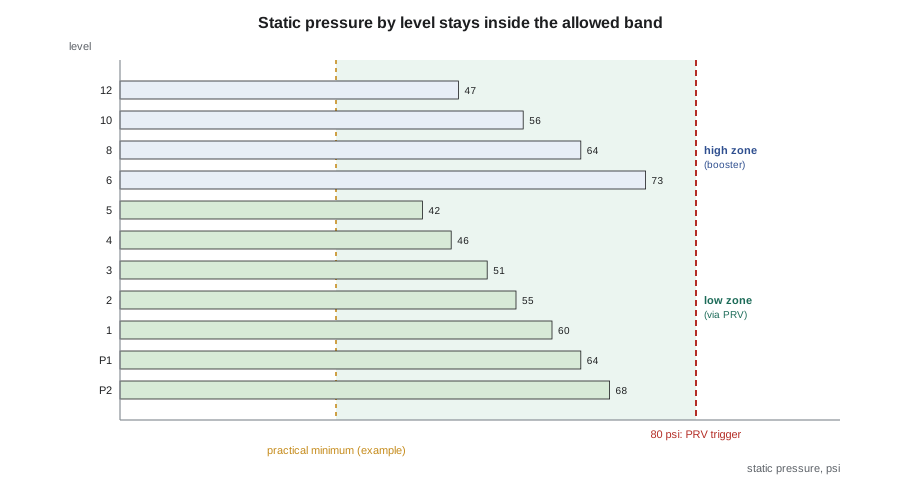
The IPC requires a pressure-reducing valve where the static pressure of the water supply exceeds 80 psi, and sets minimum flow pressures at fixtures, such as 8 psi for most fixtures and higher pressures for flushometer valves and some other devices. The Ohio Plumbing Code keeps these values.
At Kingsway, the low zone is fed through the pressure-reducing valve station described in PLB-130, so the café is already within the pressure limit. Maya still checked the café's highest and lowest fixtures: the hand sinks at counter height had plenty of pressure, and the floor-level mop sink was within the maximum.
Worked problem
Pressure at the café's lowest fixture
The low-zone PRV station in the lower parking level is set to 65 psi. The café's mop sink faucet is 18 ft above the PRV outlet. What is the static pressure at the faucet, and is it within the 80 psi trigger for a pressure-reducing valve?
Show solution
- Pressure lost to height: \(18 \times 0.433 \approx 7.8\) psi.
- Static pressure at the faucet: \(65 - 7.8 \approx 57\) psi.
- 57 psi is below 80 psi, so no additional pressure-reducing valve is needed.
- If the PRV failed open, the faucet could see the booster pressure; that is why PLB-130's station has a relief valve and an alarm.
Answer: About 57 psi, below 80 psi.
Sizing rules
The code requires water pipes to be sized so that every fixture receives enough flow at enough pressure when the system is under its peak demand. Most codes give a choice of methods: a prescriptive method using tables of fixture units and pipe sizes, or an engineered method based on pressure loss, as PLB-130 described. The code also sets minimum sizes for the water service, for fixture supplies and for individual fixture connections.
The IPC assigns water supply fixture units in a table, gives a method for converting them to demand in gallons per minute, and sets minimum sizes for fixture supply pipes and the water service. An appendix offers a sizing method, and the IPC also recognizes the Water Demand Calculator, a newer method for estimating peak demand in dwellings with efficient fixtures, where the jurisdiction adopts it.
| Fixture | Practice minimum supply size |
|---|---|
| Lavatory | 3/8 in |
| Kitchen or bar sink | 1/2 in |
| Water closet, tank type | 3/8 in |
| Water closet, flush valve | 1 in |
| Mop or service sink | 1/2 in |
| Hose bibb | 1/2 in |
The program below runs a quick check that each fixture connection on the café drawing is at least the practice minimum size. The same check works with the real code table.
# Check fixture supply sizes against a minimum table (practice values, inches)
minimum = {"lavatory": 3/8, "sink": 1/2, "wc tank": 3/8, "wc flush valve": 1, "mop sink": 1/2, "hose bibb": 1/2}
drawing = [("hand sink 1", "sink", 1/2), ("hand sink 2", "sink", 3/8), ("lav, washroom A", "lavatory", 1/2),
           ("wc, washroom A", "wc tank", 3/8), ("mop sink", "mop sink", 1/2), ("3-comp sink", "sink", 3/4)]
for name, kind, size in drawing:
    need = minimum[kind]
print(f"{name:16s} {size:5.3f} in (min {need:5.3f}): {'ok' if size >= need else 'UNDERSIZED'}")hand sink 1 0.500 in (min 0.500): ok hand sink 2 0.375 in (min 0.500): UNDERSIZED lav, washroom A 0.500 in (min 0.375): ok wc, washroom A 0.375 in (min 0.375): ok mop sink 0.500 in (min 0.500): ok 3-comp sink 0.750 in (min 0.500): ok
The check found one undersized connection: a hand sink shown with a smaller supply than the practice minimum. On the real drawing, the engineer had made the same slip, and it was corrected before rough-in.
Valves required by code
The code requires valves so that parts of the system can be isolated for repair without shutting down the whole building. PLB-130 discussed valve layout in detail. The code sets the minimum.
- A main shutoff valve on the water service, accessible inside the building near where the service enters.
- Valves on the water supply to each dwelling unit or tenant space in multi-unit buildings, so one suite can be shut off without affecting the others.
- Valves at the base of risers or on branches in larger buildings.
- Valves on the supply to each fixture or appliance, or to groups of fixtures, depending on the code, and on the cold supply to every water heater.
- Valves must be accessible and, in many codes, identified; full-way valves are required in some locations so they do not restrict flow.
The café needed its own shutoff valve near where its branch left the low-zone main, plus fixture stops at each fixture and a valve on the cold supply to the under-counter heater. The drawing showed all of them, but Maya added a note that the tenant valve had to be accessible from inside the café, not hidden above a ceiling in the corridor.
Protecting the potable water
The most important water supply rules protect the drinking water from contamination. Backflow happens when water flows backward from a fixture, appliance or system into the potable supply, either because the supply pressure drops (back-siphonage) or because the downstream pressure rises above the supply pressure (backpressure). The code requires protection at every cross-connection, chosen to match the hazard.
- Air gap: an open vertical space between the water outlet and the flood level of the receiving fixture. It is the most reliable protection and is required in high-hazard cases.
- Atmospheric and pressure vacuum breakers: protect against back-siphonage only, used on hose bibbs, some fixtures and irrigation systems.
- Dual check valves and double check valve assemblies: for low-hazard connections, such as some boiler fills in houses and premise isolation where permitted.
- Reduced pressure principle assemblies: for high-hazard connections where the water could be contaminated with toxic substances, such as chemical dispensers and some boiler feeds.
For the café, the coffee machine and ice machine required backflow protection suited to beverage equipment; carbonated beverage dispensers in particular need protection that is not made of copper, because carbonated water can dissolve copper. The three-compartment sink filled through faucets with air gaps above the flood level rim. The dishwasher had its own internal air gap. The mop sink faucet needed a vacuum breaker. Lesson 10 covers how the code matches backflow devices to hazards.
Water service and meter rules
The code's water supply rules start at the property line. The water service must be of a permitted material, large enough for the building's demand, buried below frost or protected, and kept apart from the building sewer so that a leaking sewer cannot contaminate it. Where the service and sewer must cross or share a trench, the code sets conditions on separation, materials and elevation.
The IPC sets minimum separations between the water service and the building sewer, commonly 5 feet horizontally unless conditions on elevation and materials are met, and Columbus's Division of Water rules govern the connection to the city main, the curb valve and the meter. The city owns and installs the meter, and the plumber provides the meter setting to the city's standard detail, with valves on both sides and support for the meter.
For the café, the water came from inside the building, so the service rules did not apply directly, but the submeter for the tenant space had to be installed to the building owner's standard so that the café could be billed fairly. Maya made sure there was a valve on each side of the submeter and room to remove it without cutting the pipe.
Common mistakes
MistakeSupplying a drinking fixture from a non-potable system.
InsteadPotable water is required at every fixture used for drinking, cooking, bathing or washing.
MistakeUsing pipe or hoses not certified for potable water.
InsteadCheck the health-effects certification and lead-free marking on everything that touches drinking water.
MistakeChecking pressure only at the top of the building.
InsteadCheck the highest and lowest outlets in each zone against the minimum and the code maximum.
MistakeUndersizing individual fixture connections.
InsteadMeet the code's minimum fixture supply sizes.
MistakeHiding a tenant shutoff valve outside the tenant's space.
InsteadMake required valves accessible to the people who need to use them.
Summary and key terms
- IPC water supply rules are in Chapter 6, water heaters in Chapter 5 and nonpotable systems in Chapter 13.
- Potable water is required where people drink, cook, bathe or wash; non-potable systems must be separate and identified.
- Materials in contact with potable water must be certified for health effects and lead-free.
- A pressure-reducing valve is required where static pressure exceeds 80 psi, and fixtures need minimum flow pressures.
- Pipes must be sized for peak demand, with minimum fixture supply sizes.
- Required valves allow isolation of the service, suites, risers, fixtures and water heaters, and must be accessible.
- Every cross-connection needs backflow protection suited to the hazard.
- Potable water system
- The piping and devices that carry drinking water to fixtures.
- Non-potable water
- Water not suitable for drinking, such as rainwater, greywater or reclaimed water.
- Static pressure
- Water pressure with no water flowing.
- Back-siphonage
- Backflow caused by a drop in supply pressure, which draws water backward.
- Backpressure
- Backflow caused when downstream pressure exceeds the supply pressure.
- Air gap
- An unobstructed vertical distance between a water outlet and the flood level rim of the receiving fixture.
Practice problems
Work each problem on paper first, then reveal the answer to check.
Which IPC chapter covers water supply and distribution?
Show answer
Chapter 6.
Above what static pressure does the IPC require a pressure-reducing valve?
Show answer
80 psi.
A PRV is set to 70 psi and a fixture is 30 ft above it. What is the static pressure at the fixture?
Show answer
About 70 minus 13, or 57 psi.
Name two places where code-required shutoff valves are found in a multi-unit building.
Show answer
On the water service inside the building and on the supply to each dwelling unit or tenant space.
Why can a carbonated beverage dispenser not use a copper backflow device?
Show answer
Carbonated water can dissolve copper and contaminate the water.
What is the most reliable form of backflow protection?
Show answer
An air gap.
Lesson quiz · 5 questions
Score 60% or more to complete this lesson.
Create a free account to save your progress, take quizzes and earn a certificate.