
PLB-210 · Lesson 4 of 12 · 22 min
Code intent, alternative materials and methods, and approvals
Two weeks into the term, the engineer for Kingsway Tower sent a request to the building department. The owner wanted to use a pressure-rated drainage system of a newer plastic material for the high-rise stacks, partly to save weight and partly because the material was quieter than the original design. The material was certified to a product standard, but the plumbing code's list of permitted drainage materials did not include it for buildings of that height. Maya asked Luis how a building could use something the code did not list. "The code is a floor," he said, "not a fence. If you can prove something else is at least as good, there is a way to get it approved. It just takes work."
This lesson covers the part of the code that explains what the rules are for, and how a designer can meet the code another way. The IPC and the Ohio Plumbing Code state their intent and allow alternative materials, designs and methods of construction when the code official finds that they are at least equivalent to what the code prescribes. The UPC has a similar provision.
Prescriptive rules and performance
Most of a plumbing code is prescriptive. It tells you exactly what to do: use this material, install this size, slope at this rate, put a cleanout here. Prescriptive rules are easy to follow and easy to inspect. Their weakness is that they cannot anticipate every situation or every new product. A rule written for cast iron and copper may not fit a material invented twenty years later.
Performance thinking starts from the other end. Instead of asking what the rule says, it asks what the rule is trying to achieve: keep sewer gas out, keep drinking water clean, prevent scalding, carry the flow without blockage. If a design achieves the goal at least as well as the prescribed solution, it should be acceptable. Modern plumbing codes combine the two approaches: prescriptive rules for ordinary work, and a route for proving that something different performs as well.
What the rules are for
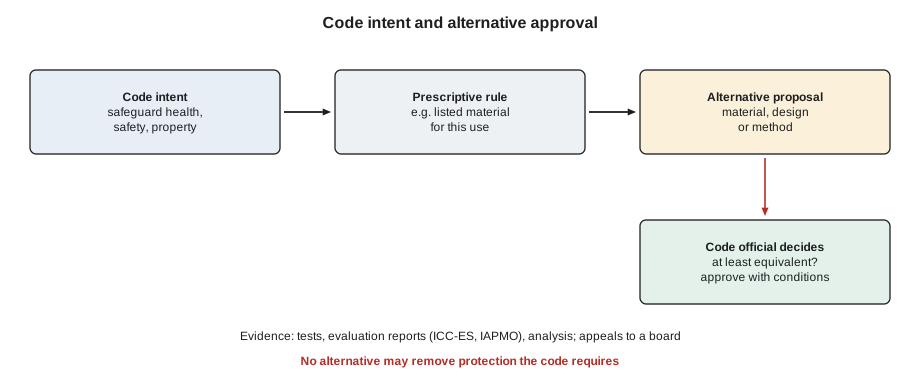
The IPC states its intent at the start: to provide minimum standards to safeguard life or limb, health, property and public welfare by regulating the design, construction, installation, quality of materials, location, operation and maintenance of plumbing systems. That statement, together with the purpose of each section, tells a plumber what a rule is trying to achieve.
The IPC does not link each section to a separate list of objectives the way some codes do, but the purpose of most rules is clear from the section headings and the code's commentary. When a rule seems arbitrary, the commentary usually explains the hazard it addresses, such as siphonage of trap seals, backflow, scalding or blockage.
Why intent matters on the job
Knowing what a rule is for helps a plumber in three ways. First, it helps in interpreting unclear wording: the reading that serves the rule's purpose is usually the right one. Second, it helps in explaining the rule to others, such as a foreman who wants to move a fixture or an owner who wants to skip a backflow preventer. Third, it helps in spotting when a prescribed solution does not work on a particular job and something else is needed.
Luis gave Maya an example. The code requires a cleanout at the base of each stack. A plumber who knows the purpose, which is to let someone rod a blockage at the point where it is most likely to form, will make sure the cleanout is accessible and faces the right way, not buried behind a finished wall where it technically exists but cannot be used. A plumber who only knows the rule may install it and still fail the purpose.
Alternatives: the route for something different
The IPC allows the code official to approve alternative materials, designs and methods of construction and equipment, provided the official finds that the proposal complies with the intent of the code and is at least equivalent in quality, strength, effectiveness, fire resistance, durability and safety. Approval is case by case, and the reasons are recorded. The Ohio Plumbing Code keeps this provision, and the UPC has a similar one.
An alternative is not a loophole. The burden of proof is on the person proposing it, usually the design engineer, and the authority can say no. Typical evidence includes:
- Test results from an accredited laboratory showing that a product meets a recognized standard and performs as required.
An evaluation report from an accredited evaluation service, such as ICC-ES or IAPMO's evaluation service, showing that the product complies with the code's intent.
- Engineering analysis comparing the alternative with the prescribed solution against each relevant objective or purpose.
- Evidence of successful use elsewhere, such as in other jurisdictions or in a newer edition of the code.
The alternative applies only to the project for which it was approved. Using the same product on the next building means asking again, unless the authority has issued a general approval or the product has been added to the code.
Kingsway's drainage material proposal
Maya followed the engineer's proposal for the stack material as it went through the building department, because Luis wanted her to see how it worked. The engineer's submission had five parts.
- A description of the proposal: which stacks, which floors, which material and joining method, and which code requirement it would replace.
The intent of the section being replaced, with the commentary's explanation of the hazards it addresses, so that the review compared like with like.
- Product evidence: the material's certification to its product standard, pressure and temperature ratings, and laboratory data on joint strength and fire performance.
- Fire safety: how the material would be fire stopped where it passed through floors, using a listed firestop system tested for that material and pipe size.
- Installation and inspection: the manufacturer's installation manual, training for the installers and a testing plan.
The building official asked two follow-up questions, one about noise and one about expansion in the tall stacks, and the engineer answered both. Six weeks later the alternative was accepted for Kingsway's stacks, with conditions: installers had to be trained by the manufacturer, every joint had to be inspected before the shafts were closed, and the firestop systems had to match the tested assemblies exactly. Northbridge kept the approval letter in the job file and gave copies to every crew working on the stacks.
Worked problem
Is this an alternative, or just a different product?
For each case, decide whether an alternative approval is needed: (a) using a brand of PEX tubing listed to the standard the code names for water distribution; (b) using a drainage pipe material that the code does not list for that use; (c) using an air admittance valve where the Ohio Plumbing Code permits one; (d) omitting a required backflow preventer because the owner promises to be careful.
Show solution
- (a) No. Any product that meets the referenced standard and is used as the code permits complies; the brand does not matter.
- (b) Yes. The material is not an acceptable solution for that use, so it needs an approved alternative.
- (c) No. Where the code permits it under stated conditions, it is a prescribed solution, provided the conditions are met.
- (d) No alternative is possible. A promise does not perform as well as a backflow preventer, so there is no basis for approval.
Answer: Alternatives are for materials and methods that perform at least as well; they cannot be used to remove protection.
Dealing with products that are new to you
Every year new products appear: new pipe materials, new joining systems, new valves, new fixtures. Some are covered by the code from the start, because they meet a standard the code already references. Others need an approval. A plumber on site cannot always tell which is which, so it pays to ask.
- Check the marking: which standard does the product say it meets, and is that standard referenced in the adopted code for this use?
- Check the code's permitted uses: a material may be allowed for drainage but not for water supply, or below ground but not above.
- Check the specification: is the product named or approved by the engineer?
- If in doubt, ask the engineer or the building official before installing it, not after.
Luis had seen a crew lose a week because a supplier sent a new type of mechanical coupling that looked like the specified one but was certified to a different standard. The inspector rejected it, and every coupling had to be replaced. The lesson was to check markings on delivery, not at inspection.
The program below is a simple decision helper based on that checklist. It is a learning tool, not a substitute for reading the code and asking the authority.
# A simple decision helper: is an approval needed before installing this product?
def needs_approval(meets_referenced_standard, permitted_for_this_use, in_spec_or_approved):
    if not meets_referenced_standard:
        return "Yes: no recognized standard - needs an approved alternative or must not be used"
    if not permitted_for_this_use:
        return "Yes: the code does not permit it for this use - needs an approved alternative"
    if not in_spec_or_approved:
        return "Ask the engineer: code-compliant, but not the specified product"
    return "No approval needed: install to the code and the manufacturer's instructions"

cases = {
    "PEX tubing with the referenced standard mark": (True, True, True),
    "new stack material, not listed for this use": (True, False, True),
    "coupling with an unknown standard": (False, True, False),
    "different brand of listed copper fitting": (True, True, False),
}
for name, args in cases.items():
print(f"{name}:\n {needs_approval(*args)}")PEX tubing with the referenced standard mark: No approval needed: install to the code and the manufacturer's instructions new stack material, not listed for this use: Yes: the code does not permit it for this use - needs an approved alternative coupling with an unknown standard: Yes: no recognized standard - needs an approved alternative or must not be used different brand of listed copper fitting: Ask the engineer: code-compliant, but not the specified product
Variances, rulings and appeals
Sometimes an owner or contractor and a building official disagree about whether a proposal meets the code. Most jurisdictions have a board of appeals that can hear these disputes. In Ohio, decisions of local building officials on commercial construction can be appealed to a local board of building appeals where one exists, and then to the state Board of Building Appeals. These routes take time, so they are used for significant questions, not small details.
For an apprentice, the practical point is that the code is not fixed in stone for a given project. There are legal ways to approve something different. There are also legal limits: no route allows protection of health and safety to be reduced below the code's level.
When the code is silent
Occasionally a situation is not covered at all, such as an unusual fixture or a system the code never imagined. The code usually has a general provision for this, saying that work not specifically covered must be done in a way that meets the code's intent or objectives, to the satisfaction of the authority. In practice, that means the designer proposes a method based on recognized standards, the manufacturer's instructions and good practice, and the authority accepts it before the work goes in. Silence in the code is not permission to do anything at all.
Common mistakes
MistakeThinking a product is allowed because it is sold at a supply house.
InsteadCheck its certification mark and whether the code permits it for this use.
MistakeTreating an alternative as a loophole to save money.
InsteadAn alternative must perform at least as well as the rule it replaces, with evidence.
MistakeAssuming an alternative approved on one job applies to the next.
InsteadApprovals are usually project specific; ask again on a new project.
MistakeInstalling first and asking for approval later.
InsteadGet the approval before the work is installed or concealed.
MistakeIgnoring the conditions attached to an approval.
InsteadFollow every condition, such as training, inspection and tested firestop systems.
Summary and key terms
- The IPC states its intent and allows alternatives the code official finds at least equivalent.
- Knowing what a rule is for helps with interpretation, explanation and spotting when a prescribed solution does not fit.
- An alternative material, design or method must be at least equivalent in quality, strength, effectiveness, fire resistance, durability and safety.
- The person proposing an alternative carries the burden of proof, with tests, evaluations and analysis.
- Approvals are usually project specific and carry conditions.
- Disputes can go to an appeals or rulings body, but no route allows health and safety protection to be reduced.
- Intent
- What a code provision is meant to achieve, stated in the code or its commentary.
- Prescriptive requirement
- A rule that states exactly what must be done.
- Alternative material or method
- A material, design or method approved by the code official as at least equivalent to the code.
- Evaluation report
- A document from an accredited evaluation service showing how a product complies with the code.
- Code official
- The person who interprets and enforces the code, often the building official.
- Board of appeals
- A body that hears disputes about code decisions.
Practice problems
Work each problem on paper first, then reveal the answer to check.
What does the IPC's intent statement say the code safeguards?
Show answer
Life or limb, health, property and public welfare.
What must the code official find before approving an alternative?
Show answer
That it complies with the code's intent and is at least equivalent in quality, strength, effectiveness, fire resistance, durability and safety.
Who carries the burden of proof for an alternative?
Show answer
The person proposing it, usually the design engineer.
Name two kinds of evidence used to support an alternative.
Show answer
Laboratory test results and an evaluation report from an accredited evaluation service.
Does an approval on Kingsway Tower apply automatically to the next project?
Show answer
No; approvals are usually project specific.
Where can a disagreement with a building official be heard?
Show answer
A board of appeals; in Ohio, local boards where they exist and the state Board of Building Appeals.
Lesson quiz · 5 questions
Score 60% or more to complete this lesson.
Create a free account to save your progress, take quizzes and earn a certificate.