
PLB-210 · Lesson 12 of 12 · 18 min
Code changes, staying current and a code-lookup capstone
By the end of the term, the café was roughed in and inspected, the stack material approval was in the job file, and Maya's notebook of code references had grown to forty pages. On her last day of the term, Luis gave her a final assignment: a list of ten questions from the Kingsway job, each to be answered with the rule, its reference and a one-sentence explanation in her own words. He also asked her a question she had not expected. "The code you learned this term will be replaced. When the new one comes, how will you find out what changed?"
This lesson covers how codes change and how a plumber keeps up, then brings the course together in a capstone: a structured method for answering any code question, applied to a set of real questions from the Kingsway job.
How and why codes change
Codes change for several reasons. New products and methods appear, research shows that a rule is too strict or not strict enough, failures in the field reveal problems, and public policy shifts toward goals such as water conservation, accessibility, energy savings and lead reduction. Each code cycle collects these pressures into a set of changes.
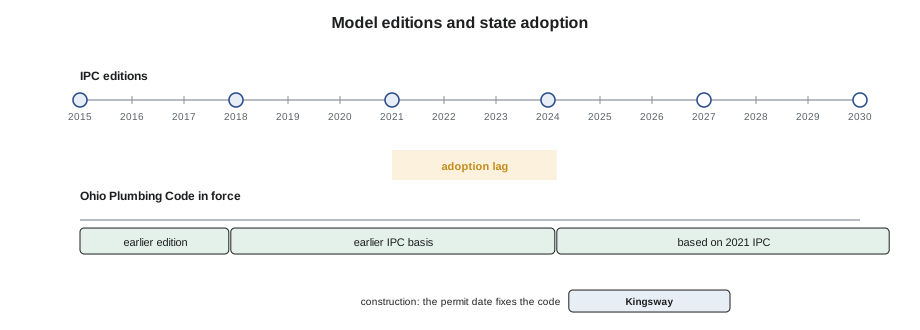
The IPC and UPC are revised every three years. The 2024 editions have been published, and the next editions are in development. Ohio's current plumbing code is based on the 2021 IPC, so changes made in the 2024 IPC reach Ohio only when Ohio adopts a newer edition. Recent cycles have brought changes such as updated rules for water demand calculation, lead-free materials, backflow protection, vent terminals and accessibility-related fixture requirements.
For an apprentice, the important point is that the code is a moving target, and a rule learned years ago may no longer be correct. An experienced plumber who has not checked the code in a decade may be confidently wrong.
Staying current
Luis's answer to his own question was a list of habits that any plumber can keep.
- Know which edition is in force where you work, and when the next one is expected. Building departments, trade associations and code publishers announce effective dates.
- Read the summary of changes. Code publishers and many associations produce lists or guides of what changed between editions, often with explanations.
- Take update courses. Many jurisdictions require or encourage continuing education when a new code is adopted, and unions, colleges and associations run code update sessions.
- Watch for bulletins and interpretations from the authority, which explain how rules will be applied.
- Keep your own notes up to date, marking rules that changed.
- Get involved: comment on proposed changes, or join a code committee, when you have experience to share.
In Ohio, the Board of Building Standards publishes code adoption notices and effective dates, and many licensing bodies require continuing education. Plumbers working across state lines must track each state's adopted edition.
A method for answering any code question
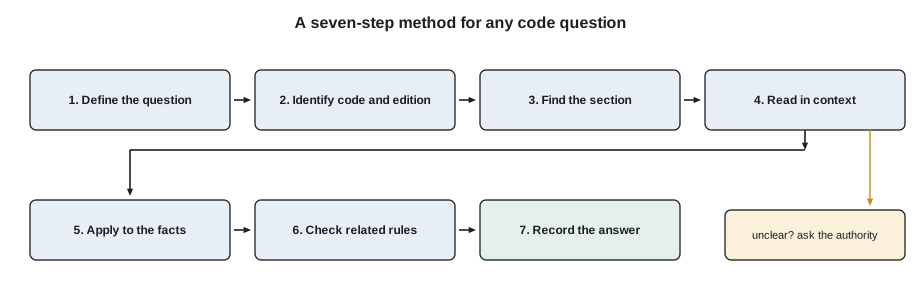
Over the course, Maya had used the same steps again and again. Luis asked her to write them down as a method she could use on any question, on any job, under any code.
- 1. Define the question precisely. What exactly is being asked: a size, a slope, a location, a material, a device, a distance?
- 2. Identify the code and edition that apply, and any local rules, specifications or approvals.
- 3. Decide which system and section the question belongs to, and find the requirement through the table of contents, the index or search.
- 4. Read the requirement in context: headings above it, definitions of key words, tables and their notes, and any exceptions or references.
- 5. Apply it to the facts, measuring the way the code says, and do the arithmetic carefully.
- 6. Check related rules: general requirements, other systems, other codes and manufacturers' instructions.
- 7. Record the answer with the reference and edition, and ask the authority if anything is genuinely unclear.
Capstone: ten questions from Kingsway Tower
Maya worked through Luis's ten questions using the method. Her answers are summarized below in the form she gave them: the question, where she found the rule, and what it meant for the job. The references are described by section rather than by exact number, because numbers change between editions; on the job, she wrote the exact number from the edition in force.
1. Which code governs the café work? Kingsway's plumbing permit and the café revision were applied for under the current Ohio Plumbing Code, based on the 2021 IPC, so that code applies, with Columbus's sewer, water and backflow rules.
2. Is the café's 4 in branch big enough? Chapter 7's table of maximum drainage fixture unit loads for horizontal branches shows the load fits; the branch does not reduce downstream and carries water closets at the required minimum size.
3. Does the branch have enough slope? Chapter 7's slope table requires 1/8 in per foot for a 4 in pipe; the branch meets it, with half an inch to spare over 60 feet.
4. Is the second lavatory's trap protected? Chapter 9's trap-to-vent distance table limits a 1-1/4 in trap arm to 5 feet; the arm was 7 feet, so an individual vent was added.
5. Which fitting joins the floor drain branch to the main branch? The drainage section's rules on changes of direction require a wye or combination fitting for horizontal-to-horizontal connections, not a sanitary tee.
6. Does the café need its own pressure-reducing valve? Chapter 6 requires one where static pressure exceeds 80 psi; the lowest fixture sees about 57 psi, so no.
7. What backflow protection does the mop sink need? The backflow rules require protection against back-siphonage at hose-connection faucets; a vacuum breaker is required, and the chemical dispenser needs its own air gap or high-hazard device.
8. What does the under-counter water heater need? The water heater rules require a relief valve with a full-size, gravity-draining, open, visible discharge, a cold supply shutoff, expansion control where the system is closed, and a pan where a leak would cause damage.
9. Do the public lavatories need temperature limiting? Chapter 4 and Chapter 6 require tempered water at public hand-washing lavatories through a limiting device, and the accessibility standard requires protected pipes under the accessible lavatory; a thermostatic mixing valve and pipe insulation were added.
10. Can the stack material be used? The code's material tables do not list it for that use in a building of Kingsway's height, so it required an approved alternative, which was granted with conditions on training, inspection and fire stopping.
Luis read her answers and found one gap: on question 2, she had not written down which table she used, only that the load fit. Without the reference, another plumber or the inspector could not check her quickly. She added it.
The program below turns the capstone's answers into a simple record of the kind Maya now keeps for every code question: the question, the code and edition, the section, the answer and whether the authority confirmed it.
# Keep a record of code questions: question, code, section, answer, confirmed?
records = [
    ("cafe branch size", "OPC (2021 IPC)", "Ch. 7, horizontal branch table", "4 in ok", True),
    ("cafe branch slope", "OPC (2021 IPC)", "Ch. 7, slope table", "8 in fall >= 7.5 in", True),
    ("lav trap arm", "OPC (2021 IPC)", "Ch. 9, trap-to-vent table", "7 ft > 5 ft; add vent", True),
    ("stack material", "OPC (2021 IPC)", "alternative materials, Ch. 1", "approved with conditions", True),
    ("coffee machine backflow", "OPC (2021 IPC)", "Ch. 6, backflow protection", "listed device", False),
]
for q, code, section, answer, confirmed in records:
    flag = "confirmed" if confirmed else "ASK THE INSPECTOR"
print(f"{q:24s} | {code:16s} | {section:30s} | {answer:26s} | {flag}")cafe branch size | OPC (2021 IPC) | Ch. 7, horizontal branch table | 4 in ok | confirmed cafe branch slope | OPC (2021 IPC) | Ch. 7, slope table | 8 in fall >= 7.5 in | confirmed lav trap arm | OPC (2021 IPC) | Ch. 9, trap-to-vent table | 7 ft > 5 ft; add vent | confirmed stack material | OPC (2021 IPC) | alternative materials, Ch. 1 | approved with conditions | confirmed coffee machine backflow | OPC (2021 IPC) | Ch. 6, backflow protection | listed device | ASK THE INSPECTOR
Common traps in code questions
Looking back at the term, Maya listed the mistakes she had made or seen others make. Each one had a matching habit that prevented it.
- Using the wrong edition or ignoring local amendments. Habit: confirm the code and edition first.
- Answering from memory. Habit: look it up, even when you are sure.
- Using the wrong table, such as a water supply table for a drain. Habit: read the table title and the requirement that sends you to it.
- Misreading a definition. Habit: check definitions of the key words.
- Measuring the wrong way. Habit: measure as the code says, usually developed length along the pipe.
- Stopping at the first rule. Habit: check related rules in other sections and other codes.
- Not writing it down. Habit: record the reference and edition with the answer.
Looking ahead
The code comes back throughout the rest of the program. PLB-220 applies it to fixtures, appliances and water heaters, PLB-320 to backflow prevention and cross-connection control, and PLB-410, Plumbing Code II and Journeyman Exam Preparation, returns to advanced code problems and a structured review for the licensing exam. The skills from this course, finding a rule, reading it carefully and applying it to the facts, are what make those later courses possible.
Luis's last piece of advice for the term was about attitude. "The code is not your enemy," he said. "Every rule in that book is there because somebody, somewhere, got sick, got burned or got flooded. When you know why a rule exists, you build it right because you want to, not because the inspector is coming."
The code on the certification exam
Licensing exams for journeyworker plumbers test code knowledge heavily, and many allow candidates to use the code book during the exam. Candidates are expected to know where rules live and how to apply them to calculations and situations, so the ability to find a rule quickly is worth far more than memorized numbers. The seven-step method in this lesson is exactly what exam questions reward: read the question carefully, decide which part of the code applies, apply the rule correctly and check the units. PLB-410 includes a structured exam review that builds on these skills.
Maya started practicing with a timer: ten minutes per question, using only the code book. At first she ran out of time on most questions. By the end of the term she could answer most of them in four or five minutes, and she noticed that the questions she missed were nearly always ones where she had skipped a definition or a table note.
Common mistakes
MistakeAssuming the rules you learned as an apprentice never change.
InsteadCheck each new edition's changes and update your notes.
MistakeAnswering code questions from memory.
InsteadLook up the rule every time it matters, even when you are confident.
MistakeWriting down answers without references.
InsteadRecord the code, edition and section with every answer.
MistakeSkipping definitions and table notes when in a hurry.
InsteadRead them; they are where most errors start.
MistakeTreating the code as an obstacle.
InsteadUnderstand what each rule protects; it makes the work better and the inspections easier.
Summary and key terms
- Model codes are revised every three years; states adopt them later on their own schedules.
- Codes change because of new products, research, field failures and policy goals.
- Stay current by knowing the edition in force, reading change summaries, taking update courses and watching bulletins.
- A seven-step method answers any code question: define, identify the code, find, read in context, apply, check related rules, record.
- Record every answer with its code, edition and section, and ask the authority when wording is unclear.
- Knowing why each rule exists leads to better work and smoother inspections.
- Code cycle
- The regular period at which a model code is revised.
- Effective date
- The date on which a newly adopted code edition becomes enforceable.
- Adoption lag
- The time between the publication of a model code edition and its adoption by a jurisdiction.
- Code bulletin
- A notice from an authority explaining how a rule will be applied or announcing a change.
- Continuing education
- Training taken during a career to keep skills and code knowledge current.
- Code reference
- The code, edition and section number that identifies a requirement.
Practice problems
Work each problem on paper first, then reveal the answer to check.
How often are the IPC and UPC revised?
Show answer
Every three years.
Why does a new IPC edition not change the rules in Ohio immediately?
Show answer
Ohio must adopt it; its current plumbing code is based on the 2021 IPC.
Name three ways to stay current with code changes.
Show answer
Read change summaries, take code update courses and watch the authority's bulletins.
List the seven steps of the code question method.
Show answer
Define the question, identify the code and edition, find the section, read in context, apply to the facts, check related rules, record the answer.
What did Luis say was missing from Maya's answer to question 2?
Show answer
The table reference.
Why should code answers be recorded with the edition?
Show answer
Because section numbers and rules change between editions.
Lesson quiz · 5 questions
Score 60% or more to complete this lesson.
Create a free account to save your progress, take quizzes and earn a certificate.