
PHYS-130 · Lesson 4 of 5 · 40 min
Momentum and collisions
Some events are over almost before they start: a hammer striking a nail, a car hitting a barrier, two railcars coupling, a jet of water hitting a turbine blade. The forces involved are large, short-lived and hard to measure, so Newton's second law in its \(F = ma\) form is awkward to use. Momentum handles these situations elegantly. It also leads to a conservation law that holds even when energy is being lost to heat and deformation.
This chapter defines momentum and impulse, derives the conservation of momentum from Newton's third law, classifies collisions, and extends the ideas to two dimensions, to the center of mass and to steady flows such as jets and rockets.
Momentum
The linear momentum of an object is its mass times its velocity:
Momentum is a vector, in the direction of the velocity, with units of kg·m/s (equivalently N·s). A 20 t railcar at 3 m/s and a 60 kg sprinter at 1000 m/s (if such a thing were possible) would have the same momentum. Momentum measures how hard it is to stop something, in the sense of how much push for how long.
Newton actually stated his second law in terms of momentum: the net force equals the rate of change of momentum,
For constant mass this is the same as \(m\mathbf{a}\). The momentum form is more general: it also covers systems whose mass changes, such as rockets and conveyor belts being loaded.
Impulse
Integrating the second law over the time a force acts gives the impulse–momentum theorem:
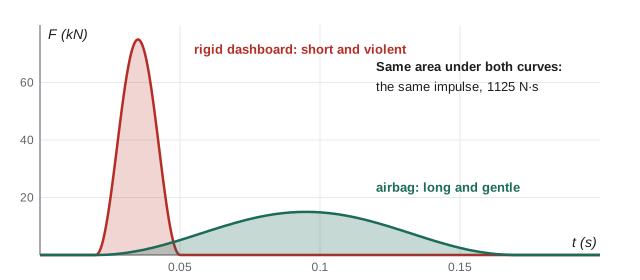
The impulse \(\mathbf{J}\) is the area under the force–time graph. During a collision the force rises and falls in a complicated way, but you rarely need its detailed shape. The change in momentum tells you the impulse, and dividing by the contact time gives the average force: \(F_{\text{avg}} = \Delta p/\Delta t\).
Worked problem
Hitting a baseball
A 0.145 kg baseball arrives at 40 m/s and leaves the bat at 50 m/s in the opposite direction. The contact lasts 1.2 ms. Find the impulse and the average force.
Show solution
- Take the outgoing direction as positive: \(v_1 = -40\) m/s, \(v_2 = +50\) m/s.
- \(\Delta p = 0.145(50 - (-40)) = 0.145 \times 90 = 13.05\) N·s.
- \(F_{\text{avg}} = 13.05/0.0012 = 10\,900\) N.
Answer: Impulse 13.1 N·s; average force about 10.9 kN, more than 7000 times the ball's weight. The reversal of direction is what makes the change so large
The same impulse can be delivered by a large force for a short time or a small force for a long time. Every piece of protective equipment, from airbags and helmets to crumple zones, packaging foam and the give in a climbing rope, works by stretching out the stopping time to reduce the force.
Worked problem
Why airbags work
A 75 kg occupant moving at 15 m/s (54 km/h) is brought to rest. Compare the average force if the stop takes 0.015 s (striking a rigid dashboard) and 0.15 s (an airbag and seatbelt).
Show solution
- Impulse in both cases: \(\Delta p = 75 \times 15 = 1125\) N·s.
- Dashboard: \(1125/0.015 = 75\,000\) N.
- Airbag: \(1125/0.15 = 7500\) N.
Answer: 75 kN versus 7.5 kN: ten times longer, ten times gentler. The momentum change is identical; only the time differs
Conservation of momentum
Consider two objects that interact, say two carts colliding. By the third law, the force of A on B is equal and opposite to the force of B on A at every instant, and the two forces act for the same time. Their impulses are therefore equal and opposite, so whatever momentum A gains, B loses. The total is unchanged:
More generally: if the net external force on a system is zero, the total momentum of the system is constant. Internal forces, however large, only move momentum around within the system.
In collisions this holds to an excellent approximation even when external forces such as friction or gravity are present, because the collision forces are so much larger and act so briefly that external impulses during the impact are negligible. So for any collision or explosion, momentum just before equals momentum just after.
Worked problem
Recoil
A 4.0 kg rifle fires a 10 g bullet at 800 m/s. Find the recoil velocity of the rifle (if held loosely) and compare the kinetic energies.
Show solution
- Before firing, total momentum is zero. After: \(0.010(800) + 4.0\,v_r = 0\).
- \(v_r = -8.0/4.0 = -2.0\) m/s: 2.0 m/s backward.
- Kinetic energies: bullet \(\tfrac12(0.010)(800^2) = 3200\) J; rifle \(\tfrac12(4.0)(2.0^2) = 8\) J.
Answer: 2.0 m/s backward. The momenta are equal and opposite, but the light bullet carries 400 times as much kinetic energy
The same principle drives jet engines and rockets, explains why a fire hose kicks back and why a person stepping off a small boat pushes it away from the dock.
Types of collisions
Collisions are classified by what happens to kinetic energy.
- Elastic: kinetic energy is conserved. Nearly true for steel ball bearings, billiard balls, and gas molecules.
- Inelastic: some kinetic energy becomes heat, sound and deformation. Most real collisions.
- Perfectly inelastic: the objects stick together and move off with a common velocity. This loses the most kinetic energy that momentum conservation allows.
The coefficient of restitution \(e\) measures where a collision falls on this scale: the ratio of the speed of separation to the speed of approach, from \(e = 1\) (elastic) to \(e = 0\) (perfectly inelastic).
Worked problem
Coupling railcars
A 20 t railcar rolling at 3.0 m/s couples with a 15 t car at rest. Find their common velocity and the kinetic energy lost.
Show solution
- Momentum: \(20\,000(3.0) + 0 = 35\,000\,v\), so \(v = 1.71\) m/s.
- KE before: \(\tfrac12(20\,000)(3.0^2) = 90.0\) kJ.
- KE after: \(\tfrac12(35\,000)(1.714^2) = 51.4\) kJ.
- Lost: \(38.6\) kJ, or 43% of the original.
Answer: 1.71 m/s; 38.6 kJ lost, absorbed by the couplers and buffers. Rail yards limit coupling speeds to keep this energy within what the equipment can take
For a head-on elastic collision, momentum and energy conservation together give two equations for the two final velocities. With object B initially at rest, the solution is
Equal masses swap velocities (the moving one stops dead, as in a Newton's cradle). A light object bounces off a heavy one; a heavy object barely slows when it hits a light one.
Worked problem
An elastic collision
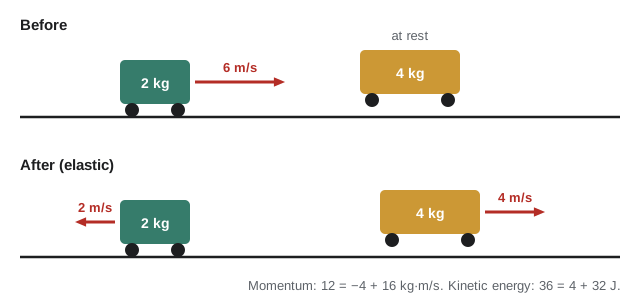
A 2.0 kg cart moving at 6.0 m/s collides elastically head-on with a 4.0 kg cart at rest. Find both final velocities and check the conservation laws.
Show solution
- \(v_{A2} = \dfrac{2 - 4}{6}(6.0) = -2.0\) m/s (it bounces back).
- \(v_{B2} = \dfrac{2(2)}{6}(6.0) = 4.0\) m/s.
- Momentum: before \(2(6) = 12\); after \(2(-2) + 4(4) = 12\) kg·m/s.
- Kinetic energy: before \(\tfrac12(2)(36) = 36\) J; after \(\tfrac12(2)(4) + \tfrac12(4)(16) = 4 + 32 = 36\) J.
Answer: −2.0 m/s and +4.0 m/s
Collisions in two dimensions
Momentum is a vector, so in two dimensions it is conserved separately in each direction: \(\sum p_x\) before equals \(\sum p_x\) after, and likewise for \(y\). That gives two equations, which is enough for a perfectly inelastic collision (two unknown velocity components).
Worked problem
Intersection collision
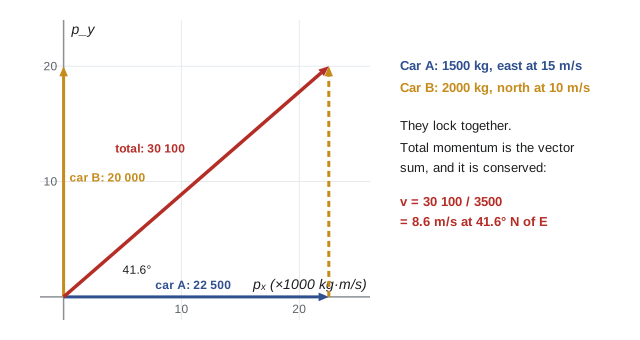
A 1500 kg car traveling east at 15 m/s collides with a 2000 kg car traveling north at 10 m/s. They lock together. Find the velocity of the wreckage just after impact.
Show solution
- \(x\) (east): \(1500 \times 15 = 22\,500\) kg·m/s. \(y\) (north): \(2000 \times 10 = 20\,000\) kg·m/s.
- After: \(3500\,v_x = 22\,500\) and \(3500\,v_y = 20\,000\), so \(v_x = 6.43\) and \(v_y = 5.71\) m/s.
- \[v = \sqrt{6.43^2 + 5.71^2} = 8.60 \text{ m/s}, \qquad \theta = \arctan\frac{20\,000}{22\,500} = 41.6^\circ \text{ north of east}\]
Answer: 8.6 m/s at 41.6° north of east. Kinetic energy falls from 269 kJ to 129 kJ: more than half goes into crushing metal
Collision investigators run this calculation backward. From the masses, the direction the wreckage traveled (from tire marks) and the distance it slid (from the work done by friction, Lesson 3), they can work out each vehicle's speed before impact.
The center of mass
For a system of particles, the center of mass is the mass-weighted average position:
and similarly for \(y\) and \(z\). (For continuous bodies, the sums become the integrals you met in Calculus II.) The total momentum of a system equals its total mass times the velocity of its center of mass, so
The center of mass moves as if the whole mass were concentrated there and all the external forces acted on it. Internal forces cannot change its motion. A shell that explodes in mid-flight sends fragments everywhere, but their center of mass continues along the original parabola. A person walking to the front of a floating canoe moves the canoe backward so that the center of mass of person plus canoe stays put.
Worked problem
Walking in a canoe
A 70 kg person stands at one end of a 30 kg, 4.0 m canoe at rest in still water and walks to the other end. How far does the canoe move? (Ignore water resistance.)
Show solution
- No horizontal external force, so the center of mass does not move.
- Let the canoe move a distance \(d\) backward. The person moves \(4.0 - d\) forward relative to the water.
- Center of mass unchanged: \(70(4.0 - d) = 30\,d\), so \(280 = 100\,d\).
Answer: d = 2.8 m. The person moves only 1.2 m relative to the water
Momentum in flowing systems
For a steady stream of fluid, the momentum form of the second law gives the force needed to change the stream's velocity: force = (mass flow rate) × (change in velocity), \(F = \dot m\,\Delta v\). This is the basis of the momentum equation in fluid mechanics.
Worked problem
Force of a water jet
A jet of water carrying 0.005 m³/s (5 L/s) at 20 m/s strikes a flat plate head-on and spreads out sideways. What force does it exert on the plate?
Show solution
- Mass flow: \(\dot m = 1000 \times 0.005 = 5.0\) kg/s.
- The water's velocity normal to the plate goes from 20 m/s to 0: \(\Delta v = 20\) m/s.
- \(F = \dot m\,\Delta v = 5.0 \times 20 = 100\) N.
Answer: 100 N. A curved bucket that turns the jet right around (as in a Pelton turbine) can nearly double this
Rockets and jet engines work the same way in reverse: they throw mass backward at high speed, and the thrust is the mass flow rate times the exhaust velocity. A rocket burning 200 kg/s with an exhaust velocity of 3000 m/s produces 600 kN of thrust.
Common mistakes
MistakeForgetting that momentum is a vector: adding magnitudes, or dropping the sign of a rebound.
InsteadPick a positive direction and give every velocity its sign. In 2D, conserve each component separately.
MistakeAssuming kinetic energy is conserved in every collision.
InsteadOnly in elastic collisions. Momentum is conserved in all of them.
MistakeComputing impulse as mΔv using speeds when the object reverses direction (e.g. 50 − 40 = 10).
InsteadUse velocities: 50 − (−40) = 90 m/s.
MistakeUsing the elastic-collision formulas when the objects stick together.
InsteadSticking together means perfectly inelastic: one common final velocity from momentum alone.
MistakeApplying momentum conservation to one object rather than the system.
InsteadConservation applies to the total momentum of all interacting objects.
MistakeMixing tonnes and kilograms, or km/h and m/s, in the same momentum balance.
InsteadUse consistent units. Any consistent set works for momentum balances, but energy needs SI.
Summary and key terms
- Momentum p = mv is a vector. Newton's second law in full: ΣF = dp/dt.
- Impulse J = ∫F dt = Δp, the area under the force–time curve. Average force = Δp/Δt; longer stopping times mean smaller forces.
- With no net external force, total momentum is conserved. In collisions this holds almost exactly.
- Elastic collisions conserve kinetic energy; inelastic ones lose some; perfectly inelastic ones (sticking together) lose the most.
- In two dimensions, conserve momentum separately in x and y.
- The center of mass moves as if all external forces acted on the total mass there.
- For a fluid stream, force = mass flow rate × change in velocity.
- Momentum
- Mass times velocity, p = mv.
- Impulse
- The integral of force over time; equals the change in momentum.
- Conservation of momentum
- Total momentum is constant when the net external force is zero.
- Elastic collision
- A collision that conserves kinetic energy.
- Perfectly inelastic collision
- A collision in which the objects stick together.
- Coefficient of restitution
- Ratio of separation speed to approach speed, from 0 to 1.
- Center of mass
- The mass-weighted average position of a system.
- Thrust
- The force produced by expelling mass, equal to mass flow rate times exhaust velocity.
Practice problems
Work each problem on paper first, then reveal the answer to check.
Find the momentum of a 1200 kg car at 90 km/h and of a 0.010 kg bullet at 900 m/s.
Show answer
Car: 1200 × 25 = 30 000 kg·m/s. Bullet: 9.0 kg·m/s.
A 60 kg person jumps off a 1.0 m wall and lands stiff-legged, stopping in 0.010 s. Repeat with bent knees stopping in 0.20 s. Find the average force from the ground in each case (include the weight).
Show answer
Landing speed √(2 × 9.81 × 1.0) = 4.43 m/s; Δp = 266 N·s. Stiff: 266/0.010 + 589 ≈ 27 200 N. Bent: 266/0.20 + 589 ≈ 1920 N.
A 0.5 kg ball hits a wall at 12 m/s and rebounds at 8 m/s. Contact lasts 0.02 s. Find the average force on the wall.
Show answer
Δp = 0.5(8 − (−12)) = 10 N·s. F = 10/0.02 = 500 N.
A 3 kg cart at 4 m/s collides and sticks to a 1 kg cart at rest. Find the final velocity and the fraction of KE lost.
Show answer
v = 12/4 = 3 m/s. KE 24 J → 18 J; 25% lost.
A 1 kg ball at 5 m/s hits an identical ball at rest in a head-on elastic collision. What happens?
Show answer
Equal masses swap velocities: the first stops and the second moves off at 5 m/s.
A 5 kg ball at 3 m/s collides elastically with a 1 kg ball at rest. Find both final velocities.
Show answer
v₁ = (5 − 1)/6 × 3 = 2 m/s. v₂ = 10/6 × 3 = 5 m/s.
A 50 kg skater at rest throws a 2 kg ball forward at 10 m/s. What is the skater's recoil speed?
Show answer
50v = 2 × 10, so v = 0.40 m/s backward.
A 1000 kg car going north at 20 m/s collides with a 1500 kg truck going east at 12 m/s, and they stick. Find the velocity after impact.
Show answer
px = 18 000, py = 20 000. v = √(18 000² + 20 000²)/2500 = 26 907/2500 = 10.8 m/s at arctan(20/18) = 48.0° north of east.
Masses of 2 kg, 3 kg and 5 kg sit at x = 0, 1 and 4 m. Find the center of mass.
Show answer
x_cm = (0 + 3 + 20)/10 = 2.3 m.
A fire hose delivers 15 kg/s of water at 25 m/s. What force must the firefighters exert to hold the nozzle steady?
Show answer
F = ṁv = 15 × 25 = 375 N.
Lesson quiz · 5 questions
Score 60% or more to complete this lesson.
Create a free account to save your progress, take quizzes and earn a certificate.