
PHYS-130 · Lesson 4 of 12 · 32 min
Applying Newton's laws: springs, drag, curves and accelerating frames
Lesson 3 set out Newton's three laws and the free-body method, and applied them to blocks, inclines, friction, connected bodies and circular motion. This lesson extends the same method to forces and situations that engineers meet daily. Springs push back in proportion to how far they are stretched; air and water resist motion with a force that grows with the square of speed, which sets the terminal velocity of a falling object and most of the fuel use of a highway vehicle; tires roll with a resistance of their own; banked roads and loops let gravity and the normal force supply centripetal force; and inside an accelerating vehicle or lift, objects seem to feel extra forces. The method never changes: isolate the body, draw every force, choose axes, apply \(\sum\mathbf{F} = m\mathbf{a}\) and check the answer.
Springs and Hooke's law
Most solid objects deform slightly under load and push back. For a spring, and for many structural members within their elastic range, the restoring force is proportional to the deformation:
where x is the extension or compression from the natural length and k is the spring constant (stiffness) in N/m. The minus sign says the force opposes the deformation. Springs combine like this: in parallel (side by side, sharing a load) their stiffnesses add, \(k = k_1 + k_2\); in series (end to end, carrying the same force) their flexibilities add, \(1/k = 1/k_1 + 1/k_2\).
Worked problem
A vehicle suspension
A 1400 kg car sits on four springs, each with k = 30 kN/m. How far does the body settle when two 80 kg passengers get in, assuming their weight is shared equally?
Show solution
- The four springs act in parallel: \(k = 4 \times 30 = 120\) kN/m.
- Added weight: \(2 \times 80 \times 9.81 = 1570\) N.
- Extra compression: \(1570/120\,000 = 0.013\) m.
Answer: About 13 mm. The same parallel-spring model, with the stiffness of each structural member, underlies the analysis of frames and foundations. Note that k also sets how fast the car bounces, which Lesson 11 calculates.
Fluid drag and terminal velocity
An object moving through air or water at ordinary engineering speeds feels a drag force that grows with the square of its speed:
where ρ is the fluid density, A the frontal area and \(C_D\) a dimensionless drag coefficient that depends on shape: about 1.0 to 1.3 for a person or a flat plate broadside to the flow, 0.47 for a sphere, 0.25 to 0.35 for a modern car and under 0.1 for a streamlined body. (At very low speeds, for dust or droplets, drag is proportional to v instead, the case of Lesson 2.) A falling object speeds up until drag balances its weight, reaching the terminal velocity:
Worked problem
A skydiver
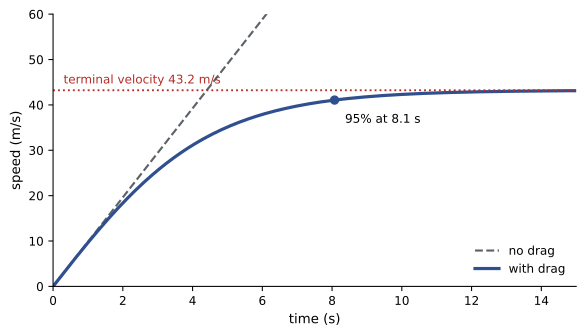
An 80 kg skydiver falls belly-down with \(C_DA = 0.70\) m² through air of density 1.2 kg/m³. Find the terminal velocity, and the time and distance to reach 95% of it.
Show solution
- \(v_t = \sqrt{2 \times 80 \times 9.81/(1.2 \times 0.70)} = 43.2\) m/s, or 156 km/h.
- Solving \(m\,dv/dt = mg - \tfrac{1}{2}\rho C_DAv^2\) by separation of variables gives \(v = v_t\tanh(gt/v_t)\).
- 95%: \(\tanh(gt/v_t) = 0.95\), so \(t = (43.2/9.81) \times 1.83 = 8.1\) s; the distance fallen by then is \((v_t^2/g)\ln\cosh(gt/v_t) = 222\) m.
Answer: About 43 m/s, reached (to 95%) after 8 s and 220 m of fall. Opening a parachute increases C_D A about fortyfold and cuts the terminal velocity to around 5 to 6 m/s, a safe landing speed.
Drag and the energy cost of speed
Because drag force grows as v², the power needed to overcome it, \(P = F_Dv\), grows as v³. This is why fuel consumption rises steeply at highway speeds.
Worked problem
Highway speed and power
A car has \(C_DA = 0.65\) m². Find the aerodynamic drag force and power at 100 km/h and at 120 km/h (ρ = 1.2 kg/m³).
Show solution
- At 100 km/h (27.8 m/s): \(F_D = 0.5 \times 1.2 \times 0.65 \times 27.8^2 = 301\) N; \(P = 301 \times 27.8 = 8.4\) kW.
- At 120 km/h (33.3 m/s): \(F_D = 433\) N; \(P = 14.4\) kW.
Answer: A 20% increase in speed raises the drag power by 73%. Shaping vehicles to reduce C_D, and driving a little slower, both pay off directly in fuel or battery range, which matters especially for electric vehicles.
Rolling resistance
A tire flexes as it rolls, losing energy in the rubber, which appears as a resisting force roughly proportional to the load: \(F_R = C_{rr}N\), with a rolling resistance coefficient \(C_{rr}\) of about 0.008 to 0.015 for car tires on asphalt, 0.001 to 0.002 for steel wheels on rail, and much higher on gravel or sand. For a 1500 kg car with \(C_{rr} = 0.010\), \(F_R = 0.010 \times 1500 \times 9.81 = 147\) N, independent of speed to a first approximation. So at low speeds rolling resistance dominates, while above about 60 to 80 km/h aerodynamic drag takes over. The very low rolling resistance of steel on rail is the main reason trains are so energy-efficient for freight.
Static and kinetic friction in braking
Lesson 3 distinguished static friction, which can rise to \(\mu_sN\) before slipping begins, from kinetic friction \(\mu_kN\) once surfaces slide, with \(\mu_k\) usually smaller. Braking shows why the difference matters. A tire that is still rolling grips the road with static friction; a locked, skidding tire slides with kinetic friction. On dry asphalt, typical values might be \(\mu_s \approx 0.9\) and \(\mu_k \approx 0.7\). Since the maximum deceleration is \(\mu g\), a car braking at the limit of grip stops at up to 8.8 m/s², but a skidding car only at 6.9 m/s². From 100 km/h, the stopping distances \(v^2/(2\mu g)\) are about 44 m and 56 m, a difference of a car length or two. Worse, a skidding wheel cannot steer. Anti-lock braking systems sense when a wheel is about to lock and release and reapply the brake many times a second, keeping the tire near its peak static grip while preserving steering. On ice, both coefficients may fall below 0.1, multiplying stopping distances by nine or more, which is why winter tires, sanding and lower speed limits matter so much on Canadian and northern US roads.
Curves: banking, friction and loops
A vehicle on a curve needs a net force of \(mv^2/r\) toward the center (Lesson 3). On a flat road, only friction between tires and road can supply it. Banking the road (superelevation) tilts the normal force so that part of it points toward the center. With no friction at all, a curve banked at angle θ is perfect for one speed, the design speed:
With side friction coefficient f available as well, the maximum safe speed becomes \(v = \sqrt{rg\,(\tan\theta + f)/(1 - f\tan\theta)}\).
Worked problem
A highway curve
A highway curve of radius 250 m has a superelevation of 6% (tan θ = 0.06). Find the speed that needs no side friction, and the maximum speed if a side friction factor of 0.12 can be relied on.
Show solution
- No friction: \(v = \sqrt{250 \times 9.81 \times 0.06} = 12.1\) m/s, or 44 km/h.
- With f = 0.12: \(v = \sqrt{250 \times 9.81 \times 0.18/(1 - 0.0072)} = 21.1\) m/s, or 76 km/h.
Answer: Banking alone supports 44 km/h, and with a conservative allowance for tire friction the curve suits about 76 km/h. Road design guides choose superelevation and minimum radius together with design side friction factors that keep a margin below the true tire grip, especially for icy conditions in winter.
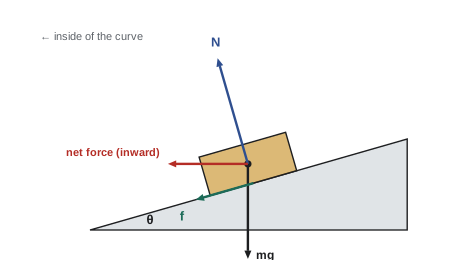
In a vertical loop, as on a roller coaster, the forces change around the loop. At the top, gravity and the track's push both point down toward the center, and the minimum speed to stay on the track is the one at which gravity alone provides the centripetal force, \(v_{min} = \sqrt{gr}\). Designers keep speeds well above this, and use clothoid-shaped loops (MATH-209) to limit the forces at the bottom, where riders feel heaviest.
Accelerating frames and apparent weight
Newton's laws hold in inertial frames, those not accelerating. Inside an accelerating lift, vehicle or aircraft, it often helps to analyze the motion as seen from the inside. The rule is simple: in a frame accelerating at \(\mathbf{a}_0\), add a fictitious (inertial) force \(-m\mathbf{a}_0\) to every body, then apply the equilibrium or motion equations as if the frame were at rest. The fictitious force is not a real interaction, but it correctly accounts for the frame's acceleration.
A person in a lift accelerating upward at a feels the floor push with \(N = m(g + a)\): they feel heavier. Accelerating downward, \(N = m(g - a)\); in free fall, N = 0 and they feel weightless, as astronauts in orbit do (Lesson 10). What a bathroom scale reads, and what structures and bodies actually feel, is this apparent weight.
Worked problem
A truck accelerometer
A small weight hangs on a string from the cab ceiling of a truck. While the truck accelerates uniformly, the string makes an angle of 8.0° with the vertical. Find the acceleration.
Show solution
- In the truck's frame the weight is in equilibrium under gravity mg (down), the tension T along the string and the fictitious force ma (backward).
- Horizontal: \(T\sin\theta = ma\); vertical: \(T\cos\theta = mg\).
- Dividing: \(a = g\tan\theta = 9.81 \times \tan 8.0° = 1.38\) m/s².
Answer: 1.38 m/s². The same principle, a mass whose deflection measures acceleration, is used in the tiny micromachined accelerometers in phones, airbag controllers and vibration sensors, where the "string" is a flexible silicon beam.
Checking your answers
Applying Newton's laws to new situations is where most errors occur, and a few checks catch nearly all of them. Are the units right? Does the answer behave sensibly in limiting cases: does a banking formula give zero speed for a flat road with no friction, does terminal velocity grow with mass? Is the sign of each force consistent with the free-body diagram? And is the size plausible: a car's deceleration of 50 m/s² or a skydiver's terminal velocity of 400 m/s should prompt a second look.
Common mistakes
MistakeAdding stiffnesses of springs in series.
InsteadSeries springs add flexibilities: 1/k = 1/k₁ + 1/k₂.
MistakeAssuming drag is proportional to speed at highway or freefall speeds.
InsteadAt ordinary speeds drag is ½ρC_DAv², proportional to v².
MistakeForgetting that drag power grows as v³.
InsteadP = F_Dv, so modest speed increases cost much more energy.
MistakeTreating centripetal force as an extra force on the free-body diagram.
InsteadIt is the net inward force supplied by friction, normal force, tension or gravity.
MistakeUsing fictitious forces in an inertial frame.
InsteadAdd −ma₀ only when working in an accelerating frame.
Summary and key terms
- Hooke's law F = −kx; parallel stiffnesses add, series flexibilities add.
- Fluid drag F_D = ½ρC_DAv²; terminal velocity v_t = √(2mg/(ρC_DA)).
- Drag power grows as v³; rolling resistance F_R = C_rrN is roughly independent of speed.
- A frictionless banked curve suits one speed, tan θ = v²/(rg); friction extends the safe range.
- At the top of a vertical loop, v_min = √(gr).
- In an accelerating frame, add a fictitious force −ma₀; apparent weight is m(g ± a).
- Check units, limits, signs and plausibility.
- Spring constant
- The stiffness k relating spring force to deformation.
- Drag coefficient
- The dimensionless shape factor C_D in the drag force equation.
- Terminal velocity
- The speed at which drag balances weight.
- Rolling resistance
- The resisting force from tire deformation, about C_rrN.
- Superelevation
- The banking of a road on a curve.
- Design speed
- The speed at which a banked curve needs no side friction.
- Inertial frame
- A reference frame that is not accelerating, in which Newton's laws hold directly.
- Fictitious force
- The term −ma₀ added in an accelerating frame.
- Apparent weight
- The supporting force an object actually feels, m(g ± a) in a vertically accelerating frame.
Practice problems
Work each problem on paper first, then reveal the answer to check.
Two springs of 200 and 300 N/m are joined end to end. Find the combined stiffness.
Show answer
120 N/m.
The same springs side by side support a load. Find the combined stiffness.
Show answer
500 N/m.
A 0.5 kg ball (C_D = 0.47, diameter 0.22 m) falls in air. Find its terminal velocity.
Show answer
A = 0.038 m²: √(2 × 0.5 × 9.81/(1.2 × 0.47 × 0.038)) = 21 m/s.
If a skydiver's C_DA doubles, by what factor does the terminal velocity change?
Show answer
Divides by √2 (to 0.71 times).
Drag power is 10 kW at 90 km/h. Estimate it at 110 km/h.
Show answer
10 × (110/90)³ = 18 kW.
Find the rolling resistance of a 20 t truck with C_rr = 0.007.
Show answer
0.007 × 20 000 × 9.81 = 1370 N.
Find the frictionless design speed of a curve with r = 400 m and tan θ = 0.08.
Show answer
√(400 × 9.81 × 0.08) = 17.7 m/s (64 km/h).
Find the minimum speed at the top of a loop of radius 10 m.
Show answer
√(9.81 × 10) = 9.9 m/s.
A 70 kg person stands in a lift accelerating downward at 2 m/s². What does a scale read?
Show answer
70 × 7.81 = 547 N (about 55.7 kg on a scale calibrated in kilograms).
A pendulum in a braking car hangs 5° forward of vertical. Find the deceleration.
Show answer
9.81 tan 5° = 0.86 m/s².
Lesson quiz · 5 questions
Score 60% or more to complete this lesson.
Create a free account to save your progress, take quizzes and earn a certificate.