
PHOT-420 · Lesson 10 of 12 · 29 min
Generative editing workflows and professional practice
AI is now part of almost every professional photography workflow, whether or not the photographer thinks of it that way: subject-detection autofocus, AI culling, one-click masks, AI denoising, distraction removal, sky replacement and generative expand all use machine learning. The professional questions are not whether to use AI but which uses are acceptable for which kind of work, what to tell clients and audiences, what contracts, contests and stock agencies require, how to protect client images and people's likenesses, and how to keep quality high. This lesson builds a practical framework: a ladder of AI interventions from assistive to fully synthetic, matched to the expectations of different genres; contract clauses; disclosure wording; contest, editorial and stock policies; privacy and consent; quality control; and the ethical questions of labor and environmental cost. PHOT-202 lesson 12 introduced manipulation ethics generally, PHOT-320 lesson 9 covers photojournalism codes and CRE-410 covers creator platforms; this lesson focuses on running a professional workflow.
A ladder of AI interventions
Not all AI use is equal. It helps to sort tools by how much they change the content of an image.
- Level 0, capture assistance: subject-detection autofocus, computational exposure, scene recognition. The content is what the camera recorded.
- Level 1, workflow assistance: AI culling, keywording, face grouping, search and auto-selection. Nothing in the image changes, though choices are influenced.
- Level 2, global corrections: AI denoising, sharpening, lens correction and automatic tone and color. Content is preserved but rendered differently.
- Level 3, local adjustments: AI masks for sky, subject and background, used to adjust brightness, color or contrast in regions. Content is preserved, but emphasis changes.
- Level 4, removal and cleanup: removing dust, wires, blemishes or bystanders with generative or content-aware tools. Content is subtracted.
- Level 5, generative additions and replacements: expanding the frame, replacing skies, adding or changing objects, altering faces or bodies. Content is invented.
- Level 6, fully synthetic: images generated from prompts, possibly guided by reference photos. No photograph of the scene exists.
Different genres accept different levels. Photojournalism and documentary work generally allow levels 0 to 3 within limits and forbid 4 to 6 apart from dust removal. Commercial and advertising work routinely uses levels 4 and 5, subject to advertising law and client approval. Fine art can use any level, with honest description. Event and portrait clients often accept cleanup but may object to body alterations or composited faces they did not request. The ladder gives a vocabulary for contracts, captions and conversations with clients.
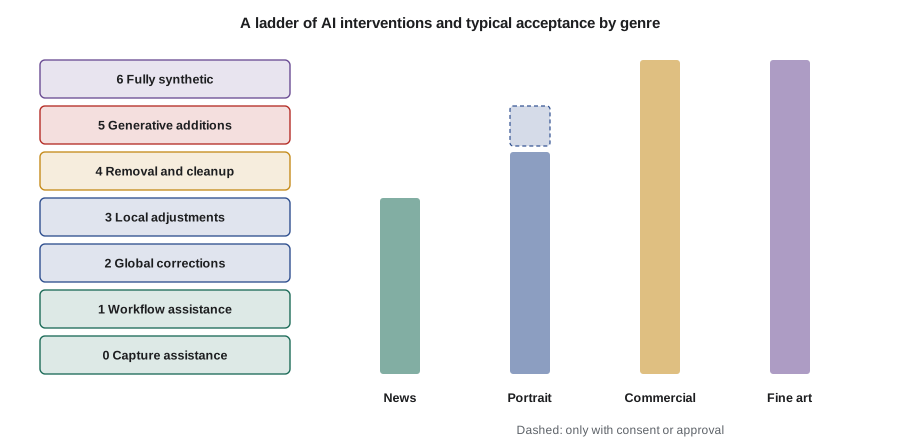
| Level | Photojournalism | Portrait and events | Commercial and advertising | Fine art |
|---|---|---|---|---|
| 0 to 1: capture and workflow assistance | Accepted | Accepted | Accepted | Accepted |
| 2: global corrections | Accepted within limits | Accepted | Accepted | Accepted |
| 3: local adjustments | Limited to traditional darkroom equivalents | Accepted | Accepted | Accepted |
| 4: removal and cleanup | Dust only | Usually accepted, disclose major removals | Accepted with approval | Accepted |
| 5: generative additions | Not accepted | Only with client consent | Accepted with approval and advertising-law care | Accepted, describe honestly |
| 6: fully synthetic | Not accepted as photography | Rarely appropriate | Accepted when disclosed as needed | Accepted, labeled as generated |
Editorial, contest and stock policies
Publications and contests set explicit rules. Major news agencies, including the Associated Press, prohibit adding, removing or altering content in news photographs and state that they will not use generative AI to alter photos; images generated by AI are not used as news photographs except when the AI image itself is the subject of a story and is clearly labeled (AP standards as published; check current versions). The World Press Photo Contest banned generative AI from all its categories for the 2024 contest after briefly allowing it in an open-format category, and its rules continue to define what counts as a photograph and to require original files for verification (at the time of writing). In 2023, artist Boris Eldagsen won a category at the Sony World Photography Awards with an AI-generated image and declined the prize to provoke debate; many competitions since then have added explicit AI rules or separate AI categories.
Stock agencies differ. Adobe Stock accepts generative AI content but requires contributors to tick a "Created using generative AI tools" box, to hold rights to the tools' output, to supply model or property releases when content depicts a real identifiable person or property, and to avoid artist names, real people, copyrighted works and implied depictions of newsworthy events in prompts and metadata. Its guidelines require labeling when generative AI adds a new primary subject or significantly changes a human subject, but not for background extension, object removal or retouching (Adobe guidelines checked October 2026). Getty Images and Shutterstock have taken more restrictive approaches to contributor uploads of AI-generated images while offering their own generators trained on licensed libraries. Policies change frequently, so read the current contributor terms before submitting.
| Organization | Policy summary | Practical consequence |
|---|---|---|
| News agencies (e.g. AP) | No generative alteration of news photos | Use only traditional adjustments for news work |
| World Press Photo | Generative AI excluded from the contest | Keep original files; no generative fill |
| Adobe Stock | Accepts AI content with labeling and releases | Tick the AI box when required; avoid restricted prompts |
| Getty Images and Shutterstock | Restrictive on contributor AI uploads; own licensed generators | Check terms before submitting AI work |
Contracts and client communication
Contracts should say how AI will and will not be used. Clients increasingly ask, and some have their own policies: a brand may forbid generative content because of uncertainty over copyright in AI output (lesson 11), while another may want generative expand to adapt images for every platform. Useful clauses cover the following points.
- Permitted AI use: which levels of the ladder are included in the editing service, for example "routine AI-assisted culling, denoising, masking and cleanup; no generative additions or alterations of people without written approval".
- Disclosure: whether and how deliverables will be labeled, and whether content credentials will be attached.
- Client-supplied material: whether the photographer may upload client images, logos or products to cloud AI services, which may process data on third-party servers.
- Likeness: no alteration of identifiable people's faces or bodies beyond agreed retouching, and no training of models on client people or products without written consent.
- Ownership and warranties: what the photographer can warrant about generated elements, given uncertainty over copyright in AI output, and whether the tool provider offers indemnity.
- Approvals: client sign-off before delivering images with generative additions.
Clear clauses protect both sides. A photographer who delivers a wedding album with a generated sky in one picture may be surprised to find the couple object; a brand that receives product shots with generated props may find it cannot register copyright in those elements. A sentence in the contract avoids both disputes. Tool providers' terms matter too: some enterprise generative tools offer intellectual property indemnity for outputs, while consumer tools usually disclaim responsibility. Read the terms of the tools you use for client work.
Worked problem
Writing a disclosure line
A real estate photographer replaced a gray sky with a blue one and removed a parked car from the driveway. Draft a disclosure for the listing images.
Show solution
- Identify the interventions: sky replacement (level 5) and object removal (level 4).
- Consider the context: buyers rely on listing photos, and real estate boards and advertising law prohibit misleading representations of property.
- Draft: "Sky digitally replaced and vehicle removed; property features are unaltered."
Answer: A short factual line naming the changes and confirming that the property itself was not altered; never remove permanent features such as power lines or neighboring buildings from listing photos.
Real estate is a good example of why disclosure depends on reliance. A buyer relies on photos to judge a property, so even modest generative changes can mislead. Many real estate boards and listing services have rules against misleading photos, and advertising law in both countries prohibits false or misleading representations. Virtual staging, adding generated furniture to empty rooms, is widely used and generally acceptable when clearly labeled.
Privacy, biometrics and client images
AI workflows often involve uploading client photographs to cloud services and analyzing faces. Face grouping in culling and gallery software creates biometric information: mathematical representations of facial geometry. Privacy law treats such information as sensitive.
In the United States there is no general federal privacy law covering photographers, but state laws apply. Illinois's Biometric Information Privacy Act (BIPA) requires written notice and a written release before collecting biometric identifiers such as face geometry, and it allows individuals to sue, which has led to large class-action settlements; Texas and Washington have biometric laws enforced by their attorneys general, and comprehensive state privacy laws such as California's treat biometric data as sensitive. Photographers using face-recognition gallery tools should explain them in client agreements, obtain written consent where state law requires it, check where the service stores data and allow guests to opt out.
Confidentiality matters beyond biometrics. Unreleased product images, private events and images of children deserve care. Before uploading to an AI service, check whether the provider may use uploaded content to train its models, and choose settings or plans that exclude it where client confidentiality requires. Many providers distinguish consumer terms, under which uploads may be used for improvement, from business terms, under which they are not.
Quality control for AI-assisted work
AI tools make errors that are easy to miss at screen size. A professional quality check should include the following.
- Inspect generative fills at 100 percent for repeated textures, mismatched grain, wrong perspective and edges that do not blend.
- Check lighting consistency: shadows and highlights in generated areas must match the direction and color of the light in the original.
- Check people: no extra fingers, distorted jewelry, changed facial features or skin that looks different from adjacent areas.
- Check text and logos in generated regions, which may be garbled or may introduce real trademarks.
- Match noise and grain: generated areas are often cleaner than the surrounding photo; add matching grain.
- Keep originals and layered files so changes can be reversed and explained.
Worked problem
Is AI culling worth it?
A wedding photographer shoots 4,000 frames per wedding and culls manually at 1,500 frames per hour. An AI culling tool costs $15 per wedding and lets them cull in 1 hour of review. They value their time at $60 per hour. Is it worthwhile?
Show solution
- Manual culling: \( 4000 / 1500 \approx 2.67 \) hours, worth \( 2.67 \times 60 = \$160 \).
- AI-assisted: 1 hour of review, \( \$60 \), plus \( \$15 \) = \( \$75 \).
- Saving: \( 160 - 75 = \$85 \) per wedding.
Answer: About $85 saved per wedding, plus faster delivery, provided the photographer still reviews the selection; check how the tool treats biometric data before using face grouping.
jobs = 40
hours_saved = [1.7, 1.0, 0.8]                # culling, masking, cleanup per job (assumed)
tool_cost_year = 600 + 15 * jobs             # subscriptions plus per-job fees
rate = 60
saved = sum(hours_saved) * jobs
print(f"hours saved per year: {saved:.0f}")
print(f"value of time saved: ${saved * rate:,.0f}; tool costs: ${tool_cost_year:,.0f}")
print(f"net benefit: ${saved * rate - tool_cost_year:,.0f}")
print(f"extra jobs possible if time is reinvested at 12 h per job: {saved / 12:.1f}")hours saved per year: 140 value of time saved: $8,400; tool costs: $1,200 net benefit: $7,200 extra jobs possible if time is reinvested at 12 h per job: 11.7
Ethics: labor, consent and the environment
Generative AI raises ethical issues beyond accuracy. Many photographers and illustrators object that models were trained on their work without consent or payment, while competing with them for commissions; using such tools commercially is, for some, a matter of professional solidarity. Some tools offer opt-out mechanisms for training, and some providers pay contributors whose work was used; lesson 11 covers the legal position. Consent is central when people are involved: generating or altering images of identifiable people, especially sexualized or demeaning content, can cause serious harm and is increasingly a crime in both Canada and the United States (lesson 11). Environmental cost is real though often overstated per image: generation consumes electricity and water for data-center cooling, and choosing efficient tools and avoiding wasteful mass generation reduces it. Finally, there is the question of trust: every undisclosed synthetic image presented as a photograph erodes the public's willingness to believe photographs, which is the foundation of documentary photography's value.
A professional AI-use policy, published on a website or included in contracts, turns these values into practice. It might state which ladder levels the studio uses for each service, a commitment to disclose generative changes, how client images are handled, a refusal to create deceptive images of real people, and how the studio responds if a client requests something it will not do. Lesson 12 asks you to write such a policy.
Common mistakes
MistakeAssuming all AI use is equivalent
InsteadClassify each intervention on the ladder and match it to the genre and client expectations.
MistakeUsing generative fill in news or contest entries
InsteadCheck editorial and contest rules; most forbid generative alteration.
MistakeUploading client images to AI services without checking terms
InsteadVerify whether the provider trains on uploads, where data is stored and whether the contract permits it.
MistakeUsing face-grouping tools without consent
InsteadTreat facial templates as biometric data and obtain consent as privacy law requires.
MistakeSkipping a 100 percent inspection of generative edits
InsteadCheck edges, lighting, people, text and grain before delivery.
Summary and key terms
- A ladder from capture assistance to fully synthetic images helps classify AI interventions.
- Photojournalism allows only minimal intervention; commercial work allows more with approval; fine art allows anything honestly described.
- News agencies, contests and stock agencies publish specific AI rules that change often.
- Contracts should cover permitted AI use, disclosure, client material, likeness, ownership and approvals.
- Face grouping creates biometric data subject to privacy laws such as Quebec's Law 25 or Illinois's BIPA.
- Quality control should inspect generated areas for lighting, edges, people, text and grain.
- Ethical practice considers consent, creators' labor, environmental cost and public trust in photographs.
- AI intervention ladder
- A scale classifying AI uses from capture assistance to fully synthetic images.
- Generative expand
- Extending an image beyond its original frame with generated content.
- Virtual staging
- Adding generated or rendered furniture to photos of empty rooms.
- Disclosure
- A clear statement of how an image was altered or created.
- Biometric information
- Data derived from physical characteristics such as face geometry.
- IP indemnity
- A provider's promise to cover certain legal claims arising from use of its tool's output.
- AI culling
- Using machine learning to select or rank frames from a shoot.
- Model release
- Written permission from a person to use their likeness for stated purposes.
- AI-use policy
- A published statement of how a studio uses AI and what it will not do.
- Training opt-out
- A mechanism to exclude one's content from use in training AI models.
Practice problems
Work each problem on paper first, then reveal the answer to check.
Classify sky replacement and dust removal on the ladder.
Show answer
Sky replacement: level 5 (generative replacement); dust removal: level 4 (cleanup).
What do most news agencies forbid regarding AI?
Show answer
Generative alteration of news photographs, including adding or removing content.
When does Adobe Stock require the generative AI label?
Show answer
When generative AI is used to create content, including adding a new primary subject or significantly changing a person.
Name three topics an AI clause in a photography contract should cover.
Show answer
Permitted AI use, disclosure, client material uploads (also likeness, ownership, approvals).
Why is real estate photography sensitive to generative edits?
Show answer
Buyers rely on listing photos, so alterations can mislead and breach advertising rules.
Why is face grouping a privacy issue?
Show answer
It creates biometric templates, which privacy laws treat as sensitive and often require consent for.
What should you check before uploading client photos to a cloud AI tool?
Show answer
Whether uploads are used for training, where data is stored and whether the contract permits it.
Manual culling takes 3 hours at $50 per hour; AI culling takes 1 hour plus $20. What is saved?
Show answer
\( 150 - 70 = \$80 \).
Give two quality checks for generative fills.
Show answer
Lighting consistency and matching grain (also edges, people, text).
Why does undisclosed synthetic imagery harm documentary photography?
Show answer
It erodes public trust in photographs as records.
Lesson quiz · 5 questions
Score 60% or more to complete this lesson.
Create a free account to save your progress, take quizzes and earn a certificate.