
PHOT-330 · Lesson 10 of 12 · 27 min
Ethics, parks and wildlife law in the US
Nature photography depends on the health of the places and creatures it portrays, and photographers can harm them. Approaching too closely, baiting animals, disturbing nests, flying drones over wildlife, trampling fragile ground and broadcasting the location of rare species all cause real damage. Laws set minimum standards, and ethical codes set higher ones. This lesson covers the principles of ethical field practice, the specific problems of baiting, calls, nests, drones and location sharing, and the laws and park rules that apply.
The guiding principle
Most ethical codes for nature photography come down to one idea: the welfare of the subject and its environment comes before the photograph. Organizations such as the North American Nature Photography Association (NANPA), the National Audubon Society, Birds Canada and many camera clubs and competitions publish guidelines built on this idea. Their common points include:
- Learn about your subject so you can recognize stress and avoid disturbance.
- Keep a respectful distance; if an animal changes its behavior, you are too close.
- Do not feed, bait or lure wildlife in ways that harm it or break the law.
- Never disturb nests, dens or young, and be especially careful during breeding seasons.
- Stay on trails and avoid trampling vegetation, especially in fragile habitats such as alpine meadows, wetlands and dunes.
- Respect other visitors, private property and Indigenous lands and sites.
- Be honest about how images were made, including captive or controlled subjects.
- Share location information responsibly.
Ethics also cover the way photographers treat each other and the public: not crowding other visitors, not blocking roads or trails, and setting a good example, because people copy what they see photographers doing.
Distance and disturbance
Disturbance has costs that may not be visible. An animal that flees uses energy it needs to survive winter or raise young; a bird flushed from its nest leaves eggs exposed to cold and predators; repeated disturbance can drive animals from good habitat. In winter, when food is scarce and moving through snow is costly, even short flights can matter for deer, elk and birds. Large animals also threaten people who get too close: elk, moose and bison injure more visitors in some parks than bears do.
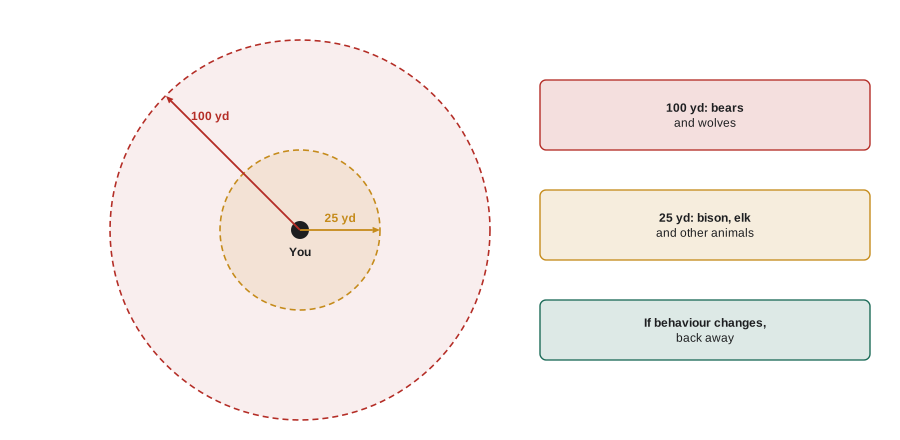
In Yellowstone and several other national parks, visitors must stay at least 100 yards (about 91 m) from bears and wolves and at least 25 yards (about 23 m) from other animals such as bison and elk. National Park Service regulations in 36 CFR 2.2 prohibit feeding, touching, teasing, frightening or intentionally disturbing wildlife, and violations can bring fines and, in serious cases, jail. Some parks set specific distances in their superintendent's compendium and close areas seasonally to protect wildlife.
Worked problem
Distance and lens planning
A photographer wants to photograph a bull elk during the rut. The park minimum is 25 yd, but the elk is displaying aggressively, so the photographer decides on 65 yd (about 59 m). The elk's body is about 8 ft (2.4 m) long. With a 400 mm lens on full frame, what share of the frame width does the elk fill?
Show solution
- Frame width: \( 36 \times 59 / 400 ≈ 5.3 \) m.
- Share: 2.4 / 5.3 ≈ 0.45, or 45 percent.
Answer: Nearly half the frame width: a strong frame without approaching. Doubling the minimum distance during the rut, when bulls are aggressive, costs little photographically and protects both elk and photographer.
Baiting, luring and calls
Baiting means using food or other attractants to bring wildlife into position. Some forms are widely accepted, such as ordinary backyard bird feeders kept clean and stocked consistently. Others are harmful or illegal: throwing pet-store mice to owls so they swoop toward the camera, a practice that teaches owls to approach people and roads; putting out meat for foxes or bears; or scattering seed in parks. Feeding wildlife in national parks is illegal in both Canada and the United States, and many provinces and states restrict feeding dangerous wildlife or big game.
Calls and playback, broadcasting recorded songs or calls to attract birds, can stress territorial birds, distract them from feeding young and draw them away from nests. Many guidelines advise using playback sparingly or not at all, never during the breeding season, and never for rare or endangered species; some parks and refuges prohibit it.
Images made with bait or calls should be disclosed in competitions and editorial contexts, because viewers assume wild behavior is natural. Many competitions ban baited images of predators entirely.
Nests, dens and young
Nest photography was once common in bird photography; today most ethical guidelines discourage it, and many competitions refuse nest images unless they were taken under license or from a safe distance with no disturbance. Approaching a nest can expose eggs and chicks to cold, heat and predators, which may follow human scent or trails to the nest. Removing leaves or branches to get a clear view of a nest, called gardening, removes the cover that protects it. Similar concerns apply to dens of foxes, wolves and bears, and to seal pups or fawns left alone by their mothers, which are not abandoned and should be left alone.
Drones
Drones can disturb wildlife severely: birds may attack them or abandon nests, and mammals may flee. They also disturb other visitors and can start wildfires if they crash.
Since 2014, the National Park Service has prohibited launching, landing or operating unmanned aircraft in national parks under 36 CFR 1.5, except with specific authorization, and the EXPLORE Act did not change that. Outside parks, FAA rules apply, including Part 107 for commercial pilots and Remote ID. Many national wildlife refuges, wilderness areas and state parks also restrict drones, and harassing wildlife with a drone can violate federal and state wildlife laws.
Location sharing and social media
Posting exact locations of sensitive subjects can bring crowds that trample habitat, disturb wildlife and attract poachers or collectors. Rare orchids, owl roosts, nesting raptors, dens and fragile geological features are especially vulnerable. Many photographers now avoid geotagging sensitive images, describe locations only generally, and share details privately only with people they trust. Some land managers ask photographers not to identify certain sites. The same caution applies to iconic viewpoints that have become overcrowded: sharing them responsibly, with information on rules and Leave No Trace principles, helps protect them.
Social media also spreads images of risky or harmful behavior, such as people approaching bison for selfies. Photographers can counter this by modeling good behavior and explaining how their images were made.
Wildlife and species-at-risk law
Several federal laws protect wildlife in the United States. The Endangered Species Act prohibits the take of listed endangered species, where take includes harassing and harming, and similar rules apply to many threatened species. The Migratory Bird Treaty Act protects most native birds, their eggs and nests from take, possession and sale. The Bald and Golden Eagle Protection Act prohibits disturbing eagles, defined to include agitating them to the point of injury, reduced productivity or nest abandonment. The Marine Mammal Protection Act prohibits harassing marine mammals, and NOAA guidelines recommend viewing distances, such as 100 yards for most whales. States add their own wildlife harassment and feeding laws; check the rules where you photograph.
| Law | Main protection | Relevance to photographers |
|---|---|---|
| Endangered Species Act | Listed species; take includes harass and harm | Avoid harassing listed species |
| Migratory Bird Treaty Act | Native birds, eggs and nests | Do not disturb nests or collect feathers |
| Bald and Golden Eagle Protection Act | Eagles, including from disturbance | Keep away from eagle nests and roosts |
| NPS regulations (36 CFR) | Wildlife and resources in national parks | Distances, no feeding, no drones, permits |
| State wildlife laws | Harassment, feeding, nests | Varies by state; check local rules |
Permits for photography in parks
Personal photography in national parks generally needs no permit. Under the EXPLORE Act of 2025, federal land agencies are updating their filming rules: small crews of about five or fewer people who follow basic conditions, such as not impeding other visitors, not needing exclusive use of a site and not using sets or staging equipment, generally need no permit or fee, while somewhat larger groups may need a simple authorization and large or disruptive shoots still need permits. The USDA Forest Service finalized its rule in March 2026; check each agency's current implementation. Workshops and guided tours on federal lands usually need a commercial use authorization.
Worked problem
Does this shoot need a permit?
A photographer plans a sunrise shoot in a national park for a clothing brand, with two models, an assistant and portable lights, at a popular lakeshore, a crew of four. Is a permit likely to be needed?
Show solution
- The crew is four people, within the small-group threshold.
- Handheld lighting is generally allowed, but the shoot must not impede visitors or require exclusive use of the lakeshore.
- If those conditions are met, the EXPLORE Act approach suggests no permit or fee, but the photographer should check the park's current guidance, because implementation varies and some sites have extra restrictions.
Answer: Possibly not, if the shoot stays small and unobtrusive, but confirm with the park. If it grows, needs exclusive use or adds sets, a permit will be required.
Indigenous lands and cultural sites
Many landscapes in Canada and the United States are on the traditional territories of Indigenous peoples, some are reserve or reservation lands with their own rules, and some contain sacred or culturally significant sites. Respectful practice includes learning whose land you are on, following local rules on access and photography, asking permission before photographing people, ceremonies or sacred sites, and avoiding commercial use of culturally significant places without consent. Some Indigenous nations require permits for photography or filming on their lands; others share guidelines for visitors. Co-managed parks, such as several in northern Canada and some tribal parks in the United States, may combine government and Indigenous rules.
Leave No Trace
The seven Leave No Trace principles, used across North America, apply directly to photographers: plan ahead and prepare; travel and camp on durable surfaces; dispose of waste properly; leave what you find; minimize campfire impacts; respect wildlife; and be considerate of other visitors. For photographers, the most relevant are staying on durable surfaces, especially at viewpoints where photographers have worn new trails, leaving rocks, plants and artifacts in place, and respecting wildlife.
When you see others breaking the rules
Photographers often encounter people approaching wildlife too closely, feeding animals or flying drones where they are prohibited. Confronting strangers can escalate, so personal safety comes first. A calm, friendly comment about the rules, or about the danger to the animal, often works. If it does not, note the time, place and details and report the behavior to park staff or wildlife officers, who have the authority to act. Avoid sharing images of other people's poor behavior in ways that could identify them online; reporting to authorities is usually more effective and fairer.
Ethics beyond the law
Laws set minimums and cannot cover every situation. A behavior may be legal and still harm wildlife, such as repeatedly visiting a popular owl roost or crowding a moose in a pond. Ethical photographers ask whether their presence adds cumulative pressure, especially at sites many others visit, and sometimes choose to stay away altogether.
Common mistakes
MistakeAssuming the legal minimum distance is always close enough.
InsteadTreat minimums as a floor; give more space when animals are stressed, rutting or with young.
MistakeBaiting owls or foxes for a dramatic action shot.
InsteadPhotograph natural behavior and disclose any baiting where it is legal.
MistakeFlying a drone in a national park because no one is around.
InsteadRecreational drones are prohibited in national parks; follow the rules.
MistakeGeotagging a rare orchid or active nest online.
InsteadShare sensitive locations only in general terms, if at all.
MistakeAssuming a commercial shoot needs no permit because it is small.
InsteadCheck current park rules; commercial filming often needs a permit or authorization.
Summary and key terms
- The welfare of the subject and environment comes before the photograph.
- Yellowstone and several other parks require 100 yards from bears and wolves and 25 yards from other animals; 36 CFR 2.2 prohibits disturbing or feeding wildlife.
- Baiting predators and heavy use of playback harm wildlife and should be avoided and disclosed.
- Nest and den photography risks exposing eggs and young; most guidelines discourage it.
- Drones have been prohibited in national parks without authorization since 2014.
- The ESA, MBTA, Eagle Act, MMPA and state laws protect wildlife.
- Share locations responsibly, respect Indigenous lands and follow Leave No Trace.
Practice problems
Work each problem on paper first, then reveal the answer to check.
State the guiding principle of nature photography ethics.
Show answer
The welfare of the subject and its environment comes before the photograph.
Minimum distance for bears in Yellowstone?
Show answer
100 yards.
Frame width at 80 m with a 500 mm lens on full frame?
Show answer
36 × 80 / 500 = 5.76 m.
Why is throwing mice to owls harmful?
Show answer
It teaches owls to approach people and roads, where they may be hit or harmed.
What is gardening in nest photography?
Show answer
Removing vegetation around a nest, exposing it to weather and predators.
Can you fly a drone in a US national park without authorization?
Show answer
No.
Name one reason not to geotag a rare plant.
Show answer
Crowds or collectors may damage it.
Which federal act protects listed species from take?
Show answer
The Endangered Species Act.
Give two Leave No Trace principles relevant to photographers.
Show answer
Travel on durable surfaces and respect wildlife (also leave what you find).
What should you do before photographing on Indigenous lands?
Show answer
Learn and follow local rules and ask permission for people, ceremonies or sacred sites.
Lesson quiz · 5 questions
Score 60% or more to complete this lesson.
Create a free account to save your progress, take quizzes and earn a certificate.