
PHOT-310 · Lesson 8 of 12 · 29 min
Macro product work and focus stacking
Small products such as jewelry, watches, cosmetics, electronic components, medical devices and food details are often photographed at high magnification, where the image on the sensor is a substantial fraction of the product's real size or even larger. Macro work brings special problems: depth of field becomes extremely shallow, diffraction softens images at small apertures, the slightest vibration blurs details, dust becomes enormous, and lighting must be scaled down to fit tiny sets. The most important technique for overcoming shallow depth of field in commercial product photography is focus stacking: capturing a series of frames focused at different distances and combining the sharp parts of each into one image. This lesson explains magnification, depth of field and diffraction at close range, how to plan and execute a focus stack, how to use tilt to align the plane of focus, and how to light small products such as jewelry and watches.
Magnification and the macro range
Magnification is the ratio of the size of the image on the sensor to the real size of the subject. A magnification of 1:1 (m = 1) means a 10 mm object produces a 10 mm image on the sensor; on a full-frame sensor 36 mm wide, the frame then covers a 36 mm wide area of the subject. Macro photography traditionally refers to magnifications of 1:1 or greater, but in commercial practice the term covers close-up work from about 1:10 to several times life size.
Dedicated macro lenses focus close enough to reach 1:1 on their own. Higher magnifications use extension tubes, bellows, close-up lenses or specialized high-magnification macro lenses and microscope objectives. As magnification increases, the effective aperture becomes smaller than the marked aperture because the lens moves further from the sensor, spreading light over a larger image. The effective f-number is approximately:
At 1:1, a lens set to f/8 behaves like f/16 for exposure and diffraction. Many modern cameras display the effective aperture automatically with macro lenses; if not, the photographer must account for it when calculating flash exposure.
Depth of field at close range
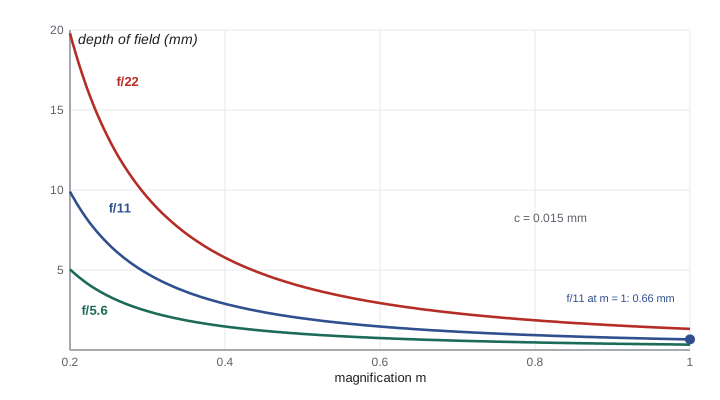
At close focusing distances, depth of field depends mainly on magnification, aperture and the acceptable circle of confusion, and hardly at all on focal length. A useful approximation for total depth of field is:
Here \(N\) is the marked f-number, \(c\) the circle of confusion on the sensor and \(m\) the magnification. The circle of confusion is the largest blur spot that still looks sharp in the final image; a traditional value for full frame is 0.03 mm, but high-resolution commercial images viewed at large sizes often require a smaller value such as 0.015 mm or less.
Worked problem
Depth of field for a ring
A ring 20 mm across is photographed so that it fills most of a full-frame sensor, at about m = 1.2. The photographer uses f/11 and a circle of confusion of 0.015 mm for a high-resolution image. What is the depth of field? The ring is about 20 mm deep from front to back. Can it be sharp in one frame?
Show solution
- DOF ≈ 2 × 11 × 0.015 × (1 + 1.2) / 1.2².
- Numerator: 2 × 11 × 0.015 × 2.2 = 0.726.
- Denominator: 1.44.
- DOF ≈ 0.50 mm.
Answer: About half a millimeter, far less than the ring's 20 mm depth. No single aperture can make the ring sharp; focus stacking is needed.
Diffraction: why stopping down is not the answer
Stopping down increases depth of field, but it also increases diffraction, the spreading of light as it passes through a small aperture. Diffraction creates a blur spot, the Airy disk, whose diameter is approximately:
For green light with a wavelength of 0.00055 mm, an effective aperture of f/22 produces an Airy disk about 0.03 mm across, which is several times the pixel pitch of a high-resolution sensor (about 0.004 mm on a 60-megapixel full-frame camera). Images become visibly soft. At high magnification, effective apertures are already much smaller than the marked aperture, so diffraction appears sooner.
Worked problem
Diffraction at 1:1
At m = 1, a lens is set to f/16. What is the effective aperture and the Airy disk diameter? Compare it with a 0.0038 mm pixel pitch.
Show solution
- Effective aperture: 16 × (1 + 1) = f/32.
- Airy disk: 2.44 × 0.00055 × 32 ≈ 0.043 mm.
- Ratio to pixel pitch: 0.043 / 0.0038 ≈ 11 pixels.
Answer: f/32 effective, with an Airy disk about 0.043 mm, roughly 11 pixels across. The image will look noticeably soft at full resolution. A wider aperture with focus stacking gives a much sharper result.
For most high-resolution macro product work, photographers choose an aperture near the lens's sharpest setting, often between f/5.6 and f/11 marked, and use focus stacking to extend depth of field rather than stopping down further.
Focus stacking
Focus stacking combines several images, each focused at a different distance, into one image that is sharp from front to back. Software analyses each frame, identifies the sharpest areas, and blends them. Widely used programs include Helicon Focus, Zerene Stacker and Adobe Photoshop's auto-blend layers; many capture programs and cameras also offer focus bracketing that captures the sequence automatically.
There are two ways to change focus between frames:
- Focus ring stepping: the lens focus is changed in small steps while the camera stays still. This is convenient and supported by in-camera focus bracketing, but focusing changes magnification slightly (focus breathing), which the software must correct.
- Rail stepping: the whole camera moves forward or backward on a focusing rail while focus stays fixed. This keeps magnification more consistent at high magnification and is preferred for very close work. Motorized rails, such as those from StackShot or Cognisys, move in precise steps and trigger the camera automatically.
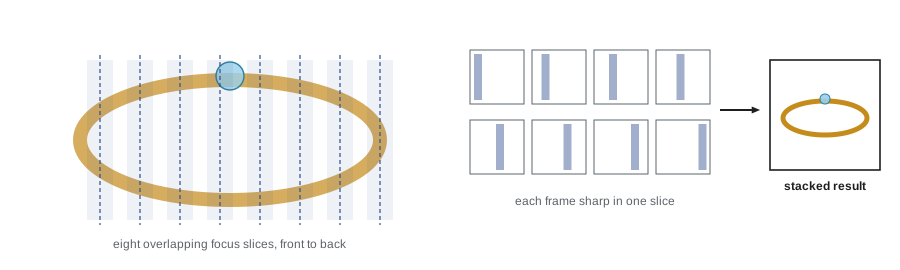
To plan a stack, divide the depth of the subject by a step size slightly smaller than the depth of field of a single frame, so that consecutive slices overlap. An overlap of 20 to 30 percent is common to avoid soft bands between slices.
Here \(D\) is the depth to be covered, \(s\) the step size and \(o\) the overlap fraction.
Worked problem
Planning a stack for the ring
The ring is 20 mm deep. Each frame has 0.50 mm depth of field. Using 25 percent overlap, what step size and how many frames are needed? At 3 seconds per frame including flash recycling, how long does capture take?
Show solution
- Step: s = (1 − 0.25) × 0.50 = 0.375 mm.
- Frames: n = 20 / 0.375 + 1 ≈ 53.3 + 1, round up to 55.
- Capture time: 55 × 3 s = 165 s, under 3 minutes.
Answer: A step of about 0.375 mm and about 55 frames, captured in under three minutes. Many photographers shoot a few extra frames beyond the front and back of the subject for safety.
Stacking produces characteristic artifacts that retouchers must watch for: halos around edges where a sharp foreground overlaps a blurred background, transparent areas where the software mixes foreground and background, smeared fine details such as hair, fibers or tiny gems, and changes in highlights between frames on reflective products. Different stacking algorithms handle these differently; Helicon and Zerene, for example, offer several methods, such as depth map and pyramid methods, and retouchers often blend results from more than one. Keep lighting absolutely constant during the stack, use flash or very stable continuous lights, and avoid moving the product, the surface or any reflectors.
Tilt and the plane of focus
For products that extend mainly in one plane, such as a watch dial at an angle, a row of cosmetics, a knife blade or a circuit board, tilting the plane of focus can sometimes replace or reduce focus stacking. When a lens is tilted relative to the sensor, the plane of sharp focus also tilts, according to the Scheimpflug principle: the plane of the sensor, the plane of the lens and the plane of focus meet along a single line. By tilting the lens, the photographer can align the plane of focus with the main plane of the product, so that it is sharp from front to back at a moderate aperture. Tilt-shift macro lenses and technical cameras are used for this. Tilt does not help with products that have depth in all directions, such as a ring or a bottle seen from the side, where stacking remains necessary.
Stability and dust
At high magnification, tiny vibrations become visible blur. Use a heavy stand or tripod on a solid floor, an electronic shutter or electronic first curtain, remote triggering, and flash to freeze any residual movement. Avoid walking near the set during capture, and turn off air conditioning fans if they move the product or the air around it. The product must be fixed in place with wax, putty or a hidden mount so that it cannot settle during a long stack.
Dust and surface flaws, invisible to the eye, become large and obvious at macro magnifications. Clean products with lint-free cloths, compressed air and soft brushes, wear gloves, and keep the set covered when not shooting. Even so, retouching time for macro product work is often longer than shooting time, and the estimate must allow for it.
Lighting jewelry and small products
Lighting small products uses the same principles as larger products, scaled down. Small softboxes, light tents, small diffusion panels, mirrors, small reflector cards and fiber-optic or snooted lights provide control at close range. Because the product is small, even a modest softbox is a large source relative to it, giving very soft light; hard light and sparkle require small, distant or snooted sources.
Jewelry combines polished metal and gemstones. Metal needs the environment control of lesson 5: white diffusion with black strips to create bands of reflection that define the shape. Gemstones need small, hard sources to create sparkle (scintillation) and fire, because diamonds and other cut stones produce flashes of light and color as light enters, reflects internally and exits through their facets. A common approach combines a soft environment for the metal with one or two small hard lights or mirrors aimed at the stones, often in separate exposures blended in post-production.
Watches have their own conventions. Watch advertisements traditionally show the hands at about 10:10, which frames the logo below the 12 and creates a symmetrical, smiling shape. The crystal reflects strongly, so photographers often shoot one frame with the crystal reflections controlled and another with the dial clear, or temporarily remove the crystal where the client allows. Dials, hands, indices and the case each need careful lighting and often their own exposure.
| Problem at macro scale | Cause | Solution |
|---|---|---|
| Very shallow depth of field | High magnification | Focus stacking or tilt |
| Soft images at small apertures | Diffraction at small effective apertures | Use moderate apertures and stack |
| Exposure darker than expected | Effective aperture N(1 + m) | Compensate or use effective aperture readouts |
| Blur from vibration | Magnified movement | Heavy stand, electronic shutter, flash |
| Halos and transparency in stacks | Stacking algorithm limits | Overlap, multiple algorithms, retouching |
| Huge dust and flaws | Magnification of tiny particles | Clean, gloves, cover set, retouch |
Focus bracketing in camera
Many current mirrorless cameras offer built-in focus bracketing, in which the camera steps the lens focus automatically after each frame. The photographer sets the starting point at the nearest part of the subject, the number of frames and a step width expressed as a relative value rather than in millimeters. Because the meaning of the step width changes with aperture and magnification, test it on a ruler or a scale placed at an angle on the set: photograph the scale with the planned settings, check that consecutive frames overlap in sharpness, and adjust the step width before photographing the product. Record the settings that work for each lens, magnification and aperture so that later jobs can be set up quickly and the results are repeatable.
Common mistakes
MistakeStopping down to f/32 for depth of field at 1:1.
InsteadUse a moderate aperture and focus stack to avoid diffraction.
MistakeForgetting effective aperture when calculating flash exposure.
InsteadUse Ne = N(1 + m) or the camera's effective aperture readout.
MistakeUsing step sizes equal to the depth of field.
InsteadOverlap slices by 20 to 30 percent.
MistakeChanging lighting or reflectors during a stack.
InsteadKeep everything constant until the stack is complete.
MistakeUnderestimating retouching time for macro work.
InsteadAllow time for dust, stacking artifacts and reflections.
Summary and key terms
- Magnification is image size divided by subject size; macro work reaches 1:1 and beyond.
- Effective aperture at close range is N(1 + m).
- Depth of field at close range is approximately 2Nc(1 + m)/m².
- Diffraction limits sharpness at small effective apertures.
- Focus stacking combines overlapping slices of sharpness into one image.
- Tilt aligns the plane of focus with planar products.
- Jewelry and watches need environment control for metal and small hard sources for sparkle.
- Magnification
- Image size on the sensor divided by real subject size.
- Effective aperture
- The working f-number at close focus, N(1 + m).
- Circle of confusion
- The largest blur spot accepted as sharp.
- Diffraction
- Spreading of light through a small aperture causing blur.
- Airy disk
- The blur spot produced by diffraction.
- Focus stacking
- Combining frames focused at different distances.
- Focus bracketing
- Automatic capture of frames at stepped focus distances.
- Focusing rail
- A rail that moves the camera in precise steps.
- Scheimpflug principle
- Sensor, lens and focus planes meet along one line.
- Scintillation
- Flashes of light from a moving cut gemstone.
Practice problems
Work each problem on paper first, then reveal the answer to check.
Effective aperture of f/8 at m = 1?
Show answer
f/16.
DOF at m = 1, f/8, c = 0.015 mm?
Show answer
2 × 8 × 0.015 × 2 / 1 = 0.48 mm.
Airy disk at Ne = f/22?
Show answer
About 0.03 mm.
Step size for 0.8 mm DOF and 25% overlap?
Show answer
0.6 mm.
Frames to cover 12 mm with 0.6 mm steps?
Show answer
21.
Name two stacking programs.
Show answer
Helicon Focus and Zerene Stacker.
Why rail stepping at high magnification?
Show answer
Keeps magnification consistent.
Name two stacking artifacts.
Show answer
Halos and transparency.
Why are watches shown at 10:10?
Show answer
It frames the logo and looks symmetrical.
What makes gemstones sparkle?
Show answer
Small hard light sources.
Lesson quiz · 5 questions
Score 60% or more to complete this lesson.
Create a free account to save your progress, take quizzes and earn a certificate.