
PHOT-210 · Lesson 3 of 12 · 25 min
Flash power, duration, sync and triggers
Working with flash means understanding a few technical behaviors that differ from continuous light: how power is set and how it relates to exposure, how long the flash lasts and whether it will freeze motion, how the camera's shutter limits when flash can be used, and how lights are triggered and controlled. Mastering these lets you choose settings confidently instead of guessing. This lesson covers power settings in stops, recycling time, flash duration and the t.1 and t.5 measures, the two exposures in every flash photograph, flash sync speed and its effects, high-speed sync and its trade-offs, triggering methods including radio systems, TTL and manual flash, and front and rear curtain sync.
Power settings and stops
Flash power is adjusted in stops or fractions of stops, often displayed as fractions of full power (1/1, 1/2, 1/4 and so on down to 1/128 or 1/256) on speedlights, or as numbers on a scale such as 1.0 to 10.0 on studio strobes, where each whole number is one stop. Halving the power reduces the light by one stop. A flash with a range from full power to 1/256 offers eight stops of adjustment. Adjusting power is the main way to control a flash's contribution to exposure without changing aperture, which would affect depth of field, or moving the light, which would affect its softness and fall-off. Power can also be set in tenths of a stop on many strobes, allowing precise balancing between lights.
| Speedlight setting | Studio scale (example) | Stops below full |
|---|---|---|
| 1/1 | 10.0 | 0 |
| 1/2 | 9.0 | 1 |
| 1/4 | 8.0 | 2 |
| 1/8 | 7.0 | 3 |
| 1/16 | 6.0 | 4 |
| 1/32 | 5.0 | 5 |
| 1/64 | 4.0 | 6 |
| 1/128 | 3.0 | 7 |
Recycling time
After firing, a flash must recharge its capacitors before it can fire again at the same power. Recycling time is shortest at low power and longest at full power: a speedlight might take two to four seconds at full power and a fraction of a second at 1/16, while a mains-powered studio strobe might recycle in one to two seconds at full power. Firing before the flash is fully recycled can produce underexposed frames. For fast-paced shooting, such as fashion with continuous movement, working at lower power settings, with a larger aperture or higher ISO, or using more powerful lights at lower settings, keeps recycling fast. Many lights beep or flash a ready indicator when recycled, and some can be set to show the modeling light dimming until ready.
Flash duration
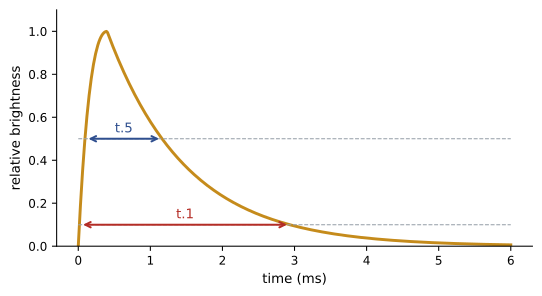
The brief burst of a flash is not a perfect instant; its brightness rises quickly to a peak and then decays. Flash duration is quoted as t.5, the time during which the flash is above half its peak brightness, or t.1, the time from when it rises to 10 % of peak until it falls back below 10 %. The t.1 figure is about two to three times longer than t.5 and better describes motion-freezing ability. Typical values range from about 1/300 s (t.1) at full power on some studio strobes to 1/10,000 s or shorter at low power on speedlights and specialized action strobes.
For traditional flashes, called voltage-controlled or capacitor-dump designs, duration is longest at full power and shortens as power decreases. Many modern strobes use IGBT circuits that cut off the flash early to reduce power, so their duration becomes very short at low power. Some strobes offer a freeze or action mode that prioritizes short duration. To freeze fast action, such as splashes, hair flips or a dancer's jump, use low power settings, ideally with several lights each at low power, and a dark studio so that ambient light does not add a blurred exposure.
Worked problem
Will the flash freeze a splash?
A photographer wants to freeze splashing water for a drinks advertisement. The strobe's t.1 duration is 1/800 s at full power and 1/8,000 s at 1/32 power. At full power, the exposure is f/16 at ISO 100. Which setting should be used, and what aperture follows?
Show solution
- 1/800 s is too long to freeze fast droplets sharply; 1/8,000 s will freeze them well.
- From full power to 1/32 power is 5 stops less light.
- f/16 minus 5 stops is f/2.8 at ISO 100, too shallow for a product.
- Raise ISO to 400 (2 stops) and add a second light, or move lights closer (1 to 2 stops), to work at about f/8 with short flash durations.
Answer: Use 1/32 power for a 1/8,000 s duration, compensating with higher ISO, closer lights or more lights to keep around f/8.
Two exposures in every flash photograph
Every flash photograph contains two exposures added together: the flash exposure, created by the brief burst, and the ambient exposure, created by any continuous light during the time the shutter is open. They are controlled differently:
- Flash exposure depends on flash power, distance, aperture and ISO, but not on shutter speed, because the flash is much shorter than any normal shutter speed.
- Ambient exposure depends on shutter speed, aperture and ISO, like any normal photograph.
This means shutter speed acts as an ambient-light control. In a dark studio, ambient light is negligible at typical sync speeds, so changing shutter speed changes nothing. With window light or modeling lights present, a slower shutter speed adds more ambient exposure, which can be used deliberately to blend flash with ambient light, for example to keep a warm lamp glowing in the background, or which may cause unwanted blur and color shifts. Understanding this separation is fundamental to working with flash in any situation.
| Setting change | Effect on flash exposure | Effect on ambient exposure |
|---|---|---|
| Shutter speed slower | None | Brighter |
| Aperture wider | Brighter | Brighter |
| ISO higher | Brighter | Brighter |
| Flash power higher | Brighter | None |
| Light moved closer | Brighter (and softer) | None |
Flash sync speed
Most cameras use a focal-plane shutter with two curtains: the first curtain opens to start the exposure and the second curtain follows to end it (PHOT-201). At slow shutter speeds, there is a moment when the whole sensor is uncovered, and the flash fires then. At fast speeds, the second curtain starts closing before the first finishes opening, so only a moving slit of the sensor is exposed at any instant. A flash fired during this time lights only a band of the frame, producing a dark band across part of the image. The fastest shutter speed at which the whole sensor is open at once is the flash sync speed, typically 1/160 to 1/250 s on mechanical shutters. With radio triggers, delays may lower the practical sync speed slightly, so test your camera and triggers. Electronic shutters on most cameras read the sensor too slowly for flash and are often disabled with flash, although cameras with very fast readout or global shutters can sync at much higher speeds. Leaf shutters, built into the lens on medium-format and some compact cameras, can sync at all speeds, often up to 1/800 s or more.
High-speed sync
High-speed sync (HSS), also called focal-plane sync, allows flash at shutter speeds above the sync speed. Instead of a single burst, the flash emits a rapid series of pulses that act like continuous light while the shutter slit travels across the sensor. HSS is useful for using flash with wide apertures in bright daylight, for overpowering the sun or darkening a sky, and for some fill-flash situations. It has costs: because the flash spreads its energy over the whole shutter travel time, and only a slit receives light at each moment, effective power drops substantially, often by two stops or more, and drops further as shutter speed increases. HSS also does not freeze motion with the flash's short duration, since the effective exposure is the shutter speed. Most studio work does not need HSS, but it is essential on location (PHOT-340).
Triggers and control
Flashes must be triggered to fire in sync with the shutter. Methods include:
- Sync cables (PC cords) connecting the camera's sync socket to the flash: reliable but cumbersome.
- Optical slaves, built into many flashes, which fire when they detect another flash: inexpensive but sensitive to other photographers' flashes and confused by pre-flashes from TTL systems.
- Infrared or optical wireless control from camera manufacturers: works indoors but needs line of sight.
- Radio triggers: a transmitter on the camera's hot shoe communicates with receivers built into the flashes or attached to them, usually in the 2.4 GHz band. Modern systems from flash makers allow control of power, groups, modeling lights and modes for each light from the camera position, which is a great convenience in the studio.
Radio systems are now the standard. Choose a system that supports your camera brand for TTL and HSS if needed, and organize lights into groups, such as A for key, B for fill and C for background, so that each can be adjusted independently.
TTL and manual flash
TTL (through-the-lens) flash metering fires a low-power pre-flash before the main exposure, measures its reflection through the lens, and sets flash power automatically. TTL is invaluable at events and in changing situations, but in the studio, where subjects and lights stay in fixed positions, manual flash is usually preferred: power is set deliberately, measured with a light meter or tested, and remains consistent from frame to frame regardless of changes in framing or the subject's clothing, which can fool TTL. Many photographers use TTL to find a starting point quickly and then switch to manual to lock it in.
First and second curtain sync
By default, the flash fires just after the first curtain opens, called first-curtain or front-curtain sync. With second-curtain or rear-curtain sync, the flash fires just before the second curtain closes. With short exposures in a dark studio, there is no difference. With longer exposures and moving subjects lit by both ambient and flash, first-curtain sync places the frozen flash image at the start of the motion, so ambient blur trails ahead of the subject, which looks unnatural; second-curtain sync places the sharp image at the end, so blur trails behind, suggesting movement. Rear-curtain sync with slow shutter speeds is a creative technique for dance, motion and light-trail effects in the studio.
Flash consistency
For professional work, the consistency of flash output from shot to shot and across power settings matters as much as raw power. Quality strobes deliver exposures within about a tenth of a stop from frame to frame and keep color temperature stable within a narrow range, often with modes that trade a little recycling speed for consistency. Inconsistent flashes produce frames that vary in brightness and color, which creates extra work in editing, especially for product catalogs and composites where many images must match. Test consistency by photographing a gray card repeatedly at the same settings and comparing exposure and white balance values in editing.
Triggering problems and solutions
Radio triggers occasionally misfire, fail to fire or fire late. Common causes include low batteries in the transmitter or receivers, interference from other 2.4 GHz devices such as Wi-Fi routers, mismatched channels or groups, sleep modes on receivers, and firmware incompatibilities between transmitters and lights. Solutions include fresh batteries, selecting a different channel or ID code, disabling sleep modes, updating firmware, and keeping the transmitter in line of sight of lights where possible. If a radio trigger introduces delay, the effective sync speed may be slightly lower than the camera's rated speed, visible as a dark band at the edge of the frame; lower the shutter speed by a third of a stop if needed.
Freezing motion with ambient light present
When ambient light is bright, such as near a window, moving subjects may show a sharp flash image overlaid with a blurred ambient ghost. Eliminating ambient light, by darkening the room or using a faster shutter speed up to the sync limit, keeps the flash image clean.
Common mistakes
MistakeShooting faster than the sync speed with normal flash.
InsteadStay at or below sync speed, or use HSS or leaf shutters.
MistakeUsing shutter speed to control flash exposure.
InsteadUse power, distance, aperture or ISO for flash.
MistakeExpecting full power to freeze fast action.
InsteadUse low power for short flash durations.
MistakeRelying on TTL in a fixed studio setup.
InsteadUse manual flash for consistency.
MistakeFiring before the flash recycles.
InsteadWait for the ready signal or lower power.
Summary and key terms
- Flash power is set in stops; halving power reduces light by one stop.
- Recycling is fastest at low power.
- t.1 duration best describes motion-freezing ability; low power is usually shortest.
- Flash exposure ignores shutter speed; ambient exposure depends on it.
- Sync speed is the fastest speed with the whole sensor open, typically 1/160–1/250 s.
- High-speed sync allows faster shutter speeds at a large power cost.
- Radio triggers with groups and manual power are standard in the studio.
- Flash duration
- How long the flash emits light.
- t.1
- Duration above 10 % of peak brightness.
- t.5
- Duration above 50 % of peak brightness.
- IGBT
- Circuit that cuts off flash to reduce power.
- Sync speed
- Fastest shutter speed for normal flash.
- High-speed sync
- Pulsed flash for speeds above sync.
- Leaf shutter
- In-lens shutter that syncs at all speeds.
- Radio trigger
- Wireless system to fire and control flashes.
- TTL
- Automatic flash metering through the lens.
- Rear-curtain sync
- Flash fired at the end of the exposure.
Practice problems
Work each problem on paper first, then reveal the answer to check.
Stops between full and 1/32 power?
Show answer
5 stops.
When is recycling fastest?
Show answer
At low power.
Which is longer, t.1 or t.5?
Show answer
t.1.
Why use low power to freeze motion?
Show answer
Duration is usually shortest at low power.
Does shutter speed affect flash exposure?
Show answer
No, only ambient exposure.
What controls flash exposure?
Show answer
Power, distance, aperture and ISO.
Typical sync speed?
Show answer
1/160–1/250 s.
What does exceeding sync speed cause?
Show answer
A dark band across the frame.
Main cost of high-speed sync?
Show answer
Large loss of effective power.
Why prefer manual flash in the studio?
Show answer
Consistent power regardless of framing and clothing.
Lesson quiz · 5 questions
Score 60% or more to complete this lesson.
Create a free account to save your progress, take quizzes and earn a certificate.