
PET-499 · Lesson 1 of 12 · 27 min
Team formation and the field development plan
On the first day of the spring semester, five senior petroleum engineering students at Front Range Polytechnic University in Denver open a data room that did not exist a year ago. Last summer Prairie Crest Energy Inc. shot the small 3D seismic survey over the Spruce Ridge prospect in McKenzie County, about 13 miles from the Tamarack Lake field. The survey came back positive, and the exploration well drilled in the fall, the Spruce Ridge 1-9, found light oil in a Red River dolomite structure. A second well, the Spruce Ridge 2-9, drilled down the flank of the structure in early winter, found the oil-water contact. The discovery well then produced for four months on an extended test, with its sour gas flared as the state's rules allow during a well's first year, and was shut in to watch the pressure recover. Prairie Crest Energy Inc. now has to decide whether, and how, to develop the pool, and it has offered the decision to a student team as its sponsored capstone project.
The team is Aisha Bello, who will act as project manager; Connor MacLeod, who has taken every geology elective the department offers; Mateo Ruiz, the strongest reservoir engineer in the class; Hannah Kowalczyk, who spent two summers as a production engineering intern; and Daniel Whitehorse, who has worked for a reserves consultancy and wants to understand how projects get approved. Their faculty supervisor is Dr. Miriam Achterberg. Their sponsor liaison is Ethan Cardinal, now a senior engineer at Prairie Crest Energy Inc., who learned most of what he knows on the Tamarack Lake field and remembers his own capstone well. Ethan's first message to the team sets the tone for the term: “Treat this as a real field development plan. We will read it as one. If the honest answer is that we should not develop Spruce Ridge yet, that is a good answer, as long as you can defend it.”
This course follows the team through the fourteen weeks of the capstone, from the data room to the final presentation to Prairie Crest Energy Inc.'s development committee. Each lesson covers one part of the plan and draws on a course you have already taken: petrophysics, reservoir fluids, reservoir engineering and simulation, well design, production and facilities engineering, economics and reserves evaluation. The emphasis now is different. Earlier courses taught you to solve well-posed problems. A field development plan asks you to frame the problem yourself, work with incomplete and sometimes contradictory data, choose between options that are all defensible, and explain your reasoning to people who will spend real money on it.
What a field development plan is
A field development plan, usually shortened to FDP, is the document that justifies spending capital to turn a discovery into a producing field. It describes what is known about the reservoir and its fluids, how much oil and gas it probably contains and how uncertain that estimate is, the development options considered, the option recommended and why, the wells and facilities needed, the production forecast, the cost and schedule, the expected economic return and its risks, and the plan for meeting environmental, regulatory and community obligations. A good FDP lets a reader who was not involved understand both the recommendation and the reasons that the alternatives were rejected.
In a large company, an FDP is prepared by a multidisciplinary team over months or years and approved through a series of decision gates. In a mid-sized producer like Prairie Crest, the team is smaller and the process lighter, but the logic is the same. The plan must answer five questions in order. What have we found? How much is there, and how sure are we? What are the sensible ways to develop it? Which way is best, judged by value, risk and practicality? And what must happen next, and when?
An FDP is not a single calculation. It is a chain of linked estimates in which each discipline's output is the next discipline's input. Mapped gross rock volume and log-derived porosity feed the oil-in-place estimate; oil in place, fluid properties and the aquifer response feed the recovery estimate; recovery and well productivity feed the production forecast; the forecast sizes the facilities and drives the cash flow; and the cash flow, combined with the uncertainty carried along the chain, supports the decision. A weak link anywhere weakens everything downstream. That is why the team's schedule is built around the chain.
Decision gates and the stages of a project
Most companies divide a development project into stages separated by decision gates. Names vary from company to company, but a common sequence is appraise, select, define, execute and operate. In the appraise stage, the company gathers enough data to establish that a discovery is worth developing and to understand its range of outcomes. In the select stage, it generates development options, evaluates them and picks one. In the define stage, it engineers the chosen option in enough detail to estimate its cost and schedule closely and to apply for approvals. Only then does it sanction the project and commit the bulk of the capital in the execute stage. The front-end stages are cheap relative to execution, and the ability to influence the value of a project is greatest early, when relatively little has been spent.
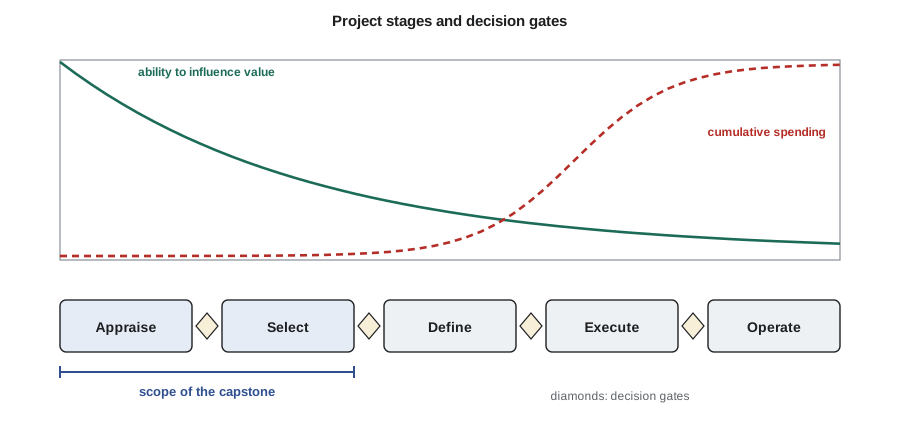
Spruce Ridge sits between the appraise and select stages. The two wells and the extended test have answered the most basic question, whether there is a commercial accumulation, but have left much uncertain. The team's task is to complete the appraisal analysis, generate and compare development options, and recommend one, with the uncertainties and the work needed in the define stage stated plainly. The sponsor does not expect detailed engineering, but it does expect the numbers to be consistent with each other and traceable to the data.
The team, its roles and its charter
Capstone teams fail far more often from poor organization than from weak engineering. The first week of the project is spent agreeing on how the team will work. Aisha drafts a team charter, a short document that every member signs, covering the project objective, each member's lead responsibilities, how decisions are made, how often the team meets, how work is reviewed, how conflicts are resolved and what happens if a member does not deliver. The charter is not bureaucracy; it is the agreement the team will point to in week nine when a deliverable is late.
| Member | Lead responsibility | Supporting role |
|---|---|---|
| Aisha Bello | Project management, schedule, final report integration | Development options, presentation |
| Connor MacLeod | Geology, mapping, petrophysics, volumetrics | Data quality control |
| Mateo Ruiz | PVT, material balance, history match, forecasts | Volumetric uncertainty |
| Hannah Kowalczyk | Well design, artificial lift, facilities | Emissions inventory |
| Daniel Whitehorse | Economics, decision analysis, regulatory and stakeholder plan | Reserves and resources classification |
Each member has a lead area and a supporting area, so that every piece of technical work is checked by someone other than its author. Dr. Achterberg insists on this: in practice, most serious errors in engineering reports are not subtle. They are unit mistakes, copied numbers that were later revised, or assumptions that one discipline made and the next did not know about. A second pair of eyes catches most of them. The charter also records how the team will make decisions when it disagrees: by discussion first, then by the project manager after consulting the supervisor, with any dissent recorded in the meeting notes.
The team also agrees on a single master data sheet, a spreadsheet held in one place, containing every number that more than one person uses: oil-water contact, datum, initial pressure, bubble point, formation volume factor, oil in place and so on. Anyone who changes a number in the master sheet announces it to the whole team. The sponsor's data room contains thousands of files; the master sheet contains the few dozen numbers that matter, each with its source. When Ethan reviews a draft in week eight and asks where the formation volume factor came from, Mateo can point to the row, the lab report and the date.
Working with a sponsor
An industry sponsor brings real data, real constraints and real reviewers, and a few obligations. The students sign a confidentiality agreement covering the data room, and they agree that the report will be reviewed by Prairie Crest before it is shared outside the course. They also agree on a communication plan: a short progress note to Ethan every Friday, a technical review meeting with Ethan and his colleagues every second week, a design review in week 13, and the final presentation in week 14. Ethan arranges for specialists at Prairie Crest to answer questions in their areas: Grace Nakoochee for geology, Mei Lin for fluid samples and laboratory work, Sofia Reyes for facilities, Diane Mercer for economics and reserves, and Lena Haugen, now vice-president of development, who will chair the final presentation.
Sponsors want the project to succeed, but they are not there to do the work. The team must ask good questions, which means doing enough homework to know what it does not know. Ethan's advice is to bring a list of specific questions to every meeting, each with the team's current best guess. “Do not ask me what the aquifer is like. Ask me whether the pressure recovery after shut-in is consistent with the aquifer strength you have estimated, and show me why you think so.”
Professional responsibility
Although the students are not yet licensed, the course treats the project as professional work. In the United States, engineering is regulated by state licensing boards; in North Dakota, by the State Board of Registration for Professional Engineers and Land Surveyors, and in Colorado, where the university is, by the state's board under the Department of Regulatory Agencies. The model rules of the National Council of Examiners for Engineering and Surveying, which most states follow closely, require engineers to hold paramount the safety, health and welfare of the public, to perform services only in areas of their competence, and to be objective and truthful in their reports. Those duties apply to every number in an FDP. A forecast shaded upward to make a project look better, or a hazard left out because it complicates the schedule, is an ethical failure as well as a technical one.
Spruce Ridge brings one hazard to the front immediately: the solution gas contains hydrogen sulfide. Sour gas is acutely toxic at low concentrations, and it shapes almost every part of the plan, from the well's metallurgy and the battery's design to emergency planning, the choice of pipeline routes and the conversations with nearby residents. The team writes it into the charter as a design premise rather than a detail: every option it considers must be one that can be built and operated safely with sour fluids.
Planning the work: a critical path schedule
With roles agreed, Aisha builds the schedule. The capstone has fixed dates: the design review in week 13 and the final presentation in week 14. Within that window the work has dependencies. The geological model cannot be finished until the data have been checked; the oil-in-place estimate needs both the geological model and the fluid properties; the material balance history match needs the oil in place; the development options need the history match, because the aquifer strength decides whether water injection is needed; and the economics need forecasts and facility costs. Some work can proceed in parallel. The environmental and regulatory plan, for example, needs to know the broad scope of the project but not its details.
The critical path method (CPM) turns these dependencies into a schedule. Each activity has a duration and a list of predecessors. A forward pass gives each activity its earliest start and earliest finish; a backward pass from the project end gives its latest start and latest finish. The difference between the latest and earliest start is the activity's float, the time it can slip without delaying the project. Activities with zero float form the critical path. Any delay on the critical path delays the whole project; delays elsewhere do not, until they use up the float.
# Critical path schedule for the 14-week capstone: forward pass, backward pass, float and a slip test.
acts = {  # code: (activity, duration in weeks, predecessors)
    "A": ("Kickoff, charter and data request", 1, []),
    "B": ("Data review and quality control", 2, ["A"]),
    "C": ("Geological model and petrophysics", 2, ["B"]),
    "D": ("Fluid characterization and PVT", 1, ["B"]),
    "E": ("Volumetrics and uncertainty", 1, ["C", "D"]),
    "F": ("Tank model and history match", 2, ["E"]),
    "G": ("Development options and well design", 1, ["F"]),
    "H": ("Forecasts and artificial lift", 1, ["G"]),
    "I": ("Facilities concept", 2, ["G"]),
    "J": ("Environmental, regulatory, stakeholder plan", 2, ["E"]),
    "K": ("Economics and decision analysis", 1, ["H", "I"]),
    "L": ("Design review with sponsor", 1, ["K", "J"]),
    "M": ("Final report", 1, ["L"]),
    "N": ("Presentation rehearsal", 1, ["L"]),
}

def schedule(acts):
    es, ef = {}, {}
    for c in acts:                                   # activities are listed in a valid order
        es[c] = max([ef[p] for p in acts[c][2]], default=0)
        ef[c] = es[c] + acts[c][1]
    end = max(ef.values())
    ls, lf = {}, {}
    for c in reversed(list(acts)):
        succ = [s for s in acts if c in acts[s][2]]
        lf[c] = min([ls[s] for s in succ], default=end)
        ls[c] = lf[c] - acts[c][1]
    return es, ef, ls, lf, end

es, ef, ls, lf, end = schedule(acts)
print(f"{'':2s} {'activity':44s} {'dur':>3s} {'ES':>3s} {'EF':>3s} {'LS':>3s} {'LF':>3s} {'float':>5s}")
for c, (name, d, _) in acts.items():
    fl = ls[c] - es[c]
    print(f"{c:2s} {name:44s} {d:3d} {es[c]:3d} {ef[c]:3d} {ls[c]:3d} {lf[c]:3d} {fl:5d}{'  critical' if fl == 0 else ''}")
print(f"project length {end} weeks; critical path: " + " - ".join(c for c in acts if ls[c] == es[c]))

# What if the history match (F) takes one week longer, or the environmental plan (J) takes two weeks longer?
for code, extra in (("F", 1), ("J", 2)):
    trial = dict(acts); n, d, p = trial[code]; trial[code] = (n, d + extra, p)
print(f"{code} +{extra} week(s): project length {schedule(trial)[4]} weeks")activity dur ES EF LS LF float A Kickoff, charter and data request 1 0 1 0 1 0 critical B Data review and quality control 2 1 3 1 3 0 critical C Geological model and petrophysics 2 3 5 3 5 0 critical D Fluid characterization and PVT 1 3 4 4 5 1 E Volumetrics and uncertainty 1 5 6 5 6 0 critical F Tank model and history match 2 6 8 6 8 0 critical G Development options and well design 1 8 9 8 9 0 critical H Forecasts and artificial lift 1 9 10 10 11 1 I Facilities concept 2 9 11 9 11 0 critical J Environmental, regulatory, stakeholder plan 2 6 8 10 12 4 K Economics and decision analysis 1 11 12 11 12 0 critical L Design review with sponsor 1 12 13 12 13 0 critical M Final report 1 13 14 13 14 0 critical N Presentation rehearsal 1 13 14 13 14 0 critical project length 14 weeks; critical path: A - B - C - E - F - G - I - K - L - M - N F +1 week(s): project length 15 weeks J +2 week(s): project length 14 weeks
The schedule fits the fourteen weeks exactly, with no slack on the critical path. The chain runs from the kickoff through data review, the geological model, volumetrics, the history match, development options, facilities, economics, the design review and the final report. Three activities have float: the PVT work (one week), forecasting and artificial lift (one week) and the environmental, regulatory and stakeholder plan (four weeks). The two slip tests show why the distinction matters. If the history match takes one week longer than planned, the whole project finishes a week late, which is not possible, so something else on the critical path must be compressed. If the environmental plan takes two extra weeks, nothing happens to the end date, because it has four weeks of float.
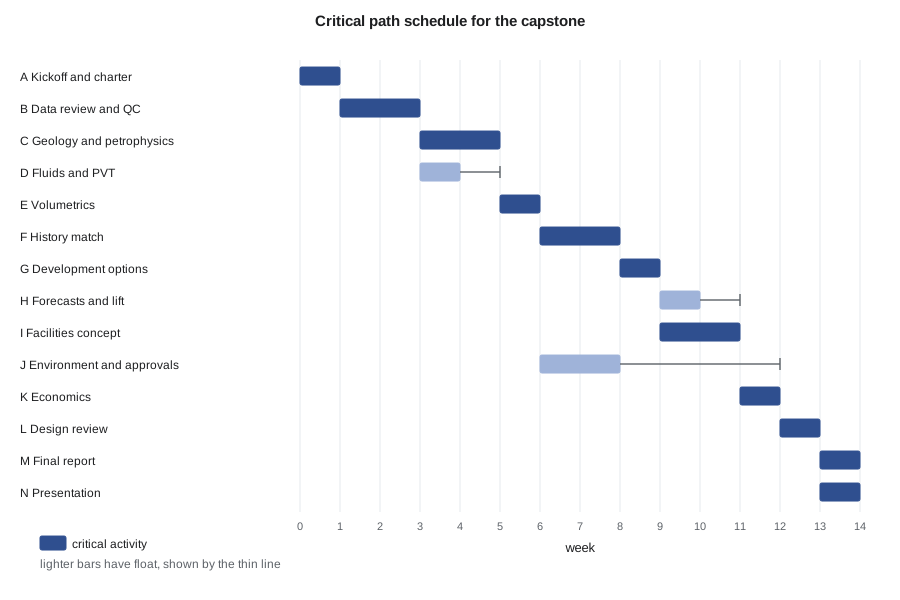
The schedule changes how the team works. Because the history match is critical and depends on Mateo, the team agrees that Connor will start the volumetric uncertainty work in week 5 with provisional fluid properties, so that Mateo can begin setting up the tank model before the volumetrics are final. Because the environmental plan has float, Daniel starts it early and works on it in the gaps around the economics, rather than leaving it to the end. And because the facilities concept is critical, Hannah asks Sofia Reyes for a cost database and a sketch of a recent Prairie Crest sour battery in week 2, long before she needs them.
Worked problem
Float and a late deliverable
In week 7, the lab tells Mateo that a repeat measurement of the bubble point will take an extra week. The PVT activity (D) was scheduled for week 3 to 4 with one week of float, but it is already finished on the original data. The repeat affects the history match (F), which uses the bubble point to check that the reservoir stayed above it during the test. Should the team change the schedule?
Show solution
- The history match is on the critical path, so any delay to it delays the project.
- The test pressures stayed more than 2,700 psi above the measured bubble point, so a revised bubble point is very unlikely to change the history match, which assumes undersaturated oil.
- The revised bubble point does matter for the forecasts (H), which have one week of float, and for the development options (G), which are critical.
Answer: Keep the schedule. Mateo completes the history match with the existing value, records the assumption in the master data sheet, and checks the sensitivity of the depletion forecast to a bubble point 150 psi higher. When the repeat result arrives, the team updates the forecasts within their float.
Risks to the project itself
The team also keeps a short risk register for the capstone itself, separate from the technical risks of the field. It lists the events that could stop the team delivering a sound plan on time, with a likelihood, a consequence and an action for each. The top three entries are that the history match does not converge or gives a non-unique answer, that the sponsor's cost data arrive late, and that a team member is unavailable for a period. For the first, the action is to start the tank model early and agree with Ethan in advance how a non-unique match would be presented. For the second, it is to build the economic model with placeholder costs from published sources so that the real numbers can be dropped in. For the third, it is the supporting role in the charter: every lead area has a second person who knows it.
Finally, the team agrees what success looks like. It is not a particular answer. It is a plan that the sponsor's development committee could act on: consistent numbers, honest uncertainty, a clear recommendation, and a list of the work the define stage must do before the company commits the bulk of the capital.
Common mistakes
MistakeStarting the technical work before agreeing on roles, reviews and a master data sheet.
InsteadSpend the first week on the charter, the schedule and a single source for shared numbers; it saves weeks later.
MistakeTreating the schedule as a list of dates rather than a network of dependencies.
InsteadUse the critical path to see which delays matter and to decide where to add effort.
MistakeAssuming the sponsor wants the project to go ahead.
InsteadThe sponsor wants a defensible decision; recommending delay or rejection can be the right answer.
MistakeLeaving hazards such as hydrogen sulfide to be dealt with in detailed design.
InsteadMake known hazards design premises from the start, because they shape every option.
Summary and key terms
- A field development plan justifies the capital to develop a discovery and explains why the recommended option is preferred over the alternatives.
- Projects pass through appraise, select, define, execute and operate stages separated by decision gates; the capstone covers appraise and select.
- The FDP is a chain of linked estimates: volumes, recovery, forecasts, facilities, costs, value and risk.
- A team charter, clear lead and review roles and a single master data sheet prevent most organizational failures.
- The critical path method finds the activities whose delay would delay the project; float shows where there is room.
- Professional obligations of honesty, competence and public safety apply to every number in the plan.
- Field development plan (FDP)
- The document that describes a discovery, the development options, the recommended option and its justification.
- Decision gate
- A point between project stages at which management decides whether to proceed, recycle or stop.
- Team charter
- A short agreement on a team's objective, roles, decision-making, reviews and conflict resolution.
- Master data sheet
- A single controlled list of the shared input numbers used by every discipline, with their sources.
- Critical path
- The longest chain of dependent activities through a project; any delay on it delays the project.
- Float
- The time an activity can slip without delaying the project end date.
- Sour gas
- Natural gas containing hydrogen sulfide.
Practice problems
Work each problem on paper first, then reveal the answer to check.
Name the five stages of a typical development project.
Show answer
Appraise, select, define, execute and operate.
An activity has an earliest start of week 6 and a latest start of week 10. What is its float?
Show answer
Four weeks.
Why should every piece of technical work in the capstone have a reviewer other than its author?
Show answer
Most serious errors are simple, such as unit mistakes or out-of-date numbers, and a second reviewer catches most of them.
Give two reasons why a sponsor might welcome a recommendation not to develop a discovery yet.
Show answer
It avoids committing capital to a project that does not meet its criteria, and it identifies the information needed to make a better decision later.
Lesson quiz · 5 questions
Score 60% or more to complete this lesson.
Create a free account to save your progress, take quizzes and earn a certificate.