
PET-360 · Lesson 1 of 12 · 22 min
Why test wells: objectives and test types
Ethan Cardinal's last rotation before he writes his professional practice exam brings him back to the reservoir group at Prairie Crest Energy Inc., where Lena Haugen has a new problem for him. The company has drilled, logged, completed and produced wells across the Tamarack Lake field, and every one of those steps left a question that only a well test can answer. How permeable is the rock away from the near-wellbore damage? Did the stimulation work? Is there a fault close to the 7-15 well? Is the disposal well taking water without fracturing the rock? 'Logs and core tell you about the rock a few centimeters from the hole,' Lena tells him. 'A well test tells you what the reservoir does when you ask it to flow. For the next twelve weeks you will work with Rafael Moreau, our well-test specialist, and you will design, run and interpret the tests that the field plan depends on.'
This course is about pressure transient testing: changing the rate of a well, recording the pressure response at the bottom of the hole, and interpreting that response to learn about the reservoir and the well. This first lesson explains why wells are tested, what kinds of tests are run, what each test can and cannot tell you, how a test is put together in the field, and what regulators require. Later lessons develop the theory, starting with the diffusivity equation in lesson 2, and work through drawdowns, buildups, the pressure derivative, type curves, boundaries, fractured reservoirs, fractured horizontal wells, gas wells, injection wells and test design.
What a well test measures
A well test is a controlled experiment. The engineer imposes a known change in flow rate at the well, such as opening it to flow or shutting it in, and measures how the bottomhole pressure responds over time. The response depends on the properties of the rock and fluids, on the condition of the well, and on the shape and size of the reservoir. Because the pressure disturbance spreads outward from the well as time passes, early data describe the well and the rock close to it, and later data describe rock farther away. A test that runs long enough can reach a fault, the edge of the pool, or the drainage area of a neighboring well.
The main results of a well test are the permeability-thickness product kh, from which the average permeability follows when thickness is known; the skin factor, which measures damage or stimulation near the well; the average or initial reservoir pressure; the distance to boundaries and the type of boundary; and, for some reservoirs, parameters that describe natural fractures, layers, hydraulic fractures or composite regions. These are effective values averaged over the volume of rock the test has investigated, which is far larger than any core or log sample.
This scale is the main reason well tests matter. A core plug from the Mission Canyon might measure 15 mD, but the plug may come from the best part of the interval, and the core cannot say whether the layers connect over hundreds of meters. A log says nothing direct about permeability. A buildup test on the same well measures the flow capacity of the rock that actually feeds the well, including any fractures, lenses or barriers. When core, log and test numbers disagree, the test usually tells the reservoir engineer what the well will do, and the core and logs help explain why.
The objectives of testing
Every test should start with a written objective, because the objective decides what kind of test to run, how long it must last and how accurate the gauges must be. Rafael keeps a short list of the reasons Prairie Crest tests wells.
| Objective | Typical test | Main results |
|---|---|---|
| Evaluate a new discovery or delineation well | Drill stem test, then a flow and buildup | Reservoir pressure, permeability, skin, fluid samples, early boundary signs |
| Check damage or stimulation | Buildup before and after a treatment | Skin before and after, so the treatment can be judged |
| Track reservoir pressure | Periodic buildup or static gradient | Average pressure for material balance |
| Find boundaries and pool size | Long drawdown or buildup | Distance to faults, closed volume |
| Design and monitor injection | Injectivity, falloff and step-rate tests | Permeability, skin, fracture pressure, well integrity |
| Measure connectivity between wells | Interference or pulse test | Communication, permeability and storage between wells |
| Measure gas well deliverability | Back-pressure or isochronal test | Absolute open flow potential, deliverability curve |
Tests also have costs. A buildup means lost production while the well is shut in, and a long buildup on a good well can defer a lot of oil. A drawdown keeps the well producing but needs a steady rate, which is hard to hold in practice. Surface equipment, gauges, wireline or slickline work, and engineering time all cost money. The art of test design is to collect enough data to answer the question without shutting in a well longer than the answer is worth. Lesson 12 returns to this with a full design for the 4-22H well.
The main types of test
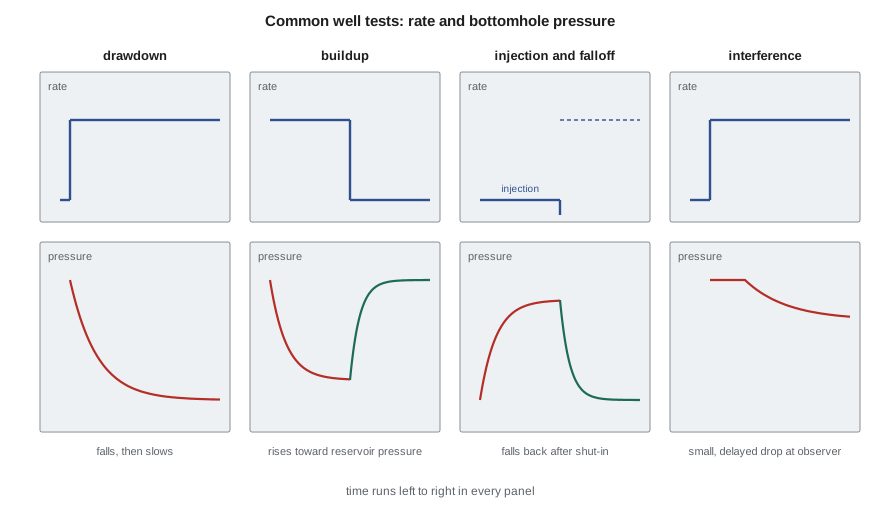
A drawdown test opens a well that has been shut in long enough for the pressure to be uniform, and then produces it at a constant rate while recording the falling bottomhole pressure. In principle it is the simplest test, because it is one rate change from a known starting state. In practice the rate is rarely constant, especially early in the test when the well is cleaning up, so drawdown data are noisier than buildup data. Drawdowns are useful when shutting in is too expensive, and long drawdowns, called reservoir limit tests, are used to measure the volume a well drains.
A buildup test shuts in a well that has been producing and records the rising pressure. The rate after shut-in is exactly zero at surface, which makes the data clean, although fluid can keep flowing into the wellbore for a while after the surface valve closes. Buildups are the most common test in the industry and the main source of reservoir pressure data. Lesson 4 develops their analysis.
An injection test is the mirror image of a drawdown, and a falloff test is the mirror image of a buildup. They are run on water injection and disposal wells, where the pressure rises during injection and falls after shut-in. A step-rate test injects at a series of increasing rates to find the pressure at which the rock starts to part. Disposal and injection wells are regulated closely, and lesson 11 covers these tests with the Tamarack SWD-1 disposal well.
An interference test produces or injects at one well and measures the small pressure response at another well some distance away. A pulse test does the same with a series of short rate changes. These tests show whether two wells are connected and measure the properties of the rock between them, which no single-well test can do.
A drill stem test, or DST, is a temporary completion made with the drill string, often in an exploration or delineation well before casing is run. Packers isolate the zone of interest, a downhole valve opens and closes the zone, and gauges record short flow and shut-in periods. A DST can give a reservoir pressure, a permeability estimate and a fluid sample within a day or two. Wireline formation testers, introduced in PET-350, measure pressure at many depths but over tiny volumes; a DST bridges the gap between them and a full production test.
A diagnostic fracture injection test, or DFIT, pumps a small volume of fluid to create a short fracture and then records the falloff for days or weeks. Completion engineers use it mainly for closure stress, as PET-330 showed, and reservoir engineers use the late falloff to estimate reservoir pressure and permeability in tight rock where a conventional buildup would take months.
How far a test sees
The pressure disturbance from a rate change spreads through the reservoir like heat spreading through a metal bar. The distance it has reached after a given time is called the radius of investigation. It is not a sharp front, but it gives a useful measure of how much rock a test has sampled. In oilfield units it is commonly written as follows, with time in hours, permeability in millidarcies, viscosity in centipoise and compressibility in reciprocal psi.
In metric units, with compressibility in reciprocal kilopascals and the radius in meters, the constant 948 becomes about 70,350. The important feature is the square root: to see twice as far, a test must run four times as long. A test that sees 300 m in three days needs twelve days to see 600 m. Low permeability, high viscosity and high compressibility all slow the spread. In tight rock such as the Bakken away from the best sand, a practical test may investigate only a few tens of meters.
# Radius of investigation for a planned buildup, and the test length needed to see a chosen distance
import math
SI = False
PSI_PER_KPA = 1 / 6.894757
FT_PER_M = 3.28084
if SI:
    name = "102/06-14 Cardium vertical well"
    k, phi, mu, ct_kpa = 15.0, 0.14, 0.72, 1.5e-6      # mD, fraction, mPa.s, 1/kPa
    ct = ct_kpa / PSI_PER_KPA                            # convert to 1/psi for the field-unit formula
    unit, scale, target = "m", 1 / FT_PER_M, 300.0       # report distances in meters
else:
    name = "Tamarack 7-15 Mission Canyon well"
    k, phi, mu, ct = 25.0, 0.12, 0.90, 1.2e-5            # mD, fraction, cp, 1/psi
    unit, scale, target = "ft", 1.0, 1000.0
def r_inv_ft(t_hours):                                  # r_i = sqrt(k t / (948 phi mu ct)), field units
    return math.sqrt(k * t_hours / (948 * phi * mu * ct))
print(name)
print(" time (h)   radius of investigation (" + unit + ")")
for t in (1, 6, 24, 72, 168):
    print(f"{t:8d}   {r_inv_ft(t) * scale:10.0f}")
target_ft = target / scale
t_need = 948 * phi * mu * ct * target_ft ** 2 / k
print(f"shut-in time to investigate {target:.0f} {unit}: {t_need:.1f} h")
print(f"doubling the distance needs {4 * t_need:.1f} h: time grows with distance squared")Tamarack 7-15 Mission Canyon well
time (h) radius of investigation (ft)
1 143
6 349
24 699
72 1210
168 1849
shut-in time to investigate 1000 ft: 49.1 h
doubling the distance needs 196.6 h: time grows with distance squaredRafael uses this calculation before every test. For the Tamarack 7-15 well, a three-day buildup sees a few hundred feet into the reservoir, which is enough to check the permeability away from the well and to look for a fault mapped from seismic data. Seeing the far edge of the pool would take weeks, which would cost more in deferred production than the answer is worth.
Equipment and data
A modern test depends on the pressure gauge. Quartz gauges have resolutions of a few hundredths of a psi or better and drift only slightly over weeks. They are run on wireline or slickline and hung near the producing interval, or installed permanently below a packer. Permanent downhole gauges record pressure continuously for the life of the well, so every unplanned shut-in becomes a buildup that can be analyzed. Surface gauges are cheaper but must be corrected for the fluid column in the well, which changes during a test as gas separates and liquid levels move.
Rates matter as much as pressures. A buildup interpretation needs the producing history before shut-in, including the rate just before the well was closed, because the theory uses superposition of rate changes (lessons 2 and 4). Test separators, multiphase meters or well tests through the battery provide rates. Fluid samples, gas-oil ratios and water cuts are recorded so that the right viscosity, formation volume factor and compressibility can be used in the analysis.
Many tests also use a downhole shut-in valve. When a well is shut in at surface, fluid keeps flowing from the reservoir into the wellbore until the wellbore pressure catches up. This afterflow, or wellbore storage, hides the reservoir response for the first part of the test, sometimes for many hours. Closing the well at the bottom of the hole cuts the wellbore volume and shortens the storage period. Lesson 6 develops wellbore storage in detail.
Regulation and reporting
In North Dakota, the Industrial Commission's Oil and Gas Division sets testing and reporting requirements for oil and gas wells, including reservoir pressure reporting for many pools and the conditions attached to each well's permit. Class II disposal and injection wells are regulated under the state's underground injection control program, which the US Environmental Protection Agency has approved, and permits commonly require mechanical integrity tests and, in some cases, falloff or step-rate tests. Test data filed with the state become part of the well file, which helps operators compare their results with tests on neighboring wells.
Testing also has safety requirements. Flowing a new well to surface brings hydrocarbons, possibly hydrogen sulfide, and high pressures to temporary equipment. Test equipment must be rated for the expected pressures, flowlines must be secured, flares must be placed and lit safely, and the crew must have the training and procedures that the operator's safety program requires. PET-310 covered well control and hydrogen sulfide safety, and the same rules apply when a well test brings the formation into the wellbore.
Worked problem
Choosing a test
The Tamarack 7-15 well has been producing for a month. Lena wants to know the permeability away from the well, the skin, and whether a fault mapped about 500 ft away affects the well. She can afford to shut the well in for about four days. Which test should Rafael recommend, and will four days be long enough?
Show solution
- The well is producing, so a buildup gives the cleanest data without needing a steady rate.
- Permeability and skin come from the radial flow period, which should start within hours once storage ends.
- To see a fault at distance L, the test must investigate a few times L; the response shows clearly only when the radius of investigation is well beyond the fault.
- From the code above, the radius of investigation reaches a few hundred feet in three days, about twice the fault distance.
Answer: A buildup of about four days, with a downhole gauge and, if possible, a downhole shut-in valve. It should give permeability and skin early and begin to show the fault late in the test. Lesson 7 shows what the fault looks like.
Common mistakes
MistakeRunning a test without a written objective.
InsteadWrite down the questions first; they decide the test type, length and gauge.
MistakeAssuming a test sees the whole pool.
InsteadCheck the radius of investigation; time grows with the square of the distance to be seen.
MistakeTreating a surface pressure as a bottomhole pressure.
InsteadUse a downhole gauge or correct carefully for the changing fluid column.
MistakeIgnoring the rate history before a buildup.
InsteadRecord rates before shut-in; the analysis uses them through superposition.
MistakeComparing core permeability directly with test permeability.
InsteadRemember the scale difference; the test averages a much larger volume.
Summary and key terms
- A well test changes the rate at a well and records the pressure response to learn about the well and reservoir.
- Main results are kh, skin, reservoir pressure, boundaries and special reservoir parameters, averaged over a large volume.
- Drawdowns, buildups, injection and falloff, step-rate, interference, pulse, drill stem and DFIT tests each serve different objectives.
- The radius of investigation grows with the square root of time, so seeing farther costs much more test time.
- Downhole gauges, accurate rate histories and downhole shut-in improve data quality.
- Regulators set testing and reporting requirements, especially for new pools, gas wells and injection wells.
- Pressure transient test
- A test that changes a well's rate and interprets the pressure response over time.
- Drawdown test
- A test that produces a well at constant rate and records the falling pressure.
- Buildup test
- A test that shuts in a producing well and records the rising pressure.
- Falloff test
- A test that shuts in an injection well and records the falling pressure.
- Radius of investigation
- The approximate distance the pressure disturbance has reached at a given time.
- Drill stem test
- A temporary test of a zone made with the drill string and downhole valves.
Practice problems
Work each problem on paper first, then reveal the answer to check.
Why is buildup data usually cleaner than drawdown data?
Show answer
The rate after shut-in is exactly zero, while a flowing rate is hard to hold constant.
How much longer must a test run to see three times as far?
Show answer
Nine times as long.
Name a test that measures connectivity between two wells.
Show answer
An interference or pulse test.
Why do many operators prefer a downhole shut-in valve?
Show answer
It reduces wellbore storage so the reservoir response appears sooner.
Lesson quiz · 5 questions
Score 60% or more to complete this lesson.
Create a free account to save your progress, take quizzes and earn a certificate.