
PET-330 · Lesson 7 of 12 · 19 min
Hydraulic fracturing fundamentals
The 4-22H will be drilled into the Bakken, where permeability is a few thousandths of a millidarcy. Without hydraulic fractures it would produce almost nothing; with forty stages of them, the 3-22H has already produced about 300,000 barrels. Before Ethan designs the next well's fractures, Tom sends him back to the rock. 'A fracture is the rock's answer to the pressure you push into it. You can't design the question until you know how the rock will answer. Start with the stresses.'
This lesson covers the physics that every fracture design rests on: the stresses in the earth, how a fracture starts and grows, which way it points, how the pressure in it behaves, and how a small injection test measures the stress that controls everything else.
What hydraulic fracturing does
Hydraulic fracturing pumps fluid into a well faster than the rock can accept it through its pores, so that the pressure rises until the rock splits. Continued pumping extends the crack, and solid particles called proppant are carried into it to hold it open when pumping stops. The result is a narrow, highly conductive slot, often a fraction of an inch wide but hundreds of feet long, through which oil and gas flow to the well far more easily than through the rock.
The technique dates from the late 1940s in the United States and has been used in many hundreds of thousands of wells. For decades it was mainly used to stimulate conventional wells with damage or moderate permeability. Since the 2000s, combined with long horizontal wells, it has made very tight shales and sands into major oil and gas producers in both countries. The fundamentals are the same in both uses; the scale and the design priorities differ.
Stresses in the earth
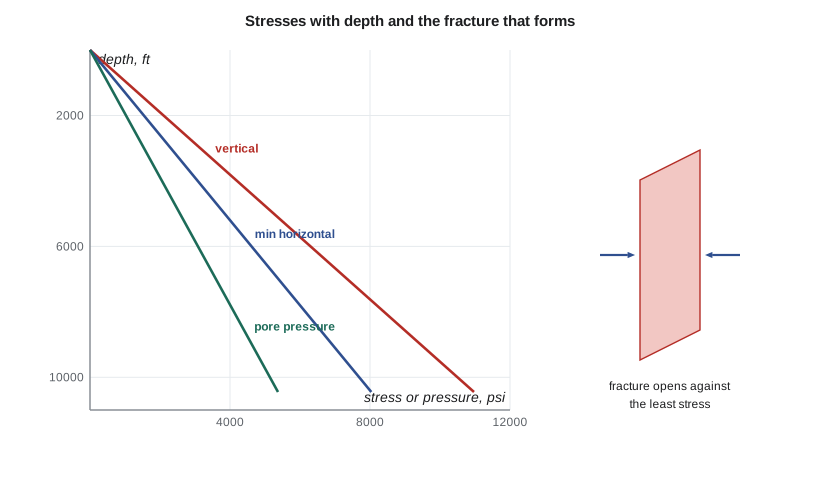
Rock at depth is under compression from three principal stresses that are, in most sedimentary basins, close to vertical and horizontal. The vertical stress, Sv, is the weight of everything above: it equals the integral of the bulk density over depth, usually about 1.0 to 1.1 psi/ft. The two horizontal stresses, the minimum Shmin and the maximum SHmax, depend on the rock's elastic properties, the pore pressure and tectonic forces.
A widely used first estimate assumes that the rock is laterally confined as it is buried, so it cannot expand sideways. Elastic theory then gives the minimum horizontal stress from Poisson's ratio ν, the vertical stress, the pore pressure p and Biot's coefficient α, plus a tectonic term for any extra horizontal push.
Two lessons follow from this equation. First, stress depends on pore pressure: depleted rock has lower stress, overpressured rock higher. Second, stress varies with rock type, because Poisson's ratio differs: shales usually have higher ν and therefore higher horizontal stress than adjacent clean sandstones or carbonates. Those stress contrasts are what contain, or fail to contain, fracture height. Because the uniaxial model is only an estimate, engineers calibrate it with measured closure stresses from injection tests and use it to fill in the profile between measurements.
Which way the fracture points
A fracture opens in the direction that needs the least force: against the minimum principal stress. It therefore grows in the plane perpendicular to that stress. In most oil and gas basins at the depths of interest, the vertical stress is the largest and the minimum stress is horizontal, so fractures are vertical, with their long dimension along the maximum horizontal stress direction. At shallow depths, or where tectonic compression is strong, the vertical stress can be the smallest and fractures may be horizontal, which is one reason shallow fracturing behaves differently.
Horizontal wells are drilled to take advantage of this. A well drilled along the minimum horizontal stress direction receives fractures transverse to the wellbore, like pages of a book along its spine, and many separate fractures can be placed along one lateral. A well drilled along the maximum stress direction would receive one long longitudinal fracture along its length. Most unconventional laterals are drilled transverse, while some conventional reservoirs with higher permeability use longitudinal fractures.
Starting a fracture
Near the wellbore the stresses are concentrated by the hole itself. Kirsch's solution for a vertical hole in a uniform stress field shows that the wall carries a hoop stress of 3Shmin − SHmax − p at its least compressive point, so the pressure needed to break the rock, the breakdown pressure, is roughly that value plus the rock's tensile strength.
In practice breakdown pressures are affected by perforations, cement, fluid penetration into the rock and the hole's orientation, so they vary widely. What matters for design is that once the fracture has grown beyond the near-wellbore stress concentration, it propagates at a pressure only somewhat above the minimum horizontal stress. Treating pressures are therefore governed mainly by Shmin plus the net pressure needed to hold the fracture open and push fluid along it.
Net pressure
The net pressure is the fluid pressure in the fracture minus the closure stress. It is what actually opens the fracture: elastic theory shows that the width of a fracture is proportional to the net pressure times its smallest dimension, divided by the rock's stiffness. Stiffness is measured by the plane-strain modulus E′ = E/(1 − ν²), where E is Young's modulus.
Net pressures are typically tens to hundreds of psi. A rising net pressure during a job, plotted on a log-log scale against time, tells the engineer whether the fracture is growing in length, being contained in height, or approaching a screenout; Nolte and Smith made this interpretation standard in the 1980s.
Measuring the closure stress
The single most important number in fracture design is the closure stress, the pressure at which the fracture closes, which approximates Shmin. It is measured with a small injection test before the main job, often called a diagnostic fracture injection test, DFIT, or a minifrac. A small volume of fluid, a few tens of barrels, is pumped to create a small fracture, then the well is shut in and the pressure decline is recorded for hours or days.
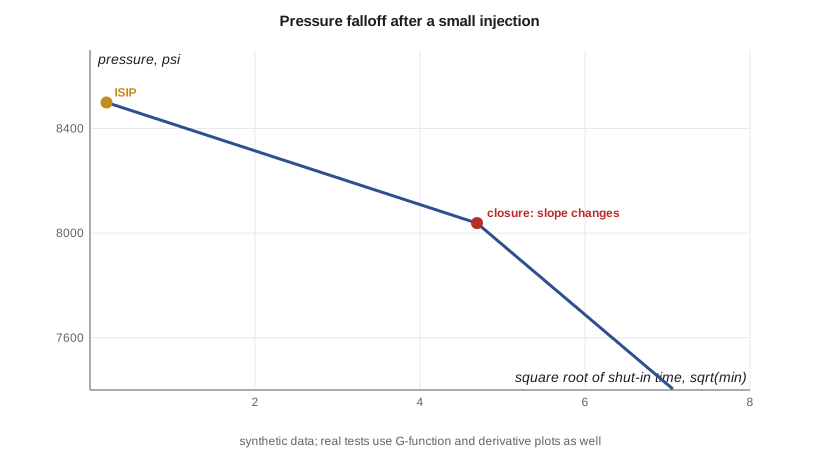
The instantaneous shut-in pressure, ISIP, read just after pumping stops, removes the friction in the pipe and perforations and approximates the pressure in the fracture. As fluid leaks into the rock, the fracture closes, and the pressure decline changes character. Plots of pressure against the square root of time, or against Nolte's G-function, together with their derivatives, show closure as a change of slope. After closure, the continued decline gives information about reservoir pressure and permeability.
# In-situ stress from the uniaxial strain model, breakdown pressure, and a closure pick from a synthetic falloff
import math
SI = False
if SI:   # 03-22 Cardium horizontal: depth m, pressures kPa
    tvd, sv_grad, pore = 1560.0, 23.0, 14090.0
    nu, biot, tect, aniso, tensile = 0.22, 1.0, 3000.0, 1500.0, 3000.0
    pu, gu = "kPa", "kPa/m"
else:    # 3-22H Bakken: depth ft, pressures psi
    tvd, sv_grad, pore = 10450.0, 1.05, 5370.0
    nu, biot, tect, aniso, tensile = 0.25, 1.0, 800.0, 250.0, 500.0
    pu, gu = "psi", "psi/ft"
sv = sv_grad * tvd
shmin = nu / (1 - nu) * (sv - biot * pore) + biot * pore + tect
shmax = shmin + aniso
print(f"vertical stress {sv:,.0f} {pu} ({sv_grad} {gu})")
print(f"minimum horizontal stress {shmin:,.0f} {pu} ({shmin/tvd:.3f} {gu}); maximum horizontal {shmax:,.0f} {pu}")
print(f"stress regime: {'normal faulting (Sv largest), so fractures are vertical' if sv > shmax else 'Sv is not the largest stress'}")
pb = 3 * shmin - shmax - pore + tensile      # Kirsch breakdown for a vertical hole, impermeable wall
print(f"breakdown pressure estimate (vertical hole, no filtration): {pb:,.0f} {pu}; propagation needs only a bit over {shmin:,.0f}")
# synthetic falloff after a small injection: pressure falls linearly with sqrt(time) before closure, faster after
isip = shmin * 1.06
times = [0.5 * i for i in range(1, 121)]       # minutes
tc = 22.0                                      # true closure time used to build the data
def p_of(t):
    a = (isip - shmin) / math.sqrt(tc)
    return isip - a * math.sqrt(t) if t <= tc else shmin - 2.6 * a * (math.sqrt(t) - math.sqrt(tc))
data = [(t, p_of(t)) for t in times]
# pick closure where the slope against sqrt(time) departs from the early straight line by more than 15 percent
early = [(math.sqrt(t), p) for t, p in data[:10]]
slope = (early[-1][1] - early[0][1]) / (early[-1][0] - early[0][0])
pick = None
for (t1, p1), (t2, p2) in zip(data, data[1:]):
    sl = (p2 - p1) / (math.sqrt(t2) - math.sqrt(t1))
    if abs(sl) > 1.15 * abs(slope): pick = (t1, p1); break
print(f"instantaneous shut-in pressure {isip:,.0f} {pu}; closure picked at {pick[0]:.1f} min, {pick[1]:,.0f} {pu} (closure stress)")
print(f"net pressure at shut-in {isip - pick[1]:,.0f} {pu}")vertical stress 10,972 psi (1.05 psi/ft) minimum horizontal stress 8,038 psi (0.769 psi/ft); maximum horizontal 8,288 psi stress regime: normal faulting (Sv largest), so fractures are vertical breakdown pressure estimate (vertical hole, no filtration): 10,955 psi; propagation needs only a bit over 8,038 instantaneous shut-in pressure 8,520 psi; closure picked at 22.0 min, 8,038 psi (closure stress) net pressure at shut-in 482 psi
For the 4-22H, the stress model gives a vertical stress of about 10,970 psi and a minimum horizontal stress of about 8,040 psi at 10,450 ft, a gradient of 0.77 psi/ft. The breakdown estimate of about 10,950 psi shows why the first stage often needs a spearhead of acid or extra pressure to break down; propagation then needs only a little more than 8,040 psi. The synthetic falloff confirms closure at the stress the model predicts, with a net pressure of about 480 psi at shut-in. In the real program, a DFIT on the 4-22H itself will replace the model value.
Rock properties for fracturing
Young's modulus controls how wide a fracture opens for a given net pressure: stiff rock gives narrow fractures, soft rock wide ones. Poisson's ratio affects the stress profile. Fracture toughness, the rock's resistance to crack growth, matters for small fractures but usually less than fluid friction for large ones. These properties come from laboratory tests on core and from sonic logs, which measure compressional and shear velocities. Log-derived dynamic properties differ from the static values that govern fracture opening and must be corrected.
Engineers also talk about brittleness: rocks rich in quartz or carbonate, with low Poisson's ratio and high modulus, tend to fracture into more complex networks and hold proppant better, while clay-rich rocks are ductile, close more readily on proppant and may embed it. Brittleness indices are rough guides, not physical laws, but they help choose landing zones in a horizontal well.
Fluid leak-off
As fluid flows into the fracture, some leaks into the rock through the fracture faces. In permeable rock, leak-off is large and the fluid builds a filter cake on the faces; in tight rock it is small. Carter's model describes leak-off velocity as a coefficient divided by the square root of the time since each face was exposed. The fraction of pumped fluid that remains in the fracture at the end of the job is the fluid efficiency. High efficiency means long, wide fractures for the volume pumped; low efficiency means much of the fluid is lost, and pad volumes must be larger. Lesson 8 uses leak-off in geometry models.
Safety and well integrity during fracturing
Fracturing pressures are among the highest that a well ever sees. Before a job, the casing, wellhead, frac tree and treating lines are pressure tested above the maximum expected pressure, and pressure relief valves and automatic shutdowns are set on the pumps. The annulus is monitored for any rise that would show a leak. Nobody enters the high-pressure zone around the treating lines while pumping. Offset wells nearby are monitored for pressure communication, because a fracture that reaches a producing neighbor can damage it or cause a well control incident.
Worked problem
Closure stress from a stress gradient
A sandstone at 8,000 ft has an Sv gradient of 1.0 psi/ft, pore pressure 3,600 psi, ν = 0.25, α = 1 and no tectonic stress. Estimate Shmin.
Show solution
- Sv = 1.0 × 8,000 = 8,000 psi.
- ν/(1 − ν) = 0.25/0.75 = 0.333.
- Shmin = 0.333 × (8,000 − 3,600) + 3,600 = 1,467 + 3,600 = 5,067 psi.
- Gradient: 5,067/8,000 = 0.63 psi/ft.
Answer: A first estimate to be calibrated against a measured closure stress.
Common mistakes
MistakeDesigning a fracture from a breakdown pressure.
InsteadUse the closure stress; breakdown reflects near-wellbore effects.
MistakeAssuming fractures always grow vertically.
InsteadFractures open against the least stress; at shallow depth that may be vertical stress.
MistakeUsing dynamic log moduli directly.
InsteadCorrect dynamic moduli to static values before predicting width.
MistakeIgnoring stress differences between layers.
InsteadStress contrasts control height growth; build a layered stress profile.
MistakeSkipping the DFIT to save time.
InsteadMeasured closure stress anchors the whole design.
Summary and key terms
- Fractures are created by pumping above the rock's ability to take fluid, then propped open.
- The vertical stress comes from overburden; horizontal stresses depend on Poisson's ratio, pore pressure and tectonics.
- Fractures open against the least stress and grow perpendicular to it, usually vertically.
- Laterals drilled along the minimum stress get transverse fractures.
- Net pressure, the pressure above closure, opens the fracture; width scales with net pressure over stiffness.
- A DFIT measures closure stress and leak-off before the main job.
- Minimum horizontal stress
- The smallest horizontal compressive stress in the rock, usually the closure stress.
- Closure stress
- The pressure at which a fracture closes, approximating the minimum principal stress.
- Breakdown pressure
- The pressure needed to initiate a fracture at the wellbore.
- Net pressure
- Fracture fluid pressure minus closure stress.
- ISIP
- Instantaneous shut-in pressure, read just after pumping stops.
- DFIT
- A diagnostic fracture injection test used to measure closure stress and leak-off.
- Fluid efficiency
- The fraction of pumped fluid that remains in the fracture at the end of pumping.
Practice problems
Work each problem on paper first, then reveal the answer to check.
Why are fractures in most basins vertical?
Show answer
The vertical stress is usually the largest, so the least stress is horizontal and fractures open against it.
Why do shales often contain fracture height?
Show answer
They usually have higher Poisson's ratio and therefore higher horizontal stress than adjacent sands.
What does ISIP remove from the treating pressure?
Show answer
Friction in the pipe and perforations.
How does depletion affect fracturing?
Show answer
Lower pore pressure lowers the horizontal stress, so fractures may grow toward depleted zones.
Lesson quiz · 5 questions
Score 60% or more to complete this lesson.
Create a free account to save your progress, take quizzes and earn a certificate.