
PET-330 · Lesson 3 of 12 · 20 min
Perforating
Perforating is the moment the reservoir and the wellbore meet. Before it, the rock sits behind steel and cement; after it, the two are connected by holes about a third of an inch across. Tom takes Ethan to watch a perforating job on a vertical Mission Canyon well being recompleted in the field. The wireline crew arms the guns behind a barricade, the radios in the trucks are switched off, and nobody stands near the wellhead until the guns are below a safe depth. 'Everything you see here is about two things,' Tom says. 'Making good holes, and making sure nobody gets hurt doing it.'
This lesson explains how perforations are made, how their geometry affects well productivity, how to choose shot density, phasing and penetration, how underbalance cleans the tunnels, and how perforating is done safely. It treats perforating charges as a manufactured product supplied and handled by specialists; the engineer's job is to specify the performance needed and to run the operation safely.
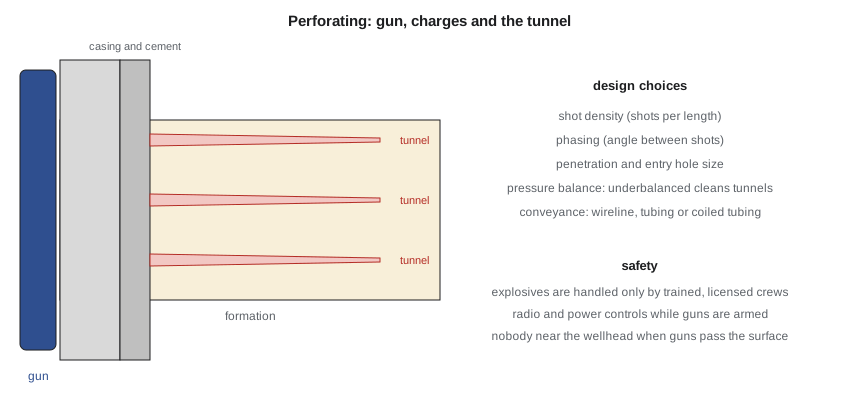
How a perforation is made
Modern perforating uses shaped charges: small, factory-made explosive units held in a steel carrier called a gun. When the charges fire, each forms a high-velocity jet that punches through the gun wall, the completion fluid, the casing and the cement, and drives a tunnel into the rock. The jet does not burn or melt its way through; it pushes material aside at extreme pressure. The tunnel is typically about a foot long, depending on the charge and on rock strength and stress, and its entry hole in the casing is a few tenths of an inch across.
Charge manufacturers rate their products in standardized tests, such as those in API Recommended Practice 19B, that shoot into concrete targets. Field penetration in stressed reservoir rock is usually much shorter than the test value, so engineers correct the catalog figure for rock strength and effective stress. Two families of charges serve different needs: deep-penetrating charges for maximum tunnel length in natural completions, and big-hole charges for large, consistent entry holes where sand or proppant must pass, such as in gravel packs and many fracture treatments.
Conveyance
Guns can be run on electric wireline, which allows depth correlation with a gamma ray or collar locator log and selective firing of individual guns; on tubing (tubing-conveyed perforating), which allows long intervals and high underbalance in one run and is useful in deviated wells; or on coiled tubing. In horizontal wells, wireline guns are pumped down the casing, as in the plug-and-perf method of lesson 1. Each method is chosen by interval length, deviation, pressure control and cost.
Perforation geometry and skin
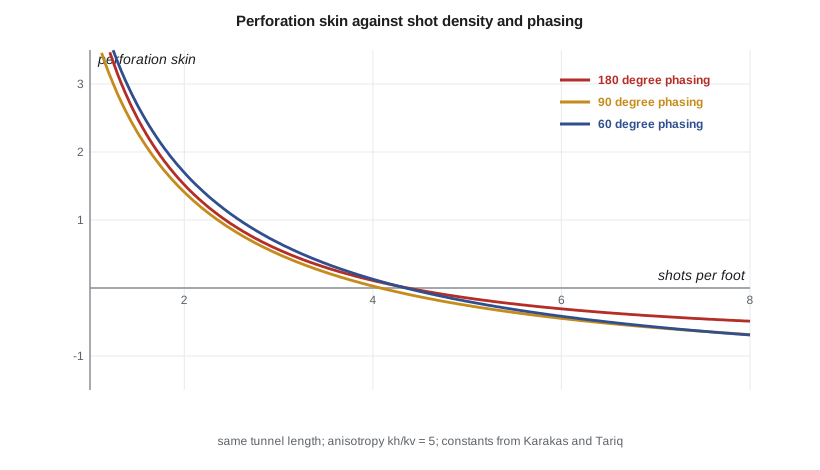
Flow converging into a few small tunnels, instead of through the full open wall of the wellbore, creates an extra pressure drop near the well: the perforation skin. Its size depends on the number of holes per unit length (shot density), the angle between successive shots (phasing), the tunnel length (penetration), the tunnel radius and the ratio of horizontal to vertical permeability.
Karakas and Tariq published a widely used method that splits the perforation skin into three parts. A horizontal flow term, sH, accounts for flow converging toward the tunnels in plan view and is usually negative, because long tunnels act like a larger wellbore. A vertical convergence term, sV, accounts for flow bending toward the tunnels from above and below; it grows when shots are far apart and vertical permeability is low. A wellbore term, sWB, is usually small.
In this equation, aθ is a constant for each phasing, rw the wellbore radius and lp the penetration. The vertical term uses the dimensionless spacing hD = (h/lp)√(kH/kV), where h here is the distance between shots, and the dimensionless tunnel radius rpD; its constants also depend on phasing.
Beyond geometry, the tunnel is surrounded by a crushed zone about half an inch thick, where the jet has broken grains and lowered permeability. If it is not cleaned out, it adds a further skin. Debris from the charges and the casing can also plug tunnels.
# Perforation skin by the Karakas-Tariq method, with a crushed-zone term (McLeod)
import math
SI = False
# phasing (degrees): a_theta, a1, a2, b1, b2, c1, c2 (constants as published by Karakas and Tariq, 1991)
KT = {180: (0.500, -2.025, 0.0943, 3.0373, 1.8115, 2.6e-2, 4.532),
      120: (0.648, -2.018, 0.0634, 1.6136, 1.7770, 6.6e-3, 5.320),
      90:  (0.726, -1.905, 0.1038, 1.5674, 1.6935, 1.9e-3, 6.155),
      60:  (0.813, -1.898, 0.1023, 1.3654, 1.6490, 3.0e-4, 7.509)}
if SI:   # vertical Cardium well 102/06-14: lengths in m
    rw, rp, kh_kv = 0.10, 0.0055, 5.0          # wellbore radius, perforation tunnel radius, permeability anisotropy
    cases = [(13.0, 60, 0.30), (20.0, 60, 0.30), (13.0, 90, 0.20), (20.0, 120, 0.45), (6.5, 180, 0.30)]
    unit, dens = "m", "shots/m"
else:    # vertical Mission Canyon well: lengths in ft
    rw, rp, kh_kv = 0.292, 0.018, 5.0
    cases = [(4.0, 60, 1.0), (6.0, 60, 1.0), (4.0, 90, 0.65), (6.0, 120, 1.5), (2.0, 180, 1.0)]
    unit, dens = "ft", "shots/ft"
def skin(spf, phase, lp, crush=False):
    a_t, a1, a2, b1, b2, c1, c2 = KT[phase]
    h = 1.0 / spf                                   # distance between shots
    rwe = a_t * (rw + lp)                           # effective wellbore radius
    sH = math.log(rw / rwe)
    hD = h / lp * math.sqrt(kh_kv)
    rpD = rp / (2 * h) * (1 + math.sqrt(1 / kh_kv))
    a = a1 * math.log10(rpD) + a2; b = b1 * rpD + b2
    sV = 10 ** a * hD ** (b - 1) * rpD ** b
    sWB = c1 * math.exp(c2 * rw / (lp + rw))
    sc = (h / lp) * (5.0 - 1.0) * math.log(3.0) if crush else 0.0   # crushed zone 2 x tunnel radius thick, permeability one-fifth
    return sH, sV, sWB, sc
print(f"{'density':>10s} {'phasing':>8s} {'penetration':>12s}   sH     sV    sWB   total  with crushed zone")
for spf, ph, lp in cases:
    sH, sV, sWB, sc = skin(spf, ph, lp, False); _, _, _, sc2 = skin(spf, ph, lp, True)
    tot = sH + sV + sWB
    print(f"{spf:6.1f} {dens:6s} {ph:5d} deg {lp:8.2f} {unit}  {sH:+6.2f} {sV:+6.2f} {sWB:+5.2f} {tot:+6.2f}   {tot + sc2:+6.2f}")
print("deeper tunnels and more shots lower the skin; a crushed zone that is not cleaned up adds to it")density phasing penetration sH sV sWB total with crushed zone 4.0 shots/ft 60 deg 1.00 ft -1.28 +1.41 +0.00 +0.13 +1.23 6.0 shots/ft 60 deg 1.00 ft -1.28 +0.86 +0.00 -0.42 +0.32 4.0 shots/ft 90 deg 0.65 ft -0.85 +1.66 +0.01 +0.82 +2.51 6.0 shots/ft 120 deg 1.50 ft -1.38 +0.44 +0.02 -0.92 -0.44 2.0 shots/ft 180 deg 1.00 ft -0.79 +2.24 +0.07 +1.52 +3.72 deeper tunnels and more shots lower the skin; a crushed zone that is not cleaned up adds to it
The results show the main levers. At 4 shots per foot with 60-degree phasing and 1 ft penetration, the perforation skin is close to zero. Raising density to 6 shots per foot makes it negative, about −0.4. Shallow tunnels at 90 degrees raise it to about +0.8, and a 180-degree gun at only 2 shots per foot gives about +1.5. An uncleaned crushed zone adds another unit or more in every case. Compared with a damage skin of +5, these are small numbers, which is the point: good perforating stops geometry from adding to the problem, and good cleanup stops the crushed zone from doing so.
Penetrating past the damage
Penetration matters most when the near-wellbore rock is damaged by drilling. If the tunnels end inside the damaged zone, the flow must still pass through damaged rock and the skin stays high. If they reach beyond it, they bypass much of the damage. This is one reason deep-penetrating charges are chosen for natural completions in conventional rock, and why a well with deep filtrate invasion may perform poorly however well it is perforated. Lesson 4 quantifies damage, and lessons 5 and 6 remove it with acid.
Underbalance and cleanup
If the wellbore pressure is lower than the reservoir pressure when the guns fire, a surge of reservoir fluid flows into the tunnels in the first instant and carries out crushed rock and debris. This underbalanced perforating gives cleaner, more productive tunnels than perforating with the wellbore overbalanced, where the debris and completion fluid are pushed into the rock. The required underbalance grows as permeability falls; published guidelines and charge suppliers give recommended values, which range from about a hundred psi in high-permeability rock to more than a thousand psi in tight rock.
Dynamic underbalance is a newer approach: special guns and chambers create a short, strong pressure drop around the guns at the moment of firing even if the static wellbore pressure is balanced. Underbalance needs well control planning, because the well can flow as soon as the guns fire, so the surface equipment and lubricator must be rated and ready.
In multistage fracturing, the clusters are perforated just before each stage is pumped, and the fracturing fluid breaks down the tunnels. Underbalance is not used; instead the design focuses on entry hole size and count, which control how the fluid divides between clusters, the subject of limited-entry design in lesson 10.
Oriented perforating
Fractures start where the rock is weakest relative to the stresses, and in a vertical well a fracture prefers to open in the direction of the maximum horizontal stress. Perforations aligned with that direction break down at lower pressure and connect better to the fracture, with less near-wellbore tortuosity. Oriented guns use weights or orienting tools to point the charges. In horizontal wells drilled along the minimum stress direction, as most unconventional wells are, transverse fractures form whatever the phasing, and many operators use 60-degree or 0-degree phasing chosen for gun efficiency and entry-hole consistency.
Perforating safety
Perforating guns contain explosives and electrical initiators, and accidents have killed people. The rules are strict and the engineer must know them even though trained specialists do the work.
In the United States, explosives are regulated federally by the Bureau of Alcohol, Tobacco, Firearms and Explosives for licensing and storage, and by the Department of Transportation for transport; occupational safety rules also apply at the wellsite. Industry recommended practices, such as API RP 67, describe safe oilfield explosives operations.
At the wellsite, guns are armed only by qualified personnel in a marked area. Sources of stray electrical energy, such as radio transmitters, cell phones near the guns, welding, cathodic protection and electrical storms, are controlled because an initiator could fire from induced current; modern electronic detonators reduce, but do not remove, this risk. Nobody is allowed near the wellhead while armed guns are at or near the surface, and misfires are handled by a set procedure. Guns that did not fire are treated as live until made safe. The completion engineer's job is to plan enough time, rate the pressure control equipment, and never pressure the crew to hurry.
Choosing a perforating design
Tom sums up the decision. For a natural completion in conventional rock, choose deep-penetrating charges at a moderate to high shot density, 60-degree or similar phasing, and adequate underbalance; aim for a perforation skin near zero. For a gravel pack, choose big-hole charges and a high density to keep velocities low through the pack. For fracturing, choose consistent entry holes in the right number for limited entry, at clusters placed to suit the rock. In every case, correct catalog performance to downhole conditions, and plan the job safely.
Worked problem
Effect of shot density on rate
A well with ln(re/rw) = 8.3 and no damage has a perforation skin of +1.5 with a 180-degree gun at 2 shots per foot. Switching to 60 degrees at 6 shots per foot gives a skin of −0.4. By how much does the rate rise at the same drawdown?
Show solution
- Rate is proportional to 1/(ln(re/rw) + s).
- Before: 1/(8.3 + 1.5) = 1/9.8. After: 1/(8.3 − 0.4) = 1/7.9.
- Ratio 9.8/7.9 = 1.24.
Answer: About 25 percent more oil for the cost of a better gun: a cheap improvement.
Checking the perforating result
After a natural completion is perforated, the engineer checks that the guns did what the design said. The wireline crew records which guns fired, from the shock and the change in cable tension, and the guns are inspected at surface: the number of holes in the carriers and their size show whether every charge fired. A short flow test or a swab run shows whether the zone is connected. If the well underperforms, a later pressure buildup test separates a high perforation skin from damage or poor rock. In multistage wells, fiber optics or tracers (lesson 11) show which clusters took fluid. Ethan adds a line to his planning sheet: inspect every gun and record the results in the well file, because a misfired gun in the middle of a stage is a cluster that was never opened.
Common mistakes
MistakeUsing catalog penetration directly.
InsteadCorrect test penetration for rock strength and stress; downhole tunnels are shorter.
MistakePerforating overbalanced in a natural completion.
InsteadUse the recommended underbalance so the surge cleans the tunnels.
MistakeChoosing low shot density to save money.
InsteadLow density raises perforation skin, especially with poor vertical permeability.
MistakeTreating a misfired gun as safe.
InsteadTreat it as live and follow the misfire procedure.
MistakeRunning guns without planning for the well to flow.
InsteadRate the lubricator and pressure control for underbalanced conditions.
Summary and key terms
- Shaped charges form jets that punch tunnels through casing, cement and rock.
- Field penetration is shorter than test penetration and must be corrected for rock and stress.
- Perforation skin depends on shot density, phasing, penetration, tunnel size and anisotropy.
- The crushed zone and debris add skin unless underbalance or flow cleans them out.
- Oriented perforations help fractures initiate in vertical wells.
- Explosives are handled only by licensed specialists under strict federal and site rules.
- Shaped charge
- An explosive unit that forms a high-velocity jet to create a perforation tunnel.
- Shot density
- The number of perforations per unit length of wellbore.
- Phasing
- The angle between successive charges around the gun.
- Perforation skin
- The extra pressure drop caused by flow converging into perforation tunnels.
- Crushed zone
- A thin layer of damaged rock around a perforation tunnel.
- Underbalance
- Wellbore pressure below reservoir pressure at the moment of perforating.
- Tubing-conveyed perforating
- Perforating with guns run on the tubing string.
Practice problems
Work each problem on paper first, then reveal the answer to check.
Why is underbalanced perforating usually more productive?
Show answer
The surge of reservoir fluid cleans crushed rock and debris out of the tunnels.
What two charge families exist and when is each used?
Show answer
Deep-penetrating for natural completions; big-hole for gravel packs and many fracture jobs.
Why do stray electrical sources matter during perforating?
Show answer
Induced currents could fire an electrical initiator.
What happens to perforation skin when vertical permeability is low and shots are far apart?
Show answer
The vertical convergence term grows and the skin rises.
Lesson quiz · 5 questions
Score 60% or more to complete this lesson.
Create a free account to save your progress, take quizzes and earn a certificate.