
PET-330 · Lesson 11 of 12 · 19 min
Post-fracture evaluation and environmental management
The pumps have gone, the plugs are drilled out and the well is flowing back. For many people this is the end of the job; for the completion engineer it is the beginning of the most useful part. 'The rock just ran an experiment for us,' Tom says. 'If we don't measure the result, we paid for it and learned nothing.' He also reminds Ethan that the work is not finished until every barrel of water is accounted for, the neighbors have been kept informed and the regulator has its reports.
This lesson covers flowback and cleanup, the diagnostics used to evaluate fractures, production analysis, and the environmental management of a fracturing program: water sourcing and recycling, produced water handling and disposal, chemical disclosure, air emissions, groundwater protection and induced seismicity.
Flowback and cleanup
After fracturing, the well is opened to flow back the treatment fluid, first through a temporary flowback package with sand separators, chokes and test separators, then to permanent facilities. The choke is opened gradually: too fast, and proppant flows back and the fracture near the wellbore loses conductivity; too slow, and gel residue and water blocks persist. Flowback crews monitor rates, pressures, solids and fluid properties, and they watch for hydrogen sulfide.
In many tight formations, only a fraction of the pumped water returns. The rest is held by capillary forces in the rock, imbibed into the matrix or trapped in poorly connected parts of the fracture network. Load recovery of 10 to 50 percent is common in shales and tight sands, and a low recovery is not by itself a sign of a bad job. The water that returns carries salts dissolved from the rock and becomes progressively more like formation water.
# After the frac: load-water recovery, cluster efficiency from tracers, and a seismicity traffic-light check
import math
SI = False
if SI:   # 03-22 Cardium: m3
    pumped, q0, decline, wu = 5200.0, 260.0, 0.11, "m3"          # load water, first-day water rate m3/d, decline per day
    rules = [(4.0, "red: stop fracturing, return the well to a safe state, report; resume only with regulator consent"),
             (2.0, "amber: report and carry out the induced seismicity plan")]
    rule_name = "Subsurface Order No. 2 style thresholds within 5 km (applies in the Duvernay area; used here as company policy)"
    radius, du = 5.0, "km"
    events = [(1.2, 3.8), (1.6, 2.9), (2.3, 4.1), (1.1, 1.2), (0.8, 6.5)]     # (magnitude, distance)
else:    # 3-22H Bakken: bbl
    pumped, q0, decline, wu = 260000.0, 9000.0, 0.075, "bbl"
    rules = [(3.0, "red: stop pumping, flow back if safe, notify the regulator, review before resuming"),
             (2.0, "amber: pause, reduce rate and volume on following stages, increase monitoring")]
    rule_name = "operator traffic-light protocol within 3 miles (thresholds chosen by the company)"
    radius, du = 3.0, "miles"
    events = [(1.2, 2.4), (1.6, 1.8), (2.3, 2.5), (1.1, 0.7), (0.8, 4.0)]
cum, day = 0.0, 0
while day < 60:
    day += 1; cum += q0 * math.exp(-decline * (day - 1))
    if day in (7, 30, 60):
        print(f"day {day:2d}: load water recovered {cum:9,.0f} {wu} = {cum/pumped:5.1%} of the volume pumped")
print("much of the pumped water stays in the rock; low recovery is normal in tight, water-wet shales and sands")
# tracer: each cluster group got a different tracer; the share of produced tracer shows which groups take part
groups = {"heel third": 0.42, "middle third": 0.36, "toe third": 0.22}
print("oil-soluble tracer recovered by section of the lateral:")
for g, f in groups.items(): print(f"   {g:12s} {f:5.0%}")
print(f"   the toe produces about half as much as the heel -> check toe stage pressures and proppant placement")
print(rule_name)
for m, d in events:
    act = "green: continue, keep monitoring"
    if d <= radius:
        for thr, a in rules:
            if m >= thr: act = a; break
print(f" magnitude {m:.1f} at {d:.1f} {du} -> {act}")day 7: load water recovered 50,874 bbl = 19.6% of the volume pumped day 30: load water recovered 111,428 bbl = 42.9% of the volume pumped day 60: load water recovered 123,173 bbl = 47.4% of the volume pumped much of the pumped water stays in the rock; low recovery is normal in tight, water-wet shales and sands oil-soluble tracer recovered by section of the lateral: heel third 42% middle third 36% toe third 22% the toe produces about half as much as the heel -> check toe stage pressures and proppant placement operator traffic-light protocol within 3 miles (thresholds chosen by the company) magnitude 1.2 at 2.4 miles -> green: continue, keep monitoring magnitude 1.6 at 1.8 miles -> green: continue, keep monitoring magnitude 2.3 at 2.5 miles -> amber: pause, reduce rate and volume on following stages, increase monitoring magnitude 1.1 at 0.7 miles -> green: continue, keep monitoring magnitude 0.8 at 4.0 miles -> green: continue, keep monitoring
For the 3-22H job of 260,000 bbl, the flowback model recovers about 20 percent in a week and levels off near 47 percent after two months, in line with what the team actually saw. The tracer survey showed the heel third of the lateral producing about twice as much as the toe third. Ethan connects this to the stage records: the toe stages had the highest treating pressures and two early screenouts, so less proppant went into them. One event of magnitude 2.3 within three miles during the job triggered the company's amber response.
Fracture diagnostics
Several tools show what the fractures did. Each answers a different question, and none gives the whole picture.
Treating pressure analysis. The net pressure record during each stage, interpreted with geometry models, shows whether fractures grew in length, broke out in height or screened out. It is free, because the data are recorded anyway.
Microseismic monitoring. Arrays of geophones in an offset well or at surface record the tiny earthquakes caused as rock shears near the growing fracture. Their locations map the extent and direction of the stimulated rock and show height growth. The events show where rock moved, not necessarily where proppant went.
Fiber optics. A fiber-optic cable cemented behind the casing measures temperature and acoustic noise along the whole lateral during the job. Distributed acoustic sensing shows which clusters took fluid; distributed temperature sensing shows where cold fluid entered and, later, where warm reservoir fluid is produced. Fibers in offset wells can detect the strain as fractures arrive, giving direct evidence of fracture length.
Tracers. Small amounts of distinct chemical or radioactive tracers are added to the fluid or proppant of each stage or group of stages. Sampling produced fluids over months shows which stages are contributing, and oil-soluble tracers show oil contribution.
Production logging and well tests. Production logs, run on coiled tubing or tractors in the lateral, measure the flow from each section. Pressure buildup tests and rate-transient analysis of production data estimate the effective fracture half-length, conductivity and stimulated area.
Offset pressure monitoring. Pressure gauges in nearby wells show when fractures from a new well reach them, a frac hit. Frac hits can damage producing offset wells, and their frequency guides well spacing.
Production analysis
In the end, the best diagnostic is production. Rate-transient analysis treats production rates and flowing pressures as a long, variable-rate well test. In tight rock, an early period of linear flow toward the fracture faces gives a characteristic straight line on special plots, from which the product of fracture area and the square root of permeability can be estimated. Comparing wells completed with different designs, normalized for lateral length, proppant and rock quality, shows which design choices paid off. Statistical and machine-learning studies of hundreds of wells are now common, but they work only when the completion data are recorded carefully and consistently, which is one more reason Tom insists on good records.
Water management
Water is the largest environmental issue in most fracturing programs. Sourcing it competes with other users; trucking it adds traffic, dust and emissions; storing it risks spills; and handling the returns, which are salty and may carry hydrocarbons, metals and naturally occurring radioactive material, needs care.
In North Dakota, water for fracturing comes from permitted groundwater and surface water sources, regulated by the State Water Commission. Flowback and produced water are stored in tanks, recycled where practical, and otherwise disposed of in Class II injection wells permitted by the the Industrial Commission under authority delegated through the federal Underground Injection Control program. Spills of produced water, which is far saltier than seawater, can damage soil for years, so secondary containment, leak detection and fast response are essential.
Recycling has grown rapidly because it reduces both freshwater use and disposal volumes. Produced water is treated to remove solids, oil and bacteria, then blended with source water for the next job. Friction reducers designed for high salinity make this possible.
Chemical disclosure
Fracturing fluid ingredients are disclosed publicly. In the United States, many states, including North Dakota, require operators to report each well's fracturing fluid composition to the FracFocus registry, with ingredients and concentrations listed. Trade secret claims are allowed for some proprietary products, under rules that still require information to be available to regulators and to health professionals who need it.
Protecting groundwater
The main protections for groundwater are well integrity and distance. Surface casing set and cemented through fresh-water aquifers (PET-310), production casing cemented across and above the target, and pressure testing before fracturing prevent fluid from escaping the wellbore. The vertical distance between most fracture targets and shallow aquifers, often thousands of feet, combined with measured fracture heights, makes direct fracture growth into aquifers unlikely in deep targets. Most documented contamination incidents have involved surface spills or failures of well integrity, not fractures growing upward. That is why regulators focus on casing, cement, monitoring of annular pressure and spill prevention, and why shallow fracturing is subject to stricter rules.
Air emissions and neighbors
Flowback releases gas, which must be captured or flared rather than vented; both countries regulate methane emissions from oil and gas operations, and practice is moving toward routing flowback gas to sales as early as possible. Diesel engines, dust from sand handling and traffic add local emissions and noise. Good operators consult neighbors, schedule truck traffic, use sound walls near homes, and keep complaint lines open. Social license, the community's acceptance of the operation, is earned or lost at the wellsite.
Induced seismicity
Fracturing and wastewater disposal can both trigger earthquakes when they raise pore pressure or change stress on faults that are already close to slipping. Most fracturing-induced events are far too small to feel, but in some areas, including parts of the Duvernay play in Alberta and northeastern British Columbia, felt events have occurred. Disposal of large wastewater volumes into deep formations has caused larger events in some US regions.
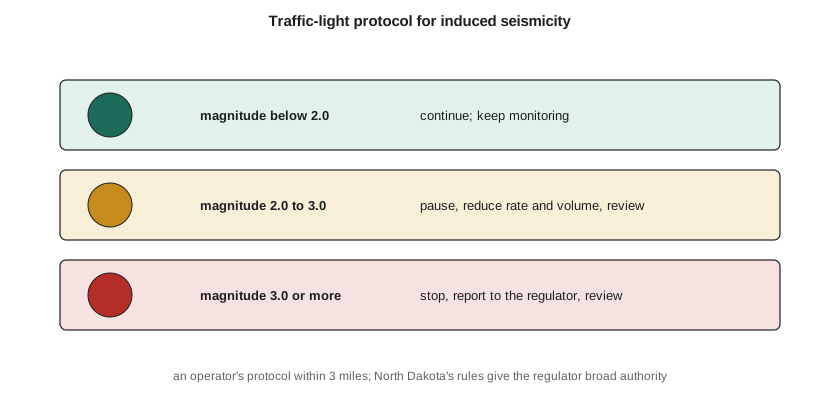
In North Dakota, induced seismicity from fracturing has been rare, but the regulator has broad authority over operations, and many operators use their own traffic-light protocols, often modeled on rules in other states and provinces. Prairie Crest's protocol watches events within three miles of a well during fracturing: amber at magnitude 2.0, when the crew pauses, reduces rate and volume on following stages and increases monitoring, and red at 3.0, when pumping stops and the regulator is notified. Disposal wells, where most US induced earthquakes have been linked, are managed through injection pressure and volume limits.
Reporting and lessons learned
Regulators require reports of completion operations, fluids and volumes, and any incidents. Inside the company, a post-job review compares the program with what happened: rates, pressures, volumes, screenouts, nonproductive time, safety and environmental events, costs and early production. Ethan's review of the 3-22H job leads him to three conclusions for the next well: protect toe stages from screenouts with more pad and a lower final proppant concentration; run fiber optics on the next well or a nearby one to measure cluster efficiency; and increase the share of recycled water.
Worked problem
Load recovery and what it means
A well received 260,000 bbl of fluid. After 30 days, 112,000 bbl has been recovered. What is the load recovery, and does it indicate a problem?
Show solution
- Recovery = 112,000/260,000 = 43 percent.
- In tight rock, recoveries of 10 to 50 percent are common because water is held by capillary forces.
- The value alone is not a problem; compare with offset wells and look at oil rates and tracers.
Answer: Load recovery is a clue, not a verdict; production and diagnostics decide.
Common mistakes
MistakeOpening the choke fully on day one.
InsteadBring the well on gradually to avoid proppant flowback and damage.
MistakeAssuming microseismic events show where proppant went.
InsteadEvents show rock movement; combine with tracers, fiber and production.
MistakeTreating low load recovery as failure.
InsteadCompare with offsets; low recovery is normal in tight rock.
MistakeVenting flowback gas.
InsteadCapture or flare it, and route to sales as early as possible.
MistakeIgnoring small seismic events during a job.
InsteadFollow the traffic-light protocol and report as required.
Summary and key terms
- Flowback is managed gradually; much of the load water stays in tight rock.
- Treating pressures, microseismic, fiber optics, tracers, production logs and offset gauges each show part of the picture.
- Rate-transient analysis of production is the most important long-term evaluation.
- Water sourcing, recycling, storage and disposal are planned and regulated.
- Fluid ingredients are disclosed to public registries.
- Well integrity and distance protect groundwater; traffic-light protocols manage induced seismicity.
- Flowback
- The return of treatment fluid from the well after fracturing.
- Load recovery
- The fraction of pumped fluid recovered during flowback.
- Microseismic monitoring
- Recording small seismic events caused by fracturing to map stimulated rock.
- Distributed acoustic sensing
- Fiber-optic measurement of acoustic signals along the wellbore.
- Frac hit
- A pressure or production response in an offset well caused by a new fracture.
- Traffic-light protocol
- A rule set linking seismic event magnitude to required actions.
- Rate-transient analysis
- Analysis of production rates and pressures to estimate well and fracture properties.
Practice problems
Work each problem on paper first, then reveal the answer to check.
Why is a low load recovery common in shales?
Show answer
Capillary forces hold water in the fine pores and fracture network.
What does distributed acoustic sensing show during a job?
Show answer
Which clusters are taking fluid along the lateral.
Where have most documented groundwater contamination incidents come from?
Show answer
Surface spills and failures of well integrity, not fractures growing upward.
What must an operator do under Alberta's Subsurface Order No. 2 for a magnitude 4.0 event?
Show answer
Stop fracturing, return the well to a safe state, report it and resume only with written consent.
Lesson quiz · 5 questions
Score 60% or more to complete this lesson.
Create a free account to save your progress, take quizzes and earn a certificate.