
MEC-270 · Lesson 4 of 12 · 24 min
Buoyancy and stability
Each autumn Platte Bluffs Water floats a small steel pontoon out to the raw-water intake to clean the screens and inspect the intake crib. The pontoon is 6.0 m long and 2.4 m wide and carries a davit crane, a portable pump and a crew of three. Ray Mendoza's first question is practical: how deep will it sit, and will it stay upright when the crane swings a load over the side? Answering it takes two ideas: Archimedes' principle, which tells us how much a submerged body is pushed up, and the metacenter, which tells us whether a floating body returns upright after it tips.
Archimedes' principle
A body immersed in a fluid feels pressure on every part of its surface, and because pressure grows with depth, the upward push on its bottom exceeds the downward push on its top. The net vertical force is the buoyant force. Archimedes found its value more than two thousand years ago: the buoyant force on a body equals the weight of the fluid it displaces, and it acts vertically upward through the centroid of the displaced volume, a point called the center of buoyancy.
The proof follows from Lesson 3. Imagine replacing the body with fluid of the same shape. That fluid would be in equilibrium, so the surrounding pressure must push up on it with a force equal to its weight, through its center of gravity. The surrounding pressure does not know what is inside the boundary, so it pushes on the real body in exactly the same way. Archimedes' principle therefore applies to any shape, fully or partly submerged, in any fluid at rest, including air: a weather balloon rises because the air it displaces weighs more than the balloon and its helium.
A body denser than the fluid sinks unless supported; a body less dense floats, sinking until the weight of displaced fluid equals its own weight. The fraction of its volume below the surface equals the ratio of its average density to the fluid's density. An HDPE float, with a density of about 955 kg/m³, rides with about 95 percent of its volume submerged in fresh water. An iceberg, at about 917 kg/m³ in seawater of 1025 kg/m³, shows only about a tenth of its bulk.
Worked problem
Draft of the maintenance pontoon
The pontoon hull is a box 6.0 m (19.7 ft) long, 2.4 m (7.87 ft) wide and 1.0 m (3.28 ft) deep, with a mass of 1900 kg (4190 lbm). It carries a 650 kg davit crane, three workers totaling 240 kg and a 300 kg pump and hoses. Find its draft in fresh water (1000 kg/m³, 62.4 lbm/ft³) and its freeboard.
Show solution
- Total mass \(m = 1900 + 650 + 240 + 300 = 3090\ \text{kg}\).
- Floating equilibrium: \(\rho g L B d = m g\), so \(d = m/(\rho L B) = 3090/(1000 \times 6.0 \times 2.4)\).
- \[d = 0.215\ \text{m}\]
- Freeboard \(= 1.0 - 0.215 = 0.785\ \text{m}\).
Answer: The pontoon draws about 21.5 cm (8.5 in) and has nearly 0.8 m (2.6 ft) of freeboard, plenty for calm water at the intake.
Buoyancy and structures
Buoyancy is not only for boats. A buried tank or pipe surrounded by groundwater is pushed up by the weight of the water it displaces. An empty concrete clearwell 20 m by 30 m sitting 4 m into saturated soil displaces 2400 m³ of groundwater, an uplift of about 23.5 MN. If its own weight plus the soil on its roof does not exceed that, it can lift out of the ground, cracking pipes as it goes. Designers check flotation with a safety factor, usually 1.1 to 1.25, and add mass, anchors or underdrains as needed. Large-diameter HDPE pipes laid in wet trenches need concrete collars or anchors for the same reason, because an empty plastic pipe floats readily.
Buoyancy also matters in measurement and in process work. Hydrometers measure liquid density from how deep a calibrated float sinks. In the treatment plant's clarifiers, particles settle only if their density exceeds that of water, and flocculation works by binding tiny particles into flocs heavy enough to sink against drag. Air bubbles rising in an aeration tank or a dissolved-air flotation unit are driven by buoyancy, and they lift light particles with them.
Stability of submerged bodies
A body in equilibrium is stable if, after a small disturbance, the forces on it tend to restore its original position. For a fully submerged body, such as a submarine or a remotely operated vehicle inspecting an intake tunnel, the center of buoyancy stays fixed relative to the body as it tilts, because the displaced shape does not change. The rule is simple: the body is stable if its center of gravity G lies below its center of buoyancy B. Tilt it, and the weight and buoyancy form a couple that rotates it back. If G is above B, the couple rotates it further and the body capsizes. Underwater vehicles therefore carry heavy batteries low and buoyant foam high.
Stability of floating bodies and the metacenter
Floating bodies are more forgiving. A ship's center of gravity is usually above its center of buoyancy, yet it floats upright. The reason is that when a floating body heels, the shape of its underwater volume changes: the side that dips displaces more water and the side that rises displaces less, so the center of buoyancy moves sideways toward the low side. The buoyant force, acting vertically up through the new center of buoyancy, crosses the body's original vertical centerline at a point called the metacenter M.
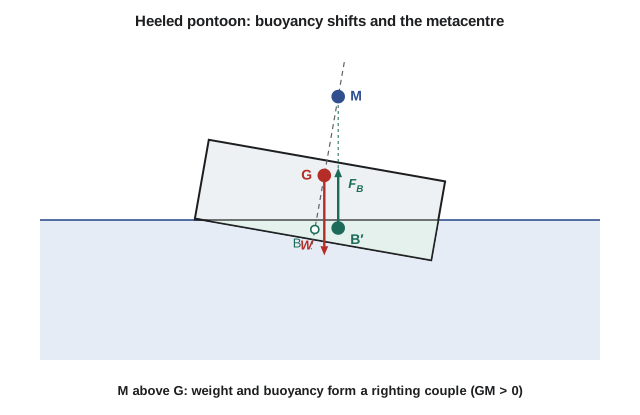
If M lies above G, the weight and buoyancy create a righting moment that brings the body back; if M lies below G, they create an overturning moment. The distance \(GM\), the metacentric height, is the standard measure of initial stability. For small angles of heel, geometry gives the height of M above B as the second moment of the waterplane area about the axis of tilting divided by the displaced volume.
Here \(K\) is the keel, the bottom of the hull, used as a convenient reference for heights. For a box-shaped pontoon of length \(L\) and beam \(B\), heeling about its long axis, \(I = LB^3/12\). Because \(I\) grows with the cube of the beam, wide, shallow vessels are very stable, which is why work pontoons and barges are beamy and why a narrow canoe feels tippy. The righting moment at a small heel angle \(\phi\) is approximately \(W\,GM\,\phi\), so a larger \(GM\) gives a stiffer response.
Worked problem
Metacentric height of the pontoon
For the loaded pontoon (mass 3090 kg, draft 0.215 m), the center of gravity of the hull is 0.45 m above the keel, the crane's is 1.60 m, the crew's 1.95 m and the pump's 1.10 m. Find KG, KB, BM and GM for heel about the long axis, and express GM in feet.
Show solution
- \(KG = [1900(0.45) + 650(1.60) + 240(1.95) + 300(1.10)]/3090 = 0.872\ \text{m}\).
- For a box, the center of buoyancy is at half the draft: \(KB = 0.215/2 = 0.107\ \text{m}\).
- \(I = 6.0(2.4)^3/12 = 6.91\ \text{m}^4\); \(V = 6.0(2.4)(0.215) = 3.09\ \text{m}^3\); \(BM = 6.91/3.09 = 2.24\ \text{m}\).
- \(GM = 0.107 + 2.237 - 0.872 = 1.47\ \text{m} = 4.83\ \text{ft}\).
Answer: GM is large and positive, so the pontoon is very stable in roll. Its stability comes almost entirely from its wide beam, not from a low center of gravity.
The program below repeats this calculation and estimates the heel when the crane swings a 650 kg load 0.8 m outboard. The shifted weight creates an overturning moment, and the pontoon heels until the righting moment \(W\,GM\tan\phi\) balances it. Try increasing the crane's height or reducing the beam to see how quickly a comfortable work platform becomes a dangerous one.
# Buoyancy and stability of the intake maintenance pontoon
rho, g = 1000.0, 9.81      # fresh water

# Rectangular pontoon: length L, beam B, height H, with a crane and crew aboard
L, B, H = 6.0, 2.4, 1.0
m_hull, zg_hull = 1900.0, 0.45      # kg, height of hull CG above the keel (m)
loads = [(650.0, 1.60, "davit crane"), (240.0, 1.95, "three workers"), (300.0, 1.10, "pump and hoses")]

m = m_hull + sum(w for w, _, _ in loads)
zg = (m_hull * zg_hull + sum(w * z for w, z, _ in loads)) / m
draft = m / (rho * L * B)          # weight = buoyancy
zb = draft / 2                      # height of the buoyancy point (box section)
I = L * B**3 / 12                   # second moment of the waterplane about the long axis
V = L * B * draft
BM = I / V
GM = zb + BM - zg
print(f"Total mass {m:.0f} kg, draft {draft*100:.1f} cm (freeboard {(H-draft)*100:.1f} cm)")
print(f"KB = {zb:.3f} m, BM = {BM:.3f} m, KG = {zg:.3f} m")
print(f"Metacentric height GM = {GM:.3f} m -> {'stable' if GM > 0 else 'unstable'}")

# Heel angle caused by moving the crane load 0.8 m to one side (small angles)
import math
shift = 650.0 * 0.8
heel = math.degrees(math.atan(shift / (m * GM)))
print(f"Swinging the davit load 0.8 m outboard heels the pontoon about {heel:.1f} degrees")

# Hydrometer-style check: what fraction of a floating HDPE pipe float is submerged?
rho_hdpe = 955.0
print(f"An HDPE float floats with {rho_hdpe/rho*100:.1f} % of its volume submerged")Total mass 3090 kg, draft 21.5 cm (freeboard 78.5 cm) KB = 0.107 m, BM = 2.237 m, KG = 0.872 m Metacentric height GM = 1.473 m -> stable Swinging the davit load 0.8 m outboard heels the pontoon about 6.5 degrees An HDPE float floats with 95.5 % of its volume submerged
Limits of the small-angle theory
The metacentric height describes stability only at small heel angles, up to perhaps 10°. At larger angles, the deck edge goes under or the bilge comes out of the water, the waterplane shape changes and the simple formula no longer applies. Naval architects then plot the righting arm, the horizontal distance between G and the line of buoyancy, against heel angle. The area under that curve measures how much energy a gust or wave must deliver to capsize the vessel. For a box pontoon with low freeboard, the righting arm drops sharply once the deck edge immerses, so heavy loads swung outboard from a low pontoon are especially risky.
Free liquid surfaces also reduce stability. Water sloshing in a partly filled tank on the pontoon moves to the low side as it heels, shifting G toward the low side and effectively lowering GM. The reduction equals the second moment of the tank's free surface divided by the displaced volume of the vessel, adjusted for the density of the liquid. A rule Ray enforces is simple: carry portable tanks either empty or full, and never pump water onto the deck.
Working afloat safely
The numbers set limits, and procedures keep the crew inside them. The pontoon carries a plate stating its maximum load and the maximum crane load at full outreach. Lifejackets are worn whenever anyone is on board, and loads are swung over the side only with the pontoon moored at both ends. On a lake or reservoir intake, wind and waves add rolling motions that the static analysis ignores, so the working limits are set well inside what the calculation allows. Fluid mechanics gives the numbers; judgment and procedure give the margin.
Common mistakes
MistakeUsing the body's total volume instead of its displaced volume.
InsteadF_B uses only the submerged volume: F_B = ρgV_displaced.
MistakeSaying a floating body is stable only if G is below B.
InsteadThat rule applies to fully submerged bodies; floating bodies are stable if the metacenter M is above G.
MistakeUsing the second moment of the hull's cross-section in BM.
InsteadUse the second moment of the waterplane area, the hull's outline at the waterline, about the tilt axis.
MistakeForgetting that buoyancy acts on buried tanks and pipes.
InsteadCheck flotation of empty structures in high groundwater with a safety factor.
MistakeIgnoring free surfaces in partly filled tanks.
InsteadSloshing liquid shifts G and reduces the effective metacentric height.
Summary and key terms
- The buoyant force equals the weight of displaced fluid and acts up through the center of buoyancy.
- A floating body sinks until the displaced fluid's weight equals its own weight.
- A fully submerged body is stable if G lies below B.
- A floating body is stable if the metacenter M lies above G; GM = KB + BM − KG.
- BM = I_waterplane/V_displaced, so wide hulls are much more stable.
- Small-angle stability theory holds only to about 10°; free surfaces reduce stability.
- Buried tanks and empty pipes in saturated ground must be checked for flotation.
- Buoyant force
- The net upward force of a fluid on an immersed body, equal to the weight of fluid displaced.
- Archimedes' principle
- The buoyant force on a body equals the weight of the fluid it displaces.
- Center of buoyancy
- The centroid of the displaced volume, through which the buoyant force acts.
- Draft
- The depth of a floating hull below the waterline.
- Freeboard
- The height of a hull's deck above the waterline.
- Metacenter
- The point where the buoyant force line of a slightly heeled floating body crosses its centerline.
- Metacentric height
- The distance GM from the center of gravity to the metacenter; positive means stable.
- Righting moment
- The moment of the weight and buoyancy couple that returns a heeled body upright.
- Free-surface effect
- The loss of stability caused by liquid moving in a partly filled tank.
- Flotation
- Uplift of a buried structure by groundwater when its weight is too small.
Practice problems
Work each problem on paper first, then reveal the answer to check.
A 0.5 m³ steel float casing has a mass of 180 kg. What mass can it support in fresh water before it sinks?
Show answer
Displaced water 500 kg, so 320 kg of payload.
A wooden beam of density 620 kg/m³ floats in water. What fraction is submerged?
Show answer
62 percent.
A box barge 10 m long and 4 m wide draws 0.5 m. Find BM for heel about its long axis.
Show answer
I = 10(4³)/12 = 53.3 m⁴; V = 20 m³; BM = 2.67 m.
An empty concrete tank displaces 1800 m³ of groundwater and weighs 15 MN. Is it safe against flotation with a factor of 1.15?
Show answer
Uplift = 9.79(1800) = 17.6 MN; 15/17.6 = 0.85 < 1.15, so it needs more weight or anchors.
Why is a fully submerged body unstable if G is above B, while a ship with G above B can be stable?
Show answer
The submerged body's B does not move when it tilts; a ship's B shifts toward the low side, creating a metacenter above G.
In the program, raise the crane's center of gravity to 3.0 m. What happens to GM and the heel?
Show answer
KG rises to about 1.17 m, GM falls to about 1.18 m, and the heel grows to about 8°.
Lesson quiz · 5 questions
Score 60% or more to complete this lesson.
Create a free account to save your progress, take quizzes and earn a certificate.