
MEC-270 · Lesson 3 of 12 · 24 min
Hydrostatic forces on submerged surfaces
The clearwell at Northside has a steel sluice gate in its wall, 1.5 m wide and 2.0 m tall, that isolates the pump suction channel for maintenance. Its top edge sits 3.0 m below the normal water level. Before a contractor replaces the gate's hinge pins, Hana Lindqvist wants to know the force the water exerts on the gate, where that force acts, and how hard the hoist must pull to hold the gate shut. These are the classic questions of hydrostatic forces on submerged surfaces, and they apply equally to dam faces, tank walls, inspection hatches and the curved walls of storage tanks.
Pressure distribution on a plane surface
On a submerged plane surface, the pressure at each point acts perpendicular to the surface and increases linearly with depth. The total force is the sum of the pressure times area over the whole surface. Because the pressure varies, the force does not act at the centroid of the surface but lower down, where the pressure is greater. Working in gauge pressure is natural here, because atmospheric pressure acts on the dry side of the gate as well and cancels.
Let the plate be inclined at angle \(\theta\) to the free surface, and measure distance \(y\) along the plate from the line where its plane meets the surface. A point at distance \(y\) is at depth \(h = y\sin\theta\), so the pressure there is \(\gamma y \sin\theta\). Integrating over the area gives a force proportional to the first moment of area, which equals the area times the distance to its centroid. The result is simple and worth memorizing: the resultant force equals the pressure at the centroid times the area.
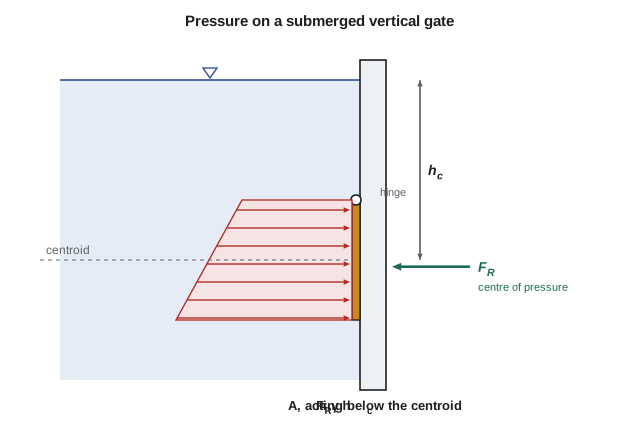
The center of pressure
To find where the resultant acts, take moments about the surface line. The moment of the distributed pressure equals the moment of the resultant, which brings in the second moment of area about the surface line. Using the parallel-axis theorem, \(I_x = I_{xc} + A y_c^2\), gives the location of the center of pressure along the plate.
Here \(I_{xc}\) is the second moment of area about a horizontal axis through the centroid. The center of pressure always lies below the centroid, by a distance \(I_{xc}/(y_c A)\) along the plate. That distance shrinks as the surface is submerged more deeply, because the pressure becomes more uniform across the plate, which is why deep gates have their resultant almost at the centroid. For symmetric shapes, such as rectangles and circles, the center of pressure lies on the vertical centerline. For a rectangle of width \(b\) and height \(h\), \(I_{xc} = bh^3/12\); for a circle of diameter \(D\), \(I_{xc} = \pi D^4/64\).
| Shape | Area A | Centroid | I about centroidal axis |
|---|---|---|---|
| Rectangle, width b, height h | bh | h/2 from the top edge | bh³/12 |
| Circle, diameter D | πD²/4 | Center | πD⁴/64 |
| Triangle, base b at the bottom, height h | bh/2 | h/3 above the base | bh³/36 |
| Semicircle, diameter D, flat edge up | πD²/8 | 2D/(3π) below the flat edge | 0.00686 D⁴ |
Worked problem
Force on the clearwell sluice gate
The vertical gate is 1.5 m (4.92 ft) wide and 2.0 m (6.56 ft) tall, with its top edge 3.0 m (9.84 ft) below the water surface. It is hinged along its top edge. Find the resultant force, the depth of the center of pressure, and the force a hoist must apply at the bottom edge, perpendicular to the gate, to hold it closed. Use \(\gamma = 9.79\ \text{kN/m}^3\) (62.3 lbf/ft³).
Show solution
- Centroid depth \(h_c = 3.0 + 1.0 = 4.0\ \text{m}\); area \(A = 3.0\ \text{m}^2\).
- Resultant: \(F_R = \gamma h_c A = 9.79(4.0)(3.0) = 117.5\ \text{kN}\).
- For a vertical plate \(y_c = h_c\): \(I_{xc} = 1.5(2.0)^3/12 = 1.0\ \text{m}^4\), so \(y_R = 4.0 + 1.0/(4.0 \times 3.0) = 4.083\ \text{m}\).
- The force acts 1.083 m below the hinge. Moments about the hinge: \(F_{\text{hoist}}(2.0) = 117.5(1.083)\), so \(F_{\text{hoist}} = 63.6\ \text{kN}\).
Answer: The water pushes on the gate with 117.5 kN (26 400 lbf), acting 83 mm (3.3 in) below its centroid. The hoist needs about 64 kN (14 300 lbf) at the bottom edge, a little more than half the total, because the force acts below the gate's midpoint.
The program below repeats this calculation, checks it by summing the pressure over two thousand thin horizontal strips, and applies the same formulas to a circular access hatch on an inclined wall. The strip summation is a useful habit: it shows that the formulas are nothing more than integrals done in advance, and it works for shapes that have no tabulated properties.
# Hydrostatic force on the clearwell sluice gate (vertical rectangle)
# and on an inclined circular access hatch
import math
rho, g = 998.0, 9.81
gam = rho * g

def plane_force(hc, A, Ixc, sin_theta):
    """Resultant force, and distance along the plate from the centroid down to the point where it acts."""
    F = gam * hc * A
    yc = hc / sin_theta
    ycp = yc + Ixc / (yc * A)
    return F, ycp - yc

# Vertical rectangular gate 1.5 m wide x 2.0 m tall, top edge 3.0 m below the surface
b, h, top = 1.5, 2.0, 3.0
A = b * h; Ixc = b * h**3 / 12; hc = top + h / 2
F, e = plane_force(hc, A, Ixc, 1.0)
print(f"Sluice gate: F = {F/1000:.1f} kN acting {e*100:.1f} cm below the centroid")
print(f"  depth of the point of action = {hc + e:.3f} m")

# Hinged at the top edge: force needed at the bottom edge to hold it shut
M = F * (h / 2 + e)
print(f"  holding force at the bottom edge = {M / h / 1000:.1f} kN")

# Circular hatch, diameter 0.9 m, on a wall inclined 60 degrees, centroid 4.2 m deep
D, theta, hcc = 0.9, math.radians(60), 4.2
A = math.pi * D**2 / 4; Ixc = math.pi * D**4 / 64
F, e = plane_force(hcc, A, Ixc, math.sin(theta))
print(f"Inclined hatch: F = {F/1000:.1f} kN, acting {e*1000:.1f} mm below the centroid along the wall")

# Pressure prism check for the vertical gate: integrate p dA numerically
n = 2000; Fn = 0.0; Mn = 0.0
for i in range(n):
    y = top + (i + 0.5) * h / n
    dF = gam * y * b * h / n
    Fn += dF; Mn += dF * y
print(f"Numerical check: F = {Fn/1000:.1f} kN, depth of action = {Mn/Fn:.3f} m")Sluice gate: F = 117.5 kN acting 8.3 cm below the centroid depth of the point of action = 4.083 m holding force at the bottom edge = 63.6 kN Inclined hatch: F = 26.2 kN, acting 10.4 mm below the centroid along the wall Numerical check: F = 117.5 kN, depth of action = 4.083 m
The pressure prism
For rectangular surfaces with one edge horizontal, a geometric picture is often quicker. Draw the pressure distribution across the plate as a solid: its base is the plate and its height at each point is the local pressure. The volume of this pressure prism equals the resultant force, and the force passes through the prism's centroid. For a gate reaching up to the free surface, the prism is a triangular wedge and the force acts two thirds of the way down. For a submerged gate like the sluice gate, the prism is a trapezoid, which can be split into a rectangle (uniform pressure from the top-edge depth) and a triangle (the extra pressure below), each with an obvious centroid.
The prism method also handles a surface with liquid on both sides. If water stands 5 m deep on one side of a gate and 2 m on the other, the net pressure is uniform below the lower surface, and the net force is the difference between the two prisms. This is how canal lock gates and the divided cells of a filter gallery are checked.
Forces on curved surfaces
Tank walls, pipe walls and dome roofs are curved, and the pressure on them changes direction as well as magnitude, so direct integration becomes awkward. The trick is to isolate a block of fluid bounded by the curved surface and by vertical and horizontal planes, and to apply equilibrium to that block. Two results follow.
The horizontal component of the force on a curved surface equals the force on the vertical projection of that surface, and acts through the center of pressure of the projection. The vertical component equals the weight of the fluid directly above the curved surface, up to the free surface, real or imaginary, and acts through the centroid of that volume. If the fluid is below the surface, as on the underside of a submerged dome, the vertical force acts upward and equals the weight of the fluid that would fill the space above it to the free surface level.
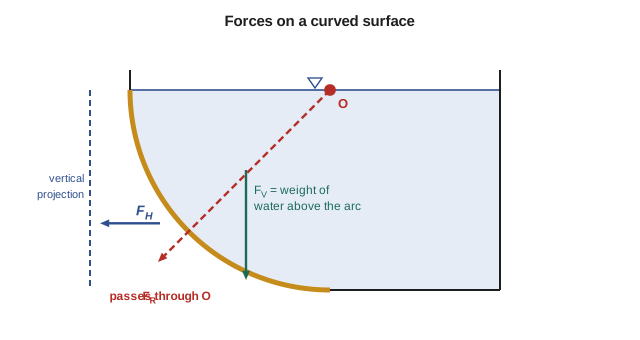
On a circular surface, every pressure force is normal to the surface and therefore passes through the center of the circle, so the resultant does too. Radial gates on spillways exploit this: the water force passes through the trunnion pin, so it exerts no moment that the hoist must overcome, and the hoist lifts only the gate's weight and friction.
Worked problem
Hoop tension in a storage tank wall
A cylindrical steel standpipe has a diameter of 12 m (39.4 ft) and holds water 30 m (98.4 ft) deep. Find the tension per meter of height in the wall at the bottom, and the wall thickness needed if the allowable stress is 140 MPa (20.3 ksi).
Show solution
- Pressure at the bottom: \(p = \gamma h = 9.79(30) = 294\ \text{kPa}\).
- Cut the tank along a vertical diameter. The horizontal pressure force on one half, per unit height, equals \(pD\) (the force on the projection), and it is resisted by two wall cuts each carrying tension \(T\): \(2T = pD\).
- \(T = pD/2 = 294(12)/2 = 1764\ \text{kN/m}\).
- Thickness: \(t = T/\sigma = 1764 \times 10^3/(140 \times 10^6) = 0.0126\ \text{m}\).
Answer: The bottom course needs about 13 mm (0.50 in) of steel before allowing for corrosion and weld efficiency. Because pressure falls linearly upward, the upper courses can be thinner, which is why tank walls step down in thickness.
Design notes from the station
Hydrostatic loads are the most predictable loads in structural design, because water density is known precisely and depth is controlled. Codes still apply load factors to them, mainly to cover overfilling. Hana checks three conditions for every tank: full to the overflow, empty with groundwater pressing on the outside, and the worst case during construction or testing. An empty clearwell in spring, with the water table high, can float out of the ground if its weight and anchors do not exceed the uplift, which is a buoyancy problem of the kind we study next.
Gate seals and hatch gaskets also depend on these forces. A seal that is pushed onto its seat by water pressure works better as the depth increases, so engineers try to arrange gates to close with the water pressure, not against it. When a gate must open against full head, as the sluice gate does, its hoist must overcome both the water load's moment and the friction in its guides, which can add 20 to 40 percent to the force calculated from hydrostatics alone.
Common mistakes
MistakePlacing the resultant force at the centroid of the surface.
InsteadIt acts at the center of pressure, a distance I_xc/(y_cA) below the centroid along the plate.
MistakeUsing the depth of the center of pressure to compute the force.
InsteadThe force uses the centroid depth: F_R = γh_cA.
MistakeMeasuring y from the hinge or top edge instead of from the free-surface line.
Insteady_c and y_R are measured along the plate from where its plane meets the free surface.
MistakeComputing the vertical force on a curved surface from the projected area.
InsteadF_V equals the weight of the fluid (real or imagined) directly above the surface.
MistakeIncluding atmospheric pressure when it acts on both sides.
InsteadUse gauge pressure when the dry side is also at atmospheric pressure.
Summary and key terms
- The resultant force on a plane surface equals the pressure at the centroid times the area, F_R = γh_cA.
- It acts at the center of pressure, y_R = y_c + I_xc/(y_cA), always below the centroid.
- The pressure prism gives the same result as a volume and centroid for rectangular surfaces.
- On a curved surface, F_H equals the force on the vertical projection and F_V equals the weight of fluid above.
- On a circular arc, the resultant passes through the center of curvature.
- Hoop tension in a tank wall is T = pD/2 per unit height, so walls thicken toward the bottom.
- Resultant force
- The single force equivalent to the distributed pressure on a surface.
- Centroid
- The geometric center of an area.
- Center of pressure
- The point where the resultant hydrostatic force acts on a surface.
- Second moment of area
- The integral of distance squared times area, I, which measures how area is spread about an axis.
- Parallel-axis theorem
- I_x = I_xc + Ay_c², moving a second moment of area to a parallel axis.
- Pressure prism
- The solid whose base is the surface and whose height is the local pressure; its volume is the resultant force.
- Vertical projection
- The shadow of a curved surface on a vertical plane, used to find the horizontal force.
- Hoop tension
- The circumferential tension in a pipe or tank wall caused by internal pressure.
Practice problems
Work each problem on paper first, then reveal the answer to check.
A square hatch 0.6 m on a side is in a vertical wall with its center 3.5 m below the water surface. Find the force and how far below the center it acts.
Show answer
F = 9.79(3.5)(0.36) = 12.3 kN; I_xc/(y_cA) = (0.6⁴/12)/(3.5 × 0.36) = 8.6 mm.
A rectangular gate 2 m wide reaches from the surface to a depth of 3 m. Find the force and its depth of action.
Show answer
F = 9.79(1.5)(6) = 88.1 kN acting at 2.0 m depth (two thirds down).
Why does the center of pressure approach the centroid as a gate is lowered deeper?
Show answer
I_xc/(y_cA) shrinks as y_c grows, because the pressure becomes more uniform over the gate.
A quarter-circle gate of radius 2 m and width 3 m holds water on its concave side with the surface level with its top. Find F_H and F_V.
Show answer
F_H = 9.79(1)(2 × 3) = 58.7 kN; F_V = 9.79(π × 2²/4)(3) = 92.3 kN.
A pipe of 1.2 m diameter carries water at 800 kPa. Find the hoop tension per meter of length.
Show answer
T = pD/2 = 800(1.2)/2 = 480 kN/m.
In the program, raise the gate so its top edge is 1.0 m deep. What happens to the force and the offset?
Show answer
F falls to 58.7 kN and the offset grows to about 167 mm, because the gate is shallower.
Lesson quiz · 5 questions
Score 60% or more to complete this lesson.
Create a free account to save your progress, take quizzes and earn a certificate.