
MEC-270 · Lesson 2 of 12 · 26 min
Pressure and manometry
Every morning Ray Mendoza walks the Northside station and reads its gauges: clearwell level, suction and discharge pressures on each pump, the differential across the venturi meter and the air pressure in the hydropneumatic surge tank. Each reading depends on the same idea: in a fluid at rest, pressure depends only on depth. That one fact lets a simple U-shaped tube of liquid measure pressures and pressure differences with remarkable accuracy, and it sets the loads on every tank wall and gate in the plant. This lesson develops the hydrostatic equation and the art of reading manometers.
Pressure at a point
Pressure is the normal compressive force per unit area that a fluid exerts on a surface. In a fluid at rest there is no shear stress, and a force balance on a tiny wedge of fluid shows that the pressure at a point is the same in every direction. A pressure sensor on the side of a pipe and one facing upstream read the same value if the water is still. That is Pascal's law, and it is why we can speak of the pressure at a point without naming a direction. In moving fluids, viscous stresses add small directional differences, but for most engineering purposes pressure remains a single number at each point.
Pressure is measured relative to some reference. Absolute pressure is measured from a perfect vacuum. Gauge pressure is measured from the local atmospheric pressure, which is what a Bourdon gauge on a pipe shows. A vacuum reading is how far below atmospheric pressure the fluid is. Hydrostatic calculations in open tanks are usually done in gauge pressure, because atmospheric pressure acts on both sides of every wall and cancels. Cavitation checks and gas calculations need absolute pressure.
The hydrostatic equation
Consider a small vertical cylinder of fluid of cross-sectional area \(dA\) and height \(dz\), with \(z\) measured upward. The pressure on its bottom face pushes up, the pressure on its top face pushes down, and gravity pulls the fluid's weight \(\rho g\,dA\,dz\) down. For the fluid to stay at rest these forces must balance, which gives the basic equation of fluid statics: pressure decreases upward at a rate equal to the specific weight.
For a liquid of constant density, integrating between two elevations gives the familiar result. Measured downward from a free surface at atmospheric pressure, as depth \(h\), the gauge pressure is simply \(\gamma h\). Pressure rises by about 9.79 kPa for every meter of depth in water at 20 °C. At the bottom of the 6 m deep clearwell, the gauge pressure is about 59 kPa, whatever the shape or size of the tank. A narrow standpipe and a wide reservoir connected at the bottom show the same water level, a result once called the hydrostatic paradox.
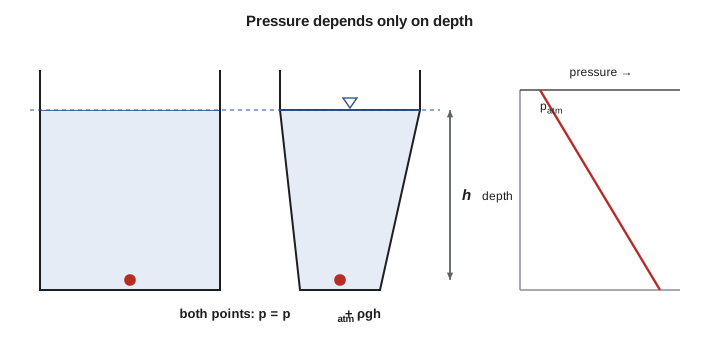
Because pressure depends only on elevation in a continuous body of the same fluid at rest, all points at the same level in that fluid have the same pressure. This is the key rule for manometers. It holds only within one continuous fluid: if you cross an interface into a different liquid, or pass through a closed valve, the rule no longer connects the two sides.
Liquid columns are often used as pressure units. A pressure head is the height of a column of a given liquid that the pressure would support, \(h = p/\gamma\). Operators speak of feet or meters of water: the discharge gauge on a Northside pump reads 540 kPa (78 psi), which is a head of 55 m (181 ft) of water. One psi is equivalent to 2.31 ft of water, a conversion every US water operator learns early. Barometers once used inches of mercury, and 29.92 in Hg (760 mm Hg) is standard atmospheric pressure.
Atmospheric pressure and the barometer
The atmosphere is itself a fluid at rest, held down by gravity. At sea level its pressure averages 101.325 kPa, and it falls with elevation, quickly at first because air near the ground is densest. A mercury barometer measures it directly: a glass tube closed at the top is filled with mercury and inverted into a dish. The mercury falls until the column's weight balances the atmosphere's push on the dish, leaving a nearly perfect vacuum above it. Standard atmospheric pressure supports 760 mm of mercury, or about 10.3 m of water, which is why no suction pump can lift water more than about 10 m and why a pump should sit low enough that the water arrives at its inlet under positive pressure.
In Omaha, at an elevation near 330 m (about 1080 ft), the average barometric pressure is about 97.4 kPa (14.1 psia, or 28.8 in Hg). Weather systems move it by a few kilopascals either way. Ray's station log records the barometer reading each day, because the absolute pressure at the pump inlet, which governs cavitation, changes with it.
In a gas, density changes with pressure, so the hydrostatic equation must be integrated with the ideal-gas law. For an isothermal atmosphere this gives an exponential decay of pressure with height. Over the height of a building or a tank, however, the change in air pressure is tiny, about 12 Pa per meter at ground level, so we treat atmospheric pressure as uniform around any one piece of equipment.
Manometers
A manometer measures pressure by balancing it against a column of liquid. The simplest is a piezometer, a vertical tube tapped into a pipe or tank and open at the top; the liquid rises until its height above the tap equals the pressure head. Piezometers work only for modest pressures in liquids, because a pressure of 100 kPa would need a tube 10 m tall. A U-tube manometer is more versatile. It holds a heavier gauge fluid, often mercury or a colored oil, in the bend, and the difference in its levels on the two sides indicates the pressure difference.
Reading any manometer, however complicated, follows one method. Start at a point where the pressure is known or wanted. Move through the fluids one leg at a time, adding \(\gamma h\) each time you go down and subtracting \(\gamma h\) each time you go up. Jump horizontally across a continuous fluid freely, because points at the same level in the same fluid share the same pressure. Finish at the other point and set the sum equal to its pressure. Written out, the method turns a confusing sketch into a single line of algebra.
Worked problem
Venturi differential with a mercury manometer
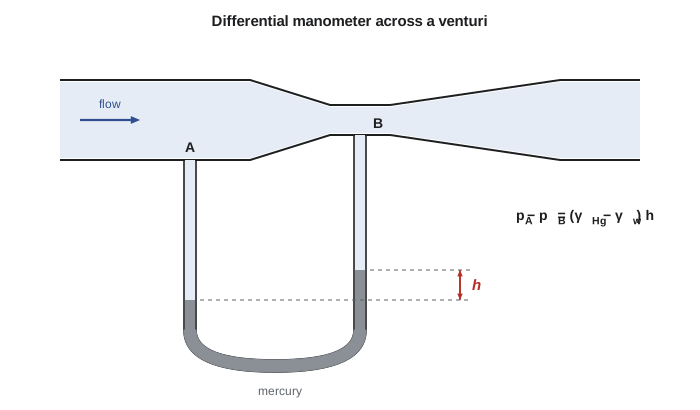
The venturi meter on the incoming main has taps A (upstream) and B (throat) at the same elevation, connected to a mercury U-tube filled with water above the mercury. The mercury levels differ by 185 mm (7.28 in). Find \(p_A - p_B\). Take \(\rho_{\text{Hg}} = 13\,550\ \text{kg/m}^3\) and \(\rho_w = 998\ \text{kg/m}^3\).
Show solution
- Start at A and go down through water a distance \(a\) to the higher mercury surface on the B side's level, then further down \(h\) through water to the lower mercury surface on the A side: \(p_A + \gamma_w(a + h)\).
- Cross the mercury at that level to the B side, then go up through mercury a height \(h\) and through water a height \(a\) to B: \(p_A + \gamma_w(a + h) - \gamma_{\text{Hg}} h - \gamma_w a = p_B\).
- The unknown \(a\) cancels: \(p_A - p_B = (\gamma_{\text{Hg}} - \gamma_w)h = (13\,550 - 998)(9.81)(0.185)\).
- \[p_A - p_B = 22.8\ \text{kPa}\]
Answer: The meter shows a 22.8 kPa (3.30 psi) drop to the throat. Note that the effective gauge fluid weight is the difference between mercury and water; using mercury alone would overstate the result by 8 percent.
The choice of gauge fluid sets the sensitivity. Mercury's high density keeps the manometer short for large differences, but it is toxic and is being phased out in water utilities in favor of electronic transmitters. For small differences, such as the draft in a duct, a light oil with a specific gravity near 0.8 gives a large deflection. An inclined manometer, with one leg tilted at a small angle \(\theta\) to the horizontal, stretches the reading along the tube by a factor \(1/\sin\theta\): at 10°, a 10 mm vertical change spreads over 58 mm of scale.
# Pressure at depth and a multi-fluid manometer
g = 9.81
rho_w, rho_hg, rho_oil = 998.0, 13550.0, 850.0
patm = 97.4   # kPa, typical barometer reading at the station (elevation about 330 m)

# Hydrostatic pressure in the clearwell (open to atmosphere)
for depth in (0.0, 2.0, 4.0, 6.0):
    p_gauge = rho_w * g * depth / 1000
    print(f"Clearwell depth {depth:3.1f} m: {p_gauge:6.2f} kPa gauge, {p_gauge + patm:6.2f} kPa abs")

# U-tube mercury manometer across the venturi on the intake main.
# Start at A (upstream tap), go down through water to the mercury surface,
# across the mercury, and up through water to B (throat tap).
h_mercury = 0.185   # m, difference in mercury levels
dp = (rho_hg - rho_w) * g * h_mercury / 1000   # kPa, taps at the same elevation
print()
print(f"Mercury manometer, deflection {h_mercury*1000:.0f} mm: pA - pB = {dp:.2f} kPa")

# Walk a chain of fluids: list of (density, change in elevation going DOWN is +)
def walk(p_start, legs):
    p = p_start
    for rho, dz_down in legs:
        p += rho * g * dz_down / 1000
    return p

# Tank of oil over water, gauge at the bottom side, manometer to air
p_bottom = walk(0.0, [(rho_oil, 1.20), (rho_w, 0.80)])
print(f"Oil 1.20 m over water 0.80 m: bottom pressure = {p_bottom:.2f} kPa gauge")

# Air pressure in a closed hydropneumatic tank read by an open water manometer
# Water stands 2.35 m above the tank's water surface in the open leg.
p_air = rho_w * g * 2.35 / 1000
print(f"Hydropneumatic tank air pressure = {p_air:.2f} kPa gauge = {p_air + patm:.2f} kPa abs")Clearwell depth 0.0 m: 0.00 kPa gauge, 97.40 kPa abs Clearwell depth 2.0 m: 19.58 kPa gauge, 116.98 kPa abs Clearwell depth 4.0 m: 39.16 kPa gauge, 136.56 kPa abs Clearwell depth 6.0 m: 58.74 kPa gauge, 156.14 kPa abs Mercury manometer, deflection 185 mm: pA - pB = 22.78 kPa Oil 1.20 m over water 0.80 m: bottom pressure = 17.84 kPa gauge Hydropneumatic tank air pressure = 23.01 kPa gauge = 120.41 kPa abs
Mechanical and electronic gauges
Manometers are accurate and need no calibration beyond the density of the gauge fluid, but they are bulky. In daily operation, Ray relies on Bourdon gauges: a curved tube of oval cross-section that straightens slightly when pressurized, turning a pointer through a gear. Bourdon gauges read gauge pressure and are typically accurate to 1 to 2 percent of full scale. They should be chosen so normal readings fall in the middle third of the dial, and they need snubbers or liquid filling where pressure pulses, such as on a pump discharge.
Electronic transmitters use a thin diaphragm whose deflection is sensed by strain gauges, a change in capacitance or a vibrating element. They can measure absolute, gauge or differential pressure, send a signal to the control system, and resolve changes of a few pascals. The venturi meter at Northside now uses a differential pressure transmitter instead of a mercury U-tube, but the transmitter is checked against a water manometer during calibration, and the principle of the measurement has not changed.
Pressure in a stratified tank
Many tanks hold more than one liquid, or a liquid under a gas. The hydrostatic equation applies layer by layer, with each layer's specific weight. A sludge holding tank might have a layer of scum on top, clear water in the middle and dense sludge at the bottom; the pressure at the floor is the sum of \(\gamma h\) for every layer. A closed hydropneumatic tank has compressed air above the water. The air pressure, nearly uniform because air is so light, adds to the hydrostatic pressure at every depth in the water.
Worked problem
Air pressure in the surge tank
The station's hydropneumatic surge tank holds water with compressed air above it. An open water-filled sight tube connected to the bottom of the tank shows water standing 2.35 m (7.71 ft) above the water surface inside the tank. Find the air pressure in the tank in gauge and absolute terms. The barometer reads 97.4 kPa (14.1 psia).
Show solution
- Start at the open top of the sight tube, at atmospheric pressure (zero gauge).
- Go down through water 2.35 m to the level of the water surface in the tank: \(p = 0 + 998(9.81)(2.35) = 23.0\ \text{kPa}\) gauge.
- At that level, inside the tank, the water touches the air, and the air pressure is uniform: \(p_{\text{air}} = 23.0\ \text{kPa}\) gauge.
- Absolute: \(p_{\text{air}} = 23.0 + 97.4 \) kPa.
Answer: The air is at 23.0 kPa gauge (3.34 psig), or about 120 kPa absolute (17.5 psia). In a real surge tank the pressure is much higher and is read with a gauge; the sight tube here illustrates the method.
Fluids in rigid-body motion
The hydrostatic equation also applies to a liquid that moves as a rigid body, with no relative motion between layers and therefore no shear. If a tank truck carrying water accelerates horizontally at \(a\), the free surface tilts at an angle whose tangent is \(a/g\), and lines of constant pressure tilt with it. A cylindrical tank spinning about its vertical axis at angular speed \(\omega\) develops a paraboloid free surface, rising by \(\omega^2 r^2/(2g)\) from the center to radius \(r\). These cases appear in tanker design and centrifugal separators. They also explain why a centrifugal pump's casing pressure rises toward the outer edge: the water spinning with the impeller behaves much like a liquid in rigid rotation.
Common mistakes
MistakeMixing absolute and gauge pressure in one calculation.
InsteadChoose one reference and stay with it; convert at the end if needed.
MistakeApplying 'same level, same pressure' across two different fluids or through a closed valve.
InsteadIt holds only within one continuous body of the same fluid at rest.
MistakeUsing the gauge fluid's density alone for a manometer filled with water above it.
InsteadUse the difference (γ_gauge − γ_water) when the same fluid fills both connecting legs at equal levels.
MistakeAssuming tank shape affects the pressure at the bottom.
InsteadPressure depends only on depth and specific weight, not on the container's shape.
MistakeForgetting that pressure head depends on the liquid.
Insteadh = p/γ; the same pressure supports 10.2 m of water but only 0.75 m of mercury.
Summary and key terms
- In a fluid at rest, pressure at a point is the same in all directions.
- The hydrostatic equation dp/dz = −ρg gives p = p_atm + ρgh for a liquid of constant density.
- Points at the same level in one continuous fluid at rest have the same pressure.
- Pressure can be expressed as a head, h = p/γ, of a chosen liquid.
- A barometer measures atmospheric pressure, which falls with elevation.
- Manometers are read by adding γh going down and subtracting going up through each fluid.
- Bourdon gauges and electronic transmitters are calibrated against manometers and dead-weight testers.
- Pressure
- Normal force per unit area exerted by a fluid.
- Pascal's law
- In a fluid at rest, the pressure at a point is the same in all directions.
- Absolute pressure
- Pressure measured from a perfect vacuum.
- Gauge pressure
- Pressure measured relative to local atmospheric pressure.
- Hydrostatic equation
- dp/dz = −ρg; pressure falls with height at a rate equal to the specific weight.
- Pressure head
- The height of a liquid column that a pressure would support, h = p/γ.
- Barometer
- An instrument that measures atmospheric pressure, classically with a mercury column.
- Piezometer
- A vertical open tube tapped into a pipe or tank to show its pressure head.
- U-tube manometer
- A bent tube holding a gauge liquid whose level difference shows a pressure difference.
- Inclined manometer
- A manometer with a tilted leg that magnifies small pressure differences.
- Bourdon gauge
- A mechanical gauge using a curved tube that straightens under pressure.
- Rigid-body motion
- Motion of a fluid with no relative motion between layers, so hydrostatics still applies.
Practice problems
Work each problem on paper first, then reveal the answer to check.
Find the gauge pressure at the bottom of a 9.0 m deep water tank open to the atmosphere.
Show answer
p = 998(9.81)(9.0) = 88.1 kPa.
A gauge reads 320 kPa where the barometer reads 96 kPa. Find the absolute pressure and the pressure head in meters of water.
Show answer
416 kPa absolute; head = 320/9.79 = 32.7 m of water (gauge).
An oil manometer (SG 0.82) inclined at 15° shows a 120 mm reading along the tube. Find the pressure difference.
Show answer
Vertical rise 120 sin 15° = 31.1 mm; Δp = 820(9.81)(0.0311) = 250 Pa.
A tank holds 1.5 m of oil (SG 0.85) over 2.0 m of water. Find the gauge pressure at the bottom.
Show answer
p = 850(9.81)(1.5) + 998(9.81)(2.0) = 12.5 + 19.6 = 32.1 kPa.
How tall a water barometer would be needed in Omaha on an average day?
Show answer
h = 97.4 × 1000/(998 × 9.81), about 9.7 to 9.9 m depending on the city.
In the program, change the mercury deflection to 250 mm. What is the new pressure difference?
Show answer
About 30.8 kPa, proportional to the deflection.
Lesson quiz · 5 questions
Score 60% or more to complete this lesson.
Create a free account to save your progress, take quizzes and earn a certificate.