
MBA-503 · Lesson 8 of 12 · 19 min
Power, influence and networks
Grace Mwangi is a regional director at a grocery chain, and she has a problem common to people in the middle of organizations. She has to persuade forty store managers to adopt a new approach to fresh produce ordering, but she does not control their pay, their promotions or their day-to-day priorities, which are set by district managers. Several store managers have run their stores for twenty years and regard head-office initiatives as fads. Grace's question to the cohort is blunt: how do you lead people who do not report to you? Dr. Sato's answer begins with the uncomfortable topic of power, because managers who are uneasy talking about power tend to use it badly.
Where power comes from
Power is the capacity to influence the behavior of others. It is a property of relationships rather than of individuals: a person has power over another to the extent that the other depends on them for something they value. Richard Emerson's power-dependence theory puts this precisely. A's power over B rises with how much B values what A controls and falls with how many alternative sources of it B has. This is why scarce expertise confers power and why people who control access to important information or resources often have influence far beyond their formal position.
In 1959 John French and Bertram Raven proposed five bases of social power, and Raven later added a sixth. Legitimate power comes from a formal position and the accepted right to make requests. Reward power comes from the ability to provide things others want. Coercive power comes from the ability to impose penalties. Expert power comes from knowledge and skill that others need. Referent power comes from being liked, admired or identified with. Informational power comes from controlling or possessing information that others need. Research has repeatedly found that expert and referent power are associated with greater commitment, satisfaction and performance among those influenced, while coercive power tends to produce compliance at best and resistance at worst. Legitimate and reward power produce compliance but rarely enthusiasm.
Grace's position gives her little legitimate, reward or coercive power over the store managers, but she is not powerless. She has expert power, since she ran three of the chain's most profitable stores and has the shrink data for every store in the region. She has informational power, since she sees results across the region that no individual store manager can see. And she can build referent power by helping store managers solve problems they actually care about. Her task is to use those bases deliberately.
What power does to the powerful
Power also changes the people who hold it. Dacher Keltner and colleagues proposed an approach-inhibition theory of power: having power activates approach tendencies, making people more action-oriented, more likely to express their views and more focused on rewards, while lacking power activates inhibition, making people more vigilant and attentive to threats and to others' reactions. A body of research suggests that people primed to feel powerful take action more readily and attend less to others' perspectives. Some of the most striking individual studies in this area have proved hard to replicate, so the size of these effects is uncertain, but the general pattern that power reduces attention to others is consistent with field observations of leaders who stop listening as they rise.
Dr. Sato reminds the cohort of the session on self-awareness, where they discussed the power pose studies. The original 2010 claim that holding expansive postures for two minutes raised testosterone and lowered cortisol did not replicate in larger studies, and one of the original authors, Dana Carney, stated publicly in 2016 that she no longer believed the effects were real. Later meta-analyses suggest at most a small effect of posture on how powerful people say they feel, with no reliable effect on behavior or hormones. The lesson is that structural sources of power, such as dependence, expertise and relationships, matter far more than tricks to feel powerful.
Influence tactics
Gary Yukl and colleagues identified a set of proactive influence tactics that people use with subordinates, peers and bosses, and studied which ones work. The most consistently effective are rational persuasion, using logical arguments and factual evidence; inspirational appeals, linking a request to the target's values and ideals; consultation, inviting the target to help plan the change; and collaboration, offering assistance or resources to carry out the request. Ingratiation, personal appeals, exchange and apprising, meaning explaining how the request benefits the target personally, are moderately effective in some situations. Pressure, through demands and threats, and legitimating tactics, through appeals to rules or authority, tend to produce compliance or resistance rather than commitment. Coalition tactics, using others to help persuade, can work but can also be seen as ganging up.
| Tactic | Example | Typical outcome |
|---|---|---|
| Rational persuasion | Showing a store manager her own shrink data alongside the pilot results | Commitment if the evidence is credible |
| Consultation | Asking store managers to help design the ordering checklist | Commitment and better solutions |
| Inspirational appeal | Connecting less waste with feeding families and food bank donations | Commitment when values are shared |
| Collaboration | Offering a produce specialist to work in the store for a week | Commitment, especially when resources are scarce |
| Exchange | Offering priority on new display fixtures in return | Compliance, sometimes commitment |
| Pressure | Telling managers the district will be watching their numbers | Compliance or resistance |
Robert Cialdini's research on persuasion identified principles that make people more likely to say yes: reciprocity, the obligation to return favors; commitment and consistency, the desire to act in line with what we have said or done; social proof, following what similar others do; authority, deferring to credible expertise; liking, saying yes to people we like and who are similar to us; scarcity, valuing what is rare; and unity, added later, the pull of shared identity. These principles are well supported in general, although the effect sizes in specific studies vary and some famous demonstrations have proved smaller or harder to reproduce than originally reported. For leaders, the ethical line is between using the principles to help people see genuine reasons, such as pointing out accurately that most peer stores have already adopted a practice, and using them to manipulate, for example by inventing deadlines or misrepresenting what others are doing.
Allan Cohen and David Bradford's model of influence without authority treats influence as exchange. Every person in an organization values certain currencies: inspiration and meaning, task-related help, recognition, opportunities to learn, personal support, and so on. Influence comes from understanding what the other party values, identifying what you can offer in that currency and building the relationship before you need it. Grace realizes that most store managers care less about head-office targets than about two things: fewer stockouts that generate customer complaints, and recognition from their peers. Her pitch for the new ordering approach becomes a pitch about those currencies.
Networks and brokerage
Informal networks often matter more than the organization chart for how work gets done and how ideas spread. Mark Granovetter's 1973 paper on the strength of weak ties showed that people often find jobs through acquaintances rather than close friends, because acquaintances move in different circles and have access to new information. A very large experiment on LinkedIn, reported by Karthik Rajkumar and colleagues in Science in 2022, varied the recommendations shown to about 20 million users over five years and found that moderately weak ties were the most useful for job mobility, more than either the strongest or the weakest ties.
Ronald Burt's research on structural holes argues that people who bridge otherwise disconnected groups, called brokers, gain access to diverse information and can combine ideas from different worlds. In studies of managers in large firms, Burt found that brokers were more likely to have their ideas judged valuable and received better evaluations and faster promotion. Brokerage has costs too: brokers can be seen as untrustworthy and are vulnerable to overload. Research by Rob Cross, Reb Rebele and Adam Grant found that in many organizations, a small share of employees, often 3 to 5 percent, account for 20 to 35 percent of value-added collaborations, and these people are at risk of collaborative overload and burnout.
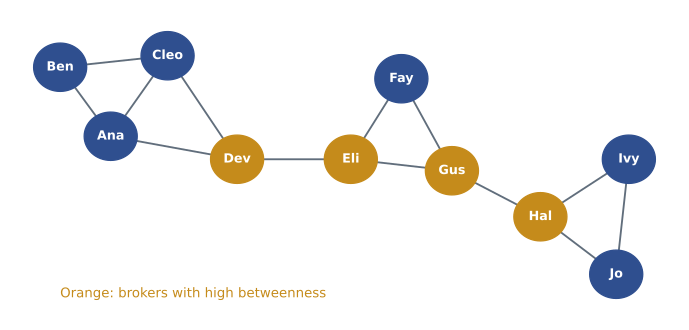
Network analysis gives leaders a way to make the informal structure visible. Two simple measures of a person's position are degree centrality, the number of direct connections, and betweenness centrality, the share of shortest paths between other pairs of people that pass through that person. High-degree people are well connected locally; high-betweenness people are brokers who connect groups. Grace surveys her store managers, asking whom they talk to about produce operations at least monthly, and analyses the result.
# Degree and betweenness centrality in a store manager advice network
from collections import deque
from itertools import combinations

edges = [("Ana","Ben"),("Ana","Cleo"),("Ben","Cleo"),("Cleo","Dev"),  # east cluster
         ("Dev","Eli"),("Eli","Fay"),("Eli","Gus"),("Fay","Gus"),     # west cluster
         ("Gus","Hal"),("Hal","Ivy"),("Ivy","Jo"),("Hal","Jo"),        # north cluster
         ("Ana","Dev")]
G = {}
for a, b in edges:
    G.setdefault(a, set()).add(b)
    G.setdefault(b, set()).add(a)

def shortest_paths(s, t):
    """Return all shortest paths from s to t (breadth-first search)."""
    paths, q, best = [], deque([[s]]), None
    while q:
        p = q.popleft()
        if best is not None and len(p) > best:
            break
        if p[-1] == t:
            best = len(p)
            paths.append(p)
            continue
        for nb in G[p[-1]]:
            if nb not in p:
                q.append(p + [nb])
    return paths

betweenness = {v: 0.0 for v in G}
for s, t in combinations(sorted(G), 2):
    paths = shortest_paths(s, t)
    for v in G:
        if v not in (s, t):
            betweenness[v] += sum(v in p for p in paths) / len(paths)

pairs = (len(G) - 1) * (len(G) - 2) / 2
for v in sorted(G, key=lambda v: -betweenness[v]):
print(f"{v:<5} degree={len(G[v])} betweenness={betweenness[v] / pairs:.2f}")Eli degree=3 betweenness=0.56 Dev degree=3 betweenness=0.50 Gus degree=3 betweenness=0.50 Hal degree=3 betweenness=0.39 Ana degree=3 betweenness=0.10 Cleo degree=3 betweenness=0.10 Ben degree=2 betweenness=0.00 Fay degree=2 betweenness=0.00 Ivy degree=2 betweenness=0.00 Jo degree=2 betweenness=0.00
Eli, Dev, Gus and Hal have no more direct connections than Ana or Cleo, three each, so degree centrality cannot tell them apart. Betweenness can: these four sit between clusters, and most advice that flows from one part of the region to another passes through them. Ana and Cleo are well connected within the east cluster but rarely act as bridges. If Grace wants the new approach to spread across the whole region, the brokers are the people to involve first, because their adoption carries information to every cluster. She should also be careful not to overload them.
Political skill, the ability to understand others at work and to use that understanding to influence them in ways that enhance one's own and the organization's objectives, has been studied by Gerald Ferris and colleagues. It has four dimensions: social astuteness, interpersonal influence, networking ability and apparent sincerity. Meta-analyses find that political skill is related to job performance and career success, and that it helps explain why some people with modest formal power are highly influential while others with impressive titles are not. The sincerity dimension is crucial: influence attempts that are seen as manipulative backfire, while the same behavior seen as genuine builds trust. Grace's advantage with her store managers is that she has run stores herself and genuinely wants them to succeed; her challenge is to make that visible.
Worked problem
Grace's influence plan
Grace needs at least 30 of 40 store managers to adopt the new produce ordering approach within six months, without formal authority over them.
Show solution
- Map the network and identify brokers and respected opinion leaders, using the advice survey.
- Consult before deciding: invite six store managers, including two brokers and one known skeptic, to adapt the ordering checklist from the pilot.
- Use rational persuasion with each manager's own data: shrink and stockout rates for their store compared with pilot stores.
- Trade in valued currencies: offer a produce specialist's help for a week and public recognition at the regional meeting for early adopters.
- Use social proof honestly: report the actual number of stores adopting each month, and avoid pressure through district managers unless adoption stalls.
Answer: An influence campaign built on expertise, consultation, valued currencies and brokers rather than formal authority.
Common mistakes
MistakePower is a dirty word; good leaders do not seek it.
InsteadPower is the capacity to influence; leaders need it to get things done, and the question is which bases they use and how.
MistakeCoercion is the fastest way to change behavior.
InsteadCoercion produces compliance at best and often resistance; rational persuasion, consultation and collaboration produce commitment.
MistakeThe most connected people are always the most influential.
InsteadPeople who bridge separate groups often have more influence over how ideas spread than those with the most local connections.
Summary and key terms
- Power arises from dependence: control over valued resources with few alternatives.
- Expert and referent power produce more commitment than coercive power; legitimate and reward power mainly produce compliance.
- Rational persuasion, inspirational appeals, consultation and collaboration are the most effective influence tactics.
- Influence without authority depends on understanding and trading in the currencies others value.
- Brokers who bridge structural holes gain information and influence; network analysis makes them visible, and they are at risk of overload.
- Power
- The capacity to influence the behavior of others.
- Referent power
- Influence based on being liked, admired or identified with.
- Consultation
- An influence tactic that involves the target in planning a change.
- Weak tie
- A relationship with an acquaintance rather than a close contact.
- Structural hole
- A gap between groups that are not connected to each other.
- Betweenness centrality
- The share of shortest paths between other people that pass through a given person.
Practice problems
Work each problem on paper first, then reveal the answer to check.
A team relies on one database administrator who is the only person who understands a critical system. Using power-dependence theory, explain her power and how the organization could reduce its dependence.
Show answer
Her power comes from controlling something the team values with no alternative source. The organization could reduce dependence by documenting the system, training a second person or simplifying the system.
A peer refuses to share data your project needs. Which influence tactics are most likely to produce commitment rather than compliance?
Show answer
Rational persuasion showing how the data will be used and why it matters, consultation about how to share it with minimal burden, and collaboration such as offering analyst time to help extract it; exchange in a currency the peer values may also help.
Why might the person with the most connections in a network not be the best person to spread an idea across an organization?
Show answer
Their connections may all be within one group. Someone who bridges otherwise separate groups, with high betweenness, can carry the idea into several clusters.
Lesson quiz · 5 questions
Score 60% or more to complete this lesson.
Create a free account to save your progress, take quizzes and earn a certificate.