
MATH-460 · Lesson 6 of 12 · 20 min
Integer partitions, recurrences and asymptotics
A partition of a positive integer \(n\) is a way of writing \(n\) as a sum of positive integers where order does not matter. The number 5 has seven partitions: 5, 4+1, 3+2, 3+1+1, 2+2+1, 2+1+1+1 and 1+1+1+1+1. Unlike compositions, which have the simple count \(2^{n-1}\), partitions have no closed formula, and their study has drawn in Euler, Jacobi, Sylvester, Hardy, Ramanujan and many others. This lesson develops the generating function approach, proves several classic identities, and then asks how fast counting sequences grow, which leads to asymptotic estimates.
Ferrers diagrams and conjugation
Write a partition as \(\lambda = (\lambda_1, \lambda_2, \ldots, \lambda_k)\) with \(\lambda_1 \ge \lambda_2 \ge \cdots \ge \lambda_k \ge 1\). Its Ferrers diagram has a row of \(\lambda_i\) boxes for each part, left-justified. Reading the diagram by columns instead of rows gives another partition \(\lambda'\), the conjugate, whose parts are \(\lambda'_j = |\{i : \lambda_i \ge j\}|\).
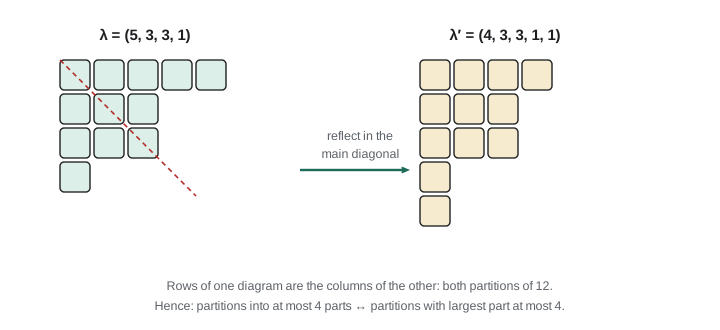
Conjugation is a bijection, since conjugating twice returns the original. It exchanges the number of parts with the size of the largest part. This proves at once: the number of partitions of \(n\) into at most \(k\) parts equals the number of partitions of \(n\) with largest part at most \(k\). A partition equal to its own conjugate is called self-conjugate; reading its diagram by hooks along the diagonal shows that self-conjugate partitions of \(n\) correspond to partitions of \(n\) into distinct odd parts. For instance \((3, 2, 1)\) is self-conjugate and corresponds to \(5 + 1\).
The partition generating function
A partition is determined by how many 1s, how many 2s, how many 3s, and so on, it contains. Choosing \(m_k\) parts equal to \(k\) contributes \(x^{km_k}\), and the choices are independent. Hence, as Euler showed in 1748, \[\sum_{n \ge 0}p(n)x^n = \prod_{k \ge 1}\frac{1}{1 - x^k} = (1 + x + x^2 + \cdots)(1 + x^2 + x^4 + \cdots)(1 + x^3 + \cdots)\cdots\] The infinite product makes sense formally because only the first \(n\) factors affect the coefficient of \(x^n\). Restricting the factors restricts the parts: \(\prod_{k=1}^{m}\frac{1}{1 - x^k}\) counts partitions with parts at most \(m\), \(\prod_{k}(1 + x^k)\) counts partitions into distinct parts, and \(\prod_{k \text{ odd}}\frac{1}{1 - x^k}\) counts partitions into odd parts.
Theorem (Euler). The number of partitions of \(n\) into distinct parts equals the number of partitions of \(n\) into odd parts.
Proof. Using \(1 + x^k = \frac{1 - x^{2k}}{1 - x^k}\), \[\prod_{k \ge 1}(1 + x^k) = \prod_{k \ge 1}\frac{1 - x^{2k}}{1 - x^k} = \frac{(1 - x^2)(1 - x^4)(1 - x^6)\cdots}{(1 - x)(1 - x^2)(1 - x^3)\cdots} = \prod_{k \text{ odd}}\frac{1}{1 - x^k},\] since every even factor in the denominator cancels against the numerator. For \(n = 6\): distinct parts 6, 5+1, 4+2, 3+2+1; odd parts 5+1, 3+3, 3+1+1+1, 1+1+1+1+1+1. Four each.
James Glaisher gave a bijection in 1883. Starting from a partition into odd parts, combine equal parts in pairs repeatedly: three 3s become 6 + 3, since \(3 + 3 = 6\); in general, write the multiplicity \(m\) of each odd part \(q\) in binary, \(m = 2^{a_1} + 2^{a_2} + \cdots\), and replace the copies of \(q\) by the distinct parts \(2^{a_1}q, 2^{a_2}q, \ldots\) Every positive integer is uniquely \(2^a q\) with \(q\) odd, and binary expansions are unique, so this is a bijection onto partitions into distinct parts.
Euler's pentagonal number theorem
Inverting the partition generating function means expanding \(\prod_{k \ge 1}(1 - x^k)\). Euler computed the first terms and found astonishing cancellation: \[\prod_{k \ge 1}(1 - x^k) = 1 - x - x^2 + x^5 + x^7 - x^{12} - x^{15} + x^{22} + x^{26} - \cdots = \sum_{j=-\infty}^{\infty}(-1)^jx^{j(3j-1)/2}.\] The exponents \(j(3j - 1)/2\) for \(j = 1, 2, 3, \ldots\) are the pentagonal numbers 1, 5, 12, 22, and for \(j = -1, -2, \ldots\) they are 2, 7, 15, 26. Euler announced the theorem around 1740 and proved it in 1750.
Combinatorial meaning. The coefficient of \(x^n\) in \(\prod(1 - x^k)\) is \(E_n - O_n\), where \(E_n\) and \(O_n\) count partitions of \(n\) into an even and an odd number of distinct parts. Fabian Franklin gave a beautiful bijective proof in 1881. In a partition into distinct parts, let the slope be the longest run of parts \(\lambda_1, \lambda_1 - 1, \lambda_1 - 2, \ldots\) decreasing by one from the largest, and let the base be the smallest part. If the base is no longer than the slope, move the base boxes onto the ends of the first rows of the slope; otherwise remove the slope, one box from each of its rows, and make it a new smallest part. Each move changes the number of parts by one, so it pairs even with odd partitions. The moves fail only when the slope and the base overlap and have lengths \(j\) and \(j\) or \(j\) and \(j + 1\), which happens exactly when \(n = j(3j \mp 1)/2\), and then there is a single unpaired partition with \(j\) parts, giving the sign \((-1)^j\).
A recurrence for p(n). Multiplying \(\sum p(n)x^n\) by \(\prod(1 - x^k)\) gives 1. Comparing coefficients of \(x^n\) for \(n \ge 1\): \[p(n) = p(n - 1) + p(n - 2) - p(n - 5) - p(n - 7) + p(n - 12) + p(n - 15) - \cdots,\] with \(p(m) = 0\) for \(m < 0\) and \(p(0) = 1\). Only about \(2\sqrt{2n/3}\) terms are nonzero, so this computes \(p(n)\) quickly. Percy MacMahon used it in 1918 to compute \(p(n)\) up to \(n = 200\), finding \(p(200) = 3{,}972{,}999{,}029{,}388\), the table against which Hardy and Ramanujan tested their formula.
Ramanujan and the growth of p(n)
The partition numbers grow faster than any polynomial but slower than any exponential \(c^n\) with \(c > 1\). In 1918 G. H. Hardy and Srinivasa Ramanujan proved \[p(n) \sim \frac{1}{4n\sqrt3}\exp\Big(\pi\sqrt{\frac{2n}{3}}\Big),\] meaning the ratio tends to 1. Their method, the circle method, studies the generating function near every root of unity on the unit circle, and became one of the main tools of analytic number theory. Hans Rademacher refined it in 1937 into an exact convergent series for \(p(n)\). The approximation is already within about 4 parts in 100 at \(n = 100\), where \(p(100) = 190{,}569{,}292\).
Ramanujan also noticed divisibility patterns in MacMahon's table: \[p(5n + 4) \equiv 0 \pmod 5, \quad p(7n + 5) \equiv 0 \pmod 7, \quad p(11n + 6) \equiv 0 \pmod{11}.\] He proved the first two. Freeman Dyson in 1944 conjectured a combinatorial explanation, the rank of a partition (largest part minus number of parts), which splits the partitions of \(5n + 4\) into five equal classes; this was proved by Atkin and Swinnerton-Dyer in 1954. In 2011 Ken Ono and Jan Bruinier found an algebraic formula for \(p(n)\) as a finite sum of algebraic numbers.
Asymptotics of counting sequences
Exact formulas are often less informative than good estimates. Stirling's formula \(n! \sim \sqrt{2\pi n}\,(n/e)^n\), found by de Moivre and Stirling around 1730, is the basic tool. From it, \[\binom{2n}{n} \sim \frac{4^n}{\sqrt{\pi n}}, \qquad C_n \sim \frac{4^n}{n^{3/2}\sqrt\pi}.\] So there are about \(4^n\) Dyck paths, and the correction factor \(n^{-3/2}\) records the constraint of staying above the axis.
The principle behind such estimates is that the growth of the coefficients of a generating function is controlled by its singularity nearest the origin. If \(A(x)\) is analytic for \(|x| < \rho\) and has a singularity at \(x = \rho\), then roughly \(a_n \approx \rho^{-n}\) times a smaller factor determined by the type of singularity. For rational functions, the smallest root of the denominator dominates: \(F(x) = \frac{x}{1 - x - x^2}\) has its smallest root at \(1/\phi\), so \(F_n \sim \phi^n/\sqrt5\). For \(\frac{e^{-x}}{1 - x}\) the only singularity is a simple pole at 1, so \(D_n/n! \to e^{-1}\), the residue there. The Catalan function \(\frac{1 - \sqrt{1 - 4x}}{2x}\) has a square-root singularity at \(\frac14\), which produces both the \(4^n\) and the \(n^{-3/2}\). The partition function has singularities at every root of unity, which is why \(p(n)\) grows subexponentially and needed the circle method.
Recurrences and growth rates. A linear recurrence with constant coefficients has a rational generating function, so its solution grows like \(r^n\) times a polynomial, where \(r\) is the largest root of the characteristic equation. A divide-and-conquer recurrence such as \(T(n) = 2T(n/2) + n\) behaves differently, giving \(T(n) \approx n\log_2 n\); this is the territory of the master theorem studied in CMPUT-204. Telling which kind of recurrence one has is the first step in estimating any counting sequence.
import math

N = 200
p = [1] + [0] * N
for part in range(1, N + 1):
    for n in range(part, N + 1):
        p[n] += p[n - part]
print("p(1..15):", p[1:16])
print("p(100) =", p[100], "  p(200) =", p[200])

def pentagonal_p(N):
    q = [1] + [0] * N
    for n in range(1, N + 1):
        total, j = 0, 1
        while True:
            g1, g2 = j * (3 * j - 1) // 2, j * (3 * j + 1) // 2
            if g1 > n:
                break
            sign = 1 if j % 2 else -1
            total += sign * q[n - g1]
            if g2 <= n:
                total += sign * q[n - g2]
            j += 1
        q[n] = total
    return q
print("pentagonal recurrence agrees up to 200:", pentagonal_p(N) == p)

def count_parts(N, allowed, distinct=False):
    c = [1] + [0] * N
    for part in allowed:
        rng = range(N, part - 1, -1) if distinct else range(part, N + 1)
        for n in rng:
            c[n] += c[n - part]
    return c
dist = count_parts(40, range(1, 41), distinct=True)
odd = count_parts(40, range(1, 41, 2))
print("distinct parts = odd parts for n <= 40:", dist == odd, " e.g. n=10:", dist[10])

def at_most_k_parts(n, k, largest=None):
    if largest is None:
        largest = n
    if n == 0:
        return 1
    if k == 0:
        return 0
    return sum(at_most_k_parts(n - first, k - 1, first) for first in range(1, min(n, largest) + 1))
k_parts = [at_most_k_parts(12, k) for k in range(1, 7)]
max_part = [count_parts(12, range(1, k + 1))[12] for k in range(1, 7)]
print("n=12, at most k parts:", k_parts, "  largest part <= k:", max_part)

for n in [10, 50, 100, 200]:
    hr = math.exp(math.pi * math.sqrt(2 * n / 3)) / (4 * n * math.sqrt(3))
    print(f"n={n}: p(n)={p[n]}, Hardy-Ramanujan estimate {hr:.4g}, ratio {p[n] / hr:.4f}")

print("p(5n+4) divisible by 5:", all(p[5 * n + 4] % 5 == 0 for n in range(39)))
print("p(7n+5) divisible by 7:", all(p[7 * n + 5] % 7 == 0 for n in range(28)))
print("p(11n+6) divisible by 11:", all(p[11 * n + 6] % 11 == 0 for n in range(18)))

for n in [10, 100, 500]:
    exact = math.comb(2 * n, n) // (n + 1)
    approx = 4 ** n / (n ** 1.5 * math.sqrt(math.pi))
    print(f"Catalan C_{n}: exact/approx = {exact / approx:.5f}")
for n in [10, 50, 100]:
print(f"Stirling ratio n!/(sqrt(2 pi n)(n/e)^n), n={n}: {math.factorial(n) / (math.sqrt(2 * math.pi * n) * (n / math.e) ** n):.6f}")p(1..15): [1, 2, 3, 5, 7, 11, 15, 22, 30, 42, 56, 77, 101, 135, 176] p(100) = 190569292 p(200) = 3972999029388 pentagonal recurrence agrees up to 200: True distinct parts = odd parts for n <= 40: True e.g. n=10: 10 n=12, at most k parts: [1, 7, 19, 34, 47, 58] largest part <= k: [1, 7, 19, 34, 47, 58] n=10: p(n)=42, Hardy-Ramanujan estimate 48.1, ratio 0.8731 n=50: p(n)=204226, Hardy-Ramanujan estimate 2.176e+05, ratio 0.9386 n=100: p(n)=190569292, Hardy-Ramanujan estimate 1.993e+08, ratio 0.9563 n=200: p(n)=3972999029388, Hardy-Ramanujan estimate 4.1e+12, ratio 0.9690 p(5n+4) divisible by 5: True p(7n+5) divisible by 7: True p(11n+6) divisible by 11: True Catalan C_10: exact/approx = 0.89780 Catalan C_100: exact/approx = 0.98886 Catalan C_500: exact/approx = 0.99775 Stirling ratio n!/(sqrt(2 pi n)(n/e)^n), n=10: 1.008365 Stirling ratio n!/(sqrt(2 pi n)(n/e)^n), n=50: 1.001668 Stirling ratio n!/(sqrt(2 pi n)(n/e)^n), n=100: 1.000834
The two methods for \(p(n)\) agree, Euler's distinct-equals-odd identity checks to 40, and conjugation is confirmed for \(n = 12\). The Hardy–Ramanujan ratio creeps toward 1 slowly, about 0.96 at \(n = 100\), as the next term of Rademacher's series would correct. Ramanujan's three congruences hold throughout the table, and the Catalan and Stirling estimates improve as \(n\) grows, with relative errors of order \(1/n\).
Worked problem
Partitions with restricted parts
In how many ways can 10 be written as a sum of parts from {1, 2, 3}, order not mattering? Find the generating function and the coefficient.
Show solution
- Generating function: \(\frac{1}{(1 - x)(1 - x^2)(1 - x^3)}\).
- Count by the number \(c\) of 3s: \(c = 0, 1, 2, 3\) leaves \(10, 7, 4, 1\) to be made from 1s and 2s.
- An amount \(m\) can be made from 1s and 2s in \(\lfloor m/2 \rfloor + 1\) ways: 6, 4, 3, 1.
- Total \(6 + 4 + 3 + 1 = 14\). By conjugation this also counts partitions of 10 into at most 3 parts.
Answer: 14 partitions.
Common mistakes
MistakeTreating 2+1 and 1+2 as different partitions.
InsteadPartitions are unordered; ordered sums are compositions.
MistakeWriting the distinct-parts function as \(\prod\frac{1}{1 - x^k}\).
InsteadEach part appears at most once: \(\prod(1 + x^k)\).
MistakeExpecting a closed formula for p(n).
InsteadThere is none of the elementary kind; use the recurrence or the Hardy–Ramanujan–Rademacher formula.
MistakeReading \(p(n) \sim f(n)\) as \(p(n) - f(n) \to 0\).
InsteadIt means the ratio tends to 1; the difference can grow without bound.
MistakeForgetting the pentagonal numbers for negative j.
InsteadBoth j(3j − 1)/2 and j(3j + 1)/2 occur: 1, 2, 5, 7, 12, 15, ...
Summary and key terms
- Partitions have generating function \(\prod_{k \ge 1}(1 - x^k)^{-1}\); restricting factors restricts the parts.
- Conjugation of Ferrers diagrams swaps number of parts and largest part.
- Euler: partitions into distinct parts and into odd parts are equinumerous, with Glaisher’s binary bijection.
- Pentagonal number theorem: \(\prod(1 - x^k) = \sum_j(-1)^jx^{j(3j-1)/2}\), proved bijectively by Franklin, giving a fast recurrence for \(p(n)\).
- Hardy–Ramanujan: \(p(n) \sim \frac{1}{4n\sqrt3}e^{\pi\sqrt{2n/3}}\); Ramanujan congruences modulo 5, 7 and 11.
- Asymptotics are governed by the nearest singularity: \(C_n \sim 4^n n^{-3/2}/\sqrt\pi\), \(F_n \sim \phi^n/\sqrt5\).
- partition of n
- An unordered way of writing n as a sum of positive integers.
- Ferrers diagram
- Rows of boxes representing the parts of a partition.
- conjugate partition
- The partition read from the columns of a Ferrers diagram.
- pentagonal number
- A number \(j(3j - 1)/2\) for an integer \(j\).
- asymptotic equivalence
- \(f(n) \sim g(n)\) means \(f(n)/g(n) \to 1\).
- dominant singularity
- The singularity of a generating function nearest the origin, which sets the exponential growth rate of its coefficients.
Practice problems
Work each problem on paper first, then reveal the answer to check.
List the partitions of 6 and check that p(6) = 11.
Show answer
6, 5+1, 4+2, 4+1+1, 3+3, 3+2+1, 3+1+1+1, 2+2+2, 2+2+1+1, 2+1+1+1+1, 1+1+1+1+1+1.
Find the conjugate of (6, 4, 4, 2, 1).
Show answer
Column lengths: \((5, 4, 3, 3, 1, 1)\).
Use the pentagonal recurrence to compute p(8) from p(0..7) = 1, 1, 2, 3, 5, 7, 11, 15.
Show answer
\(p(7) + p(6) - p(3) - p(1) = 15 + 11 - 3 - 1 = 22\).
Apply Glaisher’s map to 5+5+5+1+1.
Show answer
Three 5s: \(3 = 2 + 1\), giving 10 + 5; two 1s give 2. Result 10 + 5 + 2.
Show that the number of partitions of n with no part equal to 1 is p(n) − p(n − 1).
Show answer
Its generating function is \((1 - x)\prod_k(1 - x^k)^{-1}\).
Estimate the growth rate of the sequence with generating function 1/(1 − 2x − x²).
Show answer
Smallest root of \(1 - 2x - x^2\) is \(\sqrt2 - 1\), so growth like \((1 + \sqrt2)^n\).
Lesson quiz · 5 questions
Score 60% or more to complete this lesson.
Create a free account to save your progress, take quizzes and earn a certificate.