
MATH-101 · Lesson 2 of 5 · 48 min
Areas, volumes and work
The definite integral is a machine for adding up infinitely many thin pieces. Calculus I used it for the area under a curve. In engineering, the same idea measures the area of an irregular plate, the volume of a tank or a machined part, the length of a cable, and the work needed to lift, stretch or pump something.
Every application in this lesson follows one pattern, and if you learn the pattern you will not need to memorize the formulas:
- Slice the object into thin pieces (strips, disks, shells).
- Write the size of one piece: its area, volume, length or work, in terms of the variable and the thickness \(dx\) or \(dy\).
- Integrate over the full range to add up the pieces.
Area between curves
If \(f(x) \ge g(x)\) on \([a, b]\), a thin vertical strip at \(x\) has height \(f(x) - g(x)\) and width \(dx\). Adding the strips:
If the curves cross, the limits of integration are usually the \(x\)-values where they meet. Find them by setting the two functions equal.
Worked problem
Area between a line and a parabola
Find the area enclosed by \(y = x\) and \(y = x^2\).
Show solution
- Intersections: \(x = x^2\) gives \(x = 0\) and \(x = 1\).
- On \((0, 1)\), \(x > x^2\) (try \(x = 0.5\)), so \(y = x\) is on top.
- \[A = \int_0^1 (x - x^2)\,dx = \left[\tfrac12x^2 - \tfrac13x^3\right]_0^1 = \tfrac16\]
Answer: 1/6
Slicing horizontally
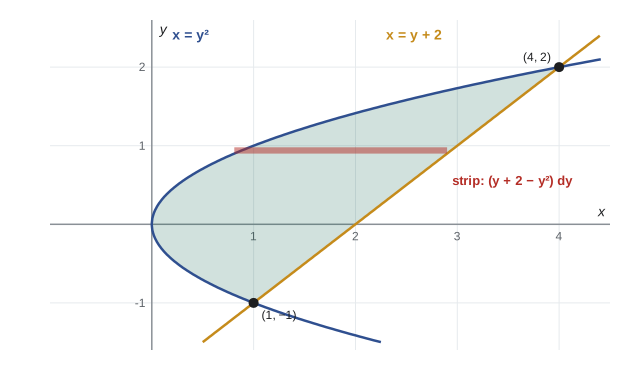
Sometimes vertical strips are awkward because the top or bottom curve changes partway across. Then slice horizontally instead: a strip at height \(y\) has length right minus left and thickness \(dy\).
Worked problem
Integrating with respect to y
Find the area between \(x = y^2\) and \(x = y + 2\).
Show solution
- Intersections: \(y^2 = y + 2\), so \((y - 2)(y + 1) = 0\), giving \(y = -1\) and \(y = 2\).
- The line is on the right: at \(y = 0\), \(x = 2\) for the line and \(x = 0\) for the parabola.
- \[A = \int_{-1}^{2}\big(y + 2 - y^2\big)\,dy = \left[\tfrac12y^2 + 2y - \tfrac13y^3\right]_{-1}^{2} = \tfrac{10}{3} - \left(-\tfrac76\right) = \tfrac92\]
Answer: 4.5 square units. With vertical strips this would need two separate integrals
Volumes by slicing
If you know the area \(A(x)\) of every cross-section of a solid, its volume is
This is how you would find the volume of any solid with a known profile: a tapered column, a hopper, a hull section.
Worked problem
A pyramid
A pyramid has a 10 m square base and a height of 6 m. Find its volume by slicing.
Show solution
- At height \(y\), the square cross-section has side \(10\left(1 - \dfrac{y}{6}\right)\), shrinking to zero at the top.
- \(A(y) = 100\left(1 - \dfrac{y}{6}\right)^2\).
- \[V = \int_0^6 100\left(1 - \frac{y}{6}\right)^2 dy = 100\left[-2\left(1 - \frac{y}{6}\right)^3\right]_0^6 = 200\]
Answer: 200 m³, matching the formula V = ⅓ × base × height
Solids of revolution: disks and washers
Rotating a region around an axis makes a solid of revolution: the shape of a shaft, a nozzle, a bottle or a lathe-turned part. Slices perpendicular to the axis are circular.
- Disk method: rotating \(y = f(x)\) about the x-axis, each slice is a disk of radius \(f(x)\): \(V = \pi\int_a^b [f(x)]^2\,dx\).
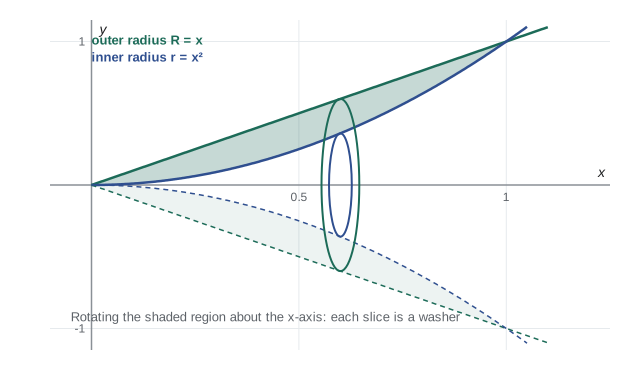
- Washer method: if the region has a hole, each slice is a washer with outer radius \(R(x)\) and inner radius \(r(x)\): \(V = \pi\int_a^b \big([R(x)]^2 - [r(x)]^2\big)\,dx\).
Worked problem
A disk
Find the volume when \(y = \sqrt{x}\), \(0 \le x \le 4\), is rotated about the x-axis.
Show solution
- \[V = \pi\int_0^4 x\,dx = \pi\left[\tfrac12x^2\right]_0^4 = 8\pi\]
Answer: 8π ≈ 25.1 cubic units (a paraboloid, the shape of a satellite dish)
Worked problem
A washer
Rotate the region between \(y = x\) and \(y = x^2\) about the x-axis. Find the volume.
Show solution
- Outer radius \(R = x\) (the line), inner radius \(r = x^2\) (the parabola), for \(0 \le x \le 1\).
- \[V = \pi\int_0^1 \big(x^2 - x^4\big)\,dx = \pi\left(\tfrac13 - \tfrac15\right) = \frac{2\pi}{15}\]
Answer: 2π/15 ≈ 0.419. Note: it is π(R² − r²), not π(R − r)²
Cylindrical shells
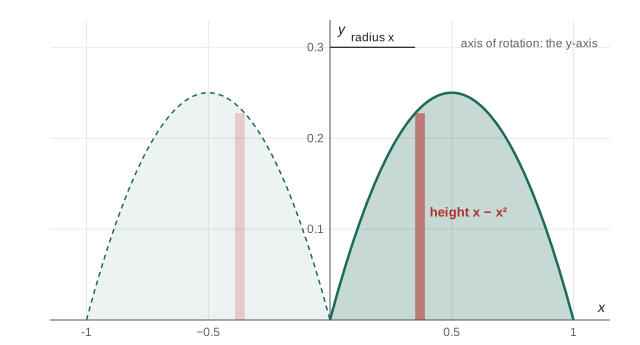
If you rotate around the y-axis a region described by \(y = f(x)\), washers would need \(x\) as a function of \(y\), which may be awkward. Shells avoid this. A thin vertical strip at distance \(x\) from the axis sweeps out a thin cylindrical shell. Unrolled, the shell is nearly a flat plate of length \(2\pi x\) (the circumference), height \(f(x)\) and thickness \(dx\):
Worked problem
Shell method
The region under \(y = x - x^2\) for \(0 \le x \le 1\) is rotated about the y-axis. Find the volume.
Show solution
- \[V = \int_0^1 2\pi x(x - x^2)\,dx = 2\pi\left[\tfrac13x^3 - \tfrac14x^4\right]_0^1 = 2\pi\cdot\tfrac{1}{12} = \frac{\pi}{6}\]
Answer: π/6 ≈ 0.524
Arc length
The length of a curve is the sum of many tiny straight segments. A segment with horizontal step \(dx\) and vertical step \(dy\) has length \(\sqrt{dx^2 + dy^2} = \sqrt{1 + (dy/dx)^2}\,dx\). So:
Arc length integrals are often hard to do exactly because of the square root, and numerical integration is common. A few work out neatly, and one is especially useful.
Worked problem
Length of a hanging cable
In Calculus I a power line hung as \(y = 50\cosh(x/50)\) between towers at \(x = \pm 30\) m. How long is the cable?
Show solution
- \(y' = \sinh(x/50)\), and the identity \(1 + \sinh^2 u = \cosh^2 u\) simplifies the root: \(\sqrt{1 + \sinh^2(x/50)} = \cosh(x/50)\).
- \[L = \int_{-30}^{30}\cosh\frac{x}{50}\,dx = 50\left[\sinh\frac{x}{50}\right]_{-30}^{30} = 100\sinh(0.6)\]
- \(\sinh(0.6) \approx 0.63665\), so \(L \approx 63.67\) m.
Answer: About 63.7 m of cable for a 60 m span with 9.3 m of sag
This is why the catenary is so convenient to work with. For most other curves, compute arc length numerically with Simpson's rule.
Surface area and tank calibration
Surface area of revolution
Rotating a curve (not a region) about an axis sweeps out a surface. A short piece of the curve, of length \(ds = \sqrt{1 + (y')^2}\,dx\), sweeps out a thin band of circumference \(2\pi y\). Adding the bands:
Surface area tells you how much sheet metal a duct or nozzle needs, how much paint or coating a tank takes, and how much area is available for heat transfer.
Worked problem
Surface of a sphere
Rotate \(y = \sqrt{r^2 - x^2}\), \(-r \le x \le r\), about the x-axis to find the surface area of a sphere.
Show solution
- \(y' = \dfrac{-x}{\sqrt{r^2 - x^2}}\), so \(1 + (y')^2 = \dfrac{r^2}{r^2 - x^2}\) and \(\sqrt{1 + (y')^2} = \dfrac{r}{\sqrt{r^2 - x^2}}\).
- The integrand simplifies beautifully: \(2\pi\sqrt{r^2 - x^2}\cdot\dfrac{r}{\sqrt{r^2 - x^2}} = 2\pi r\).
- \(S = \int_{-r}^{r} 2\pi r\,dx = 4\pi r^2\).
Answer: 4πr², the familiar formula, now derived
Calibrating a horizontal tank
Fuel and process tanks are often horizontal cylinders. Operators measure the liquid depth with a dipstick or level sensor, but they need the volume. Because the cross-section is a circle, volume is not proportional to depth, and the conversion comes from an area integral.
For a cylinder of radius \(r\) and length \(L\) filled to depth \(h\), the liquid's cross-section is a circular segment. Integrating horizontal strips of width \(2\sqrt{r^2 - y^2}\) from the bottom to the liquid surface gives the segment area
and the volume is \(V = L\,A(h)\).
Worked problem
A dipstick chart
A horizontal tank is 4 m long with a 1 m radius. How much liquid does it hold at depths of 0.25 m, 0.5 m, 1 m and 1.5 m?
Show solution
- At \(h = 0.5\): \(A = \cos^{-1}(0.5) - 0.5\sqrt{0.75} = 1.0472 - 0.4330 = 0.6142\) m², so \(V \approx 2.46\) m³.
- Similarly, \(h = 0.25\) gives about 0.91 m³, \(h = 1\) (half full) gives \(2\pi \approx 6.28\) m³, and \(h = 1.5\) gives about 10.11 m³.
- The full tank holds \(\pi(1)^2(4) \approx 12.57\) m³.
Answer: A quarter of the depth (0.5 m) holds less than 20% of the volume. Reading depth as if it were volume would badly misjudge the contents
Tank manufacturers supply exactly this kind of chart, computed from the integral. Level-monitoring software stores it as a lookup table.
Work
Work is force times distance when the force is constant. When the force varies with position, or different parts of an object move different distances, slice and integrate.
Variable force: springs
A linear spring obeys Hooke's law, \(F = kx\), where \(x\) is the extension from its natural length. The work to stretch it from \(x_1\) to \(x_2\) is
Worked problem
Spring work
A spring needs 40 N to hold it 0.1 m beyond its natural length. How much work stretches it from 0.1 m to 0.3 m?
Show solution
- Spring constant: \(k = 40/0.1 = 400\) N/m.
- \(W = \tfrac12(400)(0.3^2 - 0.1^2) = 200(0.08) = 16\) J.
Answer: 16 J
Lifting a cable
When you winch up a hanging cable, the bottom of the cable travels the whole way while the top barely moves. Slice the cable into short pieces, each lifted its own distance.
Worked problem
Winching a cable and a load
A 30 m steel cable with a mass of 2 kg/m hangs down a shaft with a 100 kg load on the end. How much work does it take to winch the cable and load up to the top?
Show solution
- A cable piece at depth \(y\) below the top has weight \(2(9.81)\,dy\) N and must be lifted \(y\) meters.
- Cable work: \(\int_0^{30} 19.62\,y\,dy = 19.62 \times \tfrac12(30)^2 = 8829\) J.
- Load work (a single object, constant force): \(100 \times 9.81 \times 30 = 29\,430\) J.
- Total: \(8829 + 29\,430 = 38\,259\) J.
Answer: About 38.3 kJ. The cable needs only half the work it would if all of it had to travel the full 30 m
Pumping liquids
You saw this in Calculus I. Slice the liquid into thin horizontal layers; each layer has a weight (density × g × volume) and a lift distance. The shape of the tank determines the volume of each layer, and the outlet height determines the lift.
Worked problem
Emptying a conical tank
An inverted conical tank (point down) is 4 m deep with a top radius of 2 m, full of water. How much work pumps all the water out over the top rim?
Show solution
- Measure \(y\) up from the point. The radius at height \(y\) is \(y/2\), so a layer has volume \(\pi(y/2)^2\,dy\) and weight \(9810\pi\dfrac{y^2}{4}\,dy\) N.
- It is lifted \(4 - y\) meters to the rim.
- \[W = \int_0^4 9810\pi\frac{y^2}{4}(4 - y)\,dy = 2452.5\pi\left[\tfrac43y^3 - \tfrac14y^4\right]_0^4 = 2452.5\pi\left(\tfrac{256}{3} - 64\right)\]
- \(= 2452.5\pi \times 21.33 \approx 164\,400\) J.
Answer: About 164 kJ
Fluid force on a surface
Pressure in a liquid at depth \(h\) is \(\rho g h\). On a vertical surface, slice horizontally: a strip of width \(w(h)\) at depth \(h\) carries force \(\rho g h\,w(h)\,dh\). For a rectangular gate this gives \(F = \tfrac12\rho g w H^2\), as you found in Calculus I. For other shapes (triangles, circles, a dam with sloping sides), \(w(h)\) changes with depth and the integral does the bookkeeping.
Common mistakes
MistakeSubtracting the curves in the wrong order and getting a negative area.
InsteadArea is top minus bottom (or right minus left). Test a point between the limits to see which curve is larger.
MistakeUsing π(R − r)² for a washer.
InsteadA washer's area is π(R² − r²): the area of the outer disk minus the area of the hole.
MistakeUsing the disk formula when rotating about the y-axis with x as the variable.
InsteadFor rotation about the y-axis with vertical strips, use shells: 2πx·height·dx.
MistakeTreating a winched cable as if every part is lifted the full distance.
InsteadEach piece of cable is lifted a different distance. Slice and integrate.
MistakeMixing mass and weight in work problems: using 2 kg/m as a force.
InsteadForce is weight, mass × g. Convert kg to N with g = 9.81 m/s².
Summary and key terms
- Every application: slice into thin pieces, write the size of one piece, and integrate.
- Area between curves: ∫(top − bottom) dx, or ∫(right − left) dy when horizontal strips are simpler.
- Volume by slicing: V = ∫A(x) dx for known cross-sections.
- Disks and washers (slices perpendicular to the axis): V = π∫(R² − r²) dx.
- Shells (strips parallel to the axis): V = ∫2π·radius·height dx.
- Arc length: L = ∫√(1 + (y′)²) dx. The catenary gives a neat answer; most curves need numerical methods.
- Work: W = ∫F(x) dx for a varying force; for cables and liquids, integrate weight × lift distance over thin slices.
- Solid of revolution
- A solid formed by rotating a region about an axis.
- Disk method
- Volume from circular slices perpendicular to the axis.
- Washer method
- Disk method with a hole: π(R² − r²) per slice.
- Shell method
- Volume from thin cylindrical shells parallel to the axis.
- Arc length
- The length of a curve, ∫√(1 + (y′)²) dx.
- Hooke's law
- F = kx for a linear spring.
- Work
- Energy transferred by a force, ∫F dx.
Practice problems
Work each problem on paper first, then reveal the answer to check.
Find the area between \(y = 4 - x^2\) and \(y = x + 2\).
Show answer
Intersections: 4 − x² = x + 2 gives x = −2 and x = 1. ∫ from −2 to 1 of (2 − x − x²) dx = [2x − x²/2 − x³/3] = (2 − 1/2 − 1/3) − (−4 − 2 + 8/3) = 7/6 + 10/3 = 4.5.
Find the area between \(y = \sin x\) and \(y = \cos x\) from \(x = \pi/4\) to \(x = 5\pi/4\).
Show answer
sin x is on top there. ∫(sin x − cos x) dx = [−cos x − sin x] = (√2/2 + √2/2) − (−√2/2 − √2/2) = 2√2 ≈ 2.83.
Find the volume when \(y = x^2\), \(0 \le x \le 2\), is rotated about the x-axis.
Show answer
π∫ from 0 to 2 of x⁴ dx = π(32/5) = 32π/5 ≈ 20.1.
A solid steel shaft is made by rotating \(y = 0.05 + 0.01x\) (meters) about the x-axis for \(0 \le x \le 2\). Find its volume.
Show answer
π∫ from 0 to 2 of (0.05 + 0.01x)² dx = π[(0.05 + 0.01x)³/0.03] from 0 to 2 = π(0.000343 − 0.000125)/0.03 ≈ 0.0228 m³.
Use shells to find the volume when the region under \(y = x^2\), \(0 \le x \le 1\), is rotated about the y-axis.
Show answer
∫ from 0 to 1 of 2πx·x² dx = 2π/4 = π/2.
Show that a sphere of radius r has volume \(\tfrac43\pi r^3\) by rotating \(y = \sqrt{r^2 - x^2}\) about the x-axis.
Show answer
π∫ from −r to r of (r² − x²) dx = π[r²x − x³/3] = π(2r³ − 2r³/3) = (4/3)πr³.
Find the arc length of \(y = \tfrac23x^{3/2}\) from \(x = 0\) to \(x = 3\).
Show answer
y′ = x^(1/2), so √(1 + x). ∫ from 0 to 3 of √(1 + x) dx = (2/3)[(1 + x)^(3/2)] = (2/3)(8 − 1) = 14/3 ≈ 4.67.
A spring has natural length 0.2 m. A 30 N force holds it at 0.25 m. How much work stretches it from 0.25 m to 0.35 m?
Show answer
k = 30/0.05 = 600 N/m. Extensions 0.05 to 0.15 m. W = 300(0.0225 − 0.0025) = 6 J.
A 20 m chain with a mass of 3 kg/m hangs from a winch. How much work winds up the whole chain?
Show answer
∫ from 0 to 20 of 3(9.81)y dy = 29.43 × 200 = 5886 J.
A rectangular tank 3 m long, 2 m wide and 2 m deep is full of water. How much work pumps it out over the top?
Show answer
Layer at depth h has weight 9810 × 6 dh and lift h. W = 58 860 ∫ from 0 to 2 of h dh = 58 860 × 2 = 117 720 J ≈ 118 kJ.
Lesson quiz · 5 questions
Score 60% or more to complete this lesson.
Create a free account to save your progress, take quizzes and earn a certificate.