
LSAT-150 · Lesson 11 of 12 · 19 min
Final review plan
▶ Video coming soon A video version of this lesson is on the way.
The last four to six weeks before an LSAT are different from the months before them. Learning new methods gives way to consolidating the ones you have. Single-type drills give way to full tests and mixed sets. The error log stops growing and starts shrinking. And the most important question changes from "What else can I learn?" to "How do I make sure what I know shows up on the day?" This lesson sets out a final review plan, with the group's January plans as examples.
Harriet presented the plan to the January testers, Élodie, Dani and Ji-won, in mid-November, with Thomas listening for April and Marcus waiting for December 2. Everything she described for December and January was a plan at that point; the group would carry it out after the course ended.
The shape of the final weeks
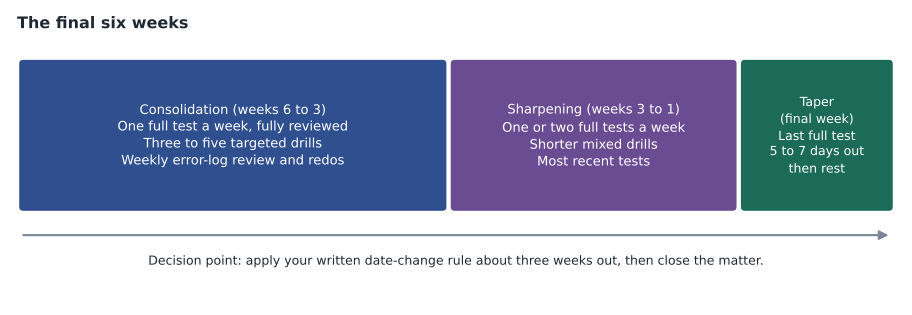
Harriet's final review plan had three phases.
- Consolidation, about six to three weeks out: one full test a week, under true conditions, with full blind review. Between tests, three to five drill sessions on the current priorities and one or two mixed sets. Weekly error-log review and redos.
- Sharpening, about three to one weeks out: one or two full tests a week, still fully reviewed. Drills become shorter and more mixed. New material is limited to the most recent official tests. The error log focuses on recurring mistakes.
- Taper, the final week: the last full test five to seven days before, as LSAT-140 explained, then light practice, logistics, sleep and rest, with no new questions in the last day or two.
The exact length of each phase depends on the candidate. A candidate whose rolling average is still rising steeply may extend consolidation; one already at target may move to sharpening earlier and keep the practice lighter.
Full tests in the final weeks
Full tests in the final weeks serve two purposes: they keep stamina and pacing sharp, and they give the most accurate measure of readiness. Harriet asked the January testers to use their most recent official tests in this phase, under conditions as close to test day as possible. For Élodie, that meant Saturday mornings at 8:30. For Dani and Ji-won, weekday or weekend mornings at the time of their appointments. Each test would include an added section, the 10-minute intermission and nothing else.
Harriet set a limit: no more than two full tests in a week, and never two on consecutive days. The reason was review. A full test without blind review in the final weeks wastes a recent test, and two full tests in two days leave no time to review either properly.
The error log in the final weeks
In the final weeks, the error log changes role. Harriet asked each member to stop adding entries for mistakes they had already logged many times and to focus instead on two things: redoing every active entry at least once, and identifying the five mistakes that had cost the most points over the autumn. Those five became a short card, as Lesson 6 described, rehearsed in the final week.
Élodie's five were: answers that go beyond the passage; flagging too late in Reading Comprehension; attributing a reported view to the author; reading "unless" without translating it; and rechecking the last two questions of a Reading Comprehension set instead of moving on. Dani's five were conditional translation, whose voice an answer expresses, eliminating answers for their wording, rushing the last questions of a section and parallel reasoning structure. Ji-won's were the cannot-be-true bins, keeping last-set care, negating finalists, not over-thinking easy questions and using two flags per set at most.
What not to do in the final weeks
Harriet listed four things she had seen candidates do in the final weeks that rarely helped.
- Starting a new method or a new prep book. Late changes tend to unsettle methods that already work.
- Taking many tests without review, hoping for a high score as reassurance. As Lesson 1 explained, that is score chasing.
- Cramming long hours. Fatigue in the final week lowers performance on test day.
- Reading forum posts about how hard the most recent test was. The difficulty of one form says nothing about yours, and the scale adjusts for it.
The final week
LSAT-140 covered the final week in detail: the last full test five to seven days before, light practice afterwards, a trial trip to the test center, sleep shifted gradually toward the test-day wake time, food and caffeine planned, logistics checked, and no new questions in the last day or two. Harriet reminded the group of Marcus's final week before November 12 as a model. His last full test had been on Saturday, October 31, reviewed the next day; he did two timed sections the following Saturday, a short error-log set on the Monday, his final session on the Tuesday, and a route drive with no practice on the Wednesday before his Thursday test.
The January plans followed the same shape. Élodie planned her last full test for Saturday, January 9, 2027, a week before her appointment, which was also the day she planned to complete her Argumentative Writing sample, as LSAT-130 described. Harriet suggested moving one of the two to a different day so that neither was rushed; Élodie agreed to take the full test on Sunday, January 10, instead. Dani and Ji-won planned their last full tests five to six days before their weekday appointments.
Deciding whether to test
The final review plan includes a decision point. Lesson 10 described the date-change rules each January tester had written in advance. In the final weeks, those rules are applied, calmly, to the data. Harriet suggested applying them about three weeks before the test, after the first sharpening-phase full test. For the January 2027 administration, the registration deadline was December 1, 2026, so under the rules described in Lesson 10 any date change after that would carry a fee, which rises after the first seven days. Dani, whose rule was the closest call and who held a fee waiver, planned to check with LSAC before mid-December exactly how the date change and fee waiver rules would apply to her, so that the cost of moving to February would be known before she needed to decide. Harriet said that was exactly the kind of question to settle in advance.
Harriet stressed that a decision to keep the test date is just as important to make deliberately. A candidate near their target who keeps second-guessing the date spends energy on worry that would be better spent on review and rest. Once the decision point has passed and the date is kept, the matter is closed.
After the test
The final review plan ends with the test, but the decisions do not. Candidates with Score Preview have six calendar days from the score release to decide whether to keep or cancel their score, as LSAT-101 explained, and candidates without it can cancel within six calendar days after the test date. Harriet asked each member to write down, before the test, what they would do with each possible outcome. Marcus's rule, to keep his November score only if above 158, had been written in September.
She also asked each member to plan the first weekend after the test as a complete break. Several had not had a weekend free of LSAT work since September. "Whatever the score," she said, "you will have earned the rest."
Thomas's longer horizon
Thomas, testing in April, would go through the same three phases in March and early April. His plan for the months before that was a longer consolidation: full tests every two to three weeks from January, weekly in March, drills on his priorities, and the remaining pacing work on the fourth section. His checklist already carried the header from LSAT-140, "HOLD THE CHECKPOINTS". His date-change checkpoint, a rolling average below 160 at the end of February, would decide whether April or June was the better date.
Marcus's two paths
Marcus's plan had two branches, depending on December 2. If his November score was above 158, he would keep it and turn to his applications. If not, he would cancel within the Score Preview window, by December 8, and plan a retake, most likely in April or June, using his saved recent tests and a priority list headed by parallel reasoning and principle questions. Harriet said either path was a good outcome, because both had been chosen in advance.
Common mistakes
A sample final four weeks
Harriet sketched what the final four weeks might look like for a January tester with an appointment on a Saturday morning. Week one: full test Saturday morning, blind review Sunday, three drill sessions on priorities during the week, one mixed set, error-log review the next Saturday before the test. Week two: the same pattern, with drills becoming more mixed. Week three: full tests on Saturday and Wednesday morning, each reviewed the next day, two short mixed sets, the decision point applied after Saturday's test. Week four: the last full test on the Sunday six days before the appointment, reviewed lightly; short sets on Monday and Tuesday; a trial trip; logistics; no new questions on Friday; test on Saturday.
She stressed that the sketch was a template, not a prescription. Dani's plan had to fit around her job and her commute. Ji-won's had to allow for longer sections under her accommodated timing, which made a full test closer to four hours with the intermission. Élodie's had to fit around the end of her university term and the holidays.
The holidays
For January testers, the final weeks included the December holidays, which brought both opportunities and risks. Time off work or school meant more hours for practice. Family gatherings, travel and late nights meant disrupted sleep and routines. Harriet asked each January tester to plan the holiday period explicitly: which days would be full test days, which would be rest days and how sleep would be protected. Dani planned to take her full tests on the mornings before family events, not after. Élodie planned one complete rest day around Christmas and one around New Year's Day, with her sleep schedule kept steady in between.
Keeping perspective in the final weeks
The final weeks can feel intense, and Harriet reminded the group that the LSAT is one part of an application, and one test among many in a legal career. A candidate who prepares well and tests as planned has done what can be done. The score matters, but so do grades, personal statements, experience and the choice of schools. Several members said that hearing this from someone who had practiced law and then taught the test for eleven years made the final weeks feel more manageable.
She also reminded them that the habits built in preparation, careful reading, precise reasoning, honest review and disciplined use of time, are habits that law school and practice will reward. "Whatever happens in January," she said, "you are not the reader and thinker you were in September."
The day after the final full test
The review of the final full test deserves particular care. It is the last chance to spot a recurring mistake before test day, but it should not become a source of anxiety. Harriet suggested a lighter version: blind review of flagged questions, a quick check of the five costliest mistakes, and a short note of anything new. If the score is lower than the rolling average, she asked the group to remember Lesson 4: a single score is the middle of a likely range, and one test five days before the real one does not change what the preceding weeks showed.
Marcus said his final full test before November had been one point below his average, and that remembering this advice had kept him from changing anything in his last week. He said that decision, more than any extra practice, had let him arrive at the test center calm.
Ji-won added a last idea that the others adopted: a short "done list" for the night before the test, ticking off each item in the plan as it was completed, so that she could go to bed knowing nothing was left undone.
Common mistakes
MistakeContinuing to learn new methods in the final weeks.
InsteadConsolidate existing methods and use full tests and mixed sets.
MistakeTaking two full tests on consecutive days.
InsteadLimit full tests to two a week and review each fully.
MistakeLetting the error log keep growing.
InsteadRedo active entries and focus on the five costliest mistakes.
MistakeReconsidering the test date every few days.
InsteadApply your written rule at one decision point about three weeks out, then close the matter.
MistakeLeaving post-test decisions until the score arrives.
InsteadWrite keep-or-cancel rules before the test.
Summary and key terms
- The final weeks have three phases: consolidation, sharpening and taper.
- Use the most recent official tests under true conditions, at most two full tests a week, each fully reviewed.
- Turn the error log into a card of the five costliest mistakes and redo every active entry.
- Apply date-change rules at one decision point about three weeks before the test.
- Write keep-or-cancel rules before the test and plan a real break afterwards.
- Consolidation phase
- About six to three weeks out: weekly full tests, targeted drills and log review.
- Sharpening phase
- About three to one weeks out: one or two full tests a week with shorter mixed drills.
- Taper
- The final week, with the last full test five to seven days before and light practice after.
- Decision point
- A planned moment to apply date-change rules to the latest data.
- Costliest mistakes card
- A short list of the five mistakes that cost the most points, rehearsed in the final week.
Practice problems
Work each problem on paper first, then reveal the answer to check.
What are the three phases of Harriet's final review plan?
Show answer
Consolidation, sharpening and taper.
What limit did Harriet set on full tests in the final weeks?
Show answer
No more than two a week, never on consecutive days.
Why did Élodie move her last full test to January 10?
Show answer
So that it would not fall on the same day as her Argumentative Writing sample.
When did Harriet suggest applying date-change rules?
Show answer
About three weeks before the test, after the first sharpening-phase full test.
What were Marcus's two paths after December 2?
Show answer
Keep a score above 158 and turn to applications, or cancel by December 8 and plan a retake.
Lesson quiz · 5 questions
Score 60% or more to complete this lesson.
Create a free account to save your progress, take quizzes and earn a certificate.