
LES-104 · Lesson 7 of 12 · 25 min
Interviewing basics: victims, witnesses and complainants
▶ Video coming soon A video version of this lesson is on the way.
Mira Osei is a nurse who works nights at Port Ardent General. On the night of the Lakeshore Hardware break-in she was off duty, asleep in her apartment above the shop next door, when breaking glass woke her. By the time the probationary officer knocks on her door at 2:21 a.m., she has already called her sister, posted about it on a neighborhood social media group and read two replies from people who say they saw 'a guy in a hoodie' on Pine Street. What she remembers, and what she tells the officer, will be shaped by everything that happens in the next twenty minutes, including how the officer asks.
Interviewing is the core skill of investigation. Most crimes are solved because someone tells police something useful: a victim, a witness, a neighbor, sometimes the person who committed the crime. This lesson covers interviews with victims, witnesses and complainants, people who are generally cooperative and who have information police need. Lesson 8 covers taking formal statements, and later courses cover interviewing suspects, which raises additional legal issues. The aim throughout is to obtain as much accurate information as possible while treating people fairly and avoiding the memory contamination described in lesson 3.
Interviews, not interrogations
For much of the twentieth century, police interviewing in North America was dominated by an accusatory style, most associated with the Reid technique, which was designed to obtain confessions from suspects the interviewer already believed guilty. Research over the past thirty years has shown that accusatory methods increase the risk of false confessions and contaminated accounts and are no better at producing accurate information than non-accusatory methods. They are also entirely unsuitable for victims and witnesses, who are trying to help.
Many police services have moved to an investigative interviewing approach, which treats the interview as a search for information rather than a search for confirmation. The best-known model is PEACE, developed in England and Wales in the early 1990s after a series of wrongful convictions and now used, in various forms, by many services in Canada, Australia, New Zealand and elsewhere. Some US agencies and the largest private interrogation training firm in the United States moved away from confrontational methods in the late 2010s. PEACE is an acronym for the five stages of an interview.
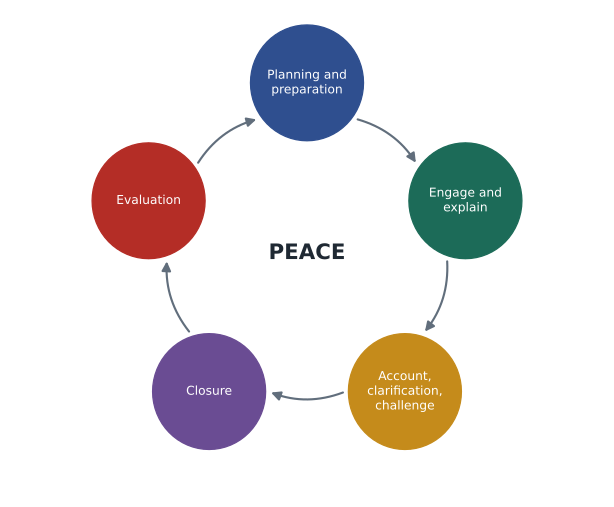
- Planning and preparation: decide what the interview needs to achieve, what is already known, where to hold it, whether an interpreter or support person is needed and how it will be recorded. Even a two-minute interview at the door benefits from thirty seconds of planning.
- Engage and explain: introduce yourself, explain the purpose of the interview and what will happen, and build rapport. Rapport is not friendliness for its own sake; it is the working relationship that lets the person concentrate and speak freely.
- Account, clarification and challenge: obtain the person's account in their own words, then clarify gaps and, where necessary, raise inconsistencies with other evidence, calmly and without accusation.
- Closure: summarize what the person said so they can correct it, explain what happens next, answer their questions and tell them how to contact you if they remember more.
- Evaluation: afterward, review what was learned, how it fits with other evidence, what needs to be checked and how the interviewer could do better.
The cognitive interview
In the 1980s two American psychologists, Ronald Fisher and Edward Geiselman, developed the cognitive interview, a set of techniques based on what psychology had learned about memory. Laboratory and field studies have consistently found that it produces substantially more correct information than standard police interviews, with little or no increase in errors. Its core techniques can be used in a full interview at the station and, in shortened form, at the scene.
| Technique | What the interviewer does | Why it works |
|---|---|---|
| Report everything | Asks the witness to report every detail, even ones that seem trivial or that they are unsure of | Witnesses filter out details they think unimportant; small details can matter and can trigger other memories |
| Mental reinstatement of context | Asks the witness to picture the scene: where they were, what they could hear and feel, what they were thinking | Memory is linked to context; recreating it helps retrieval |
| Change the order | Asks the witness to recount events in a different order, such as backward from the end | Breaks reliance on a familiar story and can bring out new details |
| Change the perspective | Asks the witness to describe events from another viewpoint, such as from the window across the street | Can bring out details not recalled from the witness's own viewpoint; used with care to avoid guessing |
The enhanced cognitive interview adds techniques for building rapport, transferring control of the interview to the witness, who knows more about the event than the interviewer, and using open questions and pauses. A key instruction is to tell the witness that it is fine to say 'I don't know' or 'I'm not sure', which reduces guessing. Interviewers are also taught not to interrupt. Studies of real police interviews found that officers interrupted witnesses within a few seconds of their starting to speak, cutting off details before they emerged.
Types of questions
The way a question is asked shapes the answer. Interviewers distinguish several types of question, and good interviews use them in a deliberate order, starting broad and narrowing down.
- Open questions invite a full account in the person's own words. A useful memory aid is TED: 'Tell me...', 'Explain...', 'Describe...'. 'Tell me everything that happened from the moment you heard the glass' is an open question.
- Probing questions follow up on what the person has said, usually beginning with who, what, where, when, why or how: 'What did you see when you looked out of the window?' They are still fairly open.
- Closed questions can be answered in a word: 'Was the streetlight on?' They are useful for confirming specific details late in the interview, but if used too early they limit what the person says.
- Leading questions suggest an answer: 'He was carrying a crowbar, wasn't he?' They should be avoided with witnesses and victims, because they can introduce misinformation and make the account less reliable in court.
- Multiple questions ask several things at once: 'Was he tall, and did he go left or right, and was anyone with him?' The person answers one part and the rest are lost. Ask one question at a time.
A good interview usually begins with a free recall phase, in which the person tells their account with as few interruptions as possible, followed by a questioning phase that probes each part of the account in turn, moving from open to closed questions. The interviewer listens far more than he or she talks. Researchers who analyze recorded interviews often measure the share of the interviewer's questions that are open and the share of words spoken by the witness; in good interviews, the witness does most of the talking.
Analyzing an interview
Linh Tran's part-time job at the communications center has given her an interest in how conversations are structured. For a class exercise, she takes the transcript of the probationary officer's first conversation with Mira Osei, recorded on the body-worn camera, and classifies each question by its opening words. The program below is deliberately simple: it uses the first words of each question as a guide, which is how training officers often do a first pass, and then counts how much each person spoke.
# Classify interviewer questions by type and measure who did the talking
turns = [
    ("officer", "Can you tell me what happened?"),
    ("witness", "I heard glass smash, really loud, and I went to the window and saw a guy "
                "run out of the store and go toward Pine. He had a white hoodie with the hood up."),
    ("officer", "Was he carrying anything?"),
    ("witness", "I think so. Maybe a bag."),
    ("officer", "He had a crowbar, didn't he?"),
    ("witness", "Maybe. I'm not sure. It was dark."),
    ("officer", "Describe the man for me as best you can."),
    ("witness", "Young, maybe twenties. Thin. He ran a bit funny, like his leg hurt. Tall, I think."),
    ("officer", "How long could you see him for?"),
    ("witness", "Only a few seconds, until he got past the bakery."),
    ("officer", "Was he tall or short, and did anyone go with him?"),
    ("witness", "Tall. No one else."),
]
def kind(q):
    q = q.lower()
    if q.endswith(("didn't he?", "wasn't he?", "right?", "wasn't it?")):
        return "leading"
    if " and " in q and q.count("?") == 1 and q.startswith(("was", "did", "is")):
        return "multiple"
    if q.startswith(("tell", "explain", "describe", "can you tell")):
        return "open"
    if q.startswith(("what", "how", "where", "when", "who", "why")):
        return "probing"
    return "closed"
counts = {}
words = {"officer": 0, "witness": 0}
for who, text in turns:
    words[who] += len(text.split())
    if who == "officer":
        k = kind(text)
        counts[k] = counts.get(k, 0) + 1
        print(f"{k:9s} {text}")
asked = sum(counts.values())
print(counts)
print(f"open or probing: {(counts.get('open', 0) + counts.get('probing', 0)) / asked:.0%}")
print(f"witness share of words: {words['witness'] / sum(words.values()):.0%}")open Can you tell me what happened?
closed Was he carrying anything?
leading He had a crowbar, didn't he?
open Describe the man for me as best you can.
probing How long could you see him for?
multiple Was he tall or short, and did anyone go with him?
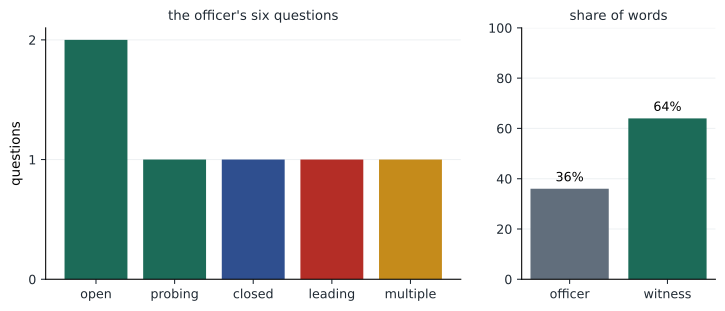
{'open': 2, 'closed': 1, 'leading': 1, 'probing': 1, 'multiple': 1}
open or probing: 50%
witness share of words: 64%Half of the officer's questions were open or probing, and the witness spoke nearly two-thirds of the words, both reasonable for a short doorstep conversation. But the analysis also flags two problems. The question 'He had a crowbar, didn't he?' is leading, and it introduced the idea of a crowbar, which the officer had heard about on the radio. Ms. Osei's answer, 'Maybe. I'm not sure,' shows she did not see one, but if she later 'remembers' a crowbar, the defense will point to this question. The multiple question at the end got an answer to its first part only, and 'tall' contradicts what the man's measured height later showed. The probationary officer should note both problems honestly, and the investigator should conduct a fuller interview using the cognitive interview techniques.
A simple program like this cannot judge the quality of an interview. It misses tone, rapport, pauses and whether the right topics were covered, and some questions do not fit neatly into one type. Training officers use it only as a starting point for a conversation about technique, together with the recording itself.
Interviewing victims
Victims are not simply sources of information. They have been harmed, and the way police treat them affects their recovery, their willingness to report future crimes and their confidence in the justice system. Victims of violent and sexual crimes may be in shock, afraid, ashamed or angry, and their accounts may come out in fragments, out of order or with details that change. These are normal responses to trauma, not signs of dishonesty.
Trauma-informed interviewing is an approach that takes these effects into account. It involves giving the victim as much control as possible over the setting, the pace and breaks; explaining every step; avoiding questions that suggest blame, such as 'Why didn't you scream?' or 'Why were you walking there alone?'; allowing the victim to tell the account in their own way and order; and recognizing that memory for a traumatic event may be clear for some details and absent for others. In the United States, federal grants and state laws have encouraged trauma-informed training for officers who interview victims of sexual assault, and many agencies have adopted it alongside reforms to the testing of sexual assault evidence kits. Victims should also be told about victim services, protective measures and how to stay informed about the case.
Interviewing witnesses at the scene
At a busy scene, the first priority is safety and the second is often to identify and separate witnesses before they talk to each other or leave. The officer should get each witness's name and contact details at once, then a brief account, often called a first account, that captures the key facts needed to act: what happened, who was involved, descriptions and directions of travel. A full interview can follow later, in a quieter setting, ideally recorded. The first account should be noted carefully, including the questions asked, because it is the witness's earliest and least contaminated version.
Witnesses are often reluctant. Some fear retaliation, some distrust police, some are busy or do not want to go to court. Officers can reduce reluctance by explaining why the witness's information matters, what will happen next and what protections exist, and by treating the witness with patience and respect. Pressuring or threatening a witness is wrong and counterproductive: it damages the relationship and the reliability of what the witness says. Some witnesses are themselves vulnerable, such as children, people with intellectual disabilities and people in crisis. Children in particular should be interviewed by specially trained officers or forensic interviewers, often at a child advocacy center, using structured protocols designed to avoid suggestion.
Interviews across language and culture
When a witness or victim is not fluent in English, or is deaf or hard of hearing, a qualified interpreter should be used for any interview that matters. Family members, especially children, and bystanders should not be used to interpret, except in an emergency, because they may change or omit what is said, may have an interest in the outcome and may expose the person to embarrassment. Telephone and video interpretation services make professional interpreters available in many languages at any hour. When using an interpreter, the officer speaks directly to the witness, not to the interpreter, in short segments, and records that an interpreter was used, their name or identification number and the language.
Cultural differences can also affect interviews. Norms about eye contact, personal space, how directly to speak and how to address authority figures vary, and an officer who misreads them may wrongly judge a witness evasive or hostile. Jesse Morningstar explains that, in his community, elders may answer a question with a story rather than a direct reply, and that interrupting to 'get to the point' would be rude and would end the conversation. Listening patiently is almost always the right approach.
Worked problem
Planning a follow-up interview
The detective assigned to the Lakeshore Hardware case wants to re-interview Mira Osei. Using PEACE and the cognitive interview, outline the plan.
Show solution
- Planning: review the doorstep recording and notes, noting that a leading question about a crowbar was asked and that her height estimate conflicts with the measured height. Choose a quiet room, arrange video recording and allow an hour. Decide not to mention the crowbar or the suspect's height.
- Engage and explain: thank her, explain that she is a witness, not a suspect, describe how the interview will work, and tell her it is fine to say she does not know.
- Account: ask her to picture her bedroom and the window, what she heard and felt, then to describe everything from the sound of the glass onward, without interruption. Then ask her to go back from the moment he passed the bakery. Probe each part with open questions: 'Describe the way he ran.'
- Clarification: ask open questions about the bag and anything in his hands, without suggesting a crowbar, and ask her to compare his height to something she knows, such as the bakery doorway.
- Closure and evaluation: summarize, invite corrections, explain next steps and victim and witness services, then evaluate how her account fits the other evidence.
Answer: The plan uses the interview to gather the fullest, least contaminated account. It deliberately avoids repeating the earlier leading question and gives her a reference point for height. Whatever she says, including that she saw no crowbar, is recorded accurately.
Common mistakes
MistakeA good interviewer asks lots of specific questions to keep control.
InsteadGood interviewers let the witness talk, start with open questions and move to specific ones later.
MistakeLeading questions save time with cooperative witnesses.
InsteadLeading questions can plant details and make the account less reliable in court.
MistakeA victim whose account changes is probably lying.
InsteadTrauma often affects how and in what order memories come out; changes are common in honest accounts.
MistakeA family member can interpret for a witness to save time.
InsteadUse a qualified interpreter for any interview that matters; family members may change what is said and have their own interests.
Summary and key terms
- Investigative interviewing seeks accurate information; accusatory methods increase the risk of false and contaminated accounts.
- PEACE: planning and preparation, engage and explain, account clarification and challenge, closure, evaluation.
- The cognitive interview uses report everything, context reinstatement, change of order and change of perspective, and produces more correct information.
- Start with free recall and open (TED) questions, then probe; avoid leading and multiple questions, and let the witness do most of the talking.
- Trauma-informed interviewing gives victims control, explains each step and avoids blame.
- Identify and separate witnesses quickly, record first accounts with the questions asked, and use qualified interpreters.
- Investigative interviewing
- An approach that treats the interview as a search for accurate information rather than confirmation of a belief.
- PEACE model
- An interviewing framework of planning, engaging, account, closure and evaluation.
- Cognitive interview
- A set of interviewing techniques based on memory research that improves recall.
- Open question
- A question that invites a full answer in the person's own words, such as "Tell me what happened."
- Leading question
- A question that suggests its own answer.
- Trauma-informed interviewing
- Interviewing that takes account of how trauma affects memory and behavior.
- Rapport
- A working relationship of trust that helps a person speak freely.
Practice problems
Work each problem on paper first, then reveal the answer to check.
What do the letters of PEACE stand for?
Show answer
Planning and preparation; engage and explain; account, clarification and challenge; closure; evaluation.
Turn 'Did he run toward Pine Street?' into an open question.
Show answer
'Tell me where he went after he left the store.'
Name the four core techniques of the cognitive interview.
Show answer
Report everything, mental reinstatement of context, change the order and change the perspective.
An officer asks 12 questions: 5 open, 3 probing, 3 closed and 1 leading. What share are open or probing?
Show answer
8 of 12, about 67%.
Why should witnesses be separated at a scene?
Show answer
To prevent them from discussing the event and merging or changing each other's memories.
Lesson quiz · 5 questions
Score 60% or more to complete this lesson.
Create a free account to save your progress, take quizzes and earn a certificate.