
HSE-408 · Lesson 7 of 12 · 21 min
Learning teams in practice
The first learning team on line 3 met in the bakery training room on a Thursday afternoon, nine days after the event. Eight people sat around two tables pushed together: Ben Kowalski and another maintenance technician, Mei Chen and another operator, the day shift lead, a sanitation worker who cleaned line 3 at weekends, an electrician who had helped with the panel upgrade, and a quality technician who ran product checks at every changeover. Elena facilitated. Tanya Morris kept notes on a flip chart. Marcus had been asked to come to the second session, not the first.
Elena opened with a sentence she would repeat at dozens of learning teams over the next two years: 'We are not here to find out who did what wrong. We are here to learn how changeovers really work on this line, what makes them hard, and where they could hurt someone. You are the experts. I am here to ask questions.'
HSE-401 Lesson 8 introduced learning teams as a Safety-II practice, and HSE-403 Lesson 10 showed how an investigation can use one to understand normal work alongside an event. This lesson goes further into the practice: when to use a learning team, who to invite, how to facilitate, what to do with what is learned, and how learning teams go wrong.
What a learning team is for
A learning team is a structured conversation among the people who do a piece of work, aimed at understanding how the work actually happens and what conditions shape it. It is not an investigation, though it can support one. It does not assign causes or blame, and it does not start by looking for fixes. Its product is understanding, from which better fixes follow.
Learning teams are useful in several situations:
- After an event, to understand the normal work in which the event happened. The line 3 team was this kind.
- On normal work that people say is risky or difficult, before anything goes wrong. Harrowgate Foods Inc. used these most.
- Before new work or after a change, to see how a new process is really working.
- When a weak signal appears, such as a run of minor events or near misses on the same task.
- When an indicator moves, such as a fall in critical control verification scores, to understand what is happening behind the number.
Who to invite
The people in the room decide what the team can learn. The guidance Harrowgate Foods Inc. developed was:
- People who do the work, usually six to ten, covering the roles and shifts involved. If only day shift attends, the team learns about day shift.
- People at the edges of the work, such as the sanitation worker or the quality technician on line 3, who see parts of it that the main crew does not.
- The people involved in an event, if they want to come. Ben was asked privately and given time to decide. Mei said she wanted to be there.
- A facilitator trained in the method, who is not the manager of the people in the room.
- A note-taker, who writes what people say in their words.
- Managers, usually not in the first session, because their presence changes what people say. They join later to listen and to own actions.
The structure
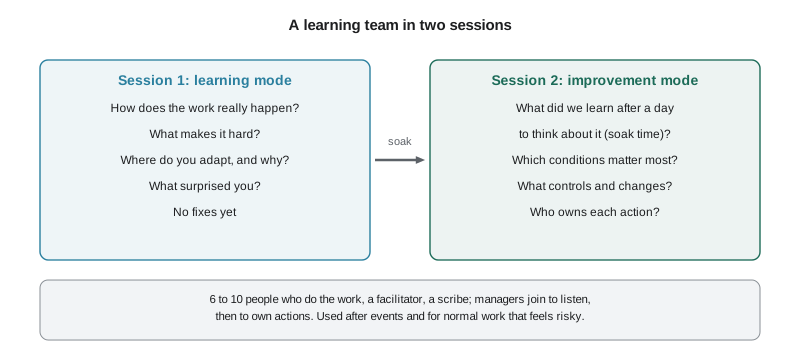
Harrowgate Foods Inc. used a two-session structure for most learning teams, separated by a day or more of what practitioners call soak time.
Session one: learning mode
The first session, usually about 90 minutes, is about understanding. The facilitator asks open questions and keeps the group from jumping to solutions. Typical questions included:
- Walk us through a normal changeover. What happens first?
- What makes this job hard? What makes it easy on a good day?
- Where do you have to adapt, work around something or improvise? Why?
- What do you need that you do not always have?
- What do new people find confusing?
- When have you been surprised on this job?
- If you were going to get hurt doing this, how would it happen?
Tanya wrote everything on the flip chart in the participants' own words. When someone proposed a fix, Elena wrote it on a separate sheet labeled 'ideas for later' and brought the group back to understanding. This was harder than it sounds, because people who solve problems for a living want to solve problems.
Soak time
Between sessions, participants are asked to think about what was said, to watch the work with fresh eyes, and to talk to colleagues who were not there. Soak time often produces the most valuable insights. On line 3, the sanitation worker came back to the second session with a photograph of the divider guard from the weekend clean, showing that the guard's fastenings were worn and that it was often removed without tools, which nobody at the first session had mentioned.
Session two: improvement mode
The second session starts by reviewing what was learned and asking what people noticed during soak time. The group then sorts what it learned into conditions that matter, separating them into those that are working well, those that need attention, and those that are critical. Only then does the group turn to fixes, using the hierarchy from Lesson 5 to prefer changes to the work over reminders and training. Managers join for this part, first to hear what was learned and then to commit to actions.
Marcus found the second line 3 session uncomfortable. He heard that the 25-minute target was seen as non-negotiable, that crews believed overruns were noticed and criticized at the morning meeting, and that the long scraper had been requested twice and never replaced. He said afterwards that he had learned more about line 3 in an hour than in two years of walking the floor.
What the line 3 learning team learned
The team's findings went well beyond the event itself. The flip charts, typed up, listed 31 conditions. The team grouped them into themes.
| Theme | Examples from the team | Action owner |
|---|---|---|
| Time and targets | 25-minute target seen as fixed; overruns discussed at morning meeting; restart time not movable | Plant manager |
| Isolation and testing | Labels not trusted after panel work; start test fooled by emergency stop; no view of who is inside | Maintenance lead |
| Tools | Long scraper lost and never replaced; guard fastenings worn and removed without tools | Maintenance lead |
| Communication | Noise from proofer fans; no agreed signal between technician and operator; radio calls at critical steps | Day shift lead |
| Roles | Unclear who controls the line during changeover; operator checklist ignores technician | Operations manager |
| What works well | Pre-staged dies; experienced technicians help new ones; quality checks catch set-up errors early | Keep and protect |
The last row mattered. Learning teams look at what goes well as well as what goes wrong, and the line 3 team identified practices that kept changeovers safe most of the time and should not be lost in the rush to fix problems. Pre-staging dies, for example, had been introduced in the lean project and genuinely reduced time pressure at the end of the changeover.
Facilitation skills
Facilitating a learning team well takes practice. Harrowgate Foods Inc. trained twelve facilitators in the first year, including supervisors from each site, worker members of the safety committees, and Elena's team. The training covered several skills.
- Setting the frame. Explaining at the start what the session is and is not, and what will happen with what is said.
- Asking open questions and following up with 'tell me more' and 'what happens then?' rather than leading questions.
- Staying curious when the group says something surprising or uncomfortable, rather than correcting or defending.
- Holding back fixes until the group understands the work.
- Balancing voices, so that the most experienced or most senior person does not dominate.
- Writing in their words, because paraphrase loses meaning and signals that the facilitator knows better.
- Closing the loop, telling participants afterwards what happened as a result.
Sam Pellerin, who facilitated at the McDonough distribution center, said the hardest skill was silence. 'You ask a question and nobody answers, and every part of you wants to fill the gap. If you wait, somebody tells you something you would never have heard otherwise.'
When learning teams go wrong
Learning teams can fail, and Harrowgate Foods Inc. saw most of the common failures in its first year.
- The team becomes an investigation. Questions drift toward what happened on the day and who did what, and participants become defensive. The fix is to keep returning to normal work.
- A manager dominates. A senior person who attends session one, even silently, can change what people say. The fix is to keep managers to session two.
- Too many actions. A team that produces 40 actions overwhelms the people who must deliver them, and most stall. The fix is to prioritize, typically three to six actions that address critical conditions.
- No follow-through. If nothing changes after a learning team, people stop coming. The fix is to report back within weeks, even if the answer is 'not yet, and here is why'.
- Learning team fatigue. Running them on everything, especially trivial events, uses up goodwill. The fix is to choose topics that matter to the crew.
- Form over substance. Some sites began recording learning teams as completed when they had been brief meetings with a checklist. The fix was a quality check by a second facilitator, covered below.
Measuring learning teams
HSE-407 warned that any indicator can be gamed. Counting learning teams held would have encouraged quick, shallow sessions. Harrowgate Foods Inc. tracked four things instead: the number of learning teams held on tasks with critical steps, the share of actions completed within the agreed time, the share of actions that changed the work rather than relying on training or reminders, and participants' answers to two questions asked a month later: 'Did anything change as a result?' and 'Would you take part again?'
In the first year the main plant held 19 learning teams, 14 of them on normal work rather than events. Of 88 actions, 71 % were completed on time and 64 % changed the work itself. Participants answered yes to 'Would you take part again?' 92 % of the time, and the share who said something had changed rose from 58 % in the first quarter to 83 % in the last, as follow-through improved.
Worked problem
A learning team on normal work: forklift battery changes at the distribution center
Show solution
- Why chosen: drivers described battery changes on the older trucks as the job they disliked most, though no injuries had been reported in two years.
- Session one: seven drivers from three shifts explained that the battery hoist was shared with the charging room cleaner, that the crane hook was often left in the wrong position, and that drivers on nights changed batteries alone.
- Soak time: one driver timed the walk to fetch the hoist control from the office; it took four minutes each way, so drivers often used the forklift forks to nudge the battery instead.
- Session two: the team identified the nudging practice as a critical condition, with a crush risk and a risk of damaging the battery case and spilling acid.
- Actions: a fixed pendant control at the charging bay, a roller stand matched to the battery height, and a rule agreed by the drivers that night battery changes need a second person, with the dispatcher arranging cover.
Answer: A job with no injury history contained a crush and acid hazard that only the drivers knew about, and the fixes changed the equipment rather than the drivers.
Common mistakes
MistakeInviting managers to the first session to show commitment.
InsteadKeep managers to the second session, where they listen and own actions.
MistakeLetting the group move straight to fixes.
InsteadHold fixes on a separate sheet until the group understands the work.
MistakeRunning learning teams only after events.
InsteadUse them most on normal work that people describe as risky or difficult.
MistakeProducing a long list of actions.
InsteadPrioritize a few actions on critical conditions and report back on each.
MistakeCounting learning teams held as the measure of success.
InsteadTrack topics with critical steps, completed actions, actions that change the work and participant feedback.
Summary and key terms
- A learning team is a structured conversation among the people who do the work, aimed at understanding how it really happens before looking for fixes.
- Learning teams are used after events, on risky normal work, before or after changes, and when weak signals or indicators move.
- Participants are mainly people who do the work, including those at its edges, with a trained facilitator and a note-taker; managers usually join the second session.
- Two sessions separated by soak time allow learning first and improvement second.
- Facilitation depends on framing, open questions, curiosity, holding back fixes, balancing voices and closing the loop.
- Learning teams fail when they become investigations, are dominated by managers, produce too many actions or lack follow-through, so quality should be measured, not just counted.
- Learning team
- A facilitated group of people who do the work, meeting to understand how it really happens and what shapes it.
- Soak time
- The period between learning team sessions in which participants reflect and observe.
- Learning mode
- The first part of a learning team, focused on understanding without proposing fixes.
- Improvement mode
- The later part of a learning team, in which conditions are prioritized and actions agreed.
- Critical condition
- A condition identified by a learning team that could lead to serious harm and needs action.
Practice problems
Work each problem on paper first, then reveal the answer to check.
Why were managers asked to join only the second line 3 session?
Show answer
Their presence in the first session would change what people were willing to say about the work.
What did the sanitation worker bring back after soak time?
Show answer
A photograph showing worn guard fastenings and that the divider guard was often removed without tools.
Why did the line 3 team record what works well?
Show answer
So that practices that keep changeovers safe, such as pre-staged dies, were protected rather than lost.
Name three ways learning teams go wrong.
Show answer
They become investigations, managers dominate, they produce too many actions, there is no follow-through, fatigue sets in, or they become form over substance.
What did the battery change learning team find that the injury records did not show?
Show answer
Drivers nudged batteries with the forks because the hoist control was far away, creating crush and acid hazards.
Lesson quiz · 5 questions
Score 60% or more to complete this lesson.
Create a free account to save your progress, take quizzes and earn a certificate.