
HSE-408 · Lesson 2 of 12 · 22 min
Error is normal: error types and performance modes
Two weeks after the line 3 event, Elena ran a short session for the plant's supervisors. She began by asking everyone to write down the number of times they had made a mistake that morning. Most wrote zero or one. She then asked them to think again: a wrong turn on the drive in, a coffee cup left on the roof of the car, a password typed twice, a meeting room walked past. The second numbers were between four and eleven. 'None of you is careless,' she said. 'You are human. The question is not whether people at Harrowgate Foods Inc. make mistakes. It is what happens when they do.'
This lesson explains why error is normal. It goes further than the classification introduced in HSE-403 Lesson 7 by linking each kind of error to the mental mode in which people were working, and by showing why some errors are more likely than others in particular situations. It then applies the framework to the actions of Ben Kowalski, Mei Chen and the panel contractor in the line 3 event.
Three modes of performance
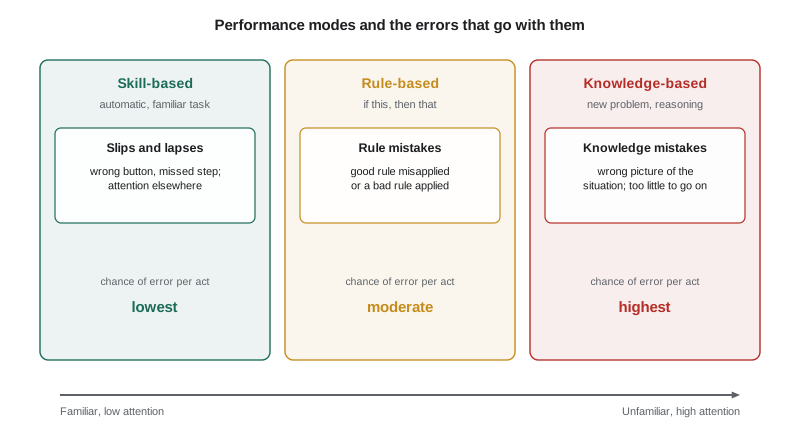
Jens Rasmussen observed that people control their actions in three different ways, depending on how familiar the situation is. The modes are not personality types or skill levels. The same expert moves between all three in a single shift.
Skill-based performance
In skill-based mode, people act automatically on well-practiced routines with little conscious attention. Driving a familiar route, typing a password and tightening a coupling are skill-based. This mode is fast and efficient, and it frees attention for other things. Its weakness is that the routine runs even when the situation has changed slightly, and that attention, once freed, wanders.
Skill-based errors are slips, where the action is not what was intended (pressing the wrong button on a panel of identical buttons), and lapses, where a step is forgotten (leaving a tool in the machine, failing to reconnect a hose). Slips and lapses are most likely when a task is interrupted, when two similar tasks share steps, when a familiar routine is changed, and when the person is tired or distracted.
Rule-based performance
In rule-based mode, people match the situation to a rule they have learned: if this, then that. The rule may be written in a procedure or carried in the person's head from experience. 'If the start button produces no movement, the machine is isolated' is a rule. So is 'if the dough sticks on the divider, clear it by hand before restarting'. Most skilled work is a mix of skill-based routines and rule-based decisions.
Rule-based errors are mistakes of two kinds. A good rule can be applied in a situation where its conditions do not hold, because the situation looks like the familiar one. Or a bad rule, one that is incomplete or wrong, can be applied correctly. Rule-based mistakes feel right to the person making them, because the rule has worked many times before.
Knowledge-based performance
In knowledge-based mode, people face a situation for which they have no rule, and they must reason from first principles using their understanding of how the system works. Troubleshooting an unfamiliar fault, responding to an emergency nobody has trained for, and working on new equipment for the first time are knowledge-based. This mode is slow, effortful and limited by working memory, which can hold only a few items at once.
Knowledge-based errors are mistakes that come from an incomplete or wrong mental model of the situation, from too little information, or from biases such as fixing on the first explanation and looking only for evidence that supports it. The chance of error per decision in knowledge-based mode is much higher than in the other two. The Department of Energy handbook gives rough orders of magnitude to make the point, with knowledge-based errors many times more likely per act than skill-based ones. The exact numbers matter less than the direction.
Why experts make errors
One of the hardest ideas for Harrowgate Foods Inc. managers to accept was that experience does not protect against error. In some ways it creates new risks. An expert does more of the work in skill-based mode, so the expert is more exposed to slips and lapses when attention drifts or a routine changes. An expert also carries more rules, some of them learned under conditions that no longer apply.
Ben was an expert. Nineteen years of lockouts had given him a smooth routine: go to the disconnect named on the placard, apply the lock, try the start. The routine had worked thousands of times. When the context changed, through relabeled disconnects and a latched emergency stop, the routine ran exactly as practiced and produced the wrong result. A new technician, slower and less certain, might have checked more. Expertise did not fail Ben; the work failed to signal that his expertise no longer fitted.
Violations and at-risk choices
Reason separated errors, which are unintended, from violations, which are deliberate departures from a rule. He described several kinds, and the distinction matters for how a company responds.
- Routine violations are shortcuts that have become the normal way of working, often because the rule is impractical or the shortcut is tolerated. Using the local start button instead of the main screen, if the procedure had forbidden it, would be one.
- Situational violations happen because the situation makes compliance hard or impossible: the right tool is not available, the time allowed is too short, or the procedure does not fit the equipment.
- Exceptional violations are rare departures in unusual circumstances, often to deal with an emergency or an unexpected problem.
- Reckless violations involve a conscious disregard of a substantial and unjustifiable risk. They are rare, and Lesson 11 discusses how they are handled.
Most violations at Harrowgate Foods Inc. turned out to be routine or situational. They were at-risk choices, in the language of HSE-401 Lesson 6: choices whose risk the person did not recognize or believed was justified, usually because the work made the compliant path slower or harder. HOP treats these as information about the work. A routine violation that everyone uses is a sign that the procedure and the work have drifted apart, which is the subject of Lesson 4.
Error rates add up
Even a low chance of error per step becomes a high chance of at least one error across a long task. A changeover on line 3 involved about 60 discrete steps, from stopping the line to the final checks. Luis Ortega, who liked numbers, wrote a short calculation to show the leadership team what this meant.
# Chance of at least one error across a task with many steps
steps = 60
for p in (0.001, 0.003, 0.01):
    at_least_one = 1 - (1 - p) ** steps
    print(f"error chance per step {p:.3f}: at least one error in {steps} steps = {at_least_one:.1%}")

# Changeovers per year on one line, and expected changeovers with an error
per_year = 5 * 52 * 2
p = 0.003
print(f"changeovers per year: {per_year}")
print(f"expected changeovers with at least one error: {per_year * (1 - (1 - p) ** steps):.0f}")

# How many of those errors happen at a step where an error can cause harm?
critical_steps = 4
share = critical_steps / steps
print(f"share of steps that are critical: {share:.1%}")
print(f"expected errors at critical steps per year: {per_year * steps * p * share:.1f}")error chance per step 0.001: at least one error in 60 steps = 5.8% error chance per step 0.003: at least one error in 60 steps = 16.5% error chance per step 0.010: at least one error in 60 steps = 45.3% changeovers per year: 520 expected changeovers with at least one error: 86 share of steps that are critical: 6.7% expected errors at critical steps per year: 6.2
The output made Luis's point. With a modest chance of error per step, roughly one changeover in six would contain at least one error somewhere. Most of those errors would be harmless, such as a guide set slightly out and corrected at the first check. But a few each year would fall on one of the handful of steps where an error could cause immediate harm, such as isolating the conveyor before reaching in. Lesson 8 calls these critical steps and explains how to concentrate effort on them.
Marcus asked whether the answer was simply to train people to make fewer errors. Luis's reply was that training might move the chance of error from 0.003 to 0.002, but it would never move it to zero, and with hundreds of changeovers a year the critical steps would still see errors. 'We need the critical steps to survive an error,' he said. 'Training is part of it. It is not the whole of it.'
Why 'be more careful' does not work
Telling people to pay attention, be careful or follow the procedure is the most common response to error, and one of the least effective. It fails for several reasons.
- Errors are not chosen. Nobody decides to slip. An instruction to be careful does not reach the automatic processes that produce slips and lapses.
- Attention is limited. People cannot be fully attentive to everything for a whole shift. Asking for more attention in one place takes it from somewhere else.
- Rule-based mistakes feel correct. Ben was being careful. He did every step he believed was needed. More care in the same mode would have produced the same result.
- The effect fades. Reminders and campaigns produce a short improvement that decays within weeks, while the conditions that produced the error remain.
- It shifts responsibility. The message to the worker is that safety depends on them alone, which is neither true nor fair when the conditions are set by others.
This does not mean attention and skill are unimportant. They are the last defense and often an effective one. It means that a system relying only on them will eventually fail, and that the stronger fixes lie in the work itself.
Applying the framework to line 3
The line 3 team used the performance modes to classify each action in the event. The aim was not to label people but to understand which conditions would make each action less likely to lead to harm.
| Action | Mode | Type | Conditions that made it likely |
|---|---|---|---|
| Contractor reinstalled labels on the wrong disconnects | Skill-based | Slip during a routine task | Identical boxes side by side; no check of labels against drawings after the work |
| Ben locked the disconnect named on the placard | Rule-based | No error by Ben; the label was wrong | Placard and label agreed; nothing signaled the change |
| Ben took no movement on the start test as proof of isolation | Rule-based | Good rule misapplied | A latched emergency stop made the start test meaningless; nothing showed it was latched |
| Mei reset the emergency stop | Rule-based | Good rule misapplied | Checklist said reset; Ben was out of sight behind the divider |
| Ben reached past the guard to clear dough | Rule-based | Normal practice after isolation | Clearing dough by hand was the only method; no tool provided |
The table changed the conversation. Nobody in the event had been careless or reckless. Each action had been reasonable given what the person could see and the rules they had. The errors were in the situation: labels not checked, a start test that could be fooled, a checklist that did not ask whether anyone was inside the guarding, and no tool for clearing dough without reaching in.
Worked problem
Classifying a lapse at the sauces plant
Show solution
- Situation: at Athens, an operator finishing a clean-in-place cycle forgot to reopen the drain valve on one tank. The next batch overflowed onto the floor.
- Mode: the valve sequence is a well-practiced routine, so the operator was in skill-based mode.
- Type: a lapse, because a step was left out rather than done wrongly.
- Conditions: the operator was interrupted by a radio call at the step before, and the drain valve is behind the tank where it cannot be seen from the control panel.
- Fix: the team added a valve position sensor and a screen interlock that will not start the fill while the drain is closed, and moved the radio call point so that calls are taken after the sequence is complete.
Answer: Classifying the error by mode pointed to interruptions and visibility, and the fix made the lapse unable to cause an overflow.
A short guide to error by situation
Elena summarized the lesson for supervisors as a list of situations in which errors become more likely. Each was a prompt to look harder at the work, not to look harder at the worker.
- Interruptions and multitasking, which lead to lapses at the step where the person resumes.
- Changes to familiar routines, which lead to slips when the old habit runs instead of the new one.
- Similar-looking controls, labels or parts, which lead to selection slips.
- First-time or rare tasks, which push people into knowledge-based mode with its higher error rate.
- Situations that resemble a familiar one but differ in an important way, which lead to rule-based mistakes.
- Fatigue, time pressure and heat or cold, which raise error rates in all modes.
Lesson 3 develops this list into a structured way of spotting error traps before work begins.
Common mistakes
MistakeAssuming experienced workers are less likely to make errors.
InsteadRecognize that experts work more in skill-based mode and carry old rules, so they face different, not fewer, error risks.
MistakeTreating every departure from procedure as a deliberate violation.
InsteadSeparate slips, lapses and mistakes from violations, and look at whether routine or situational violations point to an unworkable rule.
MistakeResponding to error with reminders to be careful.
InsteadChange the conditions that made the error likely, and protect critical steps so that they survive an error.
MistakeBelieving training can bring error rates to zero.
InsteadUse training to reduce error rates and design the work so that the remaining errors are caught or harmless.
MistakeClassifying errors in order to label people.
InsteadClassify errors in order to find the conditions that made them likely.
Summary and key terms
- People perform in skill-based, rule-based and knowledge-based modes, and the same expert moves between all three.
- Skill-based errors are slips and lapses; rule-based errors are good rules misapplied or bad rules applied; knowledge-based errors come from wrong or incomplete mental models.
- The chance of error per act is lowest in skill-based mode and highest in knowledge-based mode.
- Violations are deliberate departures from rules; most are routine or situational and point to problems in the work.
- Small error rates per step add up across long tasks, so critical steps must be designed to survive an error.
- Reminders to be careful do not reach the processes that produce errors and do not change the conditions behind them.
- Skill-based performance
- Automatic action on well-practiced routines with little conscious attention.
- Rule-based performance
- Action chosen by matching the situation to a learned rule.
- Knowledge-based performance
- Reasoning from understanding when no rule fits the situation.
- Slip
- An action that is not what the person intended, such as pressing the wrong button.
- Lapse
- A step that is forgotten or left out.
- Mistake
- An action carried out as intended, but based on a wrong rule or a wrong understanding of the situation.
- Routine violation
- A deliberate shortcut that has become the normal way of working.
Practice problems
Work each problem on paper first, then reveal the answer to check.
In which performance mode are slips and lapses most likely?
Show answer
Skill-based mode, where people act automatically on practiced routines.
Why was Ben's reliance on the start test a rule-based mistake rather than a slip?
Show answer
He applied a learned rule correctly as he understood it, but in a situation where its conditions did not hold because the emergency stop was latched.
What is the difference between a routine and a situational violation?
Show answer
A routine violation is a shortcut that has become normal practice; a situational violation happens because the situation makes compliance hard at that moment.
With a 0.003 chance of error per step, roughly what share of 60-step changeovers contain at least one error?
Show answer
About 16 %, or roughly one in six.
Give two reasons why telling people to be careful does not prevent errors.
Show answer
Errors are not chosen, so the instruction does not reach automatic processes; and attention is limited, so more in one place means less elsewhere.
Lesson quiz · 5 questions
Score 60% or more to complete this lesson.
Create a free account to save your progress, take quizzes and earn a certificate.