
HSE-404 · Lesson 1 of 12 · 21 min
What a safety management system is and why it matters
Six months after the spiral conveyor injury at the Gainesville plant and four months after the forklift collision in the freezer at the distribution center in McDonough, Rachel Okoye, vice-president of operations at Harrowgate Foods Inc., put a single slide in front of the leadership team. It listed the corrective actions from both investigations: 31 of them. Twenty-two were closed. Of those 22, Elena Novak, the health and safety manager, had checked nine in the field. Four of the nine had slipped back. The walkway at the distribution center was clear again, but a new temporary staging lane had appeared two aisles over. The lockout boards at the main plant were tidy, but two night supervisors were still signing off cleaning without seeing locks on the disconnects.
Nobody at Harrowgate Foods Inc. was careless or uncaring. Every action had an owner and a due date. What the company lacked was a way of making safety work repeatable: a set of connected processes that found hazards before they hurt people, made sure controls stayed in place, checked whether they worked, and fixed what did not, year after year, regardless of who was in which job. Rachel's slide ended with one line: 'We have safety programs. We need a safety management system.'
This course follows Elena as she builds that system across Harrowgate Foods Inc.'s three sites, with help from Rachel, Marcus Bell (the main plant manager), Grace Whitfield (the distribution center manager), Tanya Morris and Sam Pellerin (the worker co-chairs of the safety committees at the main plant and the distribution center), Luis Ortega (maintenance lead) and Aisha Rahman, the quality manager, who already runs the company's certified food safety management system. By the last lesson, the team will have taken the system through its first internal audit, its first management review and a gap assessment against an international standard.
Programs and systems
Most workplaces have safety programs: a lockout program, a forklift training program, a hearing conservation program, an inspection program. Each program addresses one hazard or one activity. A safety management system, usually called an occupational health and safety (OHS) management system, is different in kind. It is the set of interrelated processes an organization uses to set its safety direction, plan how to get there, put plans into action, check results and improve. Programs are the parts. The system is what holds them together and keeps them working.
A simple test shows the difference. Ask a supervisor what the lockout program says, and most can answer. Ask how the company knows the lockout program is working, who checks, how often, what happens to the results and when the program was last changed because of them, and the answers often trail off. A program can exist on paper and drift in practice for years. A management system builds in the checking and the correcting, so drift is noticed and fixed.
Elena explained it to the leadership team with an analogy from the food side of the business. Harrowgate Foods Inc. does not keep its products safe by having a good recipe. It keeps them safe with a food safety management system: hazard analysis, critical control points, monitoring, verification, corrective action, records, internal audits and an annual review. 'We already know how to manage a risk systematically,' she said. 'We do it for allergens every day. We just haven't done it for the people who make the food.'
Why organizations adopt a management system
Organizations adopt OHS management systems for several overlapping reasons, and it helps to be honest about which ones are driving a particular decision.
- To prevent harm more reliably. Research on management systems generally finds that well-implemented systems are associated with better safety outcomes, though the strength of the effect varies and depends heavily on how genuine the implementation is. A system that exists only for an audit does little.
- To meet legal duties more consistently. the federal Occupational Safety and Health Act (OSH Act) places general duties on employers to provide a safe workplace. A system turns those general duties into specific, checked practices.
- To manage change. New equipment, new products, new contractors and new people constantly introduce hazards. A system gives change a route through risk assessment instead of leaving it to chance.
- To satisfy customers and partners. Large retail and food-service customers increasingly ask suppliers about their safety management, and some require recognized certification.
- To earn recognition or reduce costs. Certification and recognition programs can bring reputational benefits and, in some places, financial incentives through workers' compensation.
- To learn as an organization. A system collects information from inspections, incidents, audits and workers and turns it into decisions.
Rachel's own reason was the first one, stated plainly: 'Two people were badly hurt because our controls depended on individuals remembering. I want them to depend on a system.' Customer pressure was real too. A national grocery chain that bought a third of the Gainesville plant's frozen meals had started asking suppliers for evidence of a formal safety management system as part of its supplier audits.
The core idea: plan, do, check, act
Almost every modern management system is built on the same cycle, usually credited to Walter Shewhart and popularized by W. Edwards Deming: plan, do, check, act. The cycle is simple enough to fit on a whiteboard and deep enough to organize an entire system.
- Plan. Understand the organization's context, identify hazards and risks, learn the legal requirements, set objectives and decide how to achieve them.
- Do. Put the plans into practice: provide resources and training, control operations, manage change, coordinate contractors and prepare for emergencies.
- Check. Monitor and measure performance, investigate incidents, evaluate legal compliance and audit the system.
- Act. Correct problems, address their causes, and improve the system so the next cycle starts from a better place.
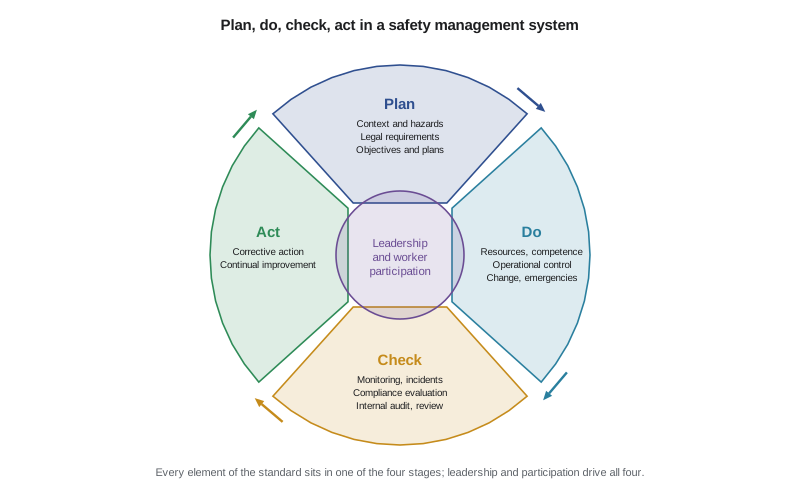
The cycle turns at every level. A whole company turns it once a year through planning and management review. A department turns it monthly through its safety meeting. A supervisor turns it every shift when she plans a job, watches it being done, checks the result and changes the next one. Lesson 4 looks at planning, lessons 5 to 9 at doing, lesson 10 at checking and lesson 12 at acting and improving.
Leadership and participation at the center
Management system standards put two things at the center of the cycle rather than in any one step: leadership and worker participation. Leadership means that senior management owns the system, provides resources, makes safety part of business decisions and holds people accountable. Participation means that workers, who know the work best and face the hazards most directly, are consulted and involved in designing, running and improving the system, not just told about it. HSE-401 covered the culture side of both. In a management system they become requirements that are planned, resourced and checked.
Tanya Morris, the worker co-chair at the main plant, asked the question many workers ask when a company announces a management system: 'Is this going to be a binder that sits on a shelf, or is it going to change what happens on nights?' Elena wrote the question on the first page of her project plan. It became the test the team applied to every procedure they wrote.
What a system is not
A management system can go wrong in predictable ways, and naming them early helps avoid them.
- Not a pile of documents. Documents support a system, but a system is what people actually do. A thousand pages of procedures nobody follows is not a system.
- Not the safety department's job. A system belongs to line management. The safety manager designs, advises and checks, but supervisors and managers run it.
- Not a certificate. Certification shows that an auditor found the system conforming on the days they visited. It does not prove that workers are safe.
- Not a substitute for the law. A system helps an organization meet its legal duties, but meeting a standard does not change what the federal Occupational Safety and Health Act (OSH Act) requires.
- Not a one-time project. The first year builds the system; the value comes from running it year after year.
Elena had seen the first failure at a previous employer, a food company that bought a set of template procedures, filled in its name and earned a certificate without changing anything on the floor. Two years later a worker lost a hand in a mixer that the paperwork said was locked out. 'I don't want a system that looks good in an audit,' she told Rachel. 'I want one that a night sanitation worker would notice.'
How this course is organized
This course is built around the structure of ISO 45001, the international standard for OHS management systems, and the American national standard ANSI/ASSP Z10.0, which covers the same ground. Lesson 2 introduces the standards. Lessons 3 to 12 follow the main parts of a management system in roughly the order an organization builds them, from understanding context and leadership through planning, support, operations and performance evaluation to improvement. Lesson 11 covers external audits and recognition, including OSHA's Voluntary Protection Programs (VPP) and the Safety and Health Achievement Recognition Program (SHARP).
None of the standards is reproduced here; their text is copyrighted and organizations that implement them should buy the current edition. The course explains what the requirements mean in practice and how a real company might meet them.
A first maturity check
Before designing anything, Elena wanted a rough picture of where Harrowgate Foods Inc. stood. She used a simple maturity scale with five levels for each of eight system elements, and asked a small group at each site, including the safety committee co-chairs, to score the company honestly. Level 1 means the element hardly exists. Level 3 means it exists and mostly works at one site. Level 5 means it is embedded, checked and improving everywhere.
# First maturity check at the three sites (1 = absent, 5 = embedded and improving).
scores = {
    "leadership and policy":      (3, 2, 2),
    "worker participation":       (3, 3, 2),
    "hazard identification":      (2, 2, 1),
    "legal requirements":         (2, 1, 1),
    "training and competence":    (3, 2, 2),
    "operational control":        (2, 2, 2),
    "monitoring and audits":      (1, 1, 1),
    "corrective action":          (2, 2, 1),
}
sites = ("main plant", "distribution", "sauces plant")
for i, site in enumerate(sites):
    avg = sum(v[i] for v in scores.values()) / len(scores)
    print(f"{site:<13} average {avg:.1f}")
weakest = sorted(scores, key=lambda k: sum(scores[k]))[:3]
print("weakest elements:", ", ".join(weakest))main plant average 2.2 distribution average 1.9 sauces plant average 1.5 weakest elements: monitoring and audits, legal requirements, hazard identification
The results were sobering but useful. Every site scored lowest on monitoring and audits: nobody systematically checked whether controls worked. Legal requirements were weak at the two smaller sites, which relied on the main plant for advice. Hazard identification was patchy, strong for machines and weak for everything else. These became the first priorities in Elena's plan.
Worked problem
Program or system?
Show solution
- The sauces plant in Athens has a written hearing conservation program. Is it part of a management system?
- Check for planning: noise was measured once, six years ago, before two new mixers were installed. Planning is out of date.
- Check for doing: hearing protection is issued and worn in most areas.
- Check for checking: nobody has measured noise since, and audiometric results are filed but not reviewed.
- Check for acting: no change has been made to the program in six years.
Answer: It is a program, not yet part of a working system. The plan-do-check-act loop is broken at check and act.
Starting with the people who do the work
Elena's first month was not spent writing. She worked one shift at each site in each of the three crews, standing beside operators, sanitation workers, forklift drivers and maintenance mechanics, and asked the same three questions everywhere: what is the most dangerous thing you do, what makes it harder to do safely, and what does the company do that actually helps. She wrote down the answers word for word.
The answers shaped the plan more than any standard did. Night sanitation workers at the main plant said the hardest part of lockout was the walk to disconnects on the far mezzanine while the restart deadline loomed. Drivers at the distribution center said agency workers arrived with no site orientation on the busiest nights. Mixer operators at the sauces plant said the new mixers were louder than the old ones and nobody had measured them. Every one of those comments became a line in the project plan, with the name of the crew that raised it, so the people who spoke up could see later what had happened to their concern.
Elena also asked each site's safety committee to nominate two workers to join the project team for the first year, with time released from their regular jobs to take part. Rachel agreed to pay for the backfill. It was the first concrete sign that the system would be built with workers rather than for them.
Common mistakes
MistakeTreating the management system as the safety department's documents.
InsteadLine management runs the system; documents only support it.
MistakeAssuming a certificate proves workers are safe.
InsteadCertification shows conformity at audit time; outcomes and field checks show whether it works.
MistakeBuying template procedures and filling in the company name.
InsteadDesign processes around the real work, with the people who do it.
MistakeThinking a system replaces legal duties.
InsteadA system is a way of meeting legal duties, not a substitute for them.
MistakeTreating the system as a project with an end date.
InsteadBuild it once, then run and improve it every year.
Summary and key terms
- Programs address single hazards; a management system connects them so they are planned, checked and improved.
- Organizations adopt systems to prevent harm reliably, meet legal duties, manage change, satisfy customers and learn.
- Plan, do, check, act is the cycle at the heart of every modern management system.
- Leadership and worker participation sit at the center of the cycle, not in one step.
- A system is not a pile of documents, a certificate or a one-time project.
- A simple maturity check shows where to start.
- OHS management system
- The set of interrelated processes an organization uses to manage health and safety risks and improve performance.
- Safety program
- A set of controls and procedures for one hazard or activity, such as lockout or hearing conservation.
- Plan, do, check, act
- The improvement cycle at the core of management systems.
- Worker participation
- The involvement of workers in designing, running and improving the system, beyond being consulted.
- Maturity scale
- A scoring method that rates how fully an element of the system exists and works.
- Certification
- Confirmation by an accredited third party that a system conforms to a standard at the time of audit.
Practice problems
Work each problem on paper first, then reveal the answer to check.
What is the difference between a safety program and a safety management system?
Show answer
A program addresses one hazard or activity; a system connects programs through planning, checking and improvement.
Name the four steps of the improvement cycle.
Show answer
Plan, do, check, act.
What two things sit at the center of the cycle?
Show answer
Leadership and worker participation.
Give two reasons an organization might adopt a management system.
Show answer
To prevent harm reliably, meet legal duties, manage change, satisfy customers, earn recognition or learn.
Which element scored lowest at all three of Harrowgate Foods Inc.'s sites?
Show answer
Monitoring and audits.
Lesson quiz · 5 questions
Score 60% or more to complete this lesson.
Create a free account to save your progress, take quizzes and earn a certificate.