
HSE-381 · Lesson 12 of 12 · 17 min
Capstone: passing a health inspection
▶ Video coming soon A video version of this lesson is on the way.
Chatham County's environmental health specialists inspect Juniper Street without warning, usually twice a year. Lesson 2 looked at the spring inspection, which scored the restaurant 79, a C, mostly because of one 9-point and two 4-point risk factor violations, and brought a follow-up visit. This capstone lesson follows Juniper through its next routine inspection, in September. It brings together everything in the course: the law and the inspector's role from Lesson 2, the hazards from Lessons 1 and 3, temperature control from Lessons 4 to 6, cross-contamination, hygiene, cleaning and allergens from Lessons 7 to 10, and the food safety plan from Lesson 11.
The goal of an inspection is not to get a good score. The goal is to serve safe food every day, and the inspection is a check on whether that is happening. Restaurants that treat inspections as a test to be passed tend to clean up when the inspector arrives and slip back afterwards. Restaurants that run their kitchen as if an inspector could walk in at any moment usually do well without trying.
What inspectors look at first
Inspectors have limited time, and they spend most of it on the things that cause outbreaks. Both countries use the same basic idea: some problems are risk factors, directly linked to foodborne illness, and others are about general sanitation and maintenance. A restaurant with a spotless floor and a cooler at 48 °F (9 °C) is in much more trouble than one with a scuffed floor and every food at the right temperature.
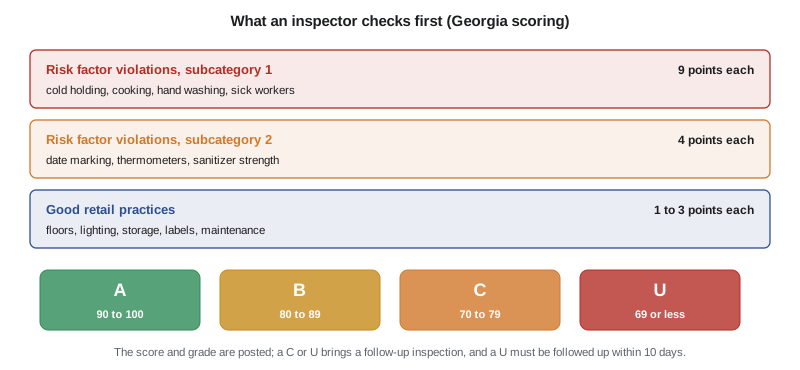
The risk factors that inspectors focus on are the same five that the FDA and Canadian health authorities have identified from decades of outbreak investigations: food from unsafe sources, inadequate cooking, improper holding temperatures, contaminated equipment, and poor personal hygiene. Every one of them has been covered in this course.
Preparing without pretending
Juniper does not prepare for a particular inspection, because it does not know when one will happen. Instead it runs its own inspection every month, two weeks after the last one, using the same checklist the inspector uses. Aisha leads it with Kofi from the safety committee, and they rotate a cook or server through each walk so that everyone learns what the inspector sees. The self-inspection takes about an hour, mid-afternoon between lunch and dinner.
The August self-inspection found seven problems. The program below sorts them the way an inspector would and estimates the result if an inspector had found the same things that day.
# Score Juniper's August self-inspection the way a Georgia inspection would.
findings = [
    # (finding, points)
    ("Cooked rice in the line reach-in at 46 F", 9),
    ("No paper towels at the bar hand sink", 9),
    ("Sanitizer bucket at the raw station at 50 ppm quat", 4),
    ("Torn gasket on the walk-in cooler door (again)", 1),
    ("Flour bin lid cracked", 1),
    ("Light shield missing over the prep table", 1),
    ("Allergen matrix missing the new soup", 2),
]

def grade(score):
    if score >= 90: return "A"
    if score >= 80: return "B"
    if score >= 70: return "C"
    return "U"

score = 100 - sum(p for _, p in findings)
for f, p in sorted(findings, key=lambda x: -x[1]):
    print(f"-{p}  {f}")
print(f"Estimated score: {score} (grade {grade(score)})")-9 Cooked rice in the line reach-in at 46 F -9 No paper towels at the bar hand sink -4 Sanitizer bucket at the raw station at 50 ppm quat -2 Allergen matrix missing the new soup -1 Torn gasket on the walk-in cooler door (again) -1 Flour bin lid cracked -1 Light shield missing over the prep table Estimated score: 73 (grade C)
A score of 73 would have meant a C, a follow-up inspection and a grade card that every guest sees at the door. None of the problems was hard to fix, and the self-inspection found them before a guest or an inspector did. The rice was discarded, and the cause, a reach-in door that did not close on its own, was repaired the same week. The bar's paper towel dispenser was added to the bartender's opening checklist. The raw-station bucket was remade and the prep cooks retrained on testing it. The other items were each given an owner and a date.
The temperature walk
Most critical findings in restaurant inspections involve temperatures. Juniper adds a temperature walk to every opening and to every self-inspection: one person probes a sample of foods in every cold and hot holding unit and writes down the readings. The program below runs a walk and flags anything outside the limits.
# Opening temperature walk at Juniper (Food Code limits: cold 41 F or colder, hot 135 F or hotter).
COLD_MAX, HOT_MIN, FROZEN_MAX = 41, 135, 0
readings = [
    ("walk-in cooler", "chicken thighs", "cold", 37),
    ("walk-in cooler", "cooked farro", "cold", 40),
    ("line reach-in", "sliced tomatoes", "cold", 44),
    ("cold station rail", "cut lettuce", "cold", 38),
    ("walk-in freezer", "halibut", "frozen", -6),
    ("steam table", "braised chicken", "hot", 154),
    ("steam table", "soup of the day", "hot", 131),
]
for unit, food, kind, t in readings:
    bad = (kind == "cold" and t > COLD_MAX) or (kind == "hot" and t < HOT_MIN) \
          or (kind == "frozen" and t > FROZEN_MAX)
    flag = "  <-- ACT NOW" if bad else ""
print(f"{unit:18s} {food:16s} {t:4d} F{flag}")walk-in cooler chicken thighs 37 F walk-in cooler cooked farro 40 F line reach-in sliced tomatoes 44 F <-- ACT NOW cold station rail cut lettuce 38 F walk-in freezer halibut -6 F steam table braised chicken 154 F steam table soup of the day 131 F <-- ACT NOW
Two readings need action. The sliced tomatoes in the line reach-in are above the cold limit, so the cook checks how long they have been out of temperature: if it is less than two hours, they are chilled quickly and the reach-in is checked; if it is unknown, they are thrown out. The soup is below the hot-holding limit, so it is reheated rapidly on the range, not in the steam table, which is designed to hold hot food, not to heat it.
The September inspection
On a Tuesday in September, at 11:20 a.m., an environmental health specialist from the Chatham County Health Department arrived at the back door and introduced himself to Daniel, the general manager. Juniper's routine for an inspection is short and practiced.
- Daniel or the most senior person on duty greets the inspector, checks their identification and walks with them for the whole inspection. Walking with the inspector is how the restaurant learns what the inspector sees and gets a chance to fix things on the spot.
- Tomás or Aisha joins them in the kitchen. Cooks keep working normally; the inspector wants to see the kitchen as it really runs.
- The records binder comes out without being asked: the food safety plan, the sanitation plan, temperature and cooling logs, the thermometer check log, the pest control reports, the sanitizer test records, the allergen matrix, the illness log and the certificates for the managers' food safety training.
- Answers are honest. If someone does not know, they say so and find out. Arguing with the inspector or hiding a problem turns a minor finding into a serious one.
- Anything that can be fixed during the visit is fixed during the visit, and the inspector notes it as corrected on site.
The inspector started where most do, with handwashing and temperatures. He watched Hana wash her hands between tasks, probed foods in the walk-in, the line reach-in and the steam table, and asked Ben how he knew the chicken was cooked. Ben showed him the probe log and took a reading on a thigh while he watched. He checked the sanitizer bucket at the cold station with his own test strip, read the cooling log for the previous day, looked at the dish machine rinse temperature and the three-compartment sink, opened the dry storage room and the basement storage room, looked for pest signs behind the dish machine where the spring pest report had noted activity, and asked to see the employee health policy and the written allergen notice. He asked Chloe, who was setting tables, what she would do if a guest said they had a nut allergy. Chloe walked him through the procedure from Lesson 10.
The inspection took about an hour and a quarter. The report listed two minor good retail practice violations: a bin of rice in dry storage had no label (1 point), and a wiping cloth had been left on the prep table instead of in the sanitizer bucket (1 point). Luis labeled the bin and the cloth went back into the bucket during the visit. The inspector noted that the spring violations had been corrected and that the cooling logs were complete. The score was 98, an A, and the new grade card went up at the front door the same day.
After the inspection
What a restaurant does after an inspection matters as much as the inspection itself. Juniper follows the same steps whatever the result.
- Read the whole report with the kitchen and front-of-house managers the same day, including the inspector's comments, not just the score or rating.
- Fix every finding, assign an owner and a date for anything that could not be fixed during the visit, and keep proof such as invoices and photos.
- Ask why each finding happened. The unlabeled rice bin was refilled by a new prep helper who had not been shown the labeling rule; labeling went into the prep helper training checklist.
- Share the result with the whole team at the next pre-shift meeting. A good result is credited to the people who earned it; a poor one is treated as a problem with the system, not a reason to blame one person.
- Update the food safety plan or the sanitation plan if the inspection showed a gap.
Bringing it together: a food safety checklist for every shift
The course has covered many rules. In practice, Juniper's kitchen runs on a handful of habits repeated every shift. They are posted at the pass as a one-page checklist, and the manager on duty initials it at opening and closing.
| When | Check |
|---|---|
| Opening | Illness question asked of every worker; hand sinks stocked; sanitizer buckets made up and tested; temperature walk done |
| Deliveries | Cold food at 41 °F or colder, frozen food frozen solid, packaging intact, put away cold first |
| Prep | Ready-to-eat first and raw last; boards by color; labels and dates on everything prepared |
| Cooking and holding | Every batch probed and logged; hot food at 135 °F or hotter; cold food at 41 °F or colder |
| Cooling | Shallow pans or ice bath; probes at 2 h and 6 h logged |
| Service | Every table asked about allergies; allergy orders flagged, prepared apart and delivered by hand |
| Closing | Cleaning schedule done; logs reviewed and signed; garbage out; doors and screens closed |
No single item on the list is difficult. The difficulty is doing all of them every shift, including the Saturday when two cooks call in sick and the walk-in is full. That is why the system matters more than any individual: written plans, simple logs that someone reads, training for every new worker, and managers who make it easy to do the right thing and normal to speak up when something is wrong. A kitchen that works this way does not need to fear the inspector, and more importantly, it does not make its guests sick.
Summary and key terms
- Inspectors focus first on the risk factors behind most outbreaks: unsafe sources, inadequate cooking, holding temperatures, contaminated equipment and poor personal hygiene.
- Run regular self-inspections with the inspector's checklist and a daily temperature walk, and fix the causes of what they find.
- During an inspection, walk with the inspector, have the records ready, answer honestly, keep working normally and correct problems on the spot.
- Georgia inspections deduct points from 100, give a letter grade that must be posted, and require follow-up for low grades.
- After an inspection, fix every finding with an owner and a date, ask why it happened, share the result with the team and update the plans.
- Risk factor
- A practice or condition, such as improper holding temperature or poor hygiene, that outbreak investigations link directly to foodborne illness.
- Self-inspection
- A restaurant's own regular inspection using the same checklist as the health inspector.
- Temperature walk
- A routine check that probes foods in every holding unit and records the readings.
- Corrected on site
- A finding fixed during the inspection, which the inspector notes on the report.
- Hazard rating or grade
- The overall result an inspection report gives, used to set follow-up and shown to the public.
When a guest complains of illness
Not every inspection is routine. If a guest calls to say they became sick after eating at Juniper, the manager takes the call seriously and politely, without arguing or admitting fault, and writes down the guest's name and contact details, what and when they ate, when the symptoms started and what they were. One complaint is often not linked to the restaurant, because many illnesses take a day or more to appear and the last meal is rarely the cause. Two or more complaints about the same days, or any report of a diagnosed illness, are reported to the Chatham County Health Department at once. The manager keeps the food in question if any is left, pulls the temperature and cooling logs and the employee illness records for those days, and is ready for an inspector to visit. Cooperating fully and early is the fastest way to find the cause and protect other guests.
Common mistakes
MistakeLeave the inspector alone in the kitchen so the staff can keep working.
InsteadWalk with the inspector the whole time, to see what they see and fix problems during the visit.
MistakeA good score means the restaurant can relax until the next inspection.
InsteadInspections are unannounced snapshots; keep self-inspections, logs and training going every day.
MistakeArguing with the inspector over each finding protects the restaurant.
InsteadListen, ask questions if a finding is unclear, fix what can be fixed, and use the formal process only if a real disagreement remains.
Practice problems
Work each problem on paper first, then reveal the answer to check.
The inspector finds soup at 131 °F (55 °C) in the steam table. What should the cook do?
Show answer
Reheat the soup rapidly on the range to the reheating temperature, then return it to hot holding, and check the steam table setting; if it had been below the limit for an unknown time, discard it.
Why does Juniper rotate a cook or server through each self-inspection?
Show answer
So everyone learns what the inspector looks for and sees the risk factors through the inspector's eyes.
Name four records an inspector may ask to see.
Show answer
Any four of: food safety plan, sanitation plan, temperature and cooling logs, thermometer check log, pest control reports, sanitizer test records, allergen matrix, illness log, food safety training certificates.
Lesson quiz · 5 questions
Score 60% or more to complete this lesson.
Create a free account to save your progress, take quizzes and earn a certificate.