
HSE-373 · Lesson 8 of 12 · 20 min
Flaggers: training, equipment and positions
A flagger is the only traffic control device that can think. Signs and cones cannot tell a driver to stop now and go in thirty seconds, cannot judge whether a truck needs extra room or wave an ambulance through. That flexibility makes flaggers valuable, and it also makes them the most exposed workers in a work zone: their job is to stand near moving traffic and stop it. This lesson covers who may flag, what they need, and where they stand. Lesson 9 covers the signals they use and how two-way traffic is controlled.
When flagging is used
Flagging is used when signs and devices alone cannot control traffic safely: when traffic in both directions must share one lane, when construction vehicles must enter or leave the road across traffic, when traffic must be stopped briefly for a crane lift or a delivery, and when conditions change too often for fixed devices. Flagging is not a substitute for a proper layout. A flagger needs advance warning signs, a taper and a buffer as much as any other part of the zone, and on high-speed, high-volume roads other methods, such as temporary signals, automated devices or a full detour, may be safer than putting a person beside the traffic.
Who may flag
The MUTCD says flaggers should be trained in safe traffic control practices and public contact techniques, and lists the abilities a flagger needs: to receive and communicate specific instructions clearly and firmly, to move and maneuver quickly to avoid danger from errant vehicles, to control signaling devices such as paddles to give clear guidance to drivers, to understand and apply safe traffic control practices, sometimes in stressful or emergency situations, and to recognize dangerous traffic situations and warn workers in time. OSHA 1926.21(b)(2) requires training in hazard recognition, and TxDOT requires flaggers on its projects to have completed an acceptable flagger training course. On the Cottonwood Place job, Mission Traffic Control LLC requires its flaggers to carry a training card from a recognized course and to be checked out on the site by the traffic control supervisor before flagging alone.
Some qualities are hard to train. A good flagger stays alert for a whole shift, stays calm with angry drivers, does not wander into the lane to argue, and watches for the one driver in a hundred who is not going to stop. A supervisor who sees a flagger using a phone, sitting down in the lane, chatting with other workers or turning their back on traffic must step in immediately, because those habits kill flaggers.
What a flagger needs
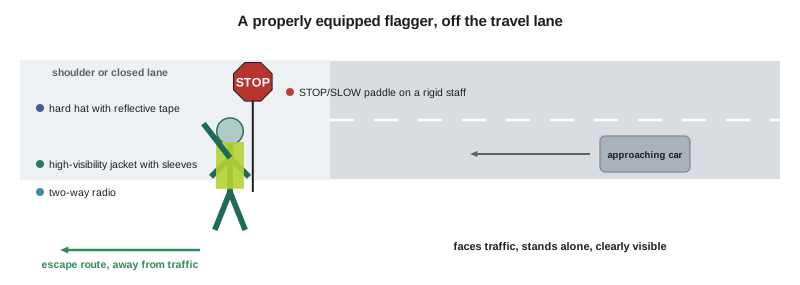
- STOP/SLOW paddle. The MUTCD makes the paddle the main hand-signaling device: an octagonal paddle with STOP in white on red on one side and SLOW in black on orange on the other, at least 18 inches (about 450 mm) across, on a rigid staff long enough to put the sign face where drivers can see it over the vehicle ahead. Flags are limited to emergencies.
- High-visibility apparel. The MUTCD requires high-visibility safety apparel meeting ANSI/ISEA 107 Class 2 or 3 for flaggers, and many contractors and agencies require Class 3. OSHA 1926.201 also requires a red or orange warning garment, reflectorized at night.
- Headwear. A high-visibility hard hat, with retroreflective material for night work.
- Communication. Two-way radios when flaggers at each end cannot see each other.
- At night, a flashlight or lighted wand and an illuminated flagger station.
- Safety footwear, eye protection and weather gear suitable for long periods outdoors.
- No personal phone use or earbuds while flagging; site rules on the Cottonwood Place job ban them.
Where a flagger stands
The flagger's position is the most important safety decision in flagging. The goal is to be clearly seen by approaching drivers early enough for them to stop, while standing where a driver who does not stop will not hit them.
- On the shoulder or in the closed lane, beside the lane being controlled, never in a lane open to traffic. The flagger steps into the lane only after traffic has stopped, if at all, and on most jobs should not need to.
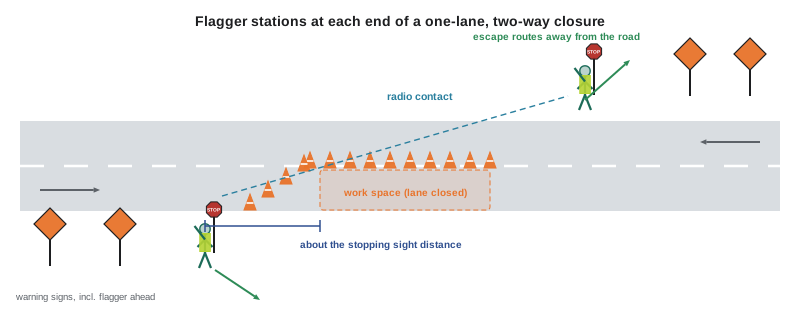
- Far enough ahead of the work space that stopped vehicles do not queue into the work and drivers who do not stop have room to slow before reaching the workers. The distance is usually based on stopping sight distance for the speed.
- Clearly visible for a long distance: not just beyond a curve or hill crest, not in the shade of a tree or building, not in front of a dark background where possible, not hidden by parked vehicles or equipment.
- Alone. Other workers should not gather around the flagger, because a group distracts the flagger and confuses drivers.
- With an escape route planned in advance, away from the traffic and clear of equipment, materials and excavations.
- Facing traffic, never with their back to the vehicles they are controlling.
- Behind the advance warning signs. Drivers must see a flagger ahead sign, and other warning signs, before they see the flagger.
How far ahead of the work
The MUTCD gives a table of distances from a flagger station to the work space by speed, based on stopping sight distance: about 200 ft at 30 mph, 305 ft at 40 mph, 425 ft at 50 mph and 570 ft at 60 mph. The program below estimates the same distances, so the supervisor can check a station position in the field.
# Estimated distance from a flagging station to the work space (stopping sight distance).
def ssd_m(kmh, t=2.5, a=3.4):
    v = kmh / 3.6
    return v * t + v * v / (2 * a)
def ssd_ft(mph, t=2.5, a=11.2):
    v = mph * 5280 / 3600
    return v * t + v * v / (2 * a)
for kmh in (40, 50, 60, 80):
    print(f"{kmh} km/h: station about {round(ssd_m(kmh) / 5) * 5} m ahead of the work space")
for mph in (30, 40, 50, 60):
    print(f"{mph} mph: station about {round(ssd_ft(mph) / 5) * 5} ft ahead of the work space")
# Sight check: can approaching drivers see the person flagging for at least this distance?
sight_available_m = 70      # measured on Larch Avenue from the bend to the station
need = ssd_m(50)
print("Larch Avenue sight check:", "OK" if sight_available_m >= need else "move the station", f"({sight_available_m} m vs {need:.0f} m)")40 km/h: station about 45 m ahead of the work space 50 km/h: station about 65 m ahead of the work space 60 km/h: station about 85 m ahead of the work space 80 km/h: station about 130 m ahead of the work space 30 mph: station about 195 ft ahead of the work space 40 mph: station about 300 ft ahead of the work space 50 mph: station about 425 ft ahead of the work space 60 mph: station about 565 ft ahead of the work space Larch Avenue sight check: OK (70 m vs 63 m)
One flagger or two
On a one-lane, two-way closure, traffic in each direction must be stopped and released in turn. A single flagger can control both directions only where the zone is very short, traffic is light and the flagger can be clearly seen by drivers approaching from both ends. In most cases, two flaggers are needed, one at each end, in constant contact by radio. On long zones, a pilot car leads each group of vehicles through, and the last vehicle in each group, or a token passed to the last driver, tells the flagger at the other end when it is safe to release traffic in the other direction. Lesson 9 covers these methods.
Breaks, heat and fatigue
Flagging looks easy and is not. A flagger stands for hours, often in heat, cold, rain, glare and exhaust fumes, while staying alert for one dangerous driver. Attention fades after an hour or two of steady flagging, and a tired flagger misses things. On the Cottonwood Place job, Mission Traffic Control LLC rotated flaggers at least every two hours, provided relief for breaks so a station was never left with the paddle propped against a cone, and supplied water, shade at the break area and cold-weather gear. In hot weather, the heat plan, with water, rest, shade and acclimatization for new workers, applied to flaggers first.
Dealing with drivers
Most drivers obey flaggers. Some argue, some refuse to wait, and a few drive through. A flagger should be courteous and brief, explain the delay if asked, and never argue or block a vehicle with their body. If a driver drives through or threatens the flagger, the flagger gets out of the way, warns the other flagger and the work crew by radio, notes the vehicle and plate if it is safe to do so, and reports it. Police can follow up; the flagger's job is to stay alive and warn others.
Worked problem
Moving the station on Larch Avenue
Show solution
- For a crane delivery, the plan places the flagger station 40 m upstream of the gate, just past a gentle bend in Larch Avenue.
- Dev takes the station and notices that eastbound drivers come round the bend and see him only about 45 m before they reach him, with a parked delivery van partly hiding him.
- The supervisor runs the check: at 35 mph, drivers need about 250 ft to stop. The station is moved about 100 ft further upstream, before the bend, where drivers can see Dev for more than 330 ft, and the van is asked to move.
- The flagger ahead sign is moved upstream by the same distance, so it still comes before the station.
- The plan is updated, and the City is told of the change.
Answer: A flagger station is in the right place only if drivers can see the flagger early enough to stop. Check sight distance from the driver's point of view.
The flagger and the trucks
On a building site, much of the flagging is for construction traffic: stopping public traffic briefly so a truck can back into the gate or pull out into the street. That task mixes two hazards, the passing traffic and the reversing truck, and the flagger must manage both. On the Cottonwood Place job, the flagger at the gate controlled public traffic only. A separate spotter inside the gate guided the reversing truck, so the flagger never had to turn their back on the street or step behind the truck.
Handover between flaggers
When one flagger relieves another, the handover is done with traffic stopped or at a quiet moment: the outgoing flagger explains any problems, such as drivers ignoring the signal or a driveway causing trouble, and hands over the radio and paddle before leaving.
Common mistakes
MistakeStanding in the open lane to make drivers stop.
InsteadStand on the shoulder or in the closed lane, beside the lane being controlled.
MistakePlacing the station just beyond a curve or hill crest.
InsteadPlace it where drivers can see the flagger for at least the stopping sight distance.
MistakeUsing a phone or earbuds while flagging.
InsteadUse only the approved radio, and stay focused on traffic.
MistakeLeaving a flagger on station all day without relief.
InsteadRotate and relieve flaggers regularly, and never leave a station unattended.
MistakeBlocking a driver who refuses to stop.
InsteadGet out of the way, warn others by radio and report the vehicle.
Summary and key terms
- Flagging is used when signs and devices cannot control traffic alone, and it needs warning signs, a taper and a buffer like any other zone.
- The MUTCD sets out the abilities a flagger needs and calls for training; OSHA requires hazard training, and TxDOT requires acceptable flagger training on its projects.
- Required equipment includes a STOP/SLOW paddle at least 18 inches across, ANSI/ISEA 107 Class 2 or 3 apparel, a high-visibility hard hat, radios and night lighting; flags are for emergencies.
- Flaggers stand off the open lane, far enough ahead of the work, clearly visible, alone, facing traffic and with an escape route.
- Two flaggers with radios are usually needed for a one-lane, two-way closure.
- Rotate flaggers, manage heat and fatigue, and never argue with or block a driver.
- Flagger
- A trained worker who controls traffic through a work zone using a STOP/SLOW paddle and hand signals.
- STOP/SLOW paddle
- An octagonal sign on a staff, with STOP on one side and SLOW on the other, used by flaggers.
- Flagger station
- The position from which a flagger controls traffic, set back from the work space and off the open lane.
- Escape route
- A planned path away from traffic that a worker can use if a vehicle does not stop.
- Pilot car
- A vehicle that leads traffic through a long one-lane work zone.
- Competency
- The demonstrated ability to apply training safely in the actual conditions of a workplace.
Practice problems
Work each problem on paper first, then reveal the answer to check.
Name four abilities the MUTCD says a flagger needs.
Show answer
Any four of communicating instructions clearly, moving quickly to avoid danger, controlling signaling devices, applying safe practices under stress, and recognizing dangerous situations and warning workers.
What colors are the two faces of a US STOP/SLOW paddle?
Show answer
STOP in white on red, and SLOW in black on orange.
List five rules for where a flagger stands.
Show answer
Any five of off the open lane, far enough ahead of the work, clearly visible, not just past a curve or crest, alone, facing traffic, with an escape route, and after the warning signs.
When can one flagger control a one-lane, two-way closure?
Show answer
Only where the zone is very short, traffic is light and drivers from both ends can clearly see the flagger.
What should a flagger do if a driver refuses to stop?
Show answer
Get out of the way, warn the other flagger and the crew by radio, note the vehicle if safe, and report it.
Lesson quiz · 5 questions
Score 60% or more to complete this lesson.
Create a free account to save your progress, take quizzes and earn a certificate.