
HSE-373 · Lesson 7 of 12 · 23 min
Taper lengths, buffer spaces and device spacing
A taper that is too short forces drivers to swerve. A buffer that is too short leaves no room for a driver who misjudges the taper. Devices spaced too far apart look like a scattering of cones rather than a line. These three numbers, taper length, buffer length and device spacing, are the arithmetic of a work zone, and a supervisor who can work them out, or at least check them, can spot a dangerous layout before anyone is hurt. This lesson shows where the numbers come from and works through examples on Larch Avenue and the state highway.
Why taper length depends on width and speed
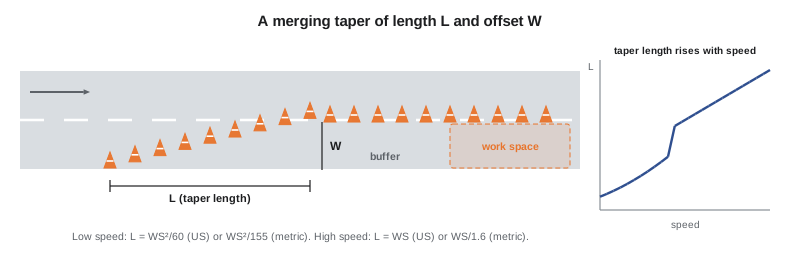
A merging taper asks drivers to move sideways by the width of a lane while they keep moving forward. The wider the lane, the further they must move. The faster they are going, the more forward distance they cover while making that move, and the harder it is to find a gap in the next lane. So taper length grows with lane width and grows faster than speed.
The US manual expresses this with two formulas, one for lower speeds and one for higher speeds, and many Canadian manuals use the same relationships in their taper tables. In US units, with L the taper length in feet, W the width of the offset in feet and S the speed in miles per hour:
In metric units, with L in meters, W in meters and S in kilometers per hour:
The speed used is normally the posted speed limit before the work started, the 85th-percentile operating speed, or the expected operating speed, whichever the road authority specifies. Using a reduced work zone speed limit to shorten the taper is not allowed unless the road authority's rules say so, because many drivers do not slow down.
the Texas Manual on Uniform Traffic Control Devices (TMUTCD) uses the same formulas and gives them in tables. TxDOT's standard plan sheets also show taper lengths for common speeds and widths. The supervisor follows the road authority's requirements, using the formulas to check or to handle unusual widths.
Different tapers, different lengths
Once L, the merging taper length, is known, the other tapers are worked out from it.
| Type of taper | Typical length |
|---|---|
| Merging taper | At least L |
| Shifting taper | At least 0.5 L |
| Shoulder taper | At least 0.33 L |
| One-lane, two-way taper (with flaggers or signals) | 50 to 100 ft (15 to 30 m) maximum |
| Downstream taper | About 50 to 100 ft (15 to 30 m) per lane |
Worked example: the curb lane on Larch Avenue
Worked problem
Taper for the Larch Avenue curb lane closure
Show solution
- Larch Avenue is posted at 35 mph, and the curb lane is 12 ft wide.
- Because 35 mph is at or below 40 mph, use the low-speed formula.
- \[L = \frac{W S^2}{60} = \frac{12 \times 35^2}{60} = \frac{14700}{60} = 245\ \text{ft}\]
- Round up to a practical length: Nadia uses 250 ft.
- With cones no more than 35 ft apart in the taper (the speed in mph), that is eight cones from the start to the end of the taper, counting both ends.
Answer: About 250 ft of taper with eight cones.
Worked problem
Taper for the highway driveway tie-in
Show solution
- the state highway is posted at 65 mph, and the right lane is 12 ft wide.
- Because 65 mph is at or above 45 mph, use the high-speed formula.
- \[L = W S = 12 \times 65 = 780\ \text{ft}\]
- The shoulder taper ahead of it, for an 8 ft shoulder, is at least a third of the merging taper for that width: about 0.33 times 520 ft, or about 172 ft.
- Drums are spaced no more than 65 ft apart in the taper, and an arrow board in arrow mode sits at the start of the merging taper.
Answer: About 780 ft of merging taper, roughly three times the city taper, because both speed and width are larger.
Buffer space: room to stop
The longitudinal buffer space gives a driver who enters the closed lane by mistake, or who loses control, room to stop before reaching workers. Its length is usually based on stopping sight distance: the distance a driver travels while seeing a hazard and reacting, plus the distance needed to brake to a stop.
Here d is the stopping distance, v the speed, t the perception-reaction time (2.5 seconds is commonly used in design) and a the deceleration rate (about 3.4 m/s², or 11.2 ft/s², a comfortable hard stop for most drivers on dry pavement). The program below computes stopping sight distance and compares it with the rounded values commonly used for buffers.
# Stopping sight distance for buffer lengths (t = 2.5 s, a = 3.4 m/s^2).
def ssd_m(kmh, t=2.5, a=3.4):
    v = kmh / 3.6
    return v * t + v * v / (2 * a)
def ssd_ft(mph, t=2.5, a=11.2):
    v = mph * 5280 / 3600
    return v * t + v * v / (2 * a)
print("km/h   SSD (m)")
for kmh in (40, 50, 60, 70, 80, 100):
    print(f"{kmh:>4}   {ssd_m(kmh):6.0f}")
print("mph    SSD (ft)")
for mph in (25, 35, 45, 55, 65):
print(f"{mph:>4} {ssd_ft(mph):6.0f}")km/h SSD (m) 40 46 50 63 60 83 70 104 80 128 100 183 mph SSD (ft) 25 152 35 246 45 359 55 492 65 644
At 35 mph the stopping sight distance is about 246 ft, close to the 250 ft value in the MUTCD's buffer table, and at 65 mph it is about 644 ft. Where the work space is short or the buffer cannot fit, the solution is to change the layout, close more of the road or protect the work space with a truck-mounted attenuator, not to shrink the buffer.
A lateral buffer, between the open lane and the edge of the work space, matters too. Even a meter (about 3 ft) of empty space between passing traffic and workers lowers the risk of being clipped by mirrors, trailers or a vehicle that drifts. Where a lateral buffer is not possible, a speed reduction, a closure of the next lane or positive protection should be considered.
Device spacing
Devices must look like a line, not a scatter. The closer the spacing, the clearer the line, especially at night and in rain. On the US side, the MUTCD's guidance is simple: in a taper, the maximum spacing in feet is about the speed in miles per hour; along the work space, about twice that. In metric terms, that works out to roughly a fifth of the speed in km/h, in meters, in the taper, and two fifths along the work space. Road authorities' tables may specify closer spacing in urban areas and at intersections.
import math
# Devices needed for a taper and a tangent, using the spacing rule of thumb.
def devices(length, spacing):
    return math.floor(length / spacing) + 1
# Metric: spacing in taper ~ 0.19 x km/h (m); tangent ~ 0.38 x km/h
for name, kmh, taper, tangent in (("Larch Ave", 50, 60, 140), ("Highway tie-in", 100, 231, 400)):
    st, sg = round(0.19 * kmh), round(0.38 * kmh)
    print(f"{name}: taper {taper} m at {st} m -> {devices(taper, st)} devices; "
f"tangent {tangent} m at {sg} m -> {devices(tangent, sg)} devices")Larch Ave: taper 60 m at 10 m -> 7 devices; tangent 140 m at 19 m -> 8 devices Highway tie-in: taper 231 m at 19 m -> 13 devices; tangent 400 m at 38 m -> 11 devices
Putting the numbers together
The full length of a lane closure is the advance warning area, plus the taper, plus the buffer, plus the work space, plus the termination area. On a highway, that can easily exceed 1.5 km (about a mile). On a city street, it may not fit in one block, which is why advance warning signs are often placed on the approach block and why some city jobs close a whole block to traffic rather than one lane. When the numbers will not fit, the answer is a different layout, not a shorter taper or buffer.
Worked problem
A buffer that disappeared
Show solution
- During the water service work, a delivery truck carrying pipe is told to park 'just inside the cones' while it unloads, which puts it in the longitudinal buffer.
- The traffic control supervisor notices during a drive-through that the buffer has shrunk from 65 m to about 15 m, and a driver who drifted into the closed lane would now hit the truck, with the excavation crew just beyond it.
- She stops the unloading, has the truck move into the work space past the excavation, where the plan shows a materials area, and restores the buffer.
- At the next morning's meeting, Marco Silva briefs his crew and the supplier's drivers: nothing is parked or stored in the buffer, ever.
- The plan is updated with a marked delivery area inside the work space and a note on the delivery ticket telling drivers where to stop.
Answer: Buffers protect workers only if they stay empty. Plan a place for trucks and materials inside the work space so the buffer is never used for parking.
Checking a layout in the field
Supervisors rarely carry a tape long enough to measure a highway taper, so they pace it, count devices or use the lane line markings, which are painted at a regular pattern on most roads, to estimate distance. On Larch Avenue, Nadia's crew knew that their cone spacing in the taper was 30 ft (about 9 m), so a taper of seven cones gave about 54 m from first cone to last, close enough to the planned 60 m with the first cone placed at the edge line. On the highway job, the crew measured the taper with a wheel at set-up and marked the start and end with paint on the shoulder, so later crews could set up in exactly the same place each morning.
Rounding and judgment
Formulas give a minimum, and in the field the numbers are rounded up, never down. Where a curve, a hill crest or a busy driveway sits near the start of the taper, supervisors move the taper or lengthen it so drivers can see it well in advance.
Common mistakes
MistakeShortening the taper because the block is short.
InsteadChange the layout: move warning signs to the approach block, close the block or detour traffic.
MistakeUsing the reduced work zone speed to calculate the taper.
InsteadUse the speed the road authority specifies, usually the normal posted or operating speed.
MistakeParking delivery trucks in the buffer space.
InsteadKeep the buffer empty and provide a delivery area in the work space.
MistakeSpreading cones further apart to make them go further.
InsteadCarry enough devices to meet the spacing; scattered cones do not form a line.
MistakeGuessing taper lengths by eye.
InsteadMeasure or pace them from the plan, and check unusual widths with the formulas.
Summary and key terms
- Taper length grows with lane width and faster than speed.
- US formulas: L = WS²/60 for 40 mph or less and L = WS for 45 mph or more; metric: L = WS²/155 for 60 km/h or less and L = WS/1.6 for 70 km/h or more.
- Shifting tapers are at least half and shoulder tapers at least a third of a merging taper; one-lane two-way and downstream tapers are short.
- Buffer length is based on stopping sight distance, about 63 m at 50 km/h and 183 m at 100 km/h (about 246 ft at 35 mph and 644 ft at 65 mph).
- Device spacing in tapers is about the speed in mph, in feet, or about a fifth of the speed in km/h, in meters, and twice that along the work space.
- When the numbers do not fit, change the layout instead of shortening the taper or buffer.
- Merging taper length (L)
- The basic taper length from which other taper lengths are worked out.
- Lateral offset (W)
- The sideways distance traffic must move in a taper, usually a lane width.
- Stopping sight distance
- The distance a driver travels while perceiving a hazard, reacting and braking to a stop.
- Perception-reaction time
- The time between a driver seeing a hazard and starting to brake, commonly taken as 2.5 seconds in design.
- Longitudinal buffer
- Empty space along the lane between the taper and the work space.
- Lateral buffer
- Empty space between the open traffic lane and the side of the work space.
Practice problems
Work each problem on paper first, then reveal the answer to check.
Calculate the merging taper for a 12 ft lane at 40 mph.
Show answer
L = 12 × 40² / 60 = 19,200 / 60 = 320 ft.
Calculate the merging taper for a 12 ft lane at 55 mph.
Show answer
L = 12 × 55 = 660 ft.
How long should a shifting taper be compared with a merging taper?
Show answer
At least half the merging taper length.
What two parts make up stopping sight distance?
Show answer
The distance traveled during perception and reaction, plus the braking distance.
A delivery truck is parked in the buffer. What should happen?
Show answer
Move it into a planned delivery area in the work space and restore the empty buffer.
Lesson quiz · 5 questions
Score 60% or more to complete this lesson.
Create a free account to save your progress, take quizzes and earn a certificate.