
HSE-373 · Lesson 4 of 12 · 20 min
Traffic control plans and layouts
A traffic control plan is the drawing and set of notes that says exactly how a work zone will be set up, run and taken down. It turns the principles from lesson 3 into a specific layout for a specific road, at a specific time, for a specific job. On the Cottonwood Place project, Mission Traffic Control LLC prepared six traffic control plans over the life of the job: the curb lane closure at the Larch Avenue gate, a sidewalk closure, a full night closure of Larch Avenue for the tower crane erection, a lane closure for the water service connection, a short-duration plan for sweeping and minor work, and a plan for the sister job's driveway tie-in on a state highway posted at 65 mph. This lesson looks at what goes into a plan and how a supervisor reads and checks one.
Standard layouts and site-specific plans
Traffic control manuals contain standard layouts for common situations: a shoulder closure, a lane closure on a two-lane road with flaggers, a lane closure on a multilane road, a work zone at an intersection, a sidewalk closure, a mobile operation and so on. The MUTCD calls them typical applications and numbers them; the Texas Manual on Uniform Traffic Control Devices (TMUTCD) follows the same set, and TxDOT also publishes its own standard traffic control plan sheets for highway projects. Cities, including San Antonio, accept standard layouts for common street closures.
A standard layout is a starting point, not a finished plan. It assumes a straight, level road with good sight lines, no driveways and no unusual features. Real roads have curves, hills, intersections, driveways, bus stops, bike lanes, parking, schools and businesses. A site-specific plan adapts the standard layout to the real site, and where the site is complex, as on Larch Avenue with the bus stop, the café driveway and the office loading dock, the road authority may require a plan prepared for that site.
What a traffic control plan contains
Nadia's plans for the Cottonwood Place project followed the same structure every time.
- Location and limits. The street, the block, the direction of travel, the start and end of the zone, and a north arrow.
- Road features. Lane widths and markings, posted speed, intersections, driveways, bus stops, bike lanes, sidewalks, crosswalks, hydrants and overhead lines.
- Work description and duration. What work is being done, by whom, and when the closure is in place: dates, hours and whether it stays overnight.
- Signs. Every sign, by type and size, with its location and spacing, including signs on side streets.
- Channelizing devices. Type, spacing and location of cones, drums, barricades or barriers, including the taper and the line along the work space.
- Tapers and buffer. The length of each taper and buffer, calculated for the posted speed.
- Flagger stations or temporary signals, if used.
- Arrow boards, message signs and lighting, if used.
- Pedestrian and cyclist routes, including any sidewalk closure, detour, temporary walkway or bike lane closure.
- Access. How driveways, businesses, transit and emergency vehicles will get through.
- Truck access to the site. Where and how construction vehicles enter and leave the zone.
- Set-up and take-down sequence, with the order in which devices are placed and removed.
- Inspection and maintenance, including who checks the zone and how often.
- Contingencies. What happens if traffic backs up too far, a device is hit, weather turns or an emergency vehicle needs to pass.
- Approvals and contacts. The road authority's approval, the permit number, the traffic control supervisor's name and phone number.
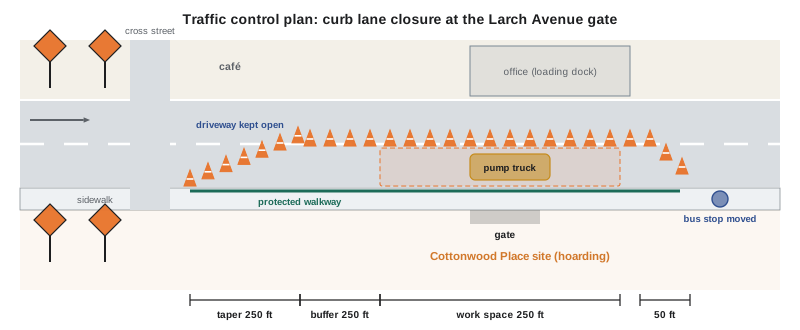
Reading a plan in the field
A plan is useless if the people setting up the zone cannot read it. Nadia trains her crew to read a plan in a set order before every set-up.
- Orient it. Find the north arrow and the direction of traffic, and stand on the site holding the plan the same way.
- Find the start. Locate the first advance warning sign and measure or pace to it from a landmark.
- Count the signs. Make sure the right signs are on the truck, in the right order.
- Measure the taper. Know its length and the number of devices it needs.
- Find the hazards. Driveways, bus stops, hydrants, overhead lines and anything else the plan marks.
- Check the time. Make sure the closure is allowed at that hour.
Set-up and take-down sequence
Most traffic control crew injuries happen while signs and devices are being placed or removed, because workers are on foot in or beside moving traffic with no protection yet in place. The plan's sequence is designed to reduce that exposure.
- Set up in the direction of traffic. Start with the first advance warning sign and work toward the work space, so drivers are warned before they meet any devices or workers. Then place the taper, starting at the upstream end, followed by the devices along the work space, and finally the termination area.
- Take down in the reverse order. Remove the devices along the work space first, then the taper, working against traffic, and the advance warning signs last, so drivers are warned until the very end.
- Use a protected vehicle where possible. On higher-speed roads, a truck with an arrow board or a truck-mounted attenuator follows or leads the crew as they place devices.
- Work facing traffic, place devices from the shoulder or the protected side when possible, and never turn your back on approaching vehicles.
- Cover or remove signs that do not apply. A sign saying a lane is closed when it is open teaches drivers to ignore signs.
Changes to the plan
Plans change. A delivery is bigger than expected and needs more space, a bus route is diverted, or the City asks for a later start. Every change goes back to the person who prepared the plan, and, where the change affects the layout, to the road authority. Field changes made without approval are a common finding after work zone crashes. On the Cottonwood Place project, Nadia kept a plan revision log in her truck, and the traffic control supervisor on shift had to see the current revision before setting up.
Counting what the crew needs
Before each set-up, Nadia uses a short program to count the cones and signs needed from the plan's dimensions, so the truck is loaded correctly and the crew does not run short halfway through a taper.
import math
# Device count for the Larch Avenue curb-lane closure (illustrative values from the plan).
taper_m, taper_spacing_m = 60, 9          # merging taper length and cone spacing in the taper
work_m, work_spacing_m = 140, 18          # buffer plus work space along the lane line
down_m, down_spacing_m = 15, 5            # downstream taper
signs = ["ROAD WORK AHEAD", "RIGHT LANE CLOSED AHEAD", "lane closed symbol", "END ROAD WORK",
         "SIDEWALK CLOSED, USE OTHER SIDE (not used: walkway kept open)", "side street ROAD WORK AHEAD"]
cones = (math.floor(taper_m / taper_spacing_m) + 1) + math.ceil(work_m / work_spacing_m) + \
        (math.floor(down_m / down_spacing_m) + 1)
spare = math.ceil(cones * 0.15)
print(f"Cones in plan: {cones}, plus {spare} spares = {cones + spare} on the truck")
used = [s for s in signs if "not used" not in s]
print(f"Signs to load: {len(used)}")
for s in used:
print(" -", s)Cones in plan: 19, plus 3 spares = 22 on the truck Signs to load: 5 - ROAD WORK AHEAD - RIGHT LANE CLOSED AHEAD - lane closed symbol - END ROAD WORK - side street ROAD WORK AHEAD
Loading 15 percent spare devices is Nadia's own rule: cones get hit and crushed, and a crew that runs out mid-shift is tempted to leave a gap rather than drive back to the yard.
Worked problem
The plan that did not fit the pour
Show solution
- The concrete pumping subcontractor tells Owen on Thursday that the Friday pour will use a larger 52 m boom pump, not the 38 m pump in the plan.
- The larger pump needs wider outrigger spread, which would put one outrigger pad in the open traffic lane, outside the approved work space.
- Owen calls Nadia, who revises the plan: the closure is extended to take both lanes on that block for the pour window, with traffic detoured around the block, which needs a new approval from the City.
- The City approves the revised plan for a Saturday morning, when traffic is light, instead of Friday.
- The pour moves a day. Owen adds a question to the pour checklist: has the pump size changed since the traffic control plan was approved?
Answer: Equipment, deliveries and methods drive the traffic control plan. When they change, the plan and its approval must change before the work does.
Contingencies: what if?
The best plans include a short section on what happens when things do not go to plan, because on a city street something always changes. Nadia's contingency notes for the Larch Avenue closure answered six questions.
- What if the queue backs up past the first sign? Extend the warning upstream with an extra sign or a portable changeable message sign, and if it keeps happening, move the closure to off-peak hours.
- What if a device is hit or a sign blown over? The gate crew radios the traffic control supervisor, who resets it from the protected side; nobody enters a live lane to fix it without traffic stopped.
- What if an emergency vehicle needs to pass? The flagger stops other traffic and the crew clears the lane of equipment, which the plan says must be possible within two minutes.
- What if the weather turns? In heavy rain, snow or high wind, cones are weighted or replaced with drums, and work that needs the closure may stop.
- What if the work runs late? The closure must be removed by the permit's end time; if it cannot be, the traffic control supervisor calls the City before the end time, not after.
- What if a crash happens in or near the zone? Stop the work, protect the scene, call 911, give first aid if trained and safe, and report to the controlling contractor immediately.
The traffic control supervisor's inspection sheet
Every set-up on the job ended with the same short inspection, done by driving the zone at the posted speed and then walking it. The traffic control supervisor checked that every sign in the plan was in place, visible, upright and clean; that the taper and buffer were the planned length; that devices were spaced correctly and in line; that the pedestrian route was open, smooth and detectable; that flaggers were in position with the right equipment; and that nothing was parked or stored in the buffer. The sheet was signed and kept, and the inspection was repeated during the shift and whenever the layout changed.
The inspection sheet also had a box for the time the closure was removed and the road returned to normal, so the City could see that the permit hours were respected.
Common mistakes
MistakeUsing a standard layout without checking the real site.
InsteadAdapt the layout for curves, hills, driveways, bus stops, intersections and other features.
MistakeSetting up the taper first because it is closest to the work.
InsteadPlace the advance warning signs first, working in the direction of traffic.
MistakeRemoving the advance warning signs first at the end of the shift.
InsteadTake down in reverse order, leaving the warning signs until last.
MistakeChanging the layout in the field to fit a bigger truck.
InsteadSend changes back to the plan's author and the road authority before the work changes.
MistakeLeaving signs uncovered when the closure is removed overnight.
InsteadCover or remove signs that do not apply, so drivers keep trusting them.
Summary and key terms
- A traffic control plan shows how a specific work zone will be set up, run and taken down.
- Standard layouts are starting points; site-specific plans adapt them to real roads and features.
- A complete plan covers location, road features, work and duration, signs, devices, tapers and buffer, flaggers, pedestrians, access, sequence, inspection, contingencies and approvals.
- Set up in the direction of traffic, starting with the advance warning signs; take down in reverse.
- Field changes go back to the plan's author and, where needed, the road authority.
- Count devices before loading, and carry spares so gaps are never left in a taper.
- Traffic control plan
- A drawing and notes showing how a specific work zone will be set up, operated and removed.
- Standard layout
- A typical arrangement of signs and devices for a common work zone situation, published in a traffic control manual.
- Typical application
- The MUTCD's name for a numbered standard layout.
- Site-specific plan
- A traffic control plan adapted to the real features of a particular road and job.
- Set-up sequence
- The order in which signs and devices are placed, normally in the direction of traffic.
- Plan revision log
- A record of changes to a traffic control plan and their approvals.
Practice problems
Work each problem on paper first, then reveal the answer to check.
Name six things a traffic control plan must show.
Show answer
Any six of location and limits, road features, work and duration, signs, channelizing devices, tapers and buffer, flagger stations, arrow boards and lighting, pedestrian routes, access, truck access, sequence, inspection, contingencies and approvals.
In what order should a crew set up a lane closure?
Show answer
In the direction of traffic: advance warning signs first, then the taper from its upstream end, then the devices along the work space, then the termination area.
Why are advance warning signs removed last?
Show answer
So drivers are warned until all workers and devices have left the road.
What should happen when a larger pump truck is planned?
Show answer
The plan must be revised and, if the layout changes, approved by the road authority before the work goes ahead.
Why does Nadia load spare cones?
Show answer
Cones get hit and damaged, and running short could tempt a crew to leave a gap in a taper.
Lesson quiz · 5 questions
Score 60% or more to complete this lesson.
Create a free account to save your progress, take quizzes and earn a certificate.