
ENGG-100 · Lesson 5 of 5 · 34 min
Engineering and society
Engineering shapes how people live: where they can live, what they breathe and drink, how they travel, how much their energy costs and what kind of world their grandchildren inherit. That influence brings responsibilities beyond making a design work. The first canon of the NSPE Code asks engineers to hold the safety, health and welfare of the public paramount, and the NSPE and ASCE codes encourage engineers to follow the principles of sustainable development. Meeting that standard today means thinking about sustainability, climate, communities, tribal nations, equity and new technologies such as artificial intelligence.
This chapter looks at those wider responsibilities: sustainable development and life-cycle thinking, energy and climate, engaging with communities and Indigenous peoples, diversity in the profession, communicating risk to the public, and the ethics of emerging technology. These are not soft extras; they increasingly decide whether projects are approved, funded and trusted.
Sustainable development
The most widely used definition comes from the 1987 Brundtland Report of the United Nations World Commission on Environment and Development: sustainable development "meets the needs of the present without compromising the ability of future generations to meet their own needs". Engineers often put it in terms of three pillars, sometimes called the triple bottom line:
- Environmental: protecting air, water, land, ecosystems and the climate.
- Social: health, safety, equity, community well-being and respect for rights.
- Economic: affordability and value over the whole life of a project, not just its first cost.
Professional societies such as ASCE make sustainability part of their codes of ethics, rating systems such as Envision (for infrastructure) and LEED (for buildings) give projects a structured way to measure it, and clients increasingly expect engineers to consider environmental and social impacts as part of competent practice.
Life-cycle thinking
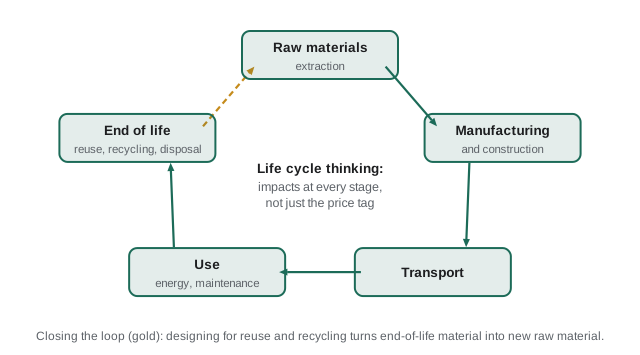
A design's impacts are not limited to the time it is in use. Life-cycle assessment (LCA) accounts for energy use, emissions and other impacts at every stage, from extracting raw materials to manufacturing, transport, use and end of life. Life-cycle costing does the same for money.
Worked problem
The real cost of a pump
A $10 000 pump with a 15 kW motor runs 8000 hours a year for 20 years. Electricity costs $0.10/kWh and maintenance about $1000 a year. What share of the life-cycle cost is energy (ignoring interest and inflation)?
Show solution
- Energy per year: \(15 \times 8000 = 120\,000\) kWh, costing \$12 000.
- Over 20 years: energy \$240 000; maintenance \$20 000; purchase \$10 000. Total \$270 000.
- Energy share: \(240\,000/270\,000 = 89\%\).
Answer: About 89%. The purchase price is under 4% of the total, so spending more on an efficient pump is almost always worthwhile. Buying on first cost alone is one of the most common and expensive mistakes in industry
Worked problem
Embodied versus operational carbon
A new building is estimated to cause 500 t CO₂e in construction (embodied carbon: materials and building) and 40 t CO₂e a year in operation for 50 years. What share is embodied? What if efficient design and clean electricity cut operational emissions to 5 t a year?
Show solution
- Base case: operational \(40 \times 50 = 2000\) t; total 2500 t; embodied share \(500/2500 = 20\%\).
- Low-energy case: operational \(5 \times 50 = 250\) t; total 750 t; embodied share \(500/750 = 67\%\).
Answer: 20%, rising to 67% once operation is efficient. As buildings and vehicles become more efficient, the emissions locked into their materials (cement, steel, aluminum) become the main target, which is why low-carbon concrete and mass timber are growing fields
Energy and climate
Climate change is the defining engineering challenge of this century. American climate policy has changed between administrations: the US withdrawal from the Paris Agreement took effect in January 2026, and federal clean-energy incentives were scaled back in 2025, while many states have targets in their own laws. California, for example, requires carbon neutrality by 2045, and New York's climate law requires an 85% cut in emissions below 1990 levels by 2050. Whatever one's views on climate policy, engineers work across the whole range: electrification, grid modernization, renewable, natural gas and nuclear generation, carbon capture and storage, hydrogen, efficient buildings, low-carbon materials and adaptation of infrastructure to more extreme weather.
Two kinds of engineering response are needed:
- Mitigation: reducing emissions, through efficiency, fuel switching, cleaner processes and capturing CO₂.
- Adaptation: designing for the climate that is coming, with larger storm sewers and culverts, flood protection, wildfire-resistant communities, and design loads that account for hotter summers and changing snow, rain and wind.
In Texas, the largest energy-producing state, engineers work across that whole range at once: producing oil and gas more efficiently and with lower methane emissions, building the country's largest fleet of wind and solar farms and grid batteries, and making the grid more resilient after the February 2021 winter storm that left millions without power.
Worked problem
A premium-efficiency motor
A 75 kW motor runs 6000 hours a year. A premium model has an efficiency of 95.4% instead of 93.0% and costs $3000 more. Electricity costs $0.10/kWh. Find the annual savings and simple payback. Assuming the grid emits 0.5 t CO₂e per MWh (an assumed value; check current figures for your region), how much CO₂ is avoided?
Show solution
- Input power: standard \(75/0.930 = 80.65\) kW; premium \(75/0.954 = 78.62\) kW. Saving 2.03 kW.
- Energy saved: \(2.03 \times 6000 = 12\,200\) kWh/year, worth \$1220.
- Payback: \(3000/1220 = 2.5\) years.
- CO₂ avoided: \(12.2 \text{ MWh} \times 0.5 = 6.1\) t/year.
Answer: $1220 a year, a 2.5-year payback, and about 6 t of CO₂ avoided each year. Efficiency projects are often the cheapest emission reductions available
Communities and Indigenous peoples
Major projects such as pipelines, transmission lines, mines, dams and highways affect people who did not ask for them. Projects that ignore those people are delayed, challenged in court, or canceled; projects that listen early often end up better designed. Engineers play a growing part in consultation: explaining options clearly, answering technical questions honestly, and changing designs in response to what they learn.
The United States recognizes 574 tribal nations as sovereign governments with a government-to-government relationship with the federal government. Executive Order 13175 requires federal agencies to consult tribes on actions with tribal implications, and section 106 of the National Historic Preservation Act requires federal agencies to consult tribes about effects on historic properties of religious and cultural significance, including sites off reservation lands. The National Environmental Policy Act (NEPA) requires environmental review of major federal actions, including many pipelines, highways and transmission lines. Disputes such as the Dakota Access Pipeline crossing near the Standing Rock Sioux Reservation, which led to years of protest and litigation over the adequacy of consultation and environmental review, show the cost of treating these duties as a formality.
For engineers this means understanding whose land and cultural resources a project affects, involving tribes and communities early rather than after the design is fixed, respecting traditional knowledge alongside technical data (for example, long-term observations of rivers, wildlife and land), and supporting real economic participation through employment and contracting. INDG-101 in the Arts stream covers this history in more depth.
Worked problem
Routing a transmission line
A utility proposes a 230 kV transmission line that needs a federal permit. The shortest route crosses a valley that a tribal nation uses for hunting and ceremonies; an alternative route is 12% longer and costs more. How should the engineering team approach the decision?
Show solution
- Engage the tribe (and other affected communities) early, before routes are fixed, alongside the federal agency's government-to-government consultation and section 106 review.
- Gather and respect both technical information (terrain, access, cost, reliability) and community knowledge (cultural sites, land use, wildlife).
- Compare routes on all three pillars: environmental, social and economic, including the risk of delay or legal challenge.
- Document the reasons for the chosen route and any accommodations, such as seasonal construction windows, cultural monitors or route adjustments.
Answer: There is no formula, but a defensible decision weighs rights and community impacts alongside cost, is reached through genuine engagement, and is documented. The cheapest line on a map is often not the cheapest project
A profession that reflects the public
The profession serves everyone, and decisions are better when the people making them bring different experiences and perspectives. American engineering is still far from reflecting the population: women made up about 15% of employed engineers in 2023, according to the Society of Women Engineers, and Black and Hispanic Americans are also under-represented. Organizations such as the Society of Women Engineers, the National Society of Black Engineers and the Society of Hispanic Professional Engineers work to widen the pipeline into the profession.
Inclusion is also a design issue. Products designed by and tested on a narrow group can fail everyone else: crash-test dummies modeled on average men, voice recognition that struggles with accents, buildings that are hard to use for people with disabilities. Universal design, the idea that environments should be usable by as many people as possible without adaptation, is good engineering.
Engineers and the public
Communicating risk
Engineers are often asked whether something is safe. The honest answer is rarely yes or no; it is a statement about risk. People do not judge risk the way a calculation does: they accept far higher risks that are voluntary, familiar or under their own control (driving, skiing) than risks imposed on them, unfamiliar or catastrophic in nature (a nearby chemical plant, a nuclear facility). Neither view is simply right or wrong. Good communication explains what is known and unknown, compares risks fairly, takes concerns seriously, and never overstates certainty.
Public service
Engineers serve the public directly in government, cities, state departments of transportation and regulators, and indirectly by volunteering: as expert witnesses, on standards committees, in schools and through organizations such as Engineers Without Borders USA, which works with communities on water, sanitation and infrastructure. State licensing boards also depend on engineers who serve as board members and exam writers.
Technology, data and AI
Engineers increasingly design systems that collect data, make decisions automatically, or use machine learning: smart grids, autonomous vehicles, medical devices, industrial control systems and predictive maintenance tools. These bring new ethical questions alongside the old ones:
- Safety: can a learning system be verified, and how does it behave in situations it was not trained on?
- Privacy and security: what data is collected, who can see it, and how is it protected from attack? Cyberattacks on industrial controls are now a real safety hazard.
- Fairness: does the system work equally well for everyone, or does it embed biases from its training data?
- Accountability: who is responsible when an automated decision causes harm? For engineers, the answer remains: the professional who authenticated the design.
The code of ethics applies unchanged. Engineers must work within their competence, be honest about a system's limits, protect the public, and keep a human accountable. Using AI tools in your own work, such as writing code, drafting reports or checking calculations, follows the same rule: you are responsible for verifying everything you sign.
Worked problem
An AI-assisted design check
An engineer uses an AI assistant to size a set of steel beams. It produces neat calculations quickly, and they look right. What must the engineer do before relying on them?
Show solution
- Check that the assumptions (loads, spans, support conditions, steel grade, code edition) match the actual project.
- Verify the calculations independently, by hand or with trusted software, at least for governing cases.
- Confirm that no confidential client information was entered into a tool that is not approved for it.
- Document how the tool was used, as part of the project record.
Answer: Treat the output like work from an unsupervised junior: potentially useful, never authenticated without full review. Responsibility stays with the engineer
Common mistakes
MistakeJudging designs on first cost alone.
InsteadUse life-cycle cost and life-cycle assessment; operating energy often dominates.
MistakeTreating environmental and social issues as someone else's job.
InsteadCodes of ethics such as ASCE's ask engineers to consider sustainability and the environment; social license decides whether projects proceed.
MistakeConsulting communities after the design is fixed.
InsteadEngage early, when their knowledge can still change the design.
MistakeTelling the public something is "completely safe".
InsteadCommunicate risk honestly, including uncertainty, and take concerns seriously.
MistakeAssuming automated or AI-generated results need less checking.
InsteadThey need at least as much. The authenticating engineer remains accountable.
Summary and key terms
- Sustainable development meets present needs without compromising future generations; it balances environmental, social and economic pillars.
- Life-cycle assessment and life-cycle costing count impacts and costs at every stage; operating energy and embodied carbon both matter.
- US climate policy varies by administration and by state (California requires carbon neutrality by 2045); engineers lead both mitigation and adaptation.
- Tribal nations are sovereign; federal agencies must consult them (Executive Order 13175, NHPA section 106), and NEPA requires environmental review of major federal actions.
- Women were about 15% of employed US engineers in 2023; inclusive teams and universal design produce better outcomes.
- Risk communication must be honest about uncertainty and respect how people perceive risk.
- Data, automation and AI raise safety, privacy, fairness and accountability questions; the code of ethics still applies.
- Sustainable development
- Development that meets present needs without compromising future generations.
- Triple bottom line
- Evaluating projects on environmental, social and economic performance.
- Life-cycle assessment
- Accounting for a product's impacts from raw materials to end of life.
- Embodied carbon
- Emissions from producing materials and constructing an asset.
- Mitigation
- Reducing greenhouse gas emissions.
- Adaptation
- Designing for the effects of climate change.
- Duty to consult
- The federal government's obligation to consult tribal nations on actions that affect them, under Executive Order 13175 and laws such as the National Historic Preservation Act.
- Universal design
- Designing so environments and products are usable by as many people as possible.
Practice problems
Work each problem on paper first, then reveal the answer to check.
Name the three pillars of sustainable development and give an engineering example of each.
Show answer
Environmental (reducing emissions from a plant), social (safe, accessible public transit), economic (minimizing life-cycle cost of a road).
A $4000 LED retrofit saves 9000 kWh a year at $0.12/kWh. What is the simple payback?
Show answer
Savings $1080 a year; payback 4000/1080 = 3.7 years.
In the pump example, how would the life-cycle cost change if electricity rose to $0.15/kWh?
Show answer
Energy becomes $18 000 a year, $360 000 over 20 years; total $390 000, energy 92%.
Give one mitigation and one adaptation measure for a municipal engineering department.
Show answer
Mitigation: converting the bus fleet to electric. Adaptation: upsizing storm sewers and culverts for heavier rainfall.
Who must consult tribal nations about a federally permitted project, and what role do engineers play?
Show answer
The federal agency issuing the permit or funding holds the duty, on a government-to-government basis; project sponsors often support it. Engineers explain options, gather and respect community knowledge, and adapt designs.
Name two organizations working to make the US engineering profession more representative.
Show answer
Any two of: the Society of Women Engineers, the National Society of Black Engineers, the Society of Hispanic Professional Engineers, the American Indian Science and Engineering Society.
Why might residents oppose a gas plant with a very low calculated risk, while accepting the higher risk of driving?
Show answer
Driving is voluntary, familiar and under their control; the plant's risk is imposed, unfamiliar and potentially catastrophic. These factors strongly affect risk perception.
Give an example of a product that failed some users because of a narrow design team or test group.
Show answer
Examples: crash-test dummies based on average male bodies, voice or face recognition that performs poorly for some groups, buildings without accessible entrances.
List two questions an engineer should ask before deploying a machine-learning system in a safety-critical application.
Show answer
How does it behave outside its training data? How are failures detected and handled safely? Also: who is accountable, and how is data secured?
Why is embodied carbon becoming more important as buildings become more efficient?
Show answer
As operating emissions fall, the fixed emissions from producing concrete, steel and other materials become a larger share of the total.
Lesson quiz · 5 questions
Score 60% or more to complete this lesson.
Create a free account to save your progress, take quizzes and earn a certificate.