
ELV-310 · Lesson 9 of 12 · 22 min
Group dispatching and destination dispatch
A single car like Larchmont's has one decision to make about a hall call: when to answer it. A group of cars has a harder one: which car should answer it. Quayside Tower's four passenger cars share a hoistway and a lobby, and every call made at a keypad is assigned to one of them by the group controller. Quayside's developer chose destination dispatch, so a resident does not press up or down: they enter or badge their floor at a keypad, and the screen tells them which car to take. The residents' first month with the system produced more complaints than all the other Northcrest buildings on the route together, most of them from people who had pressed the button again and again because the car they expected did not come. Priya used those complaints to teach Tamsin how a group thinks.
What a group controller does
A group controller has the same goal on every assignment: to keep the waiting time and the journey time short for everyone, not just for the passenger who pressed the button. To do that, it estimates, for each car, how long that car would take to reach the call, taking into account where the car is, which direction it is going, how many stops it already has, how long its doors will be open at each, and how full it is. It then assigns the call to the car with the lowest cost, where the cost includes the estimated time to arrive and penalties for things the building wants to avoid, such as very long waits for anyone, or a full car stopping for a call it cannot take.
A conventional group, with up and down buttons, assigns hall calls in this way but lets each car decide its own car calls as passengers press them, so the group does not know where passengers are going until they are already in a car. It reassigns calls when conditions change, for example when a car that was assigned a call fills up and is told to bypass it. Most conventional groups show the assigned car with a hall lantern and chime as the car arrives, or, on many current systems, light the lantern as soon as the call is assigned, which helps passengers walk to the right car but commits the group to its choice.
# Assign a hall call to the car with the lowest estimated time of arrival (simplified)
call_floor, call_dir = 14, "down"
per_floor, per_stop = 1.6, 9.0      # seconds per floor traveled, seconds per stop made
cars = [  # name, floor, direction, stops before reaching the call, load share
    ("A", 20, "down", 2, 0.30),
    ("B", 9, "up", 1, 0.20),
    ("C", 3, "idle", 0, 0.00),
    ("D", 17, "down", 1, 0.85),
]

def eta(floor, direction, stops):
    if direction == "down" and floor > call_floor:
        floors = floor - call_floor
    elif direction == "idle":
        floors = abs(floor - call_floor)
    else:  # going away from the call: go to the end of the trip, then come back
        top = 25
        floors = (top - floor) + (top - call_floor)
    return floors * per_floor + stops * per_stop

best = None
for name, floor, d, stops, load in cars:
    t = eta(floor, d, stops)
    cost = t + (60 if load > 0.8 else 0)     # penalty: a nearly full car should not take more passengers
    print(f"car {name}: ETA {t:5.1f} s, cost {cost:5.1f}")
    if best is None or cost < best[1]:
        best = (name, cost)
print(f"call at floor {call_floor} {call_dir} assigned to car {best[0]}")car A: ETA 27.6 s, cost 27.6 car B: ETA 52.2 s, cost 52.2 car C: ETA 17.6 s, cost 17.6 car D: ETA 13.8 s, cost 73.8 call at floor 14 down assigned to car C
Car D is closest in time, but it is nearly full, so the load penalty rules it out. Car C, idle at floor 3, is the next quickest and empty, so it takes the call; car A, coming down from floor 20, would arrive about ten seconds later because of its two stops, and car B is going the wrong way. Real group controllers use far more detailed models, including learned traffic patterns and the doors' actual times, but the idea is the same: estimate, add penalties, choose, and keep re-estimating.
Traffic patterns
Group controllers recognize traffic patterns and change their behavior. In an office building, the morning up-peak has nearly everyone entering at the lobby and traveling up, so the group sends empty cars back to the lobby quickly and may divide the upper floors into zones served by different cars. At lunch, traffic is two-way and between floors. In the evening down-peak, everyone wants the lobby. A residential tower like Quayside has gentler peaks, a morning down-peak and an evening up-peak, with a lot of traffic to and from parking levels and amenity floors. A hospital like Holloway has heavy traffic between particular floors, such as emergency and imaging, and needs priority service for patient transport. Groups park idle cars at chosen floors, usually the lobby and, in tall buildings, part way up, so the next call has a short wait.
Destination dispatch
In destination dispatch, the passenger tells the group where they are going before they get into a car, at a keypad or touch screen at the landing, or automatically by badging an access card that knows their home floor. The group knows every passenger's origin and destination, so it can group passengers going to the same or nearby floors into the same car. A car that would have stopped at five floors carrying people from the lobby may stop at only two, which shortens the round trip and increases the number of people the group can move in a peak. The passenger is shown a car letter and walks to that car; inside, there are often no floor buttons, or only a few for special use.
Destination dispatch works best when traffic is heavy and most passengers use it correctly. Its weaknesses are human. A passenger who enters their floor and then gets into a different car arrives at the right floor only if that car happens to be going there. A group of passengers who enter one destination for all of them confuses the load estimate. And a passenger who enters a call and, seeing no car, enters it again creates a second passenger in the group's model. Most of Quayside's first-month complaints came from residents who did not yet trust the assigned car and boarded whichever car opened first.
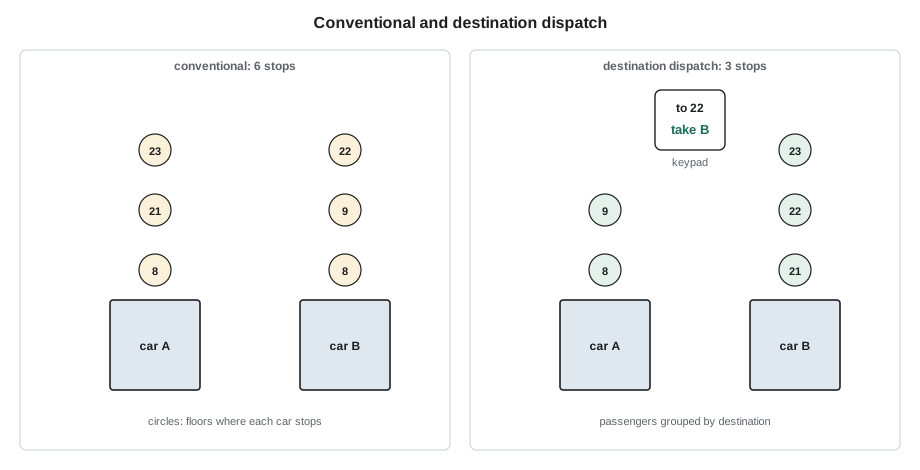
# Stops made by two cars from the lobby: conventional vs grouped by destination
passengers = [8, 22, 9, 23, 8, 21, 22, 9]          # destination floors of eight passengers
# conventional: passengers board the next car to open, alternating
conv = [set(passengers[0::2]), set(passengers[1::2])]
# destination dispatch: sort by floor and split into a low group and a high group
ordered = sorted(passengers)
dd = [set(ordered[:4]), set(ordered[4:])]
for name, cars in (("conventional", conv), ("destination", dd)):
    stops = [len(c) for c in cars]
print(f"{name:<12} car stops {stops}, total {sum(stops)}, highest floor per car {[max(c) for c in cars]}")conventional car stops [3, 4], total 7, highest floor per car [22, 23] destination car stops [2, 3], total 5, highest floor per car [9, 23]
Grouping cuts the stops from seven to five in this example, and the low-rise car goes no higher than floor 9, so it returns to the lobby much sooner. In a heavy up-peak with many passengers, the saving in round trip time is what lets destination dispatch move more people with the same cars.
Accessibility and destination dispatch
A passenger who cannot see the screen, or cannot reach the keypad, or cannot walk quickly to a distant car, must be able to use the system. Accessibility rules apply to destination-oriented elevators with their own requirements. The 2010 ADA Standards for Accessible Design include specific provisions for destination-oriented elevators, covering hall signals, audible and visible car identification, and the means to tell the cars of a bank apart. In practice, keypads have an accessibility button that, when pressed, gives a spoken announcement of the assigned car and its location, and often tells the group to give that passenger more time at the doors or a car with fewer passengers. Each car is identified by a letter shown at the entrance and announced when it arrives. Holloway's new cars, though not destination dispatch, have the same audible and visible signals at every landing.
Priya checks the accessibility functions on every destination dispatch maintenance visit, because a failed speaker or a dead accessibility button disables the system for the people who most need it. On one visit at Quayside, the speaker at the parking level keypad had been disconnected by a contractor painting the lobby, and nobody had noticed.
Measuring a group's performance
Elevator consultants describe a group's performance with a few figures. The round trip time is how long a car takes, in a peak, to leave the lobby, serve its passengers and return. The interval is the average time between cars leaving the lobby, the round trip time divided by the number of cars. The handling capacity is how many people the group can move in five minutes, usually stated as a percentage of the building's population. Office buildings are typically designed for a five-minute handling capacity of around 11 to 15 percent with an interval of 30 seconds or less; residential towers for lower values, around 5 to 8 percent and an interval under a minute. The figures are calculated at design and can be measured afterwards from the group's own logs.
This is the classical estimate of the number of probable stops S a car makes above the lobby when it carries P passengers to N floors served, each floor equally likely. With 16 passengers to 29 floors, a conventional car can expect about 12 stops; destination dispatch reduces that by grouping.
# Round trip time, interval and five-minute handling capacity for an up-peak (classical method)
N, P, L = 29, 12, 4                  # floors above the lobby, passengers per trip, cars
pop = 600                            # people above the lobby
floor_time = 10 / 8.33              # seconds per floor at rated speed
t_stop = 10.0                        # time lost per stop: deceleration, doors, acceleration
t_pass = 1.2                         # seconds per passenger to enter and leave
S = N * (1 - (1 - 1 / N) ** P)                             # probable stops
H = N - sum((i / N) ** P for i in range(1, N))             # highest reversal floor
RTT = 2 * H * floor_time + (S + 1) * t_stop + 2 * P * t_pass
interval = RTT / L
hc5 = 300 * P * L / RTT
print(f"probable stops {S:.1f}, highest reversal floor {H:.1f}")
print(f"round trip {RTT:.0f} s, interval {interval:.0f} s")
print(f"five-minute handling capacity {hc5:.0f} people = {hc5 / pop * 100:.1f} % of the population")probable stops 10.0, highest reversal floor 27.2 round trip 204 s, interval 51 s five-minute handling capacity 71 people = 11.8 % of the population
For Quayside's four cars, the classical estimate gives an interval just under a minute and a five-minute handling capacity of about 12 percent of the residents, above the range a residential tower needs, before any credit for destination grouping. The calculation is a design tool; the group's logs of actual waiting times are the real test, and Priya used them to show the building manager that the average wait in the first month was under 25 seconds, even with the complaints.
Maintaining a group
When one car of a group is out of service, the group must know, so it does not assign calls to it. Every controller reports its state to the group, and a car on inspection, independent service or fire service is removed from the group's assignments. A car whose group link has failed may keep running as a single car on its own hall calls if the hall fixtures are wired for it, or may be shut down, depending on the design. On destination dispatch, the keypads depend on the group: if the group controller fails, the system usually falls back to a simpler mode, often with a backup controller taking over. Priya's maintenance routine at Quayside includes reading the group's log for cars that dropped out of the group, keypads that went offline, and calls that waited unusually long, because these show problems long before tenants complain.
Worked problem
Why did the call wait?
A Quayside resident complains that she waited more than two minutes at floor 19 at 8:10 on a weekday, while two cars passed her floor going down without stopping. The group's log shows the call was assigned to car 3; at that moment car 3 had six stops ahead of it, while cars 1 and 4 passed floor 19 nearly full. What happened?
Show solution
- At 8:10 the building is in its morning down-peak, and cars fill on the upper floors.
- The two cars that passed were nearly full, so the group's load penalty kept them from stopping for a passenger they might not have had room for.
- Car 3 was assigned because it had room, but it had six stops ahead of it, so it took longer to arrive.
- The check is whether the load sensors on cars 1 and 4 read correctly: if they read high, the group bypasses calls with room to spare; if they read correctly, the wait was the group's best choice in a heavy peak, and the long-term answer is a parking and zoning strategy for the morning peak.
Answer: The bypass was the group working as designed; check the load sensors, then review the peak settings.
Common mistakes
MistakeTreating a car that passes a hall call as a fault.
InsteadThe group may bypass a call with a full car and assign it to another; check the log before troubleshooting.
MistakeEntering a destination for a whole group of people with one entry.
InsteadEach passenger, or the number of passengers, should be entered, or the group underestimates the load.
MistakeIgnoring the accessibility functions on destination keypads.
InsteadTest the spoken announcements and accessibility button on every visit.
MistakeLeaving a car out of service without the group knowing.
InsteadPut the car on inspection or independent service so the group removes it from assignments.
MistakeJudging a group by the rated speed of its cars.
InsteadWaiting and journey times depend on dispatching, door times and stops more than on speed.
Summary and key terms
- A group controller estimates each car's time to reach a call, adds penalties, and assigns the call to the lowest-cost car.
- Groups recognize traffic patterns such as up-peak, down-peak and interfloor, and park idle cars where calls are likely.
- Destination dispatch knows every passenger's destination and groups them, so cars make fewer stops.
- Destination systems must provide accessible operation, with spoken car assignment and clear car identification.
- Round trip time, interval and five-minute handling capacity describe a group's performance.
- Group logs show bypassed calls, cars out of the group and long waits before passengers complain.
- Group controller
- The processor that assigns calls to the cars of a group.
- Estimated time of arrival (ETA)
- The group's estimate of how long a car would take to reach a call.
- Destination dispatch
- A system in which passengers enter their destination before boarding and are assigned a car.
- Up-peak
- A traffic pattern in which most passengers enter at the lobby and travel up.
- Round trip time
- The time for a car to leave the lobby in a peak, serve its passengers and return.
- Interval
- The average time between cars leaving the lobby in a peak.
- Handling capacity
- The number of people a group can move in five minutes, often stated as a percentage of the population.
Practice problems
Work each problem on paper first, then reveal the answer to check.
Why might a group send a call to a car that is farther away?
Show answer
Because the nearer car is nearly full or has many stops; the group chooses the lowest total cost.
Why does destination dispatch reduce stops?
Show answer
Passengers going to the same or nearby floors are grouped into the same car.
With a round trip time of 120 s and four cars, what is the interval?
Show answer
30 s.
What must a destination keypad provide for a passenger who cannot see the screen?
Show answer
An accessibility button and a spoken announcement of the assigned car and its location.
Name two things to look for in a group's log on a maintenance visit.
Show answer
Any two of: cars dropping out of the group, keypads offline, calls with long waits, bypassed calls.
Lesson quiz · 5 questions
Score 60% or more to complete this lesson.
Create a free account to save your progress, take quizzes and earn a certificate.