
ELV-310 · Lesson 6 of 12 · 22 min
Safety PLCs and programmable electronic safety systems
For most of the history of elevators, the rule was simple: safety functions were done with switches and relays, and software was never trusted with them. A processor could decide which floor to go to, but whether the car was allowed to move at all was decided by contacts in series. That rule has changed. On Quayside car 2, the door zone, the leveling with doors open, the monitoring of the brake and parts of the inspection operation are supervised by a safety board that is itself a computer, with two processors checking each other. Priya spent a week of Tamsin's term on this board, because it changes how a mechanic must think about testing and repair. "On Tillicum, a safety function is a contact you can see," she said. "On Quayside, it is a function that someone proved, on paper and in a test lab, could be trusted to a software system. Our job is not to undo that proof."
Why software in safety functions
There are good reasons to let electronics do safety work. A relay contact can weld, and a mechanical switch can stick or be jumpered; an electronic system can test itself many times a second and detect faults that a relay circuit would never notice. Some functions, such as detecting unintended movement of a car away from a floor with its doors open, or supervising a car's speed near the terminal landings so that shorter buffers can be used, are far easier to do well with a processor that knows the car's position and speed than with switches. And as car tops, pits and machine spaces have filled with sensors, a safety system that reads them over a monitored serial link can replace dozens of conductors in the traveling cable.
The risk is that software can fail in ways that are hard to predict or test. A program can have a mistake that appears only in one unusual combination of conditions; a processor can fail partly rather than completely; electrical noise can corrupt a value. The answer the safety field has developed, in industry generally and in elevators specifically, is not to trust software less but to prove it more: to design, build, test and document safety-related electronic systems to a recognized standard, and to certify the result.
The standards
The general standard for safety-related electronic systems is IEC 61508, which defines four safety integrity levels, SIL 1 to SIL 4, each a band of how rarely the system may fail dangerously. Higher levels need more redundancy, more self-testing, more careful software development and more independent assessment. For lifts, ISO 22201-1, built on IEC 61508, sets out how programmable electronic systems in safety-related applications for lifts, known by the acronym PESSRAL, are designed and developed, and the European lift standards use the same approach.
ASME A17.1 and CSA B44 allow electrical protective devices and other safety functions to be performed by programmable electronic systems, provided the system is certified to the safety integrity level that the code requires for that function, and the code includes a table listing the required level for each function. Functions such as door bypass during leveling, car speed monitoring, unintended movement detection and the electronic replacement of a switch in the safety circuit each have a required level. The certification is done by an independent body against the standard, and the system must carry identification that ties it to the certificate. The maker's instructions then become part of what keeps the system safe: how it must be installed, which parts can be replaced, which settings a mechanic may change, and which tests must be done after any change.
| Function | Done by relays and switches on Tillicum car 1 | Done by the safety board on Quayside car 2 |
|---|---|---|
| Safety circuit monitoring | series contacts to the safety relay | series contacts read at several points by two processors |
| Door bypass for leveling | leveling relays and door zone switches | two independent door zone sensors cross-checked by the board |
| Unintended movement with doors open | not provided (pre-dates the rule) | detected by the board from position and door state; triggers the brake |
| Terminal speed supervision | terminal slowdown switches | speed and position from two channels compared with limits near the terminals |
| Brake monitoring | not provided | brake switches and current checked on every run |
| Inspection station agreement | wiring of the station switches | inputs read and compared by the board |
How a certified safety board works
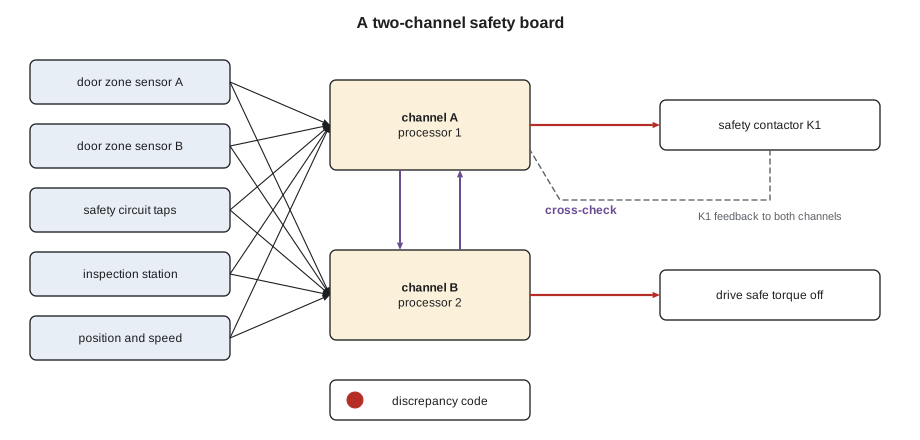
A typical safety board has two processing channels, often two processors of different types running different programs written from the same specification. Each channel reads its own copy of the safety inputs, such as the door zone sensors, the safety circuit at several points, the inspection station and the position and speed from separate sensors. Each decides independently whether the car may move, and each can open its own safety output. The outputs drive two contactors or a contactor and the drive's safe torque off input, so that either channel can stop the car. The channels compare their inputs and their decisions continuously. If they disagree beyond a short time, the board stops the car and records a discrepancy fault.
The board also tests itself. It switches its outputs briefly to check they can open, a test called a pulse test, so fast that the contactors do not react; it checks that inputs which should change during a run actually change, so a sensor stuck on, or a jumper across a door circuit, is detected; and it checks its own memory and timing. Most boards show their state with a small set of lamps and a code on the controller's display, and they keep their own fault record.
# Two-channel cross-check of the door zone sensors
tolerance_ms = 40      # how long the two channels may disagree before a fault
samples = [  # time in ms, channel A sees door zone, channel B sees door zone
    (0, False, False), (10, True, False), (20, True, True), (30, True, True),
    (200, True, True), (210, False, True), (220, False, True), (230, False, True),
    (240, False, True), (260, False, True), (270, False, False)]
start = None
for t, a, b in samples:
    if a != b:
        start = t if start is None else start
        if t - start > tolerance_ms:
            print(f"{t:4d} ms: channels disagree for {t - start} ms -> discrepancy fault, car stopped")
            break
    else:
        if start is not None:
            print(f"{t:4d} ms: channels agree again after {t - start} ms (within tolerance)")
        start = None
else:
print("no discrepancy fault")20 ms: channels agree again after 10 ms (within tolerance) 260 ms: channels disagree for 50 ms -> discrepancy fault, car stopped
On entry to the zone the sensors disagree for 10 ms, which is normal: no two sensors switch at exactly the same instant. On leaving, sensor B stays on for more than 40 ms after A has gone off, which is not normal, and the board stops the car. On a real car, the cause could be a misaligned sensor, a damaged magnet or a dirty tape, and the fault record shows which channel lagged. This is the same kind of fault Tamsin will chase in the capstone.
What a mechanic may and may not do
A certified system is safe only as long as it stays the way it was certified. That puts firm limits on what a mechanic does with it. Priya's list for Quayside, drawn from the maker's instructions, is typical.
- Never jumper, bypass or force a safety board input or output. If a function must be bypassed to move the car, use the bypass the maker provides, such as the door bypass switches, under the conditions they allow.
- Replace safety boards and safety sensors only with the parts the maker lists, and only by the procedure the maker gives. Do not swap a safety sensor for an ordinary sensor of the same shape.
- Change only the settings the maker allows a mechanic to change. Safety-related parameters are usually locked with a separate password, and many cannot be changed in the field at all.
- After any change to the safety system, including replacing a sensor or moving a magnet on the landing system, do the tests the maker specifies before returning the car to service, and record them.
- Keep the identification on the board readable, and record the board's part number, revision and software version in the car's record.
Tamsin asked what happens if the maker goes out of business. Priya said it was a fair question and part of why owners now ask for documentation and spare parts commitments when they buy a controller; the safety board cannot be repaired at the component level by a contractor, and an obsolete one means a controller replacement.
Testing safety functions
Periodic tests in the code's maintenance part apply to electronic safety functions as they do to switches: the function must be shown to work, not just assumed. On a relay car, testing a buffer switch means opening it and seeing the car stop. On Quayside, testing unintended movement detection means following the maker's procedure, which typically uses the service tool to command a small movement with the doors open and confirms that the board detects it, sets the brake and stops the car within the allowed distance. Testing a door zone sensor means confirming each channel sees the zone at each floor and that a single failed sensor is detected. These tests are often built into the service tool as guided routines that record their results.
# Unintended movement test record: was the car stopped within the limit?
limit = 48            # allowed movement from the floor with the doors open
results = [("floor 1, empty car, up", 7), ("floor 1, empty car, down", 8),
           ("floor 30, test weights, down", 13), ("floor 30, test weights, up", 6)]
for name, moved in results:
    verdict = "pass" if moved <= limit else "FAIL, investigate brake and detection"
print(f"{name:<30} stopped after {moved:5.0f} in -> {verdict}")floor 1, empty car, up stopped after 7 in -> pass floor 1, empty car, down stopped after 8 in -> pass floor 30, test weights, down stopped after 13 in -> pass floor 30, test weights, up stopped after 6 in -> pass
The figure used here for the limit follows the code's rule for stopping a car that moves away from a floor with its doors open; the maker's procedure states the limit and the test conditions for each car. The car is stopped well within the limit in every case, and the heavier test in the down direction moves farthest, as expected.
Safety boards on modernized cars
When an older car like Tillicum car 1 is modernized, the new controller usually brings a certified safety board with it, and the car gains functions it never had: brake monitoring, unintended movement protection and electronic supervision of the door zone. Those functions need new sensors on the car and in the hoistway, and sometimes a second brake or an emergency brake on the rope. A modernization plan must include them, and ELV-430 returns to this in detail. For now, Priya wanted Tamsin to understand one thing: a modernized car is a different kind of system, and the habits that work on relay cars, such as a quick jumper to move a car, do not just break the rules on a safety board car; the board will often detect them and lock the car out.
Worked problem
A discrepancy fault after cleaning the tape
After the building's hoistway cleaning contractor wipes down the landing system tape at Quayside, car 2 stops twice in a day with a door zone discrepancy fault, both times leaving floor 22. The log shows channel B leaving the door zone 70 ms after channel A both times. What should Priya and Tamsin check, and what must they do before returning the car to service?
Show solution
- The fault is specific to one floor and one channel, so look first at the tape, magnet or marker for floor 22 and at sensor B's alignment.
- Check whether the cleaning moved or damaged anything at floor 22; on many systems, the door zone markers are magnets or coded marks on the tape.
- Correct the cause using only the maker's parts and procedure; do not adjust the board's tolerance, which is a locked safety setting.
- Run the maker's door zone test for the affected floor, check both channels at every floor in a learn or verification run, record the tests and the cause in the log, and tell the building about the cleaning contractor's effect.
Answer: The cause is in the field, at the floor 22 marker or sensor B; the fix is a field repair followed by the maker's tests, not a change to the safety board.
Common mistakes
MistakeJumpering a safety board input to move a car.
InsteadUse only the maker's bypass provisions; the board may detect a jumper and will lock the car out.
MistakeReplacing a safety sensor with an ordinary sensor that fits.
InsteadUse only the listed part; a non-certified sensor breaks the certification.
MistakeIncreasing a discrepancy tolerance to stop nuisance faults.
InsteadSafety settings are locked for a reason; find the field cause of the discrepancy.
MistakeAssuming an electronic safety function needs no periodic test.
InsteadTest it by the maker's procedure and record the result, as for any safety device.
MistakeThinking two channels running the same program would catch a software mistake.
InsteadDiverse processors and programs, built from the same specification, are used so one mistake does not affect both.
Summary and key terms
- Codes now allow certified programmable electronic systems to perform safety functions, at the safety integrity level the code table requires for each function.
- IEC 61508 defines SIL levels; ISO 22201-1 applies the method to lifts (PESSRAL).
- Safety boards use two cross-checking channels, test their own outputs and inputs, and stop the car on a discrepancy.
- Mechanics must not bypass, modify or substitute parts of a certified system, and must follow the maker's replacement and test procedures.
- Electronic safety functions are tested periodically by the maker's procedures, often guided by the service tool.
- Modernized cars gain functions such as brake monitoring and unintended movement protection through their safety boards.
- SIL
- Safety integrity level: a band, from 1 to 4, of how rarely a safety function may fail dangerously.
- IEC 61508
- The general international standard for safety-related electrical, electronic and programmable electronic systems.
- PESSRAL
- Programmable electronic systems in safety-related applications for lifts, covered by ISO 22201-1.
- Discrepancy fault
- A fault recorded when the two channels of a safety system disagree for longer than allowed.
- Pulse test
- A brief switching of a safety output, too short to affect the load, to prove it can still switch.
- Safe torque off
- A drive input that removes the drive's ability to produce motor torque, used as one of two safety outputs.
- Unintended movement
- Movement of a car away from a landing with its doors open, which newer codes require to be detected and stopped.
Practice problems
Work each problem on paper first, then reveal the answer to check.
Why do safety boards use two channels?
Show answer
So a failure in one channel is detected by the other, and either can stop the car.
Name two safety functions that a certified safety board can perform.
Show answer
Any two of: door bypass during leveling, unintended movement detection, terminal speed supervision, brake monitoring, safety circuit monitoring, inspection station supervision.
A discrepancy fault occurs at only one floor. Where do you look first?
Show answer
At that floor's landing system marker or magnet and the alignment of the sensor that lagged.
What standard applies the IEC 61508 method to lift safety electronics?
Show answer
ISO 22201-1 (PESSRAL).
Can a mechanic replace a failed safety sensor with any sensor of the same size?
Show answer
No; only the part the maker lists, by the maker's procedure, followed by the required tests.
Lesson quiz · 5 questions
Score 60% or more to complete this lesson.
Create a free account to save your progress, take quizzes and earn a certificate.