
ELV-110 · Lesson 8 of 12 · 18 min
Top of car and pit work
Two procedures are used more often than any others in the elevator trade: getting onto and off the car top, and getting into and out of the pit. Every maintenance visit, most repairs and much of installation and modernization depend on them. They are also where many of the trade's accidents happen, almost always because a step was skipped. Ray taught them to Tamsin at the Tillicum Building on Route 7 on a quiet Saturday, running each procedure five times with her before letting her lead it with him watching. This lesson sets out the procedures as Northcrest writes them. They follow the practices in the elevator industry's field safety handbook, and the details for each unit are in its written procedure.
Principles before steps
Both procedures rest on four principles. First, the mechanic controls the car: before anyone is on the car top or in the pit, the car has been taken out of normal service so that no passenger, hall call or group dispatcher can move it. Second, every protective device the mechanic will rely on is tested before it is relied on: the stop switch, the inspection switch and the direction buttons, and the door interlock that keeps the car from running with the door open. Third, the mechanic is never at an open edge without fall protection or a guard. Fourth, only one person controls the car at a time, and everyone else in the hoistway knows when it is about to move.
Tamsin's first reaction to the full procedure was that it took a long time for a short ride. Ray agreed. On a familiar car it takes three or four minutes, and he has done it thousands of times. He has also been to the funerals of two mechanics who skipped part of it.
Taking the car out of service
The car is first removed from public use. In a group, it is taken out of the group so that the dispatcher does not assign calls to it. Northcrest places out-of-service signs and barricades at the landings that will be used, and tells the building contact. On units that have them, the mechanic uses independent service or the car's inspection or access features to hold the car under the mechanic's control. The point is that, from now on, the car moves only when a Northcrest mechanic moves it.
Top of car entry
The top of car entry procedure is done at the landing above the car. Northcrest's written steps, used on every traction and hydraulic elevator unless the unit's own procedure says otherwise, are as follows.
- 1. Take the car out of service and place barricades at the access landing. Tie off to the landing anchor if the procedure calls for it.
- 2. Position the car with its top a little below the access landing sill, either by running it there from inside the car and leaving the car, or, where the unit has them, by using the hoistway access switch at the landing, a key switch that lets the car be moved at low speed with the landing door partly open.
- 3. Open the hoistway door with the unlocking device, an inch or two only, and hold it. Look to confirm the car top is where expected.
- 4. Test the door interlock: with the door held open, have the car called or press a hall button. The car must not move. If it moves, close the door and stop: the unit is unsafe.
- 5. Open the door fully and, without stepping onto the car top, reach in and operate the car top stop switch to stop. Switch on the car top light.
- 6. Reach in and set the car top inspection switch to inspection. Test it: with the stop switch released to run, press up or down. The car should move only on the car top inspection controls, and only while a button is held. Return the stop switch to stop.
- 7. Step onto the car top into the refuge area, maintaining three points of contact, and connect to the car top anchor if there is no full guardrail. Close the hoistway door behind you and confirm it locks.
- 8. Before moving the car, test the stop switch again from the car top and check the hoistway above and below for hazards, such as other workers, beams, adjacent cars and counterweights.
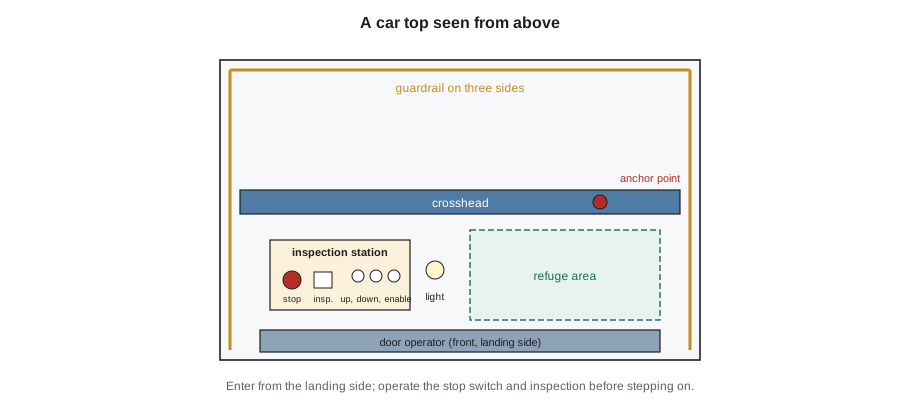
Steps 4 and 6 are the ones Ray watches hardest. Testing the interlock proves that the door circuit is working and has not been jumpered. Testing inspection proves that the car top controls, and not the car's automatic operation, are in charge. If either test fails, nobody goes on the car top until the fault is found and corrected, because the protection the procedure relies on is not there.
Riding the car top
On the car top, the mechanic runs the car on inspection, which limits its speed and requires a button to be held for motion. Many modern inspection stations need two buttons pressed at once, a direction button and a common or enable button, so that a single slip of the hand cannot move the car. The code limits inspection speed, and the editions Northcrest works to cap it at about 150 ft/min; many units are set much slower. Even so, at inspection speed the car moves faster than most people expect.
# How far the car travels after the mechanic lets go of the button on inspection
v = 2.5               # inspection speed, ft/s
react = 0.75          # human reaction time to release a button, s
decel = 5           # deceleration once the brake sets, ft/s^2
d_react = v * react
d_stop = v**2 / (2 * decel)
print(f"travel while reacting: {d_react:.2f} ft")
print(f"travel while stopping: {d_stop:.2f} ft")
print(f"total: {d_react + d_stop:.2f} ft")
for vv in [0.8, 1.7]:
print(f" at {vv} ft/s the total is {vv * react + vv**2 / (2 * decel):.2f} ft")travel while reacting: 1.88 ft travel while stopping: 0.62 ft total: 2.50 ft at 0.8 ft/s the total is 0.66 ft at 1.7 ft/s the total is 1.56 ft
Ray uses the output to explain two habits. First, he never runs the car toward an obstruction, a beam or a landing he wants to stop at without slowing down well before it, because he knows the car will travel most of three feet after he decides to stop. Second, he keeps his body inside the guardrail or the marked area of the car top while the car moves, because a head or arm out past the edge passes beams, sills and brackets with little clearance. He also stops the car before reaching across to do any work, and opens the stop switch whenever he is working rather than riding.
The counterweight passes the car at the middle of the travel. In a single hoistway, the mechanic on the car top watches for it and stays clear of the side it runs on. In a multiple hoistway, the adjacent cars and their counterweights pass close by, and many companies require adjacent cars to be taken out of service or run under control while a mechanic is on a car top beside them. At Quayside, where four cars share one hoistway, the procedure is to take the adjacent car out of service whenever the work brings the mechanic near the divider beam.
Top of car exit
Leaving the car top reverses the entry procedure. The mechanic stops the car with its top at a safe step-off height at the exit landing, opens the stop switch, opens the hoistway door from inside with the release on the door's hoistway side, steps off to the landing while tied off or within a guardrail, and then, from the landing, returns the inspection switch to normal, returns the stop switch to run and switches off the light, in that order. The door is closed and checked for locking. Only then is the car returned to service, after a run on normal operation to confirm it answers calls and levels properly.
A common mistake is to return the car to normal operation from the car top before stepping off. If the car then answers a call while the mechanic is still on it, the mechanic is riding a car top on automatic operation at full speed. Northcrest's procedure keeps the stop switch open until the mechanic is off the car top and on the landing.
Pit entry
The pit entry procedure is done at the lowest landing. The steps are similar in principle.
- 1. Take the car out of service and place barricades at the lowest landing.
- 2. Run the car up to a landing that leaves enough room in the pit, usually two or more floors above the bottom landing, and leave it there.
- 3. Open the lowest landing hoistway door with the unlocking device, an inch or two, and look into the pit.
- 4. Test that the car will not move with the door open, by calling it or pressing a hall button.
- 5. Open the door and, without entering the pit, reach in to the pit stop switch near the access and set it to stop. Switch on the pit light.
- 6. Test the pit stop switch: with the door closed or held as the procedure allows, have the car called, or check that it cannot be run. It must not move.
- 7. Climb down the pit ladder with three points of contact. Check the pit for water, oil, debris and air quality before working.
- 8. Know where the refuge space is and keep it clear. If the car will be moved while you are in the pit, agree the plan with the person moving it and stay in the refuge space during movement.
Leaving the pit reverses the steps: climb out, keep the stop switch on stop until you are out of the pit and at the landing, then return it to run, switch off the light, close the door and check it locks. On some installations the pit stop switch must be reached from the pit side, and the procedure then specifies a second stop switch at the access or a different sequence; the written procedure for the unit always governs.
| Step | Top of car | Pit |
|---|---|---|
| Out of service | Car taken out of group; barricades | Car taken out of group; barricades |
| Position the car | Car top slightly below the access landing | Car well above the lowest landing |
| Door open, look, test | Crack, look, test interlock | Crack, look, test interlock |
| Stop switch | Car top stop switch to stop, from the landing | Pit stop switch to stop, from the landing |
| Test the controls | Inspection switch and direction buttons | Car cannot run with the pit stop switch open |
| Enter | Step onto the car top; tie off; close door | Climb down with three points of contact |
| Exit | Step off first, then normal operation | Climb out first, then stop switch to run |
Hydraulic units, two-person work and communication
On a hydraulic elevator, the pit contains the cylinder head and the car may drift down if a valve leaks, so Northcrest's procedure for pit work on hydraulics adds a step: the car is supported on blocking or a pipe stand sized for the load, or run to the top and its descent prevented by the procedure in Lesson 6, before anyone works under it. On the car top of a hydraulic, the overhead clearance is usually generous, but the plunger's position and any roped sheave on roped units must be noted.
Much hoistway work is done by two people, one on the car top and one in the pit or at the controller. They agree a set of short, clear calls, and every move is called before it starts and acknowledged before the car moves: "Going down" from the car top, "Clear" from the pit, then the move. If there is no acknowledgment, there is no move. Radios are used in tall hoistways and noisy buildings. Tamsin learned the calls on the first day, and Ray made her use them even when she could see him.
Northcrest's first-year rule means Tamsin is never on a car top or in a pit alone. Ray explained that the rule is not about her skill. Alone in a pit, a worker who is struck, falls or loses consciousness may not be found for hours, and a second person can stop the car, call for help and begin the rescue.
Common mistakes
MistakeStepping onto a car top before testing the interlock and inspection.
InsteadTest both from the landing; if either fails, nobody enters.
MistakeReturning the car to normal operation before stepping off.
InsteadStep off first, then return inspection to normal and the stop switch to run.
MistakeLeaning past the car top guardrail while the car moves.
InsteadKeep the whole body inside the protected area during movement.
MistakeMoving the car without a call and an acknowledgment.
InsteadCall every move, wait for "clear", then move.
MistakeWorking under a hydraulic car supported only by oil pressure.
InsteadSupport it on blocking or a pipe stand sized for the load.
Summary and key terms
- Both procedures take the car out of service, test every protective device before it is relied on, protect against falls and keep one person in control.
- Top of car entry: position the car, crack and look, test the interlock, stop switch, inspection test, step on, tie off, close the door.
- Inspection operation limits speed and needs a held button, but the car still travels some distance after release.
- Top of car exit: step off first, then inspection to normal and stop switch to run.
- Pit entry: car well above, crack and look, test, stop switch, test, climb down, know the refuge space.
- Two-person work uses clear calls and acknowledgments; first-year workers never work alone.
- Inspection operation
- Low-speed operation controlled by constant-pressure buttons at the car top or controller.
- Stop switch
- A switch in the safety circuit that stops the car and prevents it from running.
- Hoistway access switch
- A key switch at a terminal landing that lets the car be moved at low speed with the door partly open.
- Three points of contact
- Two hands and a foot, or two feet and a hand, on a ladder or step at all times.
- Pipe stand
- A steel support placed under a car to hold it during work.
- Acknowledgment
- The reply that confirms a call before the car is moved.
Practice problems
Work each problem on paper first, then reveal the answer to check.
What must happen when the interlock test fails at step 4?
Show answer
Close the door and stop; the unit is unsafe until the fault is found and corrected.
A car runs at 100 ft/min on inspection. How far does it move during a 0.75 s reaction time?
Show answer
About 1.25 ft.
Name the last three things done after stepping off the car top.
Show answer
Inspection switch to normal, stop switch to run, light off; then close and check the door.
Why is the car run well above the lowest landing before pit entry?
Show answer
To leave room in the pit and keep the car clear of the person entering.
Lesson quiz · 5 questions
Score 60% or more to complete this lesson.
Create a free account to save your progress, take quizzes and earn a certificate.