
ELV-110 · Lesson 10 of 12 · 18 min
Electrical safety for elevator work
Every elevating device runs on electricity, and every mechanic works on live or recently live equipment almost every day. Controllers, drives, door operators, fixtures and the wiring that links them carry voltages from a few volts to 480 volts and more, and drives store energy that can kill after the power is off. Electrical injuries in the trade include shock, arc flash burns and falls caused by a shock that throws a worker off balance on a car top. This lesson covers how electricity hurts people, the standards that govern electrical safety, and the habits Tamsin practiced in her first month: identifying every supply, testing before touching, respecting approach boundaries and dealing with stored charge.
How electricity injures
Electric shock happens when current passes through the body. The harm depends on the current, its path and how long it flows. A few milliamperes through the hand is felt as a tingle; around ten milliamperes the muscles of the hand can clamp onto a conductor so the person cannot let go; current across the chest of the order of a hundred milliamperes can make the heart fibrillate, which kills within minutes without defibrillation. Current depends on voltage and on the body's resistance, which drops sharply with wet skin, sweat, cuts or a firm grip on a metal tool. That is why a wet pit is more dangerous than a dry machine room, and why even the 120 V outlet on a car top can be fatal.
| Current through the body (approximate) | Typical effect |
|---|---|
| About 1 mA | Threshold of feeling |
| About 5 to 10 mA | Painful shock; loss of muscle control begins |
| About 10 to 30 mA | Cannot let go; breathing affected |
| About 50 to 100 mA and above | Ventricular fibrillation possible |
| Several amperes | Heart stops; deep burns |
An arc flash is an electrical explosion: a short circuit through the air, usually caused by a dropped tool, a failed component or a test probe slipping between phases. It produces a fireball hotter than the surface of the sun for a fraction of a second, a pressure wave, molten metal and intense light and sound. Arc flash burns can be fatal at a distance where shock is impossible. Arc flash is most likely when a cover is removed, a meter is connected or a breaker is operated, which are exactly the moments a mechanic is closest.
Secondary injuries are common in the trade. A mild shock that makes a mechanic jerk back on a car top can cause a fall into the hoistway or a hand into a moving part. A mechanic who touches an unexpected live terminal while leaning into a controller can strike the controller frame and injure their head or hand. Electrical safety protects against these as much as against the shock itself.
The standards
In Washington, worker electrical safety is covered by DOSH's electrical safety rules, which follow the same pattern as federal OSHA's: equipment is de-energized and locked out before work unless the work must be done live under safe work practices. NFPA 70E, Standard for Electrical Safety in the Workplace, sets out how to assess shock and arc flash risk, establish approach boundaries and choose PPE, and it is the reference Northcrest's electrical safety program is built on. The National Electrical Code (NFPA 70), as adopted by Washington, governs the installation of electrical equipment, and its article on elevators, Article 620, covers the wiring of elevating devices, disconnecting means and related requirements.
Elevator mechanics do the electrical work within their trade: wiring controllers, hoistway and car equipment, fixtures and the connections from the mainline disconnect onward. The building supply up to the disconnect is usually an electrician's work. On a construction job, the boundary between the two is set out in the contract and in the permits, and Tamsin learned early to ask before touching anything on the supply side.
Know every supply
Elevating devices have more than one supply, and most electrical accidents in the trade involve one the mechanic did not know was live. The code requires a separate disconnect for the car lighting, ventilation and alarm circuits so that passengers are not left in the dark when the main power is opened, and many installations add supplies for hoistway lighting, pit outlets, machine room lights, emergency or standby power, battery-powered rescue devices and fire alarm interfaces. Group controllers may carry signals from other cars' supplies. Ray's first move at any controller is to read the wiring diagram and the labels on the disconnects and to walk the supplies.
| Supply | Feeds | Where it is isolated |
|---|---|---|
| Mainline disconnect | Machine, drive, controller power | Machine room or controller location, lockable |
| Car lighting and fan disconnect | Car lights, fan, alarm, car top outlet and light | Usually beside the mainline disconnect |
| Hoistway and pit lighting | Hoistway lights, pit light and outlets | Panel or switch at the machine room or pit |
| Emergency or standby power | Selected cars during a power failure | Transfer switch, coordinated with the building |
| Battery rescue or lowering unit | Moves the car to a landing during an outage | Battery disconnect in the controller |
| Fire alarm and building signals | Recall and other signals into the controller | Low voltage but can come from another source |
Testing before touching
Nothing is assumed dead until it has been tested. The test for absence of voltage is done with a voltage tester or meter rated for the location, often called the live-dead-live test: check the tester on a known live source, test the conductors at the point of work (each phase to each other phase and to ground), then check the tester again on the known source. If the tester fails at the end, the dead reading means nothing. Meters used on elevator controllers must be rated for the voltage and the measurement category of the circuit; a meter rated for household circuits can fail violently on a 480 V controller. Test leads must be in good condition, with shrouded tips.
Tamsin was surprised by how often Ray tested. He tested after opening the disconnect, again before reaching into a different section of the controller, and again after any break. His reason: a disconnect can fail with a contact welded shut, a neighboring car can backfeed through a shared circuit, and someone else can close a switch while you are at lunch. Locks prevent the last; testing catches the first two.
Approach boundaries and PPE
Where work has to be done near exposed live parts, for example while testing or troubleshooting an energized controller, NFPA 70E and its Canadian counterpart, CSA Z462, set approach boundaries. The limited approach boundary is the distance inside which an unqualified person must not go unless escorted by a qualified person. The restricted approach boundary is the distance inside which only qualified persons using shock protection techniques and PPE may go. The arc flash boundary is the distance at which a person without arc-rated protection could receive a second-degree burn if an arc flash occurred; it depends on the equipment and the fault current, and is found from an arc flash assessment or the tables in the standard.
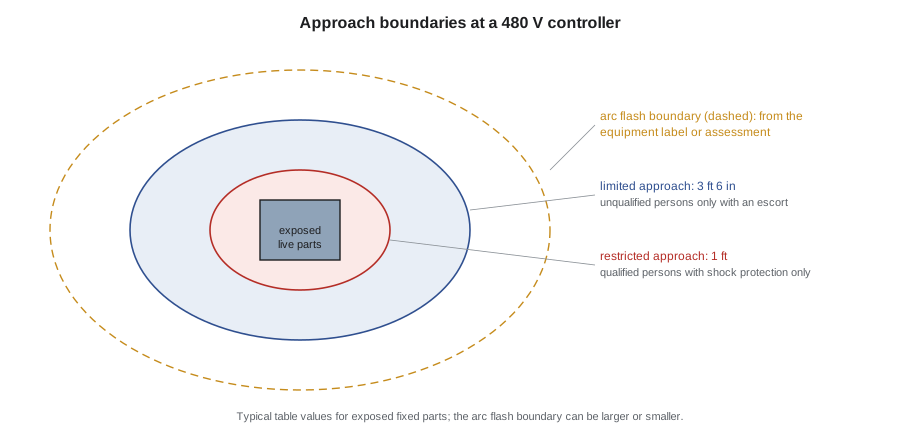
Arc flash PPE is chosen by incident energy, measured in calories per square centimeter, or by the PPE category method in the standard. The categories run from 1 to 4, each with a minimum arc rating for the clothing. Equipment that has had an arc flash assessment carries a label with the incident energy or category and the boundaries. The lookup below is illustrative: it shows how the categories map to clothing ratings, but the real values for a piece of equipment come from its label and the company's assessment.
# Illustrative arc flash PPE lookup by incident energy (cal/cm^2).
# Real values come from the equipment label and the company's arc flash assessment.
categories = [   # (category, minimum arc rating of clothing in cal/cm^2)
    (1, 4), (2, 8), (3, 25), (4, 40),
]

def ppe_for(incident_energy):
    if incident_energy < 1.2:
        return "below the second-degree burn threshold; normal PPE plus arc-rated face protection as policy requires"
    for cat, rating in categories:
        if incident_energy <= rating:
            return f"PPE category {cat}: clothing rated at least {rating} cal/cm^2"
    return "above 40 cal/cm^2: do not work energized; de-energize the equipment"

for e in (0.8, 3.2, 6.5, 12, 30, 55):
print(f"{e:5.1f} cal/cm^2 -> {ppe_for(e)}")0.8 cal/cm^2 -> below the second-degree burn threshold; normal PPE plus arc-rated face protection as policy requires 3.2 cal/cm^2 -> PPE category 1: clothing rated at least 4 cal/cm^2 6.5 cal/cm^2 -> PPE category 2: clothing rated at least 8 cal/cm^2 12.0 cal/cm^2 -> PPE category 3: clothing rated at least 25 cal/cm^2 30.0 cal/cm^2 -> PPE category 4: clothing rated at least 40 cal/cm^2 55.0 cal/cm^2 -> above 40 cal/cm^2: do not work energized; de-energize the equipment
On Route 7, the Tillicum Building's controllers have no arc flash labels, because they were installed decades before the practice existed. Northcrest's rule for unlabeled equipment is to treat it according to the category tables in the standard for that equipment type, to keep energized work to testing and diagnosis only, and to schedule an assessment when the controllers are modernized.
Shock protection for energized work includes insulating gloves with leather protectors, rated for the voltage and tested at the interval the standard requires, insulated tools, and insulating mats or blankets where needed. Arc protection includes arc-rated shirt and pants or coveralls, an arc-rated face shield or hood, hearing protection and safety glasses. Northcrest supplies arc-rated work clothing to all field staff as the daily uniform, which means a mechanic is already dressed for a category 1 or 2 task.
Drives, capacitors and batteries
Variable frequency drives convert the supply to a direct current bus and then back to a variable-frequency output for the motor. The DC bus is held up by large capacitors, and on a 480 V supply the bus voltage is roughly 1.35 to 1.4 times the line voltage, about 650 to 680 V DC. After the drive is disconnected, the capacitors discharge through internal resistors over several minutes, and the drive's label states the waiting time. A mechanic waits at least that long, then measures the DC bus voltage at the terminals the manufacturer specifies before touching anything inside the drive. Charge indicator lamps on drives are not a substitute for measurement, because a failed lamp looks the same as a discharged bus.
Battery rescue units and uninterruptible power supplies keep parts of a controller live during a power failure, by design. They are isolated by their own disconnects and checked by testing. Regenerative drives, which feed energy back to the building when the car is overhauling the motor, can also backfeed a supply in some fault conditions, which is one more reason to test at the point of work.
Wet locations, cords and temporary power
Pits and some machine spaces are wet, and water lowers the body's resistance and conducts current to ground. Pit outlets must have ground fault protection, and pit lights must be guarded. Northcrest uses battery tools and lights in pits wherever possible, and where corded tools are needed, it plugs them into a ground fault circuit interrupter and inspects the cord before use. On construction sites, all temporary power to elevator crews passes through ground fault protection, and cords are kept off the hoistway floor and away from the traveling cable's path.
Extension cords used in hoistways are damaged easily: crushed by the car, cut on sill edges, soaked in pit water. The daily cord check takes a minute: no cut or damaged jacket, no exposed conductors, a ground pin present, strain relief intact. A damaged cord is cut up and thrown away, not taped.
Jumpers
Jumpers are short wires used to bridge contacts in a controller during troubleshooting. They are sometimes necessary, and they are among the most dangerous things in the trade, because a jumper across the door circuit or the safety circuit allows the car to run with a door open or a stop switch open. Deaths have resulted from jumpers left in controllers after work, and from cars moving because a jumper defeated the stop switch a mechanic was relying on. Northcrest's rules are that jumpers are used only by qualified mechanics, only on inspection with the car under their control, only for the moment the test needs, never across a door or stop switch protecting a person in the hoistway, and always recorded on a jumper log and counted out of the controller before the unit is returned to service. Every jumper is a bright color and long enough to be seen. Tamsin is not allowed to place one in her first year.
Common mistakes
MistakeOpening the mainline disconnect and assuming the car top outlet is dead.
InsteadThe car light and fan supply is usually separate; isolate and test it too.
MistakeTesting without checking the tester on a known live source.
InsteadUse live-dead-live testing every time.
MistakeTrusting a drive's charge lamp.
InsteadWait the labeled discharge time and measure the DC bus.
MistakeUsing a damaged extension cord in a wet pit.
InsteadUse battery tools or a cord in good condition on ground fault protection.
MistakeLeaving a jumper in a controller.
InsteadLog and count every jumper out before returning the unit to service.
Summary and key terms
- Shock harm depends on current, path and time; wet conditions make low voltages dangerous.
- Arc flash causes severe burns at distances where shock is impossible, and is most likely during covers off, metering and switching.
- DOSH's electrical rules, NFPA 70E and the National Electrical Code govern electrical safety in Washington.
- Elevating devices have several supplies, including a separate car light and fan supply; identify and isolate each one.
- Test before touching with a correctly rated tester, using live-dead-live testing.
- Drives hold dangerous DC voltage after shutdown; wait and measure; control jumpers strictly.
- Arc flash
- An electrical explosion caused by a short circuit through the air.
- Limited approach boundary
- The distance inside which unqualified persons need a qualified escort.
- Restricted approach boundary
- The distance inside which only qualified persons with shock protection may go.
- Arc flash boundary
- The distance at which an unprotected person could receive a second-degree burn from an arc flash.
- Live-dead-live test
- Checking a tester on a live source before and after testing for absence of voltage.
- DC bus
- The direct current link inside a drive, held up by capacitors.
Practice problems
Work each problem on paper first, then reveal the answer to check.
What is the approximate DC bus voltage of a drive on a 480 V supply?
Show answer
About 650 to 680 V DC.
Name three supplies besides the mainline that may be live on an elevator.
Show answer
Car light and fan, hoistway and pit lighting, emergency power, battery rescue units, fire alarm signals.
An arc flash label gives 6.5 cal/cm². Which PPE category clothing rating meets it in the illustrative table?
Show answer
Category 2, at least 8 cal/cm².
What must be done with every jumper before returning a unit to service?
Show answer
Remove it, count it out and record it on the jumper log.
Lesson quiz · 5 questions
Score 60% or more to complete this lesson.
Create a free account to save your progress, take quizzes and earn a certificate.