
ELV-110 · Lesson 4 of 12 · 18 min
Safety culture: hazard analysis, toolbox talks and PPE
On Tamsin's third morning at Quayside Tower, the crew did not pick up a tool until they had spent fifteen minutes around a sheet of paper on a plywood table at the base of hoistway 2. Ray read out the day's tasks, the crew listed what could go wrong at each step, and they wrote down what they would do about it. Lena signed the sheet when she came by an hour later and asked two of the crew to explain their controls to her in their own words. Tamsin had seen hazard assessments on her old job, but they had often been filled in after the work started. At Northcrest, the paper came first. This lesson explains the habits that make up a safety culture in the elevator trade, and why they matter more here than in most trades.
What a safety culture is
A safety culture is the way a crew actually behaves when nobody is watching: whether people stop when something looks wrong, whether they report near misses, whether a first-year apprentice feels able to question a mechanic with twenty years in the trade. Rules and procedures are part of it, but they are not enough on their own, because no rulebook covers every situation in a hoistway. The elevator industry learned this through its accident history. Many of the deaths in the CPWR study happened to experienced mechanics doing familiar work, often while taking a short cut on a task they had done safely hundreds of times. The industry's response has been to build the habit of planning every task, every day, and to give every worker the authority to stop work.
Federal OSHA rules and Washington's DOSH rules protect workers from retaliation for raising safety concerns and, in limited circumstances, for refusing work that poses an imminent danger of death or serious injury when there is no time to have the hazard corrected through normal channels. Northcrest goes further with its own stop-work rule: anyone on a Northcrest crew may call a stop on any task they believe is unsafe, and the work does not restart until the concern has been resolved and recorded. Nobody is disciplined for a good-faith stop, and Lena says she would rather have ten unnecessary stops than one missed hazard.
On Tamsin's first day, Lena put it another way: a stop costs a few minutes; a fall in a hoistway costs a life. The crew at Quayside had used the rule twice in the previous month, once for an unsecured hoistway barricade left by another trade and once for a load of rail landed too close to an open hoistway entrance. Neither stop made anyone angry. That is what a working culture looks like.
The hierarchy of controls
Every control in a hazard analysis has a place in the hierarchy of controls. The most effective controls remove the hazard entirely, the next replace it with something less hazardous, then come engineering controls that isolate people from the hazard, then administrative controls such as procedures, training and signs, and finally personal protective equipment. The hierarchy matters because controls lower down depend on people doing the right thing every time, while controls higher up work even when someone makes a mistake.
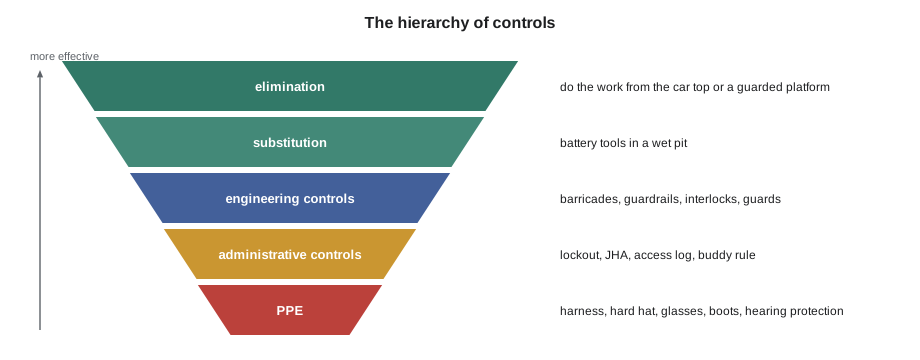
| Level | Elevator example |
|---|---|
| Elimination | Doing rail alignment from the car top or a work platform rather than from ladders in the hoistway |
| Substitution | Battery tools instead of corded tools in a wet pit; pre-assembled brackets lifted as a unit |
| Engineering | Hoistway entrance barricades, toe boards, car top guardrails, interlocks, machine guards |
| Administrative | Lockout procedures, access logs, job hazard analyzes, the first-year buddy rule |
| PPE | Harness and lanyard, hard hat, safety glasses, boots, gloves, hearing protection |
The job hazard analysis
A job hazard analysis (JHA), also called a job safety analysis or a field level hazard assessment, breaks a task into steps, lists the hazards in each step and records the controls for each hazard. At Northcrest, the JHA is done at the start of every shift and repeated whenever the task, the crew or the conditions change. The form fits on one page. It is filled in by the people who will do the work, not by an office, and every crew member signs it. A JHA written for yesterday's work is not valid today, because the hoistway, the weather and the other trades on site are all different.
Ray's rule for a good JHA is that each hazard must name a specific thing that can hurt someone and each control must name a specific thing someone will do. "Be careful" is not a control. "Barricade the 14th floor entrance and tie off to the anchor at the beam pocket before removing the barricade" is a control. The first draft of Tamsin's first JHA was full of the first kind, and Ray made her rewrite it.
| Step | Hazard | Controls |
|---|---|---|
| Set up the work platform at the 6th floor | Fall into the hoistway while boarding | Platform guardrails in place; tie off before stepping from the landing; entrance barricade kept until boarding |
| Lift rail section with the hoist | Struck by swinging rail; overloaded hoist | Tag line; hoist rating checked; nobody under the load |
| Drill bracket anchor holes | Silica dust; noise; drill bind | Shroud with vacuum; hearing protection; side handle and two-hand grip |
| Bolt brackets and clips | Dropped tools onto workers below | Tool lanyards; nobody working below; toe boards on platform |
| Move the platform up | Uncontrolled movement; pinch points | Hoist controls by a trained operator only; hands clear of the suspension |
| End of shift | Open entrances left unguarded | Barricades checked at every floor; access log signed out |
The JHA is also a record. If something goes wrong, it shows what the crew planned and what they knew. If a near miss happens, the JHA is updated on the spot and the change is shared at the next morning's talk. Lena reviews the crew's JHAs each week and picks one good example and one weak one to discuss with the whole branch.
Toolbox talks
A toolbox talk is a short safety meeting, usually ten to fifteen minutes, held at the start of a shift or week. It covers one topic in enough depth to be useful: a recent near miss, a change in the site plan, a seasonal hazard, a procedure such as top-of-car entry, or an industry accident report. Northcrest holds a weekly toolbox talk on each job, recorded with the topic, the date and the attendees' signatures, as well as the daily JHA. Good talks are specific to the job and invite questions. Poor talks are read aloud from a sheet while everyone looks at their phones.
Tamsin's first toolbox talk at Quayside was about the general contractor's new rule for hoistway barricades. The second was a review of an accident in another province, in which a mechanic had stepped from a landing onto a car top that was not there because the car had been moved by someone else. The mechanic who led it asked the crew how the same thing could happen at Quayside, and the crew came up with three answers that went straight into the next day's JHA. That is the purpose of a talk: to change what happens on the job.
| Toolbox talk topic | Why it matters on an elevator job |
|---|---|
| Hoistway access and the door key | Most falls start at an open hoistway entrance |
| Top of car entry and exit | The procedure has fixed steps that must not be skipped |
| Lockout on hydraulic units | Oil pressure is stored energy that a disconnect does not remove |
| Silica dust from drilling | Hoistway drilling raises dust in a confined, enclosed space |
| Housekeeping in the pit | Debris, oil and water make slips and fires more likely |
| Working near other trades | Other crews may remove barricades or move hoists |
Personal protective equipment
PPE is the last line of defense, not the first, but in a hoistway it is never optional. Northcrest's minimum PPE on every job is a hard hat meeting ANSI/ISEA Z89.1, safety glasses meeting ANSI/ISEA Z87.1, safety footwear meeting ASTM F2413 with toe protection and puncture-resistant soles, high-visibility clothing where the site requires it, and hearing protection where noise is above the action level. A full-body harness meeting ANSI/ASSP Z359.11, with a lanyard and energy absorber suited to the task, is worn whenever there is a fall hazard. Arc-rated clothing and insulating gloves are added for electrical work, as Lesson 10 explains.
Some PPE rules are particular to the elevator trade. Loose clothing, long hair, rings, watches, necklaces and hanging lanyards can catch on moving ropes, sheaves, governor ropes, step chains and handrails, so mechanics tie back hair, remove jewelry and keep clothing close-fitting. Gloves protect hands when handling rail, ropes and sheet metal, but they are a danger near rotating sheaves and running ropes, where a glove can be pulled in and the hand with it; Northcrest's rule is no gloves near any moving rope or rotating part. Hard hats with chin straps are worn in hoistways and on car tops, because a hat that falls off on a car top can fall the full height of the hoistway onto someone in the pit.
Respiratory protection is often needed in elevator work. Drilling anchor holes in a concrete hoistway produces respirable crystalline silica, and the hoistway confines the dust. Northcrest uses drills with dust shrouds connected to vacuums as an engineering control and adds respirators where the exposure control plan calls for them. Old buildings can contain asbestos in brake linings, hoistway insulation and fireproofing, and lead paint on steel. On Route 7, Ray checks the building's hazardous materials survey before disturbing anything that might contain them.
Reporting, near misses and leading indicators
A near miss is an event that could have caused injury or damage but did not: a tool dropped down a hoistway that missed the pit, a car that moved when a mechanic expected it to stay put, a barricade found open. Near misses are free lessons, and the industry treats reporting them as a sign of a healthy crew, not a weak one. Northcrest asks for a near-miss report within the shift, reviews each one at the branch, and shares the lessons on every job.
Companies track injury rates as lagging indicators, because they count harm after it has happened. The usual measure is the total recordable incident rate (TRIR), the number of recordable injuries and illnesses per 200,000 hours worked, which is roughly 100 full-time workers for a year. Leading indicators count the activities that prevent injuries: JHAs completed, toolbox talks held, near misses reported, inspections done and corrective actions closed. A branch with a low TRIR and few near-miss reports may simply be lucky or under-reporting; a branch with many near-miss reports and a falling TRIR is usually learning.
# Total recordable incident rate (TRIR) and near-miss reporting for the branch
hours = 60 * 1920          # 60 field staff, about 1,920 hours each in a year
recordables = 1
near_misses = 41
trir = recordables * 200_000 / hours
print(f"hours worked: {hours:,}")
print(f"TRIR: {trir:.2f} recordable cases per 200,000 hours")
print(f"near misses reported per recordable case: {near_misses / recordables:.0f}")
for target in (2.0, 1.0):
    allowed = target * hours / 200_000
print(f"a TRIR of {target} would mean about {allowed:.1f} recordable cases a year")hours worked: 115,200 TRIR: 1.74 recordable cases per 200,000 hours near misses reported per recordable case: 41 a TRIR of 2.0 would mean about 1.2 recordable cases a year a TRIR of 1.0 would mean about 0.6 recordable cases a year
The branch's numbers were good, but Lena did not celebrate them. She pointed out that one recordable case still meant one person hurt, a mechanic who cut his hand on a sheet metal car panel edge, and that the 41 near misses reported were a large part of the reason the number was not higher.
Fitness for duty and fatigue
A safety culture also covers the worker's own condition. Fatigue, illness, medication and impairment from alcohol or drugs all slow reactions and dull judgment, and in a hoistway there is little margin for either. Long shifts at the hospital, followed by a night shift at the mall, are the kind of schedule that produces mistakes. Northcrest's policy limits consecutive long shifts, and mechanics are expected to tell Lena if they are not fit for the day's work. Tamsin learned that saying "I'm not right today" at the morning JHA is treated the same way as reporting a hazard: as a responsible act.
Common mistakes
MistakeFilling in the JHA after the work has started.
InsteadComplete it before work, with the crew who will do the task, and update it when conditions change.
MistakeWriting controls such as "be careful".
InsteadEach control must name a specific action, device or person.
MistakeWearing gloves near a running rope or sheave.
InsteadGloves can be caught and pull the hand in; keep them away from moving ropes and rotating parts.
MistakeTreating PPE as the main control.
InsteadUse the hierarchy: remove or guard the hazard first, then procedures, then PPE.
MistakeNot reporting near misses to avoid trouble.
InsteadNear-miss reports are expected and used to prevent the next injury.
Summary and key terms
- A safety culture is how the crew behaves when nobody is watching, including stopping work and reporting near misses.
- The hierarchy of controls puts elimination and engineering above procedures and PPE.
- A JHA breaks the task into steps, names specific hazards and specific controls, and is done every shift.
- Toolbox talks cover one topic in depth and should change what happens on the job.
- PPE in the trade includes harnesses, chin-strapped hard hats and close-fitting clothing, with no gloves near moving ropes.
- TRIR is a lagging indicator; near misses, JHAs and inspections are leading indicators.
- JHA
- Job hazard analysis: the task broken into steps, with the hazards and controls for each.
- Toolbox talk
- A short safety meeting on one topic at the start of a shift or week.
- Hierarchy of controls
- The order of preference for controls: elimination, substitution, engineering, administrative, PPE.
- Near miss
- An event that could have caused harm but did not.
- TRIR
- Total recordable incident rate, recordable cases per 200,000 hours worked.
- Stop-work authority
- The right of any crew member to stop a task they believe is unsafe.
Practice problems
Work each problem on paper first, then reveal the answer to check.
A crew of 25 works 48,000 hours and has 2 recordable cases. What is the TRIR?
Show answer
2 × 200,000 / 48,000 ≈ 8.3.
Where does a hoistway entrance barricade sit in the hierarchy of controls?
Show answer
Engineering control.
Rewrite the control "watch out for falling objects" as a useful control.
Show answer
For example: tool lanyards on all hand tools, toe boards on the platform, and nobody working below in the pit.
Why are gloves banned near moving ropes?
Show answer
A glove can be caught and pull the hand into the rope or sheave.
Lesson quiz · 5 questions
Score 60% or more to complete this lesson.
Create a free account to save your progress, take quizzes and earn a certificate.