
ELE-280 · Lesson 1 of 12 · 27 min
Electrical lab safety
An electrical measurements lab is where circuit theory meets real hardware. On paper, a resistor has exactly the value printed on it, a wire has no resistance and a voltmeter draws no current. On the bench, none of that is true, and the job of a measurement engineer is to know by how much it is not true and whether that matters. This course teaches the instruments, the habits and the arithmetic that let you trust a number you read off a meter or a screen. It starts where every lab starts: with how to work on energized circuits without getting hurt and without destroying the equipment.
In an ABET-accredited American electrical or computer engineering program, the measurements lab usually runs in the fall of the sophomore year, alongside Circuit Analysis and Digital Logic. It supplies the bench skills that every later lab assumes: Electronics I builds amplifiers on the breadboard, Signals and Systems samples them, and the power, control and communications courses all hand you an oscilloscope on the first day and expect you to use it well. ABET's student outcomes include the ability to develop and conduct appropriate experimentation, analyze and interpret data, and use engineering judgment to draw conclusions, and this course is where you first practice them.
The examples follow Cedarline Controls, the invented Madison, Wisconsin company from ELE-210, ELE-240 and ELE-250 that designs controllers for traffic signals and small machines. Amara Osei, an engineer intern, runs the company's test bench. This term she is verifying the first prototype boards of the pedestrian crossing controller: its 24 V supply, its LED signal drivers, its sensor inputs and the microphone amplifier of its accessible pedestrian signal. Leo Tremblay, a sophomore co-op student, has just joined her, and each lesson follows a task she gives him.
What electricity does to a body
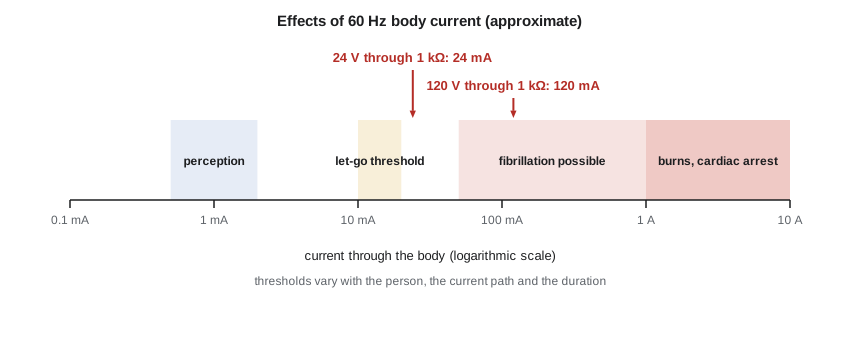
Current, not voltage, is what injures. Voltage matters because it drives current through the resistance of the body, and that resistance varies enormously. Dry, intact skin may present tens of thousands of ohms at low voltage; wet or broken skin, or a contact through a cut, can drop the total hand-to-hand or hand-to-foot path to around 1,000 Ω or less. Above roughly 50 V the skin itself can break down, so the resistance falls just when the voltage rises. The current that results is set by Ohm's law, I = V/R, and its effects depend on its size, the path it takes, its frequency and how long it lasts.
| Approximate current (60 Hz, hand to feet) | Typical effect |
|---|---|
| About 1 mA | Threshold of feeling: a tingle |
| About 5 mA | Painful shock; most people can still let go |
| About 10–20 mA | Let-go threshold: muscles clamp and the person may not be able to release the conductor |
| About 20–50 mA | Severe pain, breathing muscles may be affected |
| About 50–100 mA and above | Ventricular fibrillation becomes possible, especially for exposures of a second or more |
| Amperes | Burns, cardiac arrest and tissue damage along the current path |
Two things in that table deserve attention. First, the dangerous range starts at tens of milliamperes, which is a tiny fraction of the current a lab supply or a wall outlet can deliver. A 120 V outlet behind a 15 A breaker will happily push 100 mA through you without tripping the breaker, because breakers protect wiring, not people. Second, the let-go threshold is lower than the fibrillation threshold. A person who grips a live conductor and cannot let go stays in contact, the skin heats and its resistance falls, the current rises and the exposure lengthens. That is why a ground-fault circuit interrupter, which trips at about 5 mA of imbalance between line and neutral, is fitted to bench outlets in many teaching labs.
Worked problem
How much current flows?
Leo touches a 120 V line conductor with a damp hand while his other hand rests on a grounded bench frame. Estimate the current if the hand-to-hand path is 1,500 Ω, then repeat for dry skin at 50 kΩ, and for the controller's 24 V supply with the damp-skin resistance.
Show solution
- Use Ohm's law for each case.
- \[I = \frac{V}{R} = \frac{120\ \text{V}}{1500\ \Omega} = 80\ \text{mA}\]
- \[I = \frac{120\ \text{V}}{50\,000\ \Omega} = 2.4\ \text{mA}\]
- \[I = \frac{24\ \text{V}}{1500\ \Omega} = 16\ \text{mA}\]
- Compare each result with the table: 80 mA is in the range where fibrillation is possible; 2.4 mA is a noticeable tingle; 16 mA is near the let-go threshold.
Answer: About 80 mA, 2.4 mA and 16 mA. The same 120 V source is a tingle or a potentially lethal shock depending only on the skin, which is why lab rules never rely on dry hands. Low voltage reduces the risk sharply but does not remove it when the contact resistance is low.
Hazards beyond shock
Shock is the hazard everyone thinks of first, but the lab has others. An arc flash happens when current jumps through air between conductors, usually because a tool, probe tip or dropped screw shorts two points with a large available fault current behind them. The arc can reach temperatures of thousands of degrees in milliseconds, vaporize copper, throw molten metal and cause severe burns at a distance. A student lab bench supply limited to a few amperes cannot produce a serious arc flash, but a building's 600 V or 480 V distribution panel can, and the measurement habits you build on the bench go with you to those places. Burns also come from ordinary heat: a resistor dissipating a watt or two can reach well over 100 °C, and a soldering iron tip runs at 300 to 400 °C.
Stored energy is the hazard most often forgotten. A capacitor holds charge after the supply is off. The bulk capacitor in a mains-powered supply can hold hundreds of volts for minutes, and a large electrolytic on a low-voltage board can deliver enough current to weld a screwdriver tip. Electrolytic capacitors connected backwards, or run above their voltage rating, can vent violently. Lithium batteries can catch fire if shorted, punctured or overcharged. Finally, there are ordinary workshop hazards: flying wire clippings, which is why eye protection belongs in an electronics lab, solder fumes from flux, which need ventilation, and trailing cables across the floor.
Rules that prevent most incidents
Most lab injuries and most destroyed instruments come from a short list of mistakes, and a short list of habits prevents them. Wire the circuit with the supply off and connect the supply last. Check the wiring against the schematic before applying power, preferably with a second person. Set the current limit on the bench supply before you connect the load. Keep one hand away from the circuit when probing anything above about 30 V, so that a current path through the chest is less likely. Remove rings, watches and metal bracelets. Never work alone on circuits connected to mains voltage. Discharge capacitors through a suitable resistor, and check with a meter that they are discharged, before touching the board. When something smells hot or smokes, switch the supply off first and investigate second.
These habits are not just good practice. OSHA's electrical rules require employers to protect workers from electrical hazards and to train qualified persons, and NFPA 70E, Standard for Electrical Safety in the Workplace, sets out how to assess shock and arc flash risk and choose protective equipment for work on or near energized equipment. Cedarline's test lab follows a written procedure based on NFPA 70E, and Leo's first task is to read it and sign that he has.
Measurement categories and meter ratings
A meter is part of the circuit while you measure, and a meter that fails can become the shock or arc hazard. IEC 61010-1, the international safety standard for measurement equipment, sorts measurement locations into categories according to the size of the voltage transients, or brief spikes, that can appear there. Lightning strikes and switching of large loads send transients down power lines. Near the service entrance, where the utility supply arrives, those transients are large and the fault current available is huge. Inside a piece of equipment plugged into an outlet, they are smaller and limited by the wiring in between.
| Category | Where it applies | Examples |
|---|---|---|
| CAT I (or unrated) | Circuits not directly connected to mains | Battery-powered circuits, the low-voltage side of an isolated supply, a breadboard powered by a bench supply |
| CAT II | Circuits connected to an outlet through a plug | Appliances, portable tools, measuring at a wall outlet |
| CAT III | Building distribution wiring | Distribution panels, feeders, fixed motors, lighting circuits |
| CAT IV | The origin of the installation | Service entrance, utility meter, outdoor overhead lines |
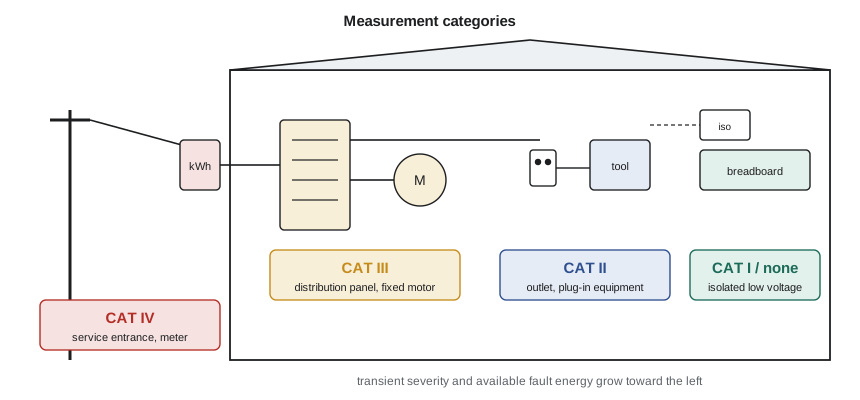
Each meter and each set of test leads is marked with a category and a voltage, for example CAT III 600 V, and the rating applies to the whole measuring set: a CAT IV meter with CAT II leads is a CAT II measuring set. The category matters more than the voltage. A CAT III 600 V meter is designed to survive a larger transient than a CAT II 1000 V meter, because the category reflects what the meter can survive in that location. A properly rated meter also has fuses on its current inputs that can interrupt a high fault current. One of the most common serious meter accidents is leaving the leads in the current jacks, where the meter is nearly a short circuit, and then touching them across a voltage source. A cheap fuse may explode instead of interrupting the arc.
Lockout and verifying the circuit is dead
Work on mains-connected equipment begins by making it safe. Switch it off, unplug it or lock out its breaker, and then prove it is dead with a meter you have just checked on a known live source. This live-dead-live test catches the dangerous case where the meter itself has failed, a blown fuse or a broken lead, and reads 0 V on a live circuit. In a teaching lab you will rarely work inside mains equipment, but the habit transfers directly: before touching a board, confirm with the meter that its supply rail reads zero and that its large capacitors have discharged.
# Body current and capacitor discharge estimates for lab safety checks
def body_current(volts, ohms):
    return volts / ohms

thresholds = [(0.001, "perception"), (0.010, "let-go threshold region"),
              (0.050, "fibrillation possible")]

def describe(i):
    label = "below perception"
    for limit, name in thresholds:
        if i >= limit:
            label = name
    return label

for v in (24, 48, 120):
    for r in (1500, 50000):
        i = body_current(v, r)
        print(f"{v:4d} V through {r:6d} ohms: {i*1000:7.2f} mA  ({describe(i)})")

# A 470 uF capacitor charged to 35 V, bled by a 10 kilohm resistor
import math
C, V0, R = 470e-6, 35.0, 10e3
tau = R * C
t_safe = tau * math.log(V0 / 2.0)    # time to fall below 2 V
print(f"Time constant {tau:.1f} s; below 2 V after {t_safe:.1f} s")
print(f"Stored energy {0.5*C*V0**2:.3f} J")24 V through 1500 ohms: 16.00 mA (let-go threshold region) 24 V through 50000 ohms: 0.48 mA (below perception) 48 V through 1500 ohms: 32.00 mA (let-go threshold region) 48 V through 50000 ohms: 0.96 mA (below perception) 120 V through 1500 ohms: 80.00 mA (fibrillation possible) 120 V through 50000 ohms: 2.40 mA (perception) Time constant 4.7 s; below 2 V after 13.5 s Stored energy 0.288 J
The capacitor part of the program matters for Cedarline's board. Its 24 V input has a 470 µF bulk capacitor rated at 35 V, and the board has no bleeder resistor. With nothing connected, the capacitor can hold its charge for a long time. Amara adds a 10 kΩ resistor to the bench fixture so the voltage falls below 2 V in about 13 seconds, and she tells Leo to read the rail with a meter before he touches the board after a test. The energy stored is under a third of a joule, too little to hurt a person, but more than enough to vaporize a fine probe tip if it is shorted.
Protecting the equipment
Safety in a lab also means protecting the instruments, the circuit and the measurement. Most damage comes from three causes. The first is connecting a meter in the wrong mode, especially measuring voltage with the leads in the current jacks. The second is exceeding an input rating: an oscilloscope input may be rated for a few hundred volts at low frequency but much less at high frequency, and a 1X probe gives no protection at all. The third is ground: on most bench oscilloscopes the outer shell of every input connector is tied to the mains safety ground. Clipping the probe's ground lead to a point that is not at ground potential creates a short circuit through the scope's ground wiring. Lesson 7 returns to this, because it is behind many destroyed boards and probes. Static electricity is the fourth, quieter cause: a few kilovolts from a walk across a carpet can damage a MOSFET gate without any visible spark, so sensitive parts are handled on a grounded mat with a wrist strap.
Worked problem
Choosing a meter for the job
Amara asks Leo which of three meters he would use to check the voltage at a 120 V outlet on the bench and at the 277/480 V lighting panel in the hallway. The meters are rated CAT II 600 V, CAT III 600 V and CAT III 1000 V / CAT IV 600 V.
Show solution
- The outlet is a CAT II location at 120 V, so all three meters are adequate there.
- The lighting panel is part of the building distribution, so it is a CAT III location. The line-to-line voltage is 480 V.
- The CAT II 600 V meter is not rated for a CAT III location, whatever its voltage rating, so it must not be used on the panel.
- The CAT III 600 V meter meets the requirement; the CAT III 1000 V / CAT IV 600 V meter gives more margin.
- The test leads must carry the same or better rating as the meter.
Answer: Use either CAT III meter, preferably the CAT III 1000 V / CAT IV 600 V one, with leads rated to match, on the panel. In practice, Leo would not open the panel at all: work on building distribution is done by qualified electricians with an arc flash assessment and protective equipment.
Common mistakes
MistakeAssuming that low voltage means no hazard.
InsteadCurrent through the body depends on contact resistance; a 24 V source can exceed the let-go threshold through wet or broken skin, and low-voltage supplies can still cause burns and arcs.
MistakeRelying on the circuit breaker to protect people.
InsteadBreakers protect wiring and trip at amperes; dangerous body currents are tens of milliamperes. Ground-fault interrupters and safe procedures protect people.
MistakeChoosing a meter by its voltage rating alone.
InsteadCheck the measurement category first; the rating applies to the meter and leads together.
MistakeLeaving the leads in the current jacks after a current measurement.
InsteadMove the red lead back to the voltage jack immediately; a meter set for current is almost a short circuit.
MistakeTouching a board as soon as the supply is switched off.
InsteadRead the supply rail with a meter first; capacitors can hold charge for minutes without a bleeder.
Summary and key terms
- Current through the body causes injury; tens of milliamperes at power frequency can prevent letting go and cause fibrillation.
- Body resistance ranges from about a thousand to tens of thousands of ohms, so the same voltage can be harmless or lethal.
- Other lab hazards include arc flash, burns, stored energy in capacitors and batteries, and flying debris.
- Simple habits prevent most incidents: wire with power off, check before energizing, set current limits, keep one hand away, and discharge capacitors.
- Measurement categories CAT I to CAT IV describe transient severity; meters and leads must be rated for the location.
- Verify a circuit is dead with a live-dead-live test, and protect instruments from wrong modes, overvoltage and ground faults.
- Let-go threshold
- The current above which muscles clamp and a person cannot release a conductor, roughly 10 to 20 mA at 60 Hz.
- Ventricular fibrillation
- Uncoordinated twitching of the heart's lower chambers that stops it pumping blood; it can be caused by currents of tens of milliamperes.
- Ground-fault circuit interrupter
- A device that trips when the current in the line and neutral differ by about 5 mA, indicating current leaking through another path.
- Arc flash
- An explosive release of energy when current flows through air between conductors.
- Measurement category
- A rating under IEC 61010-1 (CAT I to CAT IV) describing the transient severity of the location where a meter may be used.
- Live-dead-live test
- Checking a meter on a known live source, then testing the circuit, then checking the meter again.
- Bleeder resistor
- A resistor across a capacitor that discharges it after power is removed.
Practice problems
Work each problem on paper first, then reveal the answer to check.
A 48 V battery is touched hand to hand with 2 kΩ of body resistance. Estimate the current and its likely effect.
Show answer
24 mA, above the let-go threshold; painful and potentially dangerous.
Why can a 120 V outlet deliver a dangerous current without tripping its 15 A breaker?
Show answer
Because dangerous body currents are around 0.05 to 0.1 A, far below the breaker's trip current.
A meter is marked CAT III 600 V but its leads are CAT II 1000 V. What is the rating of the measuring set?
Show answer
CAT II, limited by the leads.
A 1,000 µF capacitor at 50 V is bled by a 4.7 kΩ resistor. Find the time constant and the time to fall to 5 V.
Show answer
τ = 4.7 s; t = τ ln(10) ≈ 10.8 s.
What is the purpose of the first live check in a live-dead-live test?
Show answer
To prove the meter works, so that a zero reading on the circuit can be trusted.
Name two hazards in an electronics lab other than electric shock.
Show answer
Any two of: burns from hot parts or irons, arc flash, capacitor or battery energy, flying wire clippings, solder fumes.
Lesson quiz · 5 questions
Score 60% or more to complete this lesson.
Create a free account to save your progress, take quizzes and earn a certificate.